
Among the many mysteries surrounding the Rings of Power, one question is rarely asked directly: why did Sauron allow them to endure at all?
By the end of the Third Age, Sauron had recovered several of the Rings. Others had been destroyed by dragon-fire or lost to history. The One Ring — the master of them all — remained missing. Yet at no point does Sauron attempt to unmake the remaining Rings himself.
This is striking, because Sauron understood the danger of the Rings better than anyone alive. He knew what they were capable of. He knew how they could be used against him. And he knew that without the One Ring, his control over them was incomplete.
So why keep them?
This was not an oversight. It was not negligence. And it was not sentimentality.
It was a reflection of how power truly functions in Middle-earth — and how Sauron understood domination, control, and inevitability.
The Rings Were Extensions of Sauron’s Will
The Rings of Power were never merely enchanted objects. They were not interchangeable tools that could be discarded once inconvenient. They were expressions of Sauron himself.
Sauron did not simply forge the Rings; he poured his knowledge, intent, and will into the entire system of Ring-making. Even the Rings he did not personally create were shaped according to principles he taught and corrupted. Their power flowed from the same source: the desire to impose order upon the world and bend other wills to a single design.
To destroy them would not simply remove a threat.
It would diminish his presence in Middle-earth.
Even without the One Ring, the lesser Rings continued to exert influence. They prolonged life unnaturally. They magnified desire. They distorted judgment. They reshaped the priorities of entire peoples. Wars were fought, hoards amassed, and realms weakened long before Sauron ever rose openly again.
As long as the Rings endured, Sauron’s hand remained on the scales of history — subtle, indirect, but persistent.
This is a crucial point often missed: Sauron’s power was not binary. He did not go from powerless to supreme depending on whether he held the One Ring. His influence ebbed and flowed, but it never vanished. The Rings ensured that the world continued to move, however slowly, toward the conditions he desired.

The Nine Rings Had Already Achieved Their Purpose
If the Rings of Power can be judged by outcomes, then the Nine Rings given to Men were Sauron’s greatest success.
Men proved the most vulnerable to the Rings’ corruption. Their bearers did not merely fall under Sauron’s influence — they ceased to exist as independent beings. Their wills were eroded, their identities hollowed out, until nothing remained but shadows sustained by the Rings and bound utterly to Sauron’s command.
The Nazgûl were not temporary servants. They were not mercenaries who could be replaced.
They were the final product of the Rings’ design.
To destroy the Nine Rings would mean unraveling the very existence of the Nazgûl. These were Sauron’s most reliable agents: his generals, his hunters, and the instruments of his terror. They did not question. They did not falter. And they could operate far beyond his immediate presence.
In a world where Sauron could not yet openly reveal himself, the Nazgûl were indispensable.
As long as the Rings endured, so did they.
And so the Rings were preserved — not out of caution, but out of necessity.
The Seven Rings Had Already Done Their Damage
The Seven Rings given to the Dwarves are sometimes described as failures, because they did not enslave their bearers in the same way as the Nine. But this misunderstands Sauron’s goals.
The Dwarves resisted domination of the will — but their Rings still worked exactly as intended in another sense.
They inflamed greed.
They intensified possessiveness.
They drove hoarding instincts to extremes.
Great hoards were amassed. Rivalries deepened. Trust eroded. Kingdoms became inward-looking and brittle. Dragons were drawn to wealth, and in their wake came ruin and fire.
Even when some of the Rings were destroyed by dragon-flame or reclaimed by Sauron, their influence did not simply vanish. The damage had already been done. The histories of the Dwarven realms had been permanently altered.
From Sauron’s perspective, this was success.
He did not need to rule the Dwarves directly. A divided, inward-focused people — consumed by gold and suspicion — was far less likely to unite against him.
Chaos and obsession served his purposes just as well as obedience.
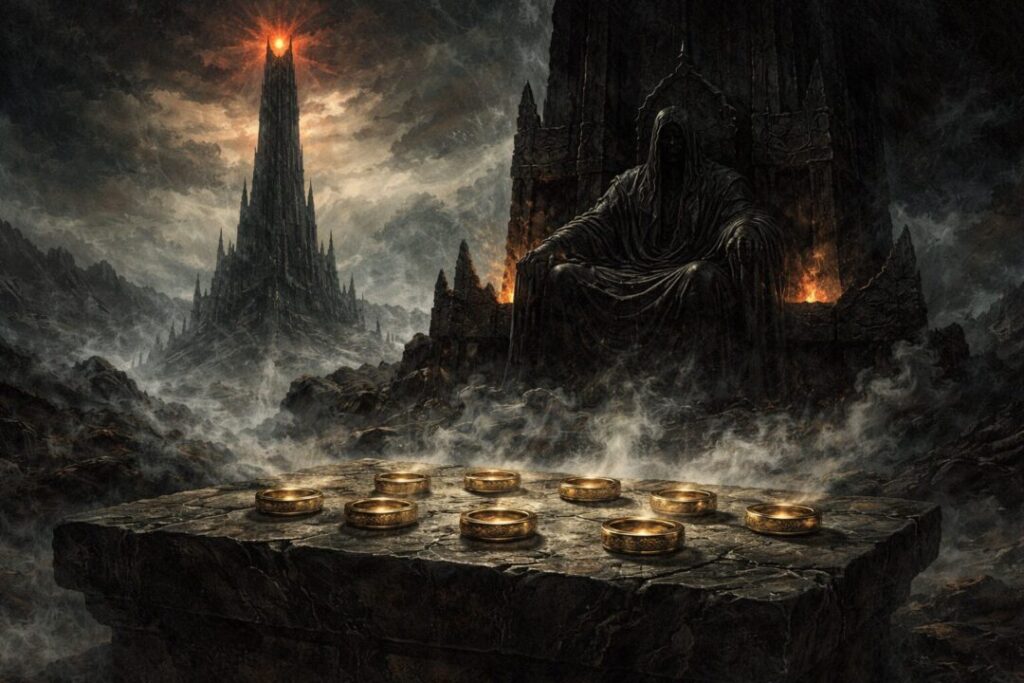
The Missing Three — And Why Their Survival Still Mattered
The Three Rings of the Elves stand apart. Sauron never touched them. He never recovered them. And he never truly controlled them.
Yet even here, destruction was not a simple option.
The Three were bound to the One Ring indirectly. Their powers — preservation, healing, resistance to decay — were sustained by the same system Sauron created. As long as the One Ring endured, the Three remained active. And as long as they remained active, they kept Middle-earth in a state of suspended balance.
This may seem counterproductive, but it aligned perfectly with Sauron’s expectations.
He did not believe the Elves would destroy the One Ring.
He did not believe anyone could willingly relinquish it.
He believed time itself was on his side.
The continued existence of the Three delayed decay — but it also delayed decisive action. It preserved a world that Sauron believed would eventually fall intact into his grasp.
Sauron Did Not Unmake His Creations
Beyond strategy, there is a deeper reason Sauron did not destroy the Rings.
He could not.
Not because he lacked the power — but because he lacked the humility.
Sauron was incapable of accepting final loss. To destroy the Rings would be to admit that his work was finished, that a path had failed, that something he made could not be mastered again.
Like his master before him, he sought control, not correction.
He believed the One Ring would return.
He believed all lesser powers would ultimately bend back toward him.
He believed the world could still be reordered according to his design.
And so the Rings were preserved — waiting, not abandoned.
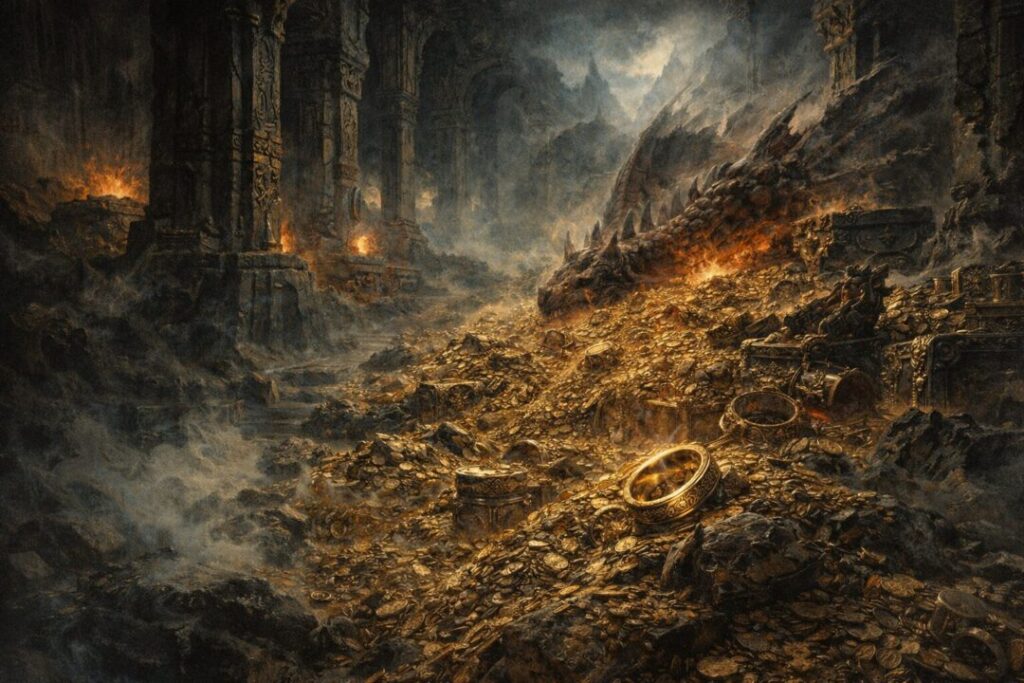
Preservation Over Erasure
In Middle-earth, evil rarely seeks to erase the past.
It seeks to possess it.
Sauron did not want to undo what had been made. He wanted to reclaim it, refine it, and complete it. The Rings were remnants of a future he believed inevitable — a world stabilized through domination, where disorder and resistance would finally be eliminated.
In that sense, the Rings were acts of faith.
Faith in inevitability.
Faith in control.
Faith that time itself favored tyranny.
The Final Failure
In the end, this faith proved fatal.
The Rings endured long enough for their purpose to be overturned — not by force, not by greater power, but by endurance, humility, and mercy. They were undone by those who refused domination rather than those who sought to wield it.
This was the one outcome Sauron never truly considered.
And that is why the Rings were never destroyed by his hand.
Because to Sauron, the idea of relinquishing control was more unthinkable than defeat itself.
Sources & Notes
- J.R.R. Tolkien, The Silmarillion, “Of the Rings of Power and the Third Age” — Sauron teaches the craft of the Rings, forges the One to rule the others, and seeks to recover the Seven and the Nine rather than discard them.
- J.R.R. Tolkien, The Lord of the Rings, Book I, Chapter 2, “The Shadow of the Past” — Gandalf explains that the Nine are held by Sauron, while of the Seven, some were consumed by dragons and some recovered by him.
- J.R.R. Tolkien, The Lord of the Rings, Book II, Chapter 2, “The Council of Elrond” — Elrond and Gandalf set out the stakes of destroying the One, including the danger that the Three would lose their power if the ruling Ring were unmade.
- J.R.R. Tolkien, Unfinished Tales, “The Hunt for the Ring” — Sauron’s use of the Nazgûl as Ring-bound servants shows why the Nine remained valuable instruments rather than liabilities to be destroyed.
- J.R.R. Tolkien, The Letters of J.R.R. Tolkien, Letter 131 — Tolkien frames Sauron’s evil as domination and ordering of wills, supporting the article’s interpretation of why he preserves tools of control.