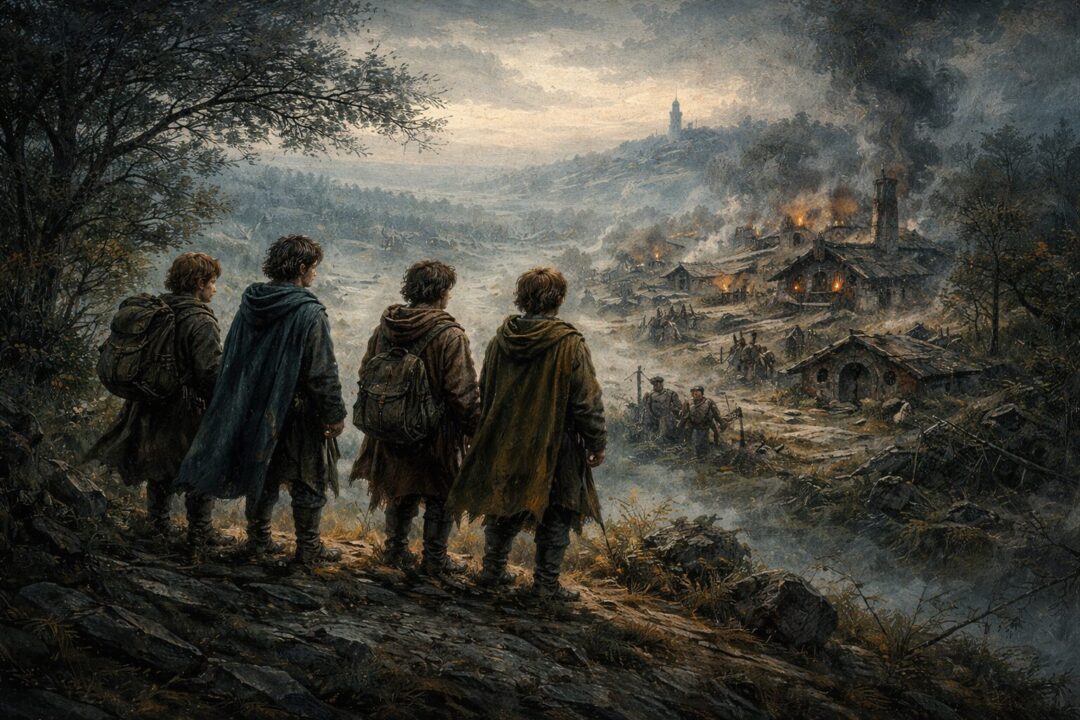
Few chapters in The Lord of the Rings have divided readers as sharply as the Scouring of the Shire.
After the fall of Sauron, after the fires of Mount Doom, after the crowning of Aragorn, the story appears ready to close. The great enemy is destroyed. The long war is over. Songs are sung, crowns are placed, and peace seems assured.
By all the rules of epic storytelling, this should be the ending.
And yet the narrative does not stop.
Instead of remaining in the halls of kings or the high places of legend, the story turns inward — back to hedgerows, lanes, mills, and familiar hills. The Hobbits return home, expecting comfort and rest, only to find that the Shire itself has been quietly broken.
Trees are gone. Food is scarce. The old customs are suppressed. Outsiders rule through fear and petty cruelty.
For some readers, this moment feels jarring — even unwelcome. Why return to conflict when the central struggle has already been resolved? Why not let the story end in triumph and relief?
This is why the Scouring is so often labeled an anti-climax.
But the Scouring is not a separate story, nor an unnecessary appendix to the war. It is the final consequence of everything that came before — and without it, the meaning of the entire journey changes.
The Shire Was Never Meant to Be Untouched
From the beginning, the Shire represents comfort, habit, and deliberate ignorance of the wider world. Hobbits pride themselves on being unimportant. They prefer things that are predictable, local, and safe.
When danger threatens beyond their borders, they trust that someone else will handle it.
This attitude is not portrayed as evil — but it is shown to be fragile.
The War of the Ring was never something that could remain “out there,” confined to distant lands and great cities. Evil in Middle-earth does not only exist as towering Dark Lords or vast armies. It spreads quietly, through neglect, opportunism, and the small compromises people make when they believe nothing truly concerns them.
The Shire does not fall because it is invaded by an army.
It falls because no one is watching.
Local authority erodes. Outsiders are tolerated. Familiar safeguards disappear one by one. By the time the damage is visible, it is already entrenched.
This is one of the most unsettling truths the Scouring presents: even the most peaceful place in the world is not immune to corruption if it assumes it always will be.
That is precisely why the chapter matters.
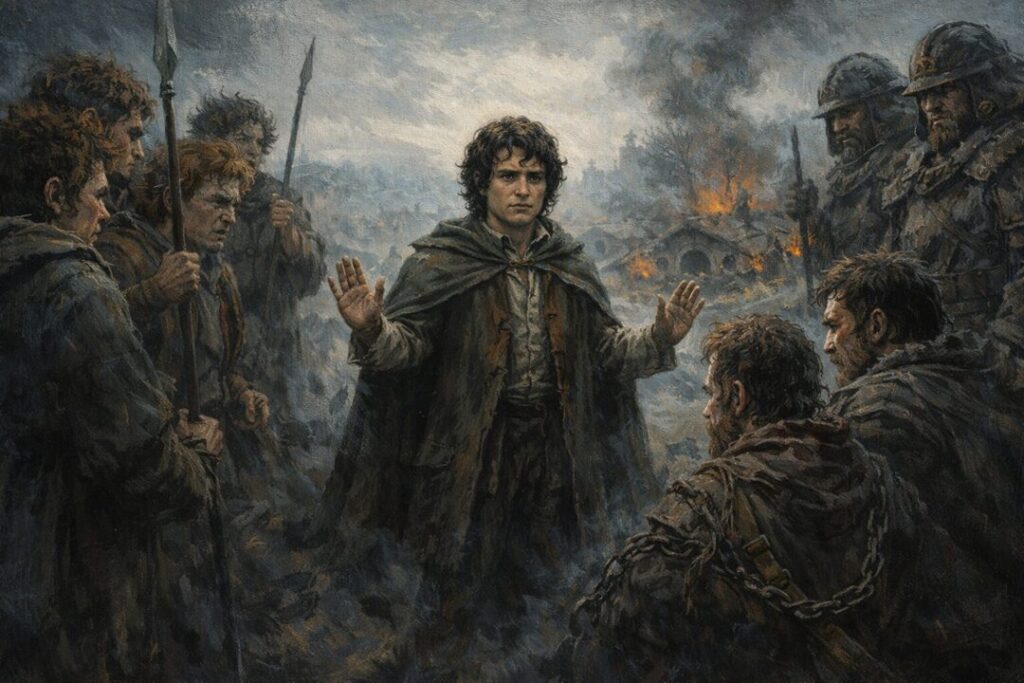
The Hobbits Return Changed — and That Is the Point
When Frodo, Sam, Merry, and Pippin first leave the Shire, they are unprepared in every sense of the word. They are physically small, socially insignificant, and politically powerless. They rely on others for protection, guidance, and survival.
When they return, they are no longer the same people.
Merry and Pippin have learned discipline, command, and courage in the service of greater powers. They understand how authority works — and how it can be abused. They know when to give orders, and when to resist them.
Sam has learned stewardship rather than adventure. His growth is not about glory, but about care: for land, for people, and for things that must be tended patiently if they are to flourish again.
Frodo’s change is the most difficult to witness.
He has gained wisdom, compassion, and restraint — but at terrible personal cost. He understands suffering intimately, and because of that, he refuses to add to it unless absolutely necessary.
The restoration of the Shire does not come from a returning wizard or a royal decree from a distant king. No outside power intervenes.
The Hobbits must act — not as heroes in a tale, but as responsible inhabitants of their own land.
This is the quiet fulfillment of their journey. They left the Shire to save the world. They return to save their home.
Frodo’s Choice: Victory Without Triumph
One of the most misunderstood elements of the Scouring is Frodo’s refusal to fight.
After everything he has endured, many readers expect — or even want — him to take up arms and strike down the ruffians who have despoiled the Shire. Instead, he urges restraint. He forbids unnecessary killing. He stands between violence and its targets.
This is not cowardice.
It is the clearest indication of how deeply the Ring has marked him.
Frodo has learned that victory achieved through domination always carries a cost. He knows that even justified violence leaves wounds that do not heal easily. Where others see enemies to be destroyed, he sees people who must be stopped — but not destroyed unless there is no other choice.
This does not make him weak.
It makes him different.
And that difference is why Frodo cannot fully return to the life he once knew. He saves the Shire, but he cannot enjoy its peace. The wounds he carries are not visible, and they cannot be mended by victory alone.
The Scouring makes this clear in a way no earlier ending could.
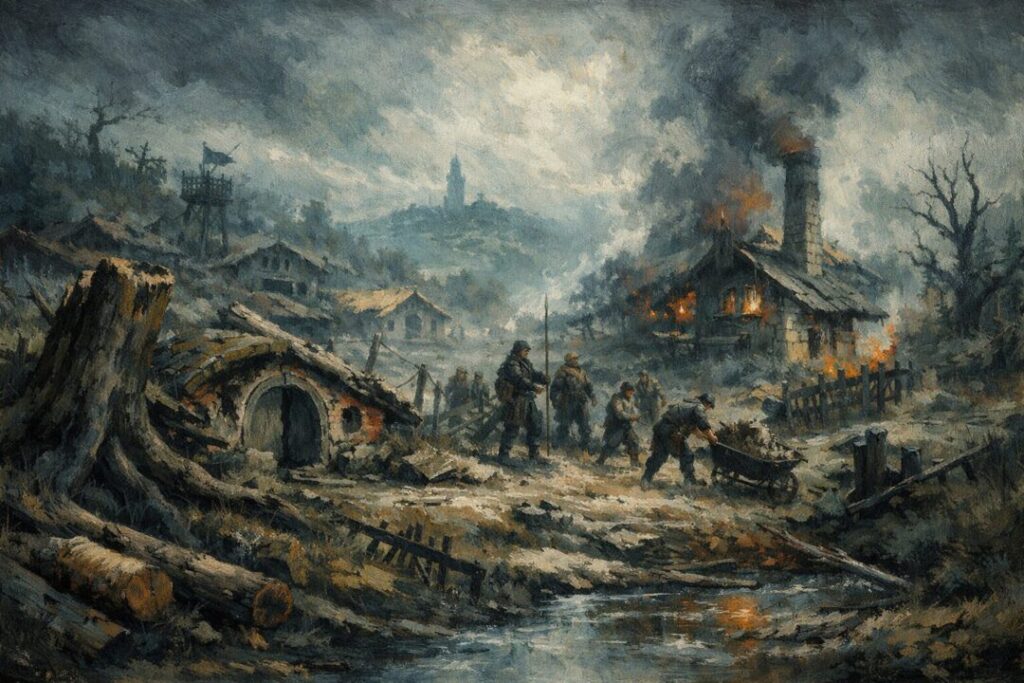
Why the Story Could Not End Earlier
If the story ended with the fall of Sauron, it would end with spectacle.
If it ended with the crowning of Aragorn, it would end with reward.
But Tolkien’s world has never been about easy endings.
Without the Scouring, the journey of the Hobbits would feel incomplete. They would return unchanged, their growth confined to distant lands with no lasting impact on their own lives.
Instead, the story ends with responsibility.
The Shire must be healed.
Damage must be undone slowly.
Loss must be acknowledged.
Evil is not banished forever.
Peace is not automatic.
Home must be protected by those who live there.
The Scouring forces readers to confront an uncomfortable truth: saving the world does not absolve you from caring for your own corner of it.
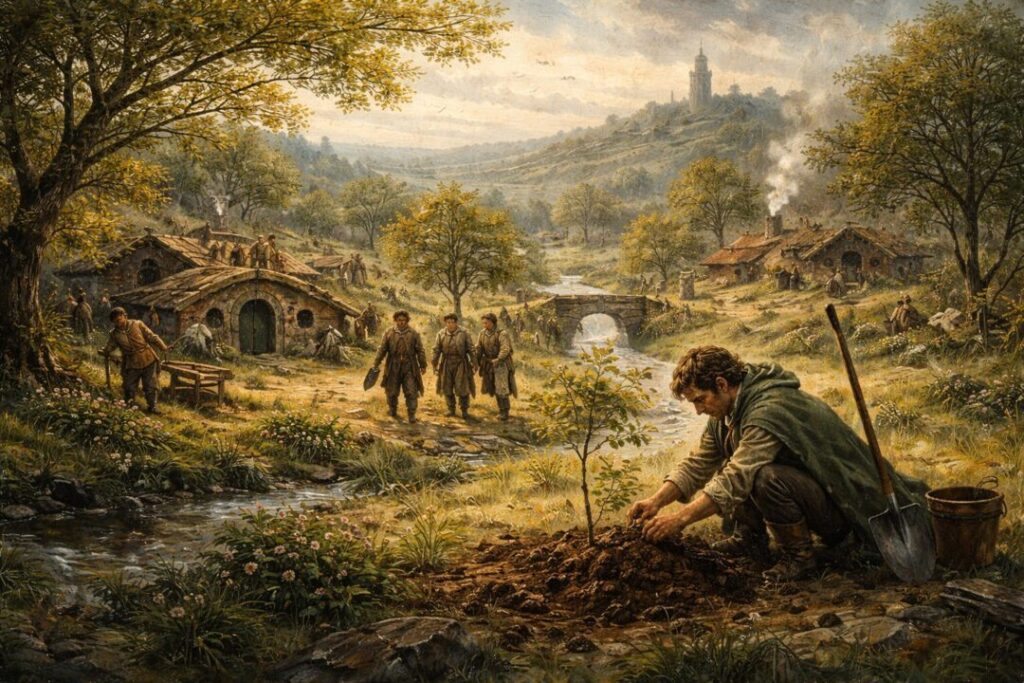
An Ending That Refuses Comfort
This is why the Scouring remains controversial.
It denies readers the comfort of a clean ending. It insists that consequences persist. It shows that victory does not erase damage — it only makes repair possible.
Some readers will always see it as an anti-climax.
Others see it as the most honest chapter in the entire book.
It shifts the story away from mythic grandeur and back toward lived reality. The great powers fade into the background. What remains are ordinary people, responsible for what they have inherited.
The Scouring is not an epilogue.
It is the final test — proving whether the journey mattered at all.
And that is why, even decades later, readers still debate it.
Because it asks the hardest question of all:
What do you do after the world is saved?
Sources & Notes
- J.R.R. Tolkien, The Lord of the Rings, Foreword to the Second Edition — Tolkien notes that the Scouring of the Shire was foreseen from the beginning, not tacked on as a topical afterthought.
- J.R.R. Tolkien, The Lord of the Rings, Book VI, Chapter 8, “The Scouring of the Shire” — the hobbits return to find the Shire controlled by ruffians, rules, shortages, and the damage done under Sharkey’s influence.
- J.R.R. Tolkien, The Lord of the Rings, Book VI, Chapter 8, “The Scouring of the Shire” — Merry, Pippin, Sam, and Frodo each show how their journey has changed them, especially in organizing resistance and restraining needless killing.
- J.R.R. Tolkien, The Lord of the Rings, Book VI, Chapter 9, “The Grey Havens” — Frodo’s lingering wounds and departure show why victory cannot simply restore him to his old Shire-life.
- J.R.R. Tolkien, The Letters of J.R.R. Tolkien, Letter 131 — Tolkien’s account of the Ring as a test of power and domination helps frame why the ending turns from triumph to moral repair and responsibility.