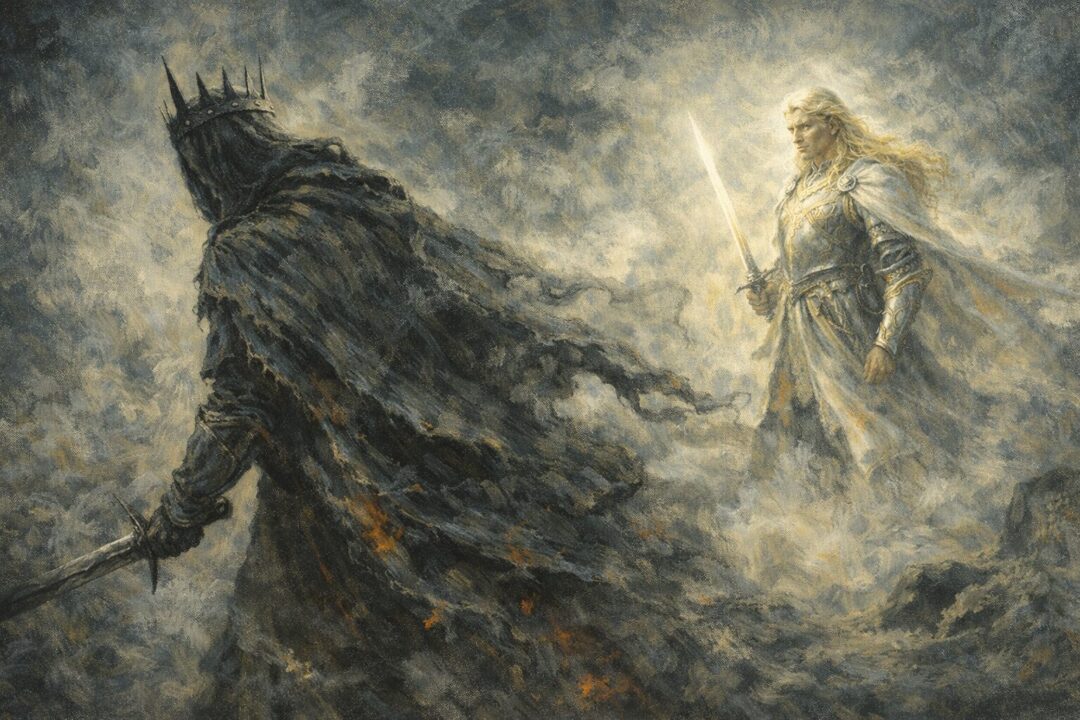
Power in Middle-earth is often misunderstood.
Readers frequently approach it as a question of comparison: who would win in a duel, who commands the greatest armies, who wields the most destructive force. This instinct comes naturally, especially in modern fantasy, where strength is measured through spectacle and escalation.
But The Lord of the Rings does not operate on that logic.
In Middle-earth, power is ontological before it is physical. It is about what a being is, not merely what that being can do. Authority, presence, and spiritual weight matter more than strength of arms. Some characters reshape the world by force; others do so simply by existing.
Nowhere is this distinction clearer than in the figure of Glorfindel.
When he appears in The Fellowship of the Ring, his role is brief—but unsettling. Frodo sees him shining with inner light when the Ring is on his finger. The Nazgûl flee before him. The Witch-king of Angmar does not press the attack. Gandalf speaks of him as one of the mightiest of the Eldar still remaining in Middle-earth.
And then Glorfindel steps out of the story.
No explanation.
No farewell.
No final act.
To understand how Glorfindel compares to Gandalf or the Witch-king, we must first understand what Glorfindel actually is—and why his kind of power does not belong at the center of the War of the Ring.
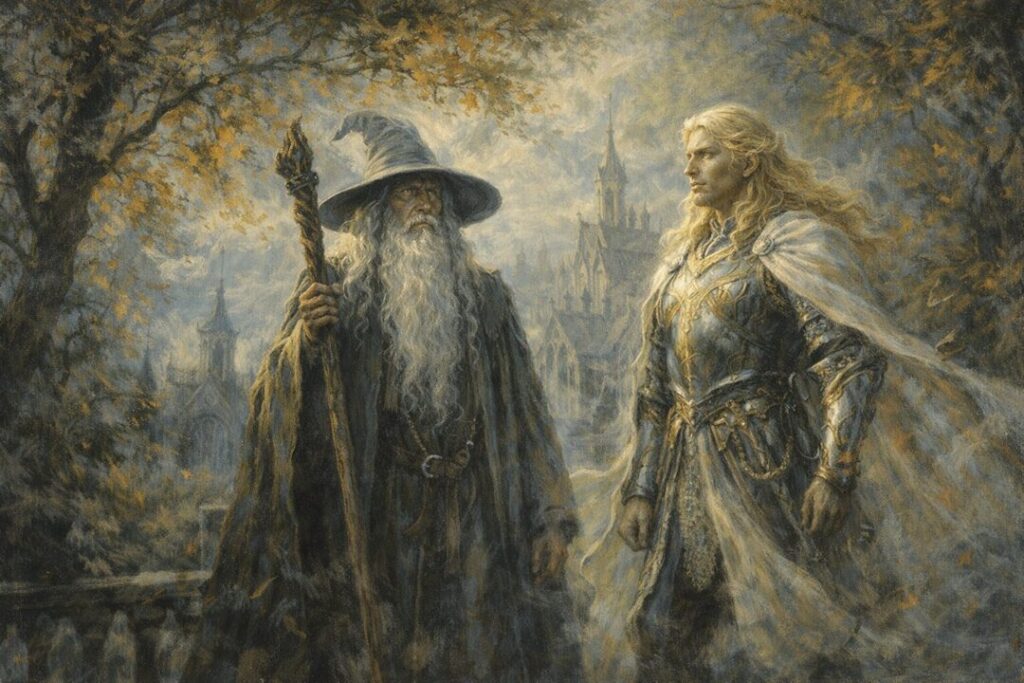
Glorfindel and the Authority of the Seen and Unseen
Glorfindel is not simply an Elf who has lived a very long time.
He is one of the rare beings in Middle-earth who has passed through death, been judged, and returned. In the First Age, he fell defending refugees during the fall of Gondolin, slaying a Balrog at the cost of his own life. Unlike most Elves who die in Middle-earth, Glorfindel was rehoused—his spirit restored and his body renewed—and sent back across the Sea.
By the Third Age, this makes him something profoundly unusual.
He is not merely ancient.
He is purified.
He carries an authority rooted in the Elder Days themselves.
This explains why Frodo sees him shining when wearing the Ring. The Ring does not create illusions. It strips them away. It reveals beings as they exist in the unseen world. What Frodo sees is Glorfindel’s true stature: a presence that stands fully in both realms, unshadowed by fear or corruption.
This also explains the reaction of the Nazgûl.
The Nazgûl are terrifying not because of physical strength, but because they exist primarily in the unseen world. Against ordinary warriors, they inspire paralysis and despair. Against Glorfindel, that relationship reverses. He does not fear them because he does not exist on their level of diminishment.
In spiritual terms, Glorfindel outranks them.
This places him in a unique category: not a Maia, not a Wizard, but an Elf whose being still carries the weight of the Elder Days, when the unseen world was not distant or faded but openly intertwined with the physical one.
Glorfindel vs. the Witch-king of Angmar
The Witch-king is formidable—but his power is derivative.
He does not generate authority from within himself. His strength flows from Sauron, from the Rings of Power, and from the terror he inspires in others. His dominance depends on fear, submission, and the weakening of wills.
Glorfindel’s strength lies elsewhere.
At the Ford of Bruinen, Glorfindel does not challenge the Witch-king to a dramatic duel. He does not need to. His presence alone denies the Witch-king supremacy in the unseen world. The Lord of the Nazgûl does not withdraw because he has been struck down—but because the balance is not in his favor.
This moment is easy to overlook, but it is deeply revealing.
The Witch-king retreats not because Glorfindel is stronger in arms, but because Glorfindel exists at a level where fear loses its leverage. Against beings who cannot be spiritually diminished, the Witch-king’s power falters.
In an open confrontation, Glorfindel would almost certainly prevail.
This does not diminish the Witch-king’s importance within the story. It clarifies his limits. He is terrifying to the fragile, overwhelming to the fearful, and devastating to armies—but he is not supreme among the powers of Middle-earth.
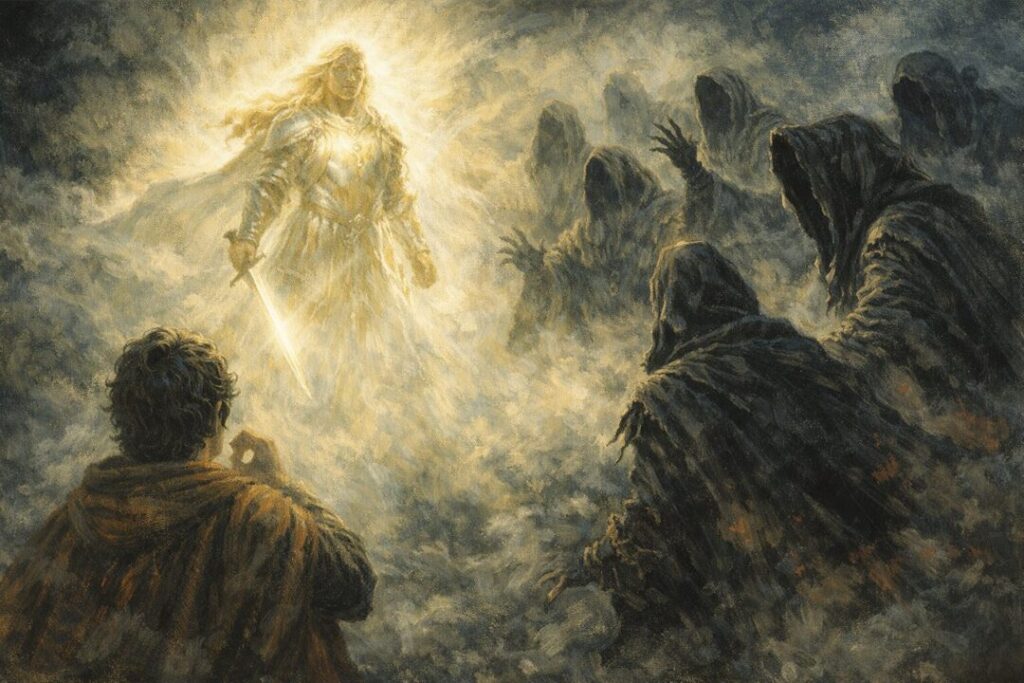
Glorfindel and Gandalf: Different Kinds of Power
Comparing Glorfindel to Gandalf is more complicated.
Gandalf is a Maia, a being of immense inherent power—greater in origin than Glorfindel. But that power is deliberately restrained. As one of the Istari, Gandalf is forbidden from dominating the wills of others or openly overthrowing evil through force. His role is to guide, encourage, and awaken resistance rather than to command it.
Glorfindel is not bound by the same limitations.
Yet he is also not tasked with shaping the fate of the world.
In raw spiritual presence within Middle-earth itself, Glorfindel may rival Gandalf. Both command deep respect. Both are terrifying to servants of darkness. But Gandalf’s greater power exists largely in reserve, revealed only in moments of extreme necessity—such as his confrontation with the Balrog or his stand against the Witch-king at Minas Tirith.
They are not rivals.
They are instruments designed for different purposes.
Gandalf moves history forward.
Glorfindel preserves what remains of the past.
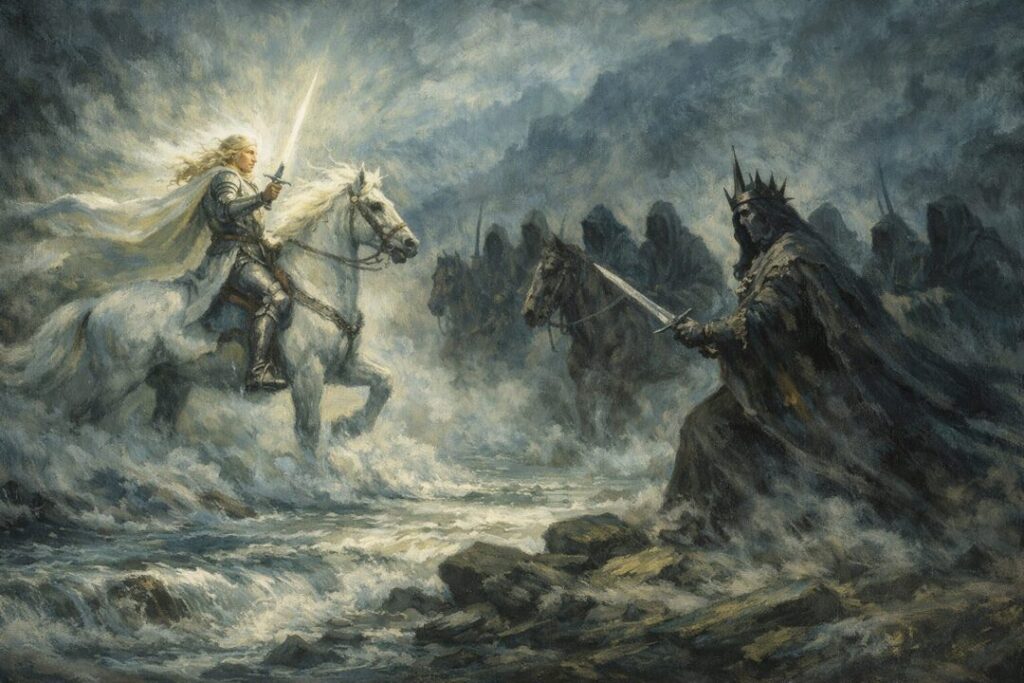
Why Glorfindel Is Absent From the Ring-Quest
This brings us to the crucial point.
The Ring-quest does not require power.
It requires invisibility.
The Ring cannot be destroyed through strength, force, or authority. It must be carried quietly, by those least likely to draw attention, least likely to inspire fear or awe, and least likely to blaze in the unseen world.
Glorfindel’s presence would do exactly that.
He would shine.
He would be felt.
He would draw the Eye.
Against open war, Glorfindel is devastating. Against secrecy, he is unsuitable.
This same principle explains several of the story’s most important decisions:
Why Gandalf hesitates to take the Ring.
Why Galadriel refuses it.
Why Elrond does not march east.
The destruction of the Ring depends not on domination, but on humility, endurance, and moral resistance. It requires beings small enough to pass unnoticed and fragile enough to struggle.
Glorfindel does not belong in that kind of story.
Power Without Centrality
Glorfindel’s role reflects the fading of the Elder Days themselves.
He is not weaker than Gandalf.
He is not lesser than the Witch-king.
He simply represents an age when power shaped the world openly—and that age is ending.
Middle-earth is passing into the dominion of Men. The great figures of earlier ages still exist, but they no longer stand at the center of events. Their role has become indirect: guarding, guiding, preserving, and then stepping aside.
Glorfindel’s absence is not a narrative oversight.
It is a thematic statement.
His strength is unquestionable.
His withdrawal is intentional.
And once this is understood, Glorfindel is no longer a mystery. He becomes a quiet reminder of what Middle-earth is leaving behind—and why the fate of the world must now rest in smaller hands.
Sources & Notes
- J.R.R. Tolkien, The Lord of the Rings, Book I, Chapter 12, “Flight to the Ford” — Glorfindel confronts the Riders near the Bruinen, and Frodo glimpses him as a shining figure in the unseen world.
- J.R.R. Tolkien, The Lord of the Rings, Book II, Chapter 1, “Many Meetings” — Gandalf explains that the great among the Eldar who have dwelt in the Blessed Realm live in both the seen and unseen worlds.
- J.R.R. Tolkien, The Peoples of Middle-earth, “Last Writings: Glorfindel” — Tolkien’s late note identifies the returned Glorfindel and explains his death, rehousing, and special authority.
- J.R.R. Tolkien, Unfinished Tales, “The Istari” — the Wizards are Maiar sent under restrictions, meant to guide and encourage resistance rather than rule by open force.
- J.R.R. Tolkien, The Lord of the Rings, Book II, Chapter 2, “The Council of Elrond” — the Ring-quest is framed as a mission where secrecy and humility matter more than power, explaining why an Elf-lord such as Glorfindel is not the answer.