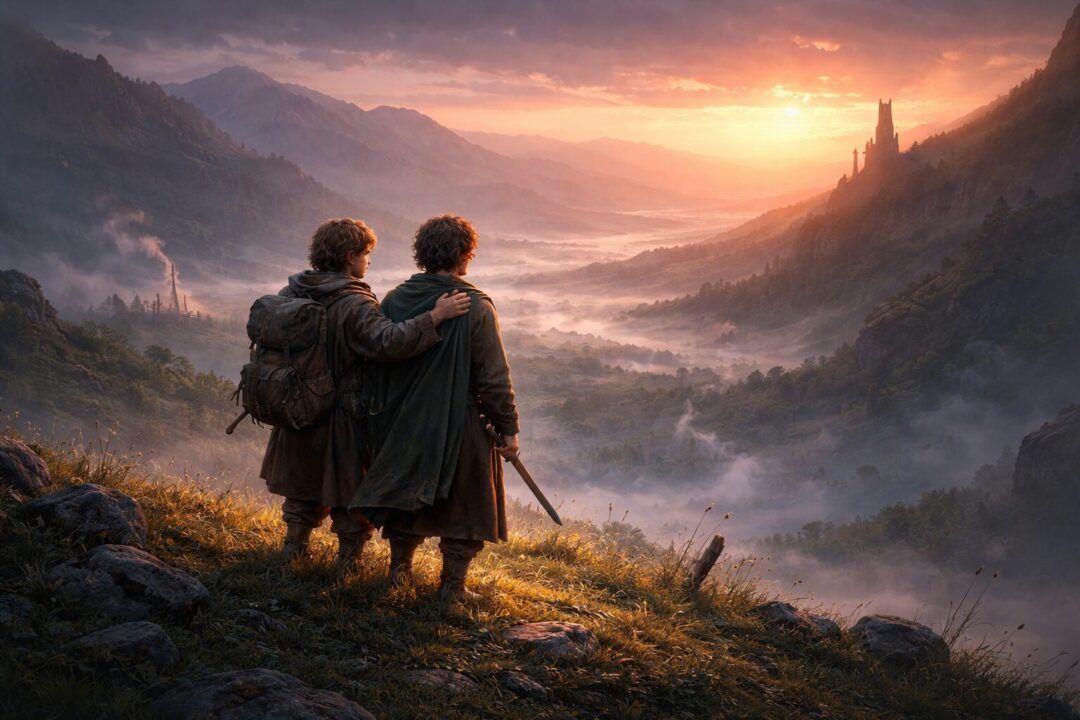
I’ve been thinking about the moment before Frodo speaks.
Not the words themselves — those are remembered, quoted, carved into memory.
But the pause that comes before them.
The room is full of people who have watched empires fall.
Warriors, rulers, beings who have outlived entire ages.
They know exactly what the Ring does.
They know how it hollows you out slowly — how it doesn’t just kill, it takes.
And still, no one moves.
Not because they lack courage.
Not because they don’t care enough.
But because they understand the cost.
That silence isn’t hesitation.
It’s recognition.
Every person in that room knows that stepping forward doesn’t mean holding an object or accepting a task.
It means surrendering a future that will never fully belong to you again.
It means surviving something you won’t truly come back from.
They aren’t afraid of dying.
They’re afraid of living afterward — changed, diminished, carrying knowledge that never loosens its grip.
So they sit with that understanding.
And in that quiet, heavy pause, the truth becomes clear:
The bravest thing in the room isn’t action.
It’s knowing exactly what the Ring asks — and realizing why no one wants to answer.
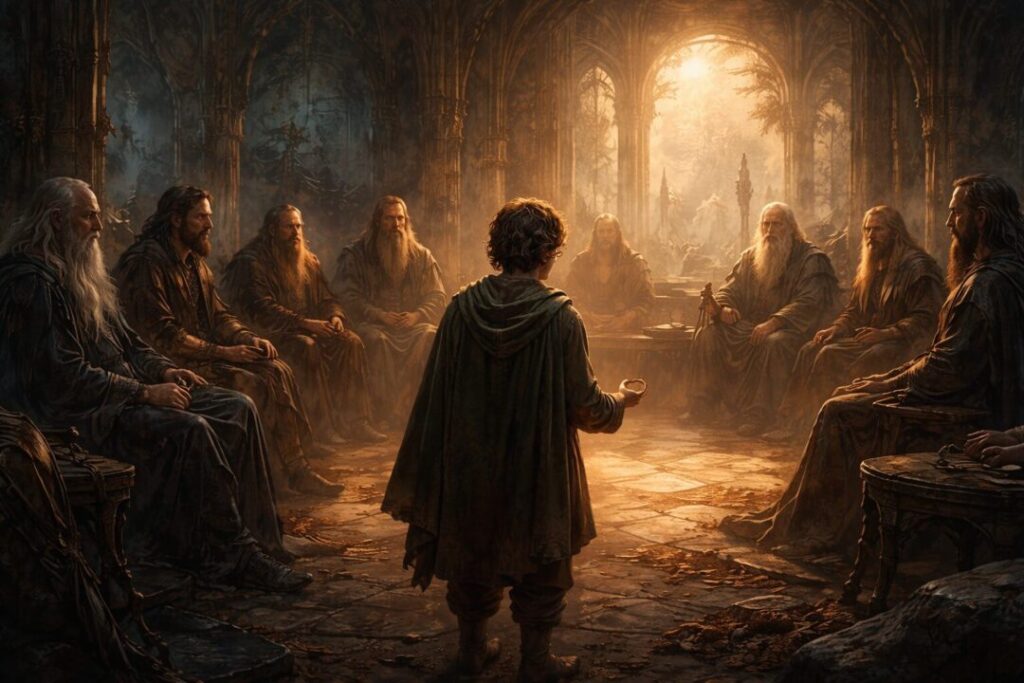
Frodo doesn’t stand because he believes he can win.
There’s no spark of confidence in him.
No surge of courage.
No moment where destiny settles into place and makes the choice easier.
You can see it on his face — the absence of certainty.
What Frodo understands, before anyone else in that room does, is that the Ring has already reached him.
That it has already altered the shape of his life.
That silence won’t protect him, and staying seated won’t return things to the way they were.
There is no safe path left for him.
So Frodo doesn’t volunteer in the way heroes are supposed to.
He doesn’t step forward because he wants glory or believes in success.
He steps forward because he recognizes reality.
He understands the cost — not in theory, but in his bones.
He knows that someone has to carry this weight, and that whoever does will lose something irreplaceable.
And in that moment, Frodo does something painfully human.
He doesn’t choose the quest.
He accepts it.
He becomes the one not because he is ready —
but because he knows that turning away would change nothing, and someone has to pay the price.
We talk about Frodo breaking at Mount Doom.
We point to the fire, the moment of failure, the weight becoming too much to bear.
But the truth is, Frodo’s life ends long before that.
It ends in Rivendell — quietly.
No farewell.
No visible fracture.
Just a small understanding settling into place.
Because once you truly grasp what evil takes, you can’t unlearn it.
You can’t return to being harmless, hopeful, and untouched by consequence.
Knowledge like that doesn’t announce itself — it stays.
Frodo carries the Ring not because he is the strongest, or the bravest, or the most capable.
He carries it because he already understands the price.
And that understanding is the real wound.
The journey doesn’t hollow him out.
It only reveals what has already been lost.
Every step after Rivendell is Frodo living inside a life that no longer belongs to him.
He walks forward, he survives, he completes the task —
but something essential has already ended.
Mount Doom isn’t where Frodo breaks.
It’s where time finally catches up to what he understood from the very beginning.
I’ve been thinking about Sam — not on the road, but after it.
After the songs are sung.
After the honors are given.
After the world decides the story has ended.
Sam comes home.
And by every visible measure, he gets what he was promised.
A place.
A family.
A future rooted in peace.
But there’s something Sam never recovers.
The belief that the world is safe by default.
Sam has seen how close everything came to ending — not in legend, but in breathless moments where survival felt uncertain.
He knows how thin the line is between comfort and collapse.
How easily darkness grows when no one is watching closely enough.
And that knowledge doesn’t leave him.
It doesn’t make him bitter.
It doesn’t make him hard.
It makes him careful.
Sam doesn’t love the world less because of what he’s seen.
He loves it more deliberately.
More gently.
He treats joy like something fragile, not guaranteed.
Like something you tend to, the way you tend a garden — knowing that neglect is all it takes to lose it.
The story may be finished for everyone else.
But for Sam, the aftermath is where the real work begins.
People say Frodo couldn’t come home.
And that’s true — in the way we usually mean it.
But Sam couldn’t either.
Not fully.
He stayed, yes.
He built a life.
He put down roots in the place he loved most.
But staying is its own kind of sacrifice.
Sam remains because someone has to.
Because love doesn’t always look like leaving — sometimes it looks like endurance.
Like choosing the same ground again and again, even when it holds memories that ache.
Sam carries memory the way others carry scars.
Quietly.
Without asking to be seen.
He doesn’t warn people about the darkness he’s known.
He doesn’t try to teach lessons or reshape the world.
He tends what remains.
He understands something most never have to learn —
that joy isn’t guaranteed, it’s guarded.
That peace doesn’t exist by accident, but because someone remembers how close it came to disappearing.
So Sam chooses to stay aware in a world that wants to forget.
He chooses care over comfort.
Presence over escape.
Every day, he bears the weight of remembering —
so others can live as if they never had to.
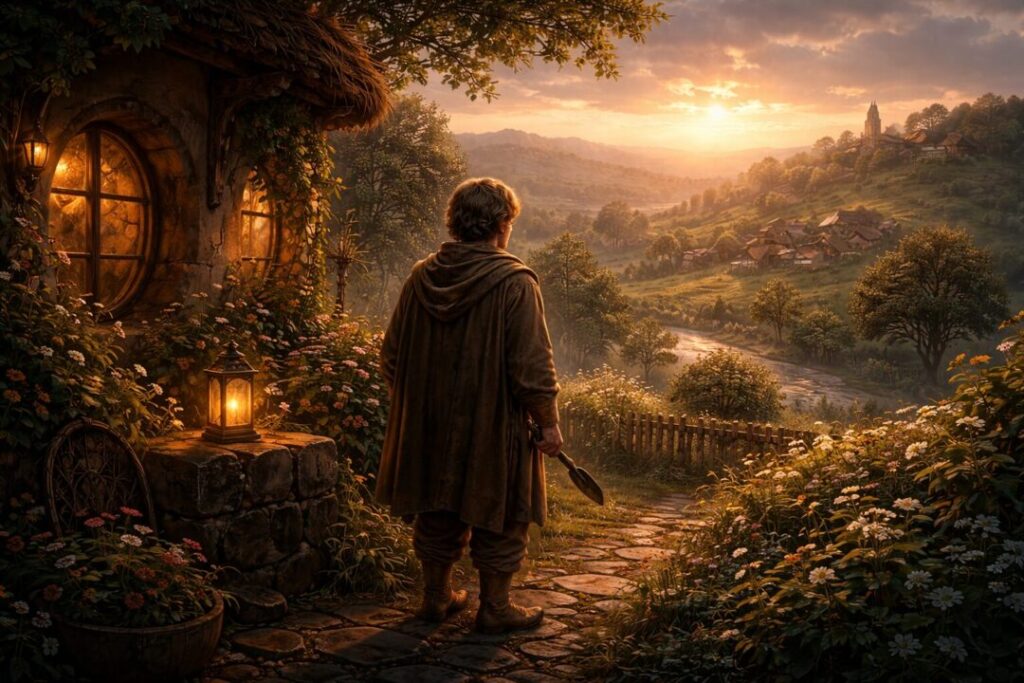
I think that’s why these stories stay with us.
Not because of the battles, or the spectacle, or the moment the world is saved.
Those are easy to admire.
What lingers are the people who carry weight invisibly.
The ones who understand too much — and still show up anyway.
Frodo doesn’t carry the Ring because he’s the strongest or the best choice.
He carries it because he recognizes what it will take — and accepts that someone must lose something that can’t be replaced.
Sam doesn’t stay because he’s untouched or whole.
He stays because he understands what leaving would cost others.
Neither of them are fearless.
They’re painfully aware.
They see the price clearly — the years, the peace, the innocence that will never fully return —
and they accept it without spectacle or applause.
They don’t demand recognition.
They don’t frame their sacrifice as virtue.
They simply do what needs to be done, and carry the consequences quietly so others can live lightly.
And maybe that’s the truest kind of heroism there is.
Not the absence of fear.
But choosing love anyway —
with open eyes, steady hands, and a full understanding of exactly how heavy it is.
Sources & Notes
- J.R.R. Tolkien, The Lord of the Rings, Book II, Chapter 2, “The Council of Elrond” — Frodo’s “I will take the Ring” moment comes after the Council has openly weighed the peril and no clear bearer has stepped forward.
- J.R.R. Tolkien, The Lord of the Rings, Book VI, Chapter 3, “Mount Doom” — Frodo’s final inability to cast away the Ring anchors the article’s reading of the burden as something that overwhelms rather than simply tests willpower.
- J.R.R. Tolkien, The Lord of the Rings, Book VI, Chapter 9, “The Grey Havens” — Frodo’s lingering wounds, his admission that the Shire was saved “but not for me,” and his departure show why he never truly returns to ordinary life.
- J.R.R. Tolkien, The Lord of the Rings, Book VI, Chapter 8, “The Scouring of the Shire” — Sam’s return is tied to repairing and tending the Shire, supporting the contrast between Frodo’s departure and Sam’s staying work.
- J.R.R. Tolkien, Letter 246 — Tolkien’s discussion of Frodo’s failure at the Cracks of Doom clarifies the moral pressure of the Quest and helps separate Frodo’s breaking point from simple cowardice or weakness.