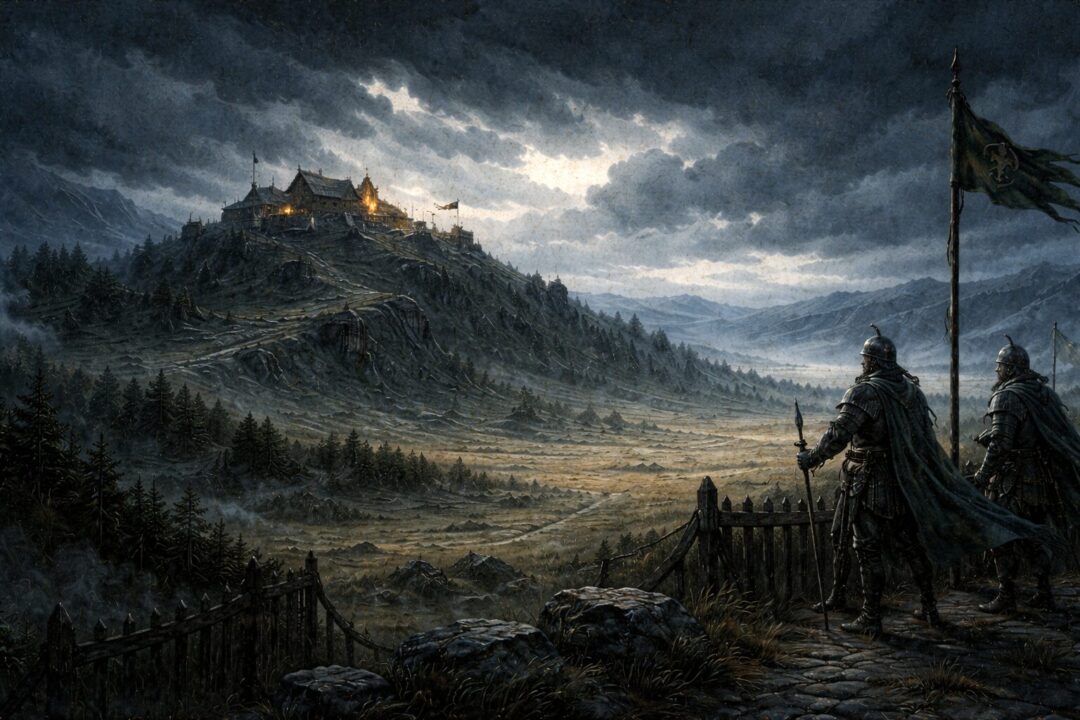
When readers first enter Edoras, the capital of Rohan, the impression is strikingly subdued.
This is not Minas Tirith, layered with walls and streets, crowded with citizens, soldiers, and stewards.
It is not Dale, reborn through trade and proximity to the Lonely Mountain.
It is not Lake-town, noisy with merchants and boats.
Instead, Edoras feels spare. Quiet. Nearly hollow.
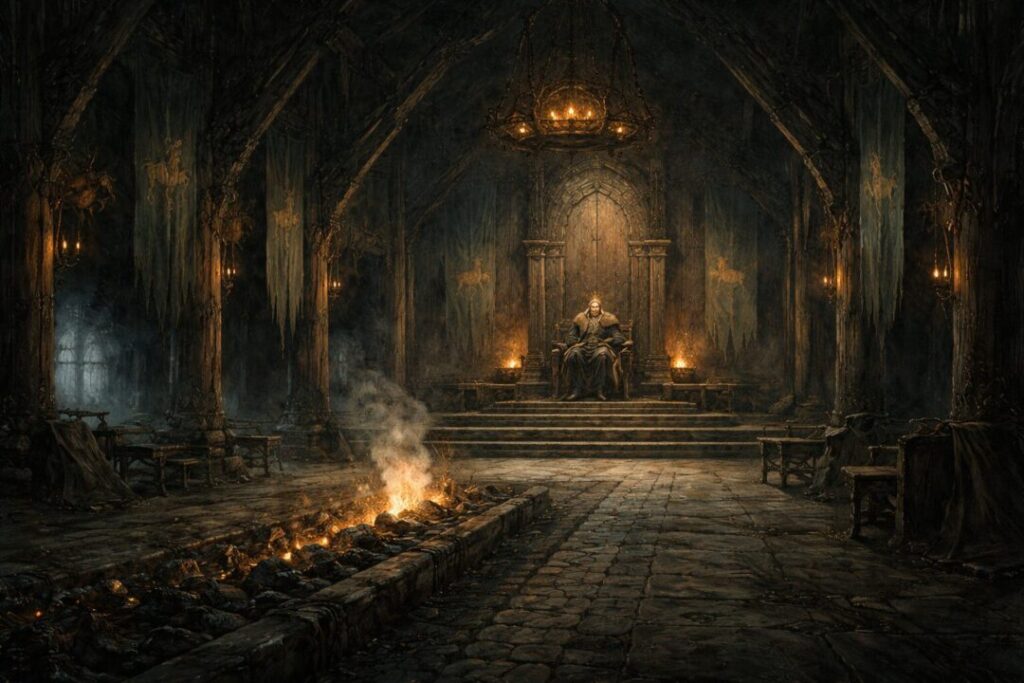
A small guard stands watch. A few doors are shut. One great structure dominates the hill: Meduseld, the Golden Hall of the Kings. Inside sits an aging ruler, surrounded by only a handful of attendants, his people seemingly vanished from around him.
For a kingdom facing invasion and collapse, the absence is unsettling.
It raises an obvious question:
Why does the capital of Rohan feel like it holds only a few dozen people?
The answer is not that something is missing from the story.
The answer is that Edoras is functioning exactly as it was meant to.
Edoras Was Never a True “City”
One of the most persistent misconceptions about Edoras is that it should resemble a medieval capital—crowded, densely populated, and constantly active.
But Edoras was never designed to be that kind of place.
Rohan is not an urban kingdom. It is a pastoral and martial society, modeled on mobility rather than fortification. Its wealth is not stored in workshops or marketplaces, but in land, horses, and people who can ride when summoned.
The Rohirrim do not live packed together behind walls. They live spread across the plains, in villages, farmsteads, and local halls governed by marshals and lords loyal to the king.
Edoras exists primarily as:
- The seat of the king
- The ceremonial heart of the Mark
- A place of councils, oaths, feasts, and remembrance
It is a political and symbolic center, not a population hub.
Even in times of peace, Edoras would never have held tens of thousands of residents. Its permanent population would have been limited largely to the royal household, guards, servants, and those whose duties required proximity to the king.
The Golden Hall stands above the land not because the people live there—but because the authority of the king must be seen.
The Riders Were Already Gone
By the time Gandalf and Aragorn arrive, Rohan is not merely uneasy.
It is already at war.
The armies of Saruman have begun their assault. Orcs and Dunlendings raid the Westfold. Villages burn. Messengers ride hard across the plains.
Men are no longer gathered near the capital.
They have been sent outward—to patrol borders, defend settlements, and respond to threats as they arise. Others have already fallen. Many more are preparing to fight.
This outward dispersal is not a sign of neglect.
It is Rohan’s core defensive doctrine.
Rohan does not rely on cities or fortresses. It relies on speed, early engagement, and striking before enemies can consolidate. To concentrate its people in Edoras would be to abandon its greatest advantage.
So Edoras stands quiet because its strength is already deployed.
The capital looks empty because the kingdom is actively resisting destruction beyond its walls.
The King’s Hall, Not the People’s City
Meduseld itself reinforces this reality.
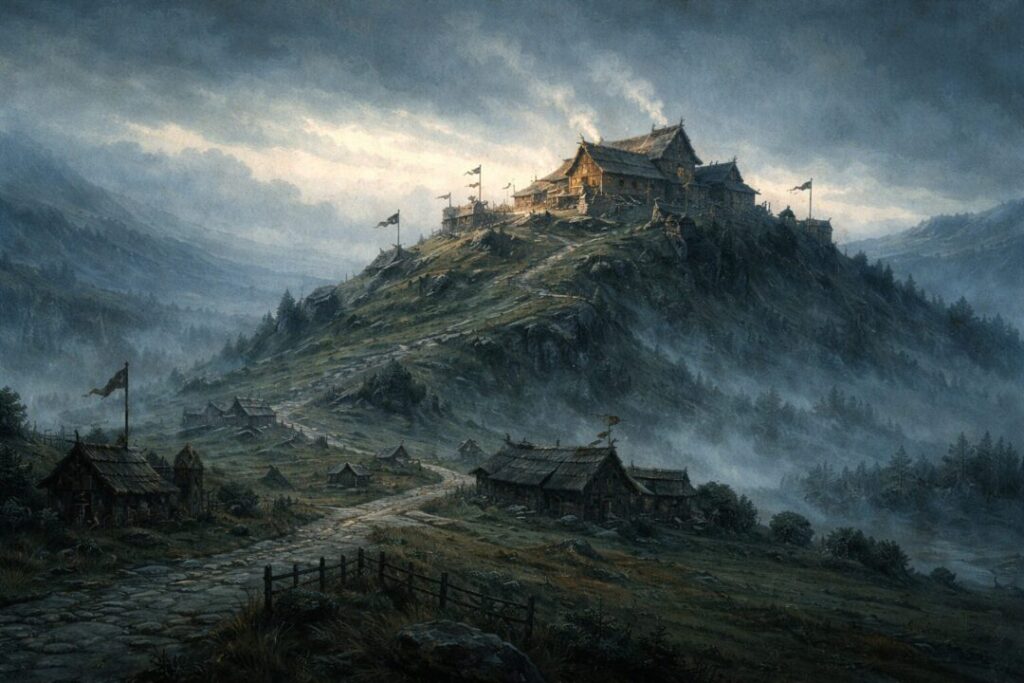
The hall is immense, beautifully crafted, and rich in symbolism—but it is not surrounded by layers of civilian housing or commercial districts. There is no urban sprawl climbing the hill.
This is not accidental.
Meduseld is a hall, not a palace complex. It is a gathering place where the people of Rohan come when summoned, not a place where they permanently reside.
In times of stability, lords and marshals would travel to Edoras for councils, feasts, and decisions, then return to govern their own lands. Loyalty flows upward; responsibility flows outward.
But when Théoden falls under the influence of Gríma Wormtongue, that cycle breaks.
Councils cease. Riders are dismissed. Messages go unanswered. The hall remains physically intact—but functionally isolated.
And so the people stop coming.
Edoras becomes what it appears to be when Gandalf arrives:
a king’s house without a kingdom gathered around it.
A Kingdom in Suspended Motion
Perhaps the most important reason Edoras feels empty is not logistical, but psychological.
Rohan is stalled.
The king doubts himself. His strength fades. His trust erodes. Decisions are delayed, sometimes deliberately undermined. In a culture that depends on decisive leadership, that paralysis spreads rapidly.
When authority falters at the top, people do not rush toward the center.
They retreat.
Families stay close to their land. Lords focus on defending what they can. Riders remain near their homes, waiting for clear orders that never come.
Edoras becomes a place people pass through, not remain in.
Its silence mirrors the uncertainty gripping the kingdom.
The emptiness of the capital is not just about population—it is about confidence. Until Théoden rises, Rohan does not know where to stand.
Geography and Exposure
There is another reason Edoras is lightly populated: it is exposed.
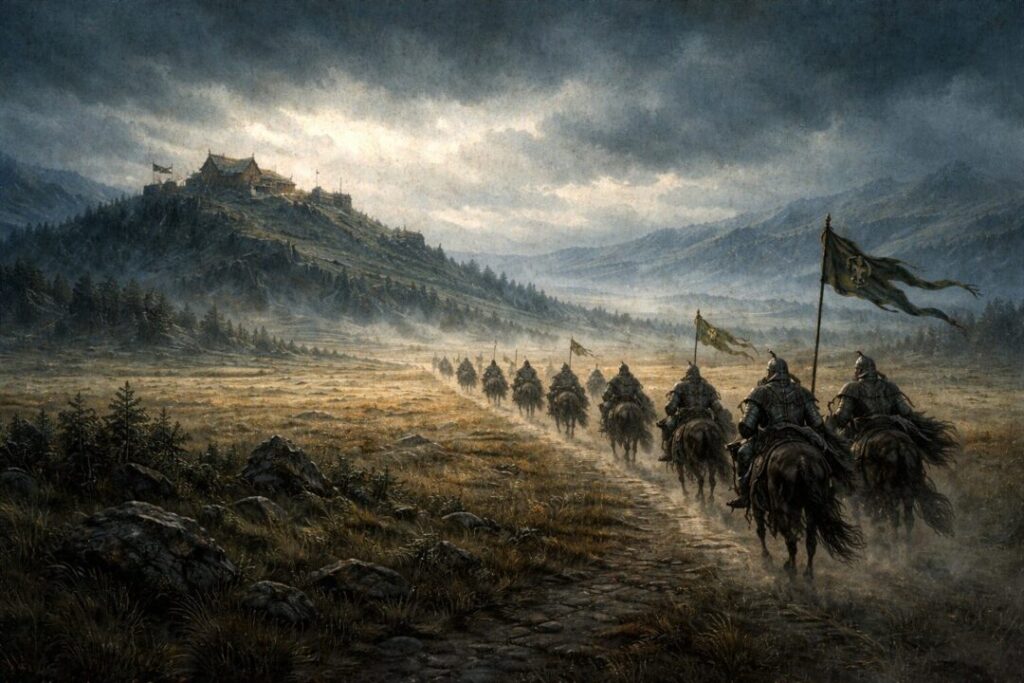
Unlike Minas Tirith or Helm’s Deep, Edoras is not built for prolonged siege. It stands on a green hill, commanding the plains visually but offering little in the way of layered defenses.
In times of crisis, civilians would be safer elsewhere—closer to natural barriers, fortresses, or places where riders could respond quickly.
Keeping large numbers of noncombatants in Edoras during Saruman’s advance would be a liability, not a strength.
So the absence of people is also a form of protection.
Edoras is not abandoned—it is kept light, ready to move, ready to respond, ready to yield space if needed.
Why the Story Shows Us Edoras This Way
Edoras is not meant to impress through size or grandeur.
It is meant to feel vulnerable.
The quiet hill.
The thin guard.
The echoing hall.
All of it reinforces how close Rohan is to collapse when Gandalf arrives. The danger is not that enemies have already conquered the capital—it is that the kingdom has nearly lost the will to defend itself.
And when Théoden is healed, the solution is not to fortify Edoras or fill it with people.
The solution is motion.
The king rides out.
The banners are called.
The riders gather—not in the city, but on the plains.
Because that is how Rohan has always survived.
Edoras After Théoden’s Awakening
Notably, even after Théoden rises, Edoras does not suddenly become crowded.
Instead of people pouring into the capital, the king leads his people out of it—first to Helm’s Deep, then later to Gondor.
This confirms what Edoras truly is.
It is not the heart because people live there.
It is the heart because it sends life outward.
The capital does not hold Rohan together.
The riders do.
The Silence Is the Point
Once you understand Rohan’s culture, the emptiness of Edoras becomes one of the most precise and intentional details in The Two Towers.
It is not a forgotten capital.
It is not underdeveloped worldbuilding.
It is not a cinematic shortcut.
It is a kingdom already in motion—its people spread across the plains, carrying the fate of the Mark with them wherever they ride.
Edoras looks abandoned because Rohan’s strength was never meant to stay still.
And when the horns finally sound, they do not echo from crowded streets or packed towers.
They echo from the open fields.
From the riders returning home.
Sources & Notes
- J.R.R. Tolkien, The Lord of the Rings, Book III, Chapter 6, “The King of the Golden Hall” — Gandalf’s arrival at Edoras shows Meduseld, Théoden’s diminished household, Gríma’s influence, and the capital’s exposed hilltop setting.
- J.R.R. Tolkien, The Lord of the Rings, Book III, Chapter 7, “Helm’s Deep” — Théoden’s ride west and the movement of Rohan’s people toward refuge show a kingdom whose strength is deployed rather than concentrated in Edoras.
- J.R.R. Tolkien, The Lord of the Rings, Appendix A, “The House of Eorl” — gives the royal history of Rohan, the building of Meduseld at Edoras, and the hall-centered kingship of the Mark.
- J.R.R. Tolkien, Unfinished Tales, “Cirion and Eorl and the Friendship of Gondor and Rohan” — provides background on the Rohirrim as a horse-lord people settled across Calenardhon, supporting the article’s pastoral, non-urban reading of Rohan.
- J.R.R. Tolkien, Unfinished Tales, “The Battles of the Fords of Isen” — details Saruman’s pressure on the Westfold and Rohan’s scattered military crisis before Théoden’s full recovery.