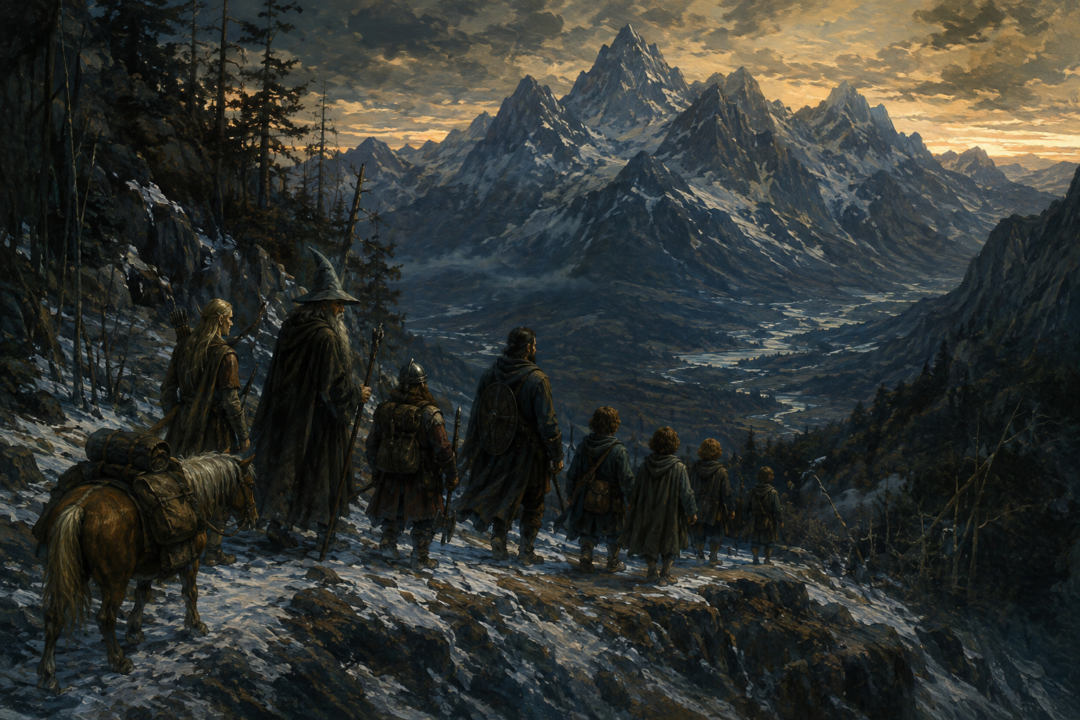
At Rivendell, the fate of the One Ring produces an unusual military problem.
Sauron cannot be defeated by sending a greater army against him. The Wise know that the Free Peoples do not possess the strength to overthrow Mordor by conventional force. Nor can the Ring simply be hidden forever. The only path to victory is to carry it into the heart of the Enemy’s own land and destroy it in the fire where it was made.
That means the most important operation of the War of the Ring begins not with an army, but with nine travellers.
Elrond deliberately sets the Nine Walkers against Sauron’s Nine Riders. The numerical opposition is explicit in The Fellowship of the Ring. But if we look beyond that deliberate correspondence, the composition of the Company reveals something practical.
The Fellowship is not a miniature army.
It is a small, mobile expedition built around one irreplaceable person: Frodo Baggins.
And almost every feature of the Company makes more sense once we see it that way.
The Mission Determines the Size
The Council of Elrond reaches a conclusion that overturns the normal logic of war.
The Ring must be destroyed, but the Free Peoples cannot openly march into Mordor to destroy it. Any large expedition would announce itself. Armies require roads, supplies, camps, animals, communication, and protection. They leave traces. They attract attention.
The Ring-bearer therefore needs companions without turning his journey into a military campaign.
That is the operational tension behind the Fellowship.
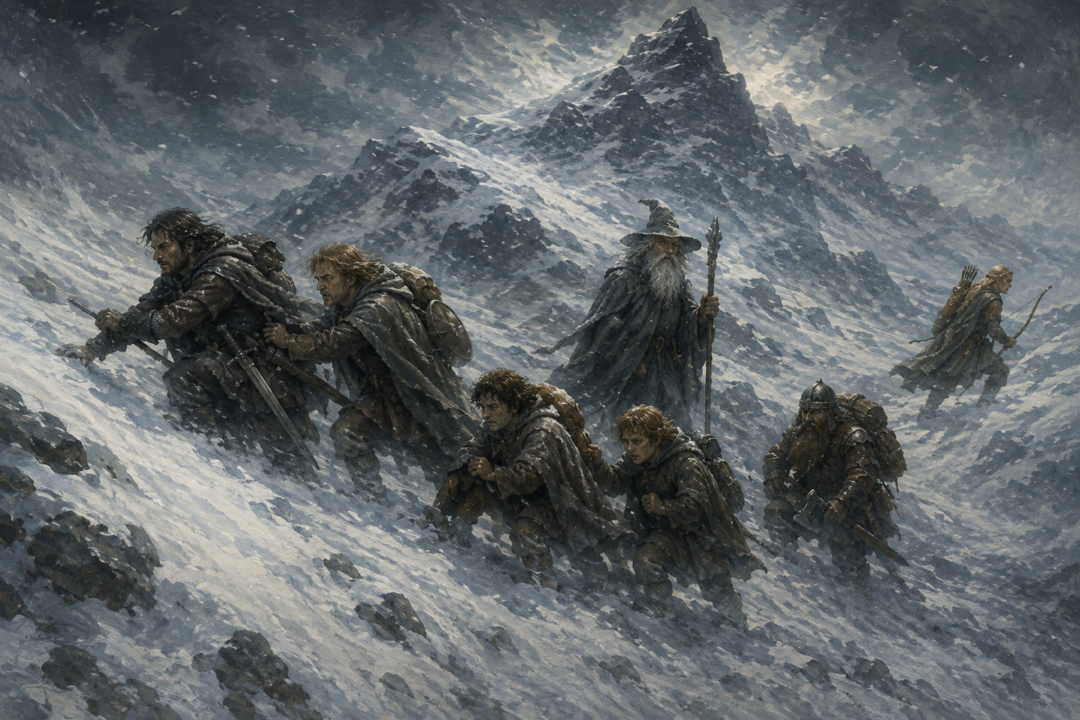
It must be strong enough to survive the wilderness but small enough to move quietly.
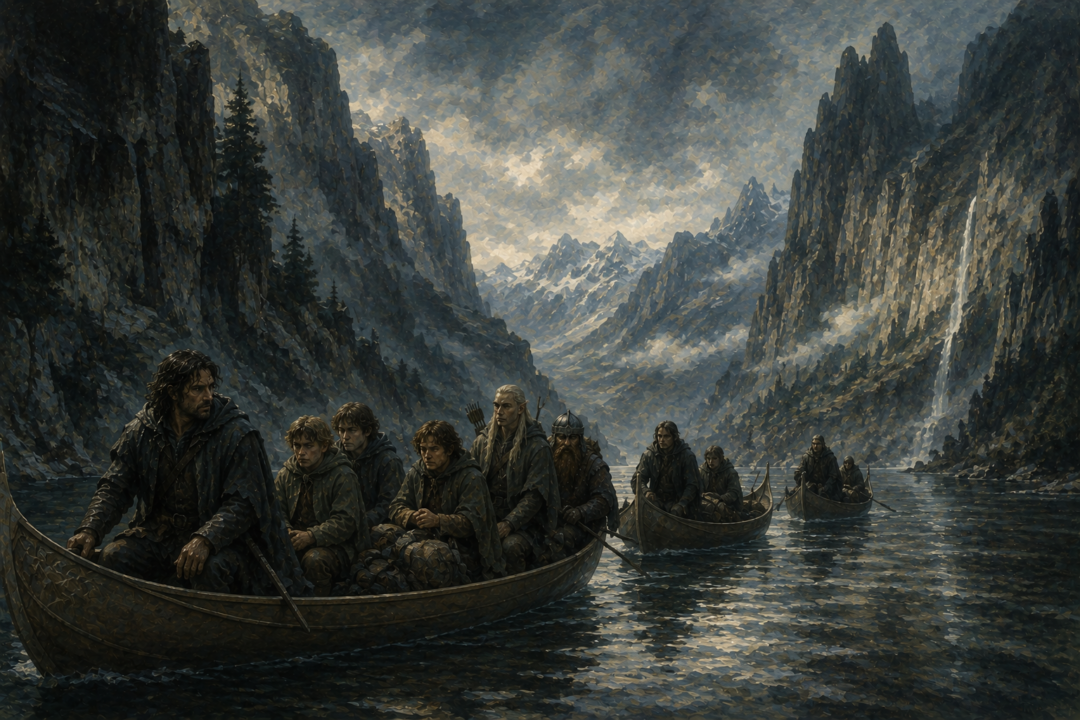
Nine is already a considerable travelling company by the standards of a secret journey. Yet it remains tiny compared with the forces moving across Middle-earth. The Fellowship can travel through wild country, hide from observation, alter its route, enter narrow passages, and eventually use boats without the logistical burden of hundreds of followers.
Its strength is concentrated in capability rather than numbers.
That distinction matters.
The Company does not need enough warriors to defeat Mordor.
It needs enough different kinds of competence to keep Frodo moving toward Mordor.
Frodo Is the Mission, Not the Commander
The most important operational fact about the Fellowship is that Frodo occupies a unique position.
He is not simply one member among nine.
He is the Ring-bearer.
If Aragorn falls, the Quest suffers terribly, but another companion can still guide Frodo. If Legolas or Gimli falls, valuable abilities are lost, but the Ring can continue eastward. Even Gandalf’s fall in Moria, devastating as it is, does not end the Quest.
Frodo is different.
The entire expedition exists because he has accepted the burden of carrying the Ring.
Yet he is not treated as a conventional military commander. Gandalf guides the Company while he remains with it, and Aragorn assumes leadership after Gandalf falls in Moria. Frodo nevertheless retains authority over the central question of his own journey.
This produces an unusual command structure.
There is tactical leadership around the Ring-bearer, but the Ring-bearer remains morally central to the mission.
The distinction becomes decisive at Parth Galen. Aragorn struggles with the choice between Minas Tirith and Mordor, but he does not simply command Frodo to follow him. The Quest cannot be reduced to an officer giving orders to a subordinate carrying valuable equipment.
Frodo has accepted a burden that ultimately remains his.
Gandalf and Aragorn Provide Redundant Leadership
One of the Fellowship’s greatest strengths becomes visible only when disaster strikes.
Gandalf is initially its guide and chief source of wisdom. He possesses knowledge of Sauron, the Ring, ancient places, languages, enemies, and the larger strategic situation. He also has long experience travelling across Middle-earth.
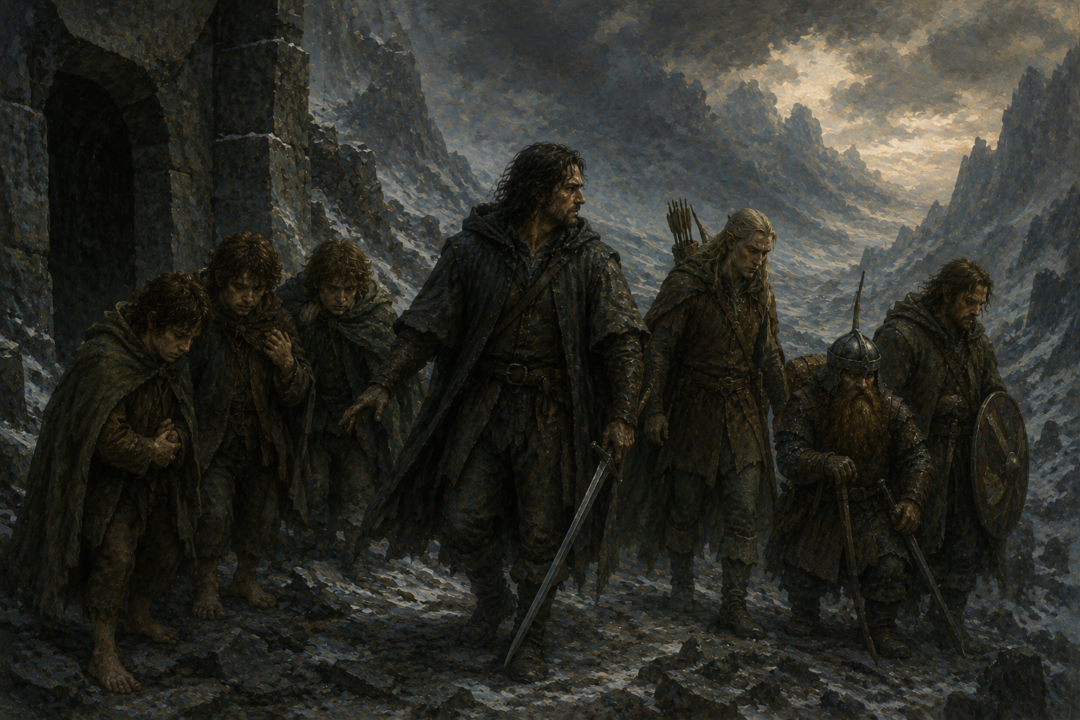
But the Company does not collapse when he falls in Moria.
Aragorn takes responsibility.
That is not accidental redundancy in a modern technical sense, but operationally the effect is clear: the Fellowship contains more than one person capable of guiding others through extreme danger.
Aragorn brings a different skill set. He has spent much of his life travelling in the wild, knows the lands through which they pass, understands tracking and survival, and possesses experience far beyond what most of the hobbits can imagine.
The contrast matters.
Gandalf provides extraordinary knowledge and judgment. Aragorn provides exceptional practical experience in the wild and later becomes the Company’s leader.
When one is lost, the mission survives.
The Fellowship has suffered a catastrophic blow, but it has not become helpless.
Legolas and Gimli Are More Than Representatives
It is tempting to read Legolas and Gimli primarily as representatives of Elves and Dwarves.
That element is certainly present in the Company’s composition, but operationally both bring abilities that become immediately useful.
Legolas possesses extraordinary Elvish sight and physical endurance. On Caradhras, he can move over the snow where others struggle through it. His senses repeatedly help the Company assess distant threats and terrain.
Gimli contributes knowledge particularly relevant to Dwarvish works and Moria. His presence also reflects something important about the expedition: the Company may have to cross environments built, inhabited, or understood by very different peoples.
Neither companion is merely ceremonial.
The route itself demands diversity of experience.
Their developing friendship therefore has a practical consequence as well as an emotional one. Two members drawn from peoples carrying old distrust become increasingly capable partners.
For a small expedition, internal cohesion is not decorative.
It is survival.
Boromir Brings Strength — and a Different Destination
Boromir is perhaps the clearest example of why the Fellowship is not a perfectly optimized commando unit.
He is a formidable warrior and an experienced captain of Gondor. His physical strength proves valuable during the attempt to cross Caradhras, and his military experience belongs naturally in a company travelling toward the greatest war zone in Middle-earth.
But Boromir does not originally intend to accompany Frodo all the way to Mount Doom.
His road leads toward Minas Tirith.
That fact reveals how loosely structured the Fellowship actually is.
Elrond does not establish a rigid organization whose members are all sworn to remain beside Frodo until the Cracks of Doom. The companions are not bound by an absolute command to follow the Ring-bearer to the end.
The route will be determined as circumstances develop.
This flexibility is essential because nobody at Rivendell possesses enough information to create a detailed operational plan for penetrating Mordor months in advance.
But flexibility also carries risk.
Boromir’s desire to reach Gondor eventually intersects with his growing belief that the Ring could be used against Sauron. At Parth Galen, that conflict contributes directly to the breaking of the Company.
The Fellowship’s greatest strength — that its members remain free people rather than controlled instruments — also means that unity cannot simply be imposed.
Why Four Hobbits?
Four hobbits can initially look like the least efficient feature of the expedition.
Surely Elrond could have sent more warriors.
Indeed, Elrond considers sending Merry and Pippin back to the Shire, while other companions could have been chosen. Gandalf argues in favour of trusting the friendship and loyalty already surrounding Frodo.
That decision proves enormously consequential.
Sam is indispensable because his loyalty is directed not toward an abstract strategy but toward Frodo himself. When Frodo attempts to leave the Fellowship alone, Sam understands what he is doing and reaches him before he can depart.
That moment preserves the Quest.
Merry and Pippin do not accompany Frodo into Mordor, but their presence eventually produces consequences no planner at Rivendell could have predicted. Their capture draws Aragorn, Legolas, and Gimli westward in pursuit. Their escape brings them to Fangorn and into contact with Treebeard. From there events contribute to the Ents’ attack on Isengard.
None of this could have been placed in an operational plan.
That is precisely the point.
The Fellowship is not assembled on the assumption that every future event can be predicted.
Some of its strength comes from bonds of loyalty whose value cannot be calculated beforehand.
The Fellowship Carries Almost No Strategic Weight
A striking feature of the Nine Walkers is how little direct military power they represent.
Boromir is a captain, but he brings no Gondorian troops.
Aragorn is Isildur’s heir, but he brings no army of Dúnedain.
Legolas does not arrive with Elven archers.
Gimli does not bring Dwarven warriors.
Gandalf possesses great power, but he does not approach the Quest as a battlefield weapon capable of simply destroying every obstacle.
The Fellowship deliberately leaves institutional power behind.
That makes sense because institutional power is exactly what Sauron is prepared to confront.
He watches kingdoms.
He calculates armies.
He fears powerful rivals who might claim the Ring and challenge him.
A handful of travellers moving through the wilderness is harder to fit into that strategic worldview.
The Fellowship’s weakness is therefore partly protective.
Not because Sauron is incapable of noticing small groups, but because the Quest depends on avoiding the kind of confrontation in which Sauron is overwhelmingly strongest.
The Company Is Designed to Adapt
The Fellowship leaves Rivendell without a fixed route all the way to Mount Doom.
That can look like poor planning until we consider the problem.
The travellers do not know which roads will remain safe. Saruman has become an enemy. The passes of the Misty Mountains may be watched or blocked. Moria is dangerous. Gondor is under increasing pressure. Mordor itself is heavily defended.
A rigid plan would probably become obsolete almost immediately.
And that is exactly what happens.
Caradhras fails.
The Company turns toward Moria.
Gandalf falls.
Aragorn assumes leadership.
They reach Lórien.
They take boats down Anduin.
Then the Fellowship breaks entirely.
Yet the mission continues.
This is the deepest operational lesson of the Nine Walkers.
The organization fails before the objective does.
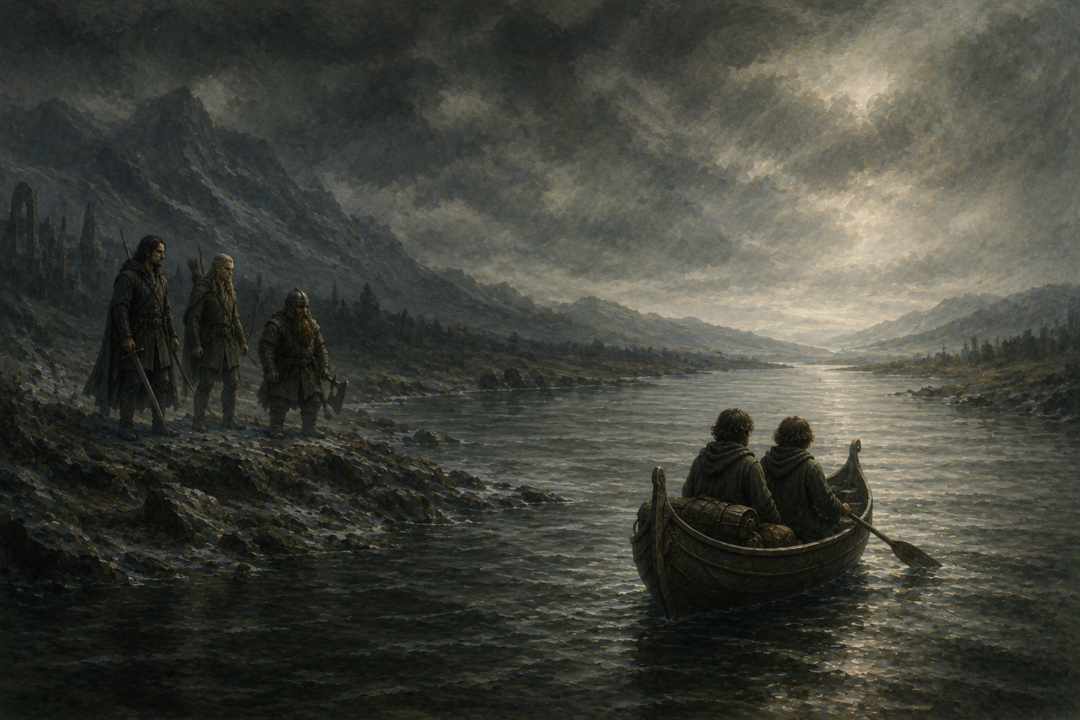
The Fellowship Breaks — and the Strategy Still Works
By the end of The Fellowship of the Ring, the original Company no longer exists as an operational unit.
Gandalf has fallen in Moria, though he will later return. Boromir dies defending Merry and Pippin. Merry and Pippin are captured. Aragorn, Legolas, and Gimli turn aside to pursue them.
Only Sam continues with Frodo.
Judged as a conventional expedition, this is catastrophic fragmentation.
Judged by the actual mission, however, something remarkable has happened.
The Ring-bearer is still moving toward Mordor.
The reduced party of Frodo and Sam becomes even less conspicuous than the original Fellowship. Meanwhile, the scattered companions become involved in other parts of the wider war: Rohan, Isengard, Gondor, and eventually the military diversion that draws Sauron’s attention toward the Black Gate.
The Nine Walkers were never powerful because nine was a magically effective number.
Elrond explicitly chose nine in opposition to the Nine Riders, giving the number deliberate meaning. But the Company’s practical effectiveness comes from something else.
It combines guidance, wilderness skill, combat ability, perception, endurance, local knowledge, and above all personal loyalty around a mission that cannot survive ordinary military methods.
The Fellowship is therefore one of the strangest successful expeditionary groups in Middle-earth.
It loses its first leader.
It loses another member to death.
It divides into separate parties.
Its original route repeatedly fails.
Its members cannot even remain united over where they should go.
And yet the essential objective survives every disruption.
That is what the Nine Walkers mean operationally.
They are not an army sent to defeat Sauron.
They are just enough people to keep the impossible journey alive.
Sources & Notes
- The Encyclopedia of Arda, “Nine Walkers” — explains Elrond’s choice of nine companions to oppose the Nine Riders and lists the Company’s members: https://www.glyphweb.com/arda/n/ninewalkers.html
- The Encyclopedia of Arda, “Fellowship of the Ring” — overview of the Company’s formation, mission to destroy the Ring, journey, and eventual breaking: https://www.glyphweb.com/arda/f/fellowshipofthering.html
- The Encyclopedia of Arda, “Council of Elrond” — account of the council at Rivendell that determined the Ring must be taken to Orodruin and destroyed: https://www.glyphweb.com/arda/c/councilofelrond.html
- The Encyclopedia of Arda, “Ring-bearers” — background on Frodo’s unique burden as bearer of the One Ring and the other people who carried it: https://www.glyphweb.com/arda/r/ringbearers.html
References for the Company’s deliberate size and composition, the Council’s destruction mission, Frodo’s unique role as Ring-bearer, and the Fellowship’s route and breaking.