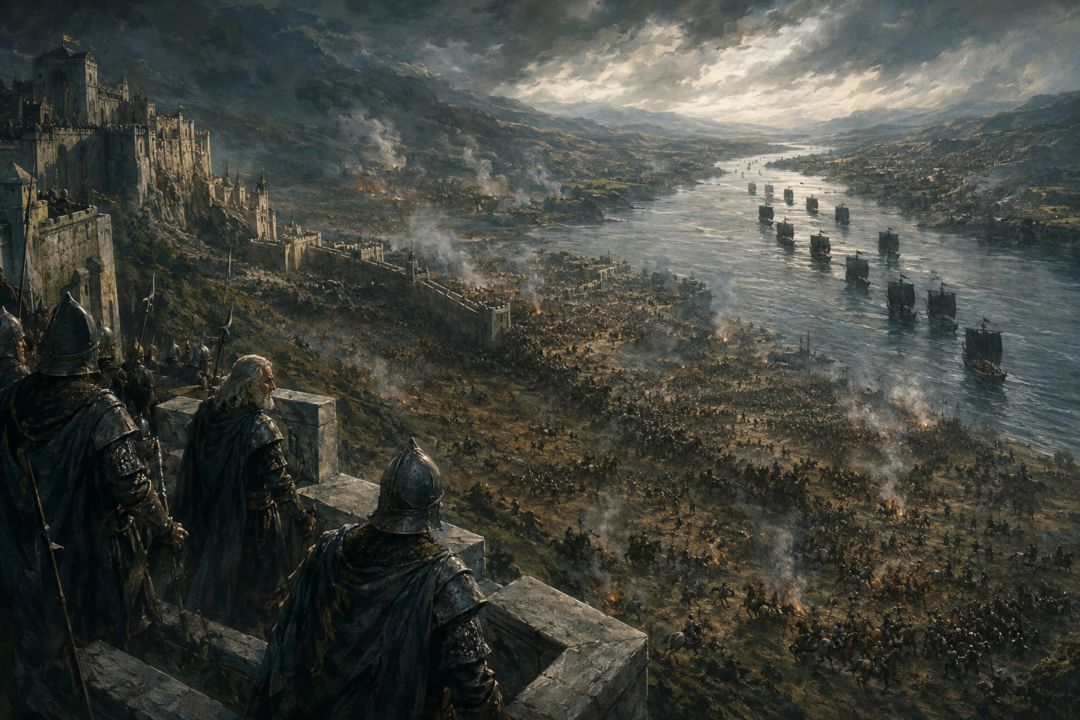
When ships appear on the Anduin during the Battle of the Pelennor Fields, the defenders of Gondor do not wait to identify their crews.
They see the sails.
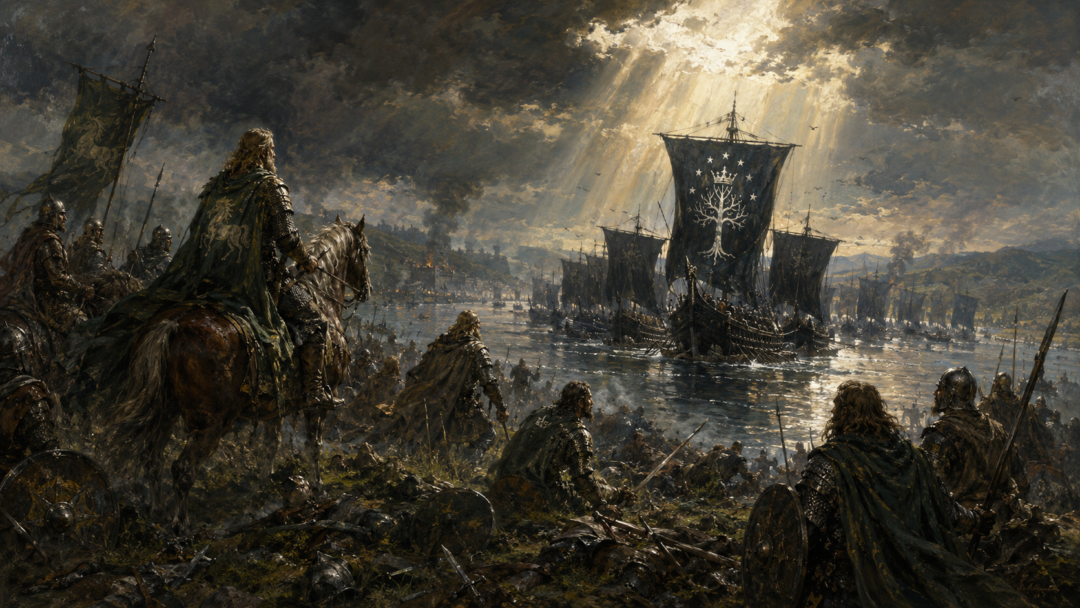
Black sails are moving north upon the river, and almost immediately men cry out that the Corsairs of Umbar have come. To those watching from Minas Tirith, the conclusion seems obvious: the southern lands have fallen, the enemy has broken through Gondor’s last reserves, and another hostile army is arriving precisely when the battle can bear no further weight.
Yet the men aboard those ships are not Corsairs.
Aragorn has captured their fleet at Pelargir and is bringing desperately needed reinforcements from southern Gondor.
That reversal is one of the great moments of the Battle of the Pelennor Fields. But its power depends on something deeper than mistaken identity. The black sails terrify Gondor because the fleet represents an entire strategic disaster before a single warrior steps ashore.
The ships seem to announce that everything south of Minas Tirith has already been lost.
The Corsairs Were Not a Distant Threat
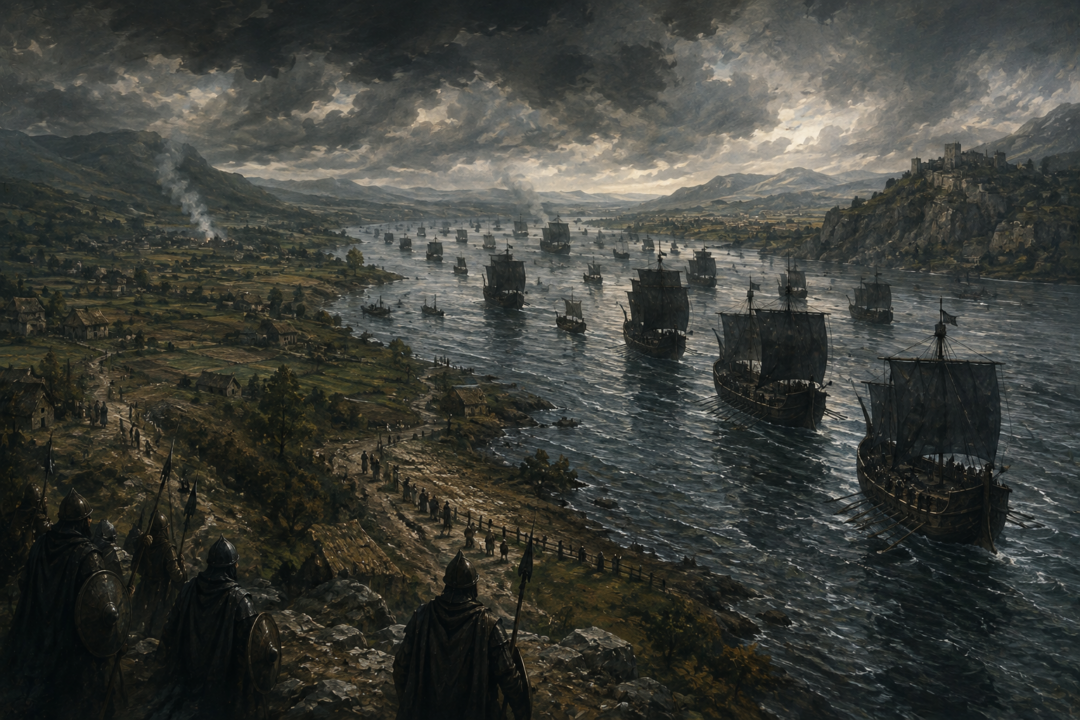
Umbar was far from Minas Tirith, but its ships had haunted Gondor’s history for centuries.
The hostility had deep roots. During Gondor’s Kin-strife, supporters of Castamir fled south after his defeat and established themselves at Umbar. Their descendants became bitter enemies of Gondor. In Third Age 1634, Corsairs descended upon Pelargir and killed King Minardil.
The political identity of Umbar changed over the centuries, and the Corsairs of the late Third Age should not simply be treated as an unchanged remnant of Castamir’s followers. But the maritime threat endured.
This mattered because Gondor possessed a long coastline and important southern provinces. An enemy fleet could strike places that armies marching from Mordor could not easily reach.
Long before the Siege of Gondor began, therefore, the Corsairs represented more than piracy. They were a strategic weapon against Gondor’s ability to concentrate its strength.
Beregond explains the danger to Pippin before the great assault. A fleet from Umbar is approaching the mouths of Anduin, and the Corsairs have allied themselves with the Enemy. Gondor cannot simply abandon its southern regions while every available soldier marches to Minas Tirith.
Sauron does not need the Corsairs to capture the White City by themselves.
He needs them to make Gondor afraid to leave its coast undefended.
Gondor’s Reinforcements Were Already Missing Because of Them
This consequence becomes visible when the forces of Gondor’s fiefs arrive at Minas Tirith.
They come from places such as Lossarnach, the Ringló Vale, Lamedon, and Dol Amroth. But the total is smaller than the people of the City hoped.
Why?
The southern lords cannot send everything.
Enemies threaten their own lands, particularly because of the danger from Umbar. The defence of the capital is therefore weakened before the main battle even begins.
That is the strategic brilliance of a maritime threat. A fleet does not have to be everywhere. It only has to make its opponent believe that several places might be attacked.
Every soldier retained in southern Gondor because the coast must be guarded is a soldier unavailable at Minas Tirith.
When the black sails eventually appear on the Anduin, the people of Gondor are therefore not encountering an unexpected enemy. They are seeing what they feared all along.
The nightmare that had already weakened their defence seems finally to have arrived.
What the Black Sails Appear to Mean
The geography makes the sight particularly terrible.
From Minas Tirith, watchers can look southward along the Anduin. During the battle they see ships approaching: large vessels with many oars, their black sails filled by the wind.
The reaction is immediate.
The men identify them as the Corsairs of Umbar and assume that Belfalas, the Ethir, and Lebennin have been overcome. Yourbookshelf
That conclusion reveals why the fleet is more frightening than its unknown number of passengers.
If Corsair ships are sailing freely toward Minas Tirith, then several things appear to have happened already.
The southern defenders must have failed to stop them. The great haven of Pelargir can no longer bar their advance. The coastline and lower Anduin are apparently open. And whatever reinforcements might once have come from southern Gondor may themselves have been defeated or trapped.
The fleet is therefore interpreted not merely as another enemy formation.
It looks like evidence of collapse.
The defenders do not know what happened hundreds of miles away. The ships seem to tell them.
And the story they appear to tell is catastrophic.
The Timing Makes the Sight Almost Unbearable
The ships do not appear when Gondor is secure behind unbroken walls.
They arrive during the Battle of the Pelennor Fields.
Minas Tirith has already endured siege. The Gate has been broken. Théoden has fallen. Éowyn and Merry have confronted the Lord of the Nazgûl. The Rohirrim are fighting far from safety, and enormous forces of the Enemy remain upon the field.
For Éomer in particular, the black sails seem like the final turn of fortune.
After believing Éowyn dead and seeing the desperate state of the battle, he rallies his remaining riders. When he becomes aware of the approaching fleet, there is no reason available to him to imagine rescue.
From his perspective, the ships belong to the enemy.
So he prepares for a last stand.
That detail is crucial. The terror of the black sails does not produce simple cowardice. Éomer does not flee. Instead the apparent hopelessness strips away expectation of survival.
The enemy seems to have closed every road.
What remains is to fight until nothing remains to be done.
Aragorn Wins Before Gondor Knows He Has Won
The great irony is that the strategic disaster represented by the black sails has already been reversed.
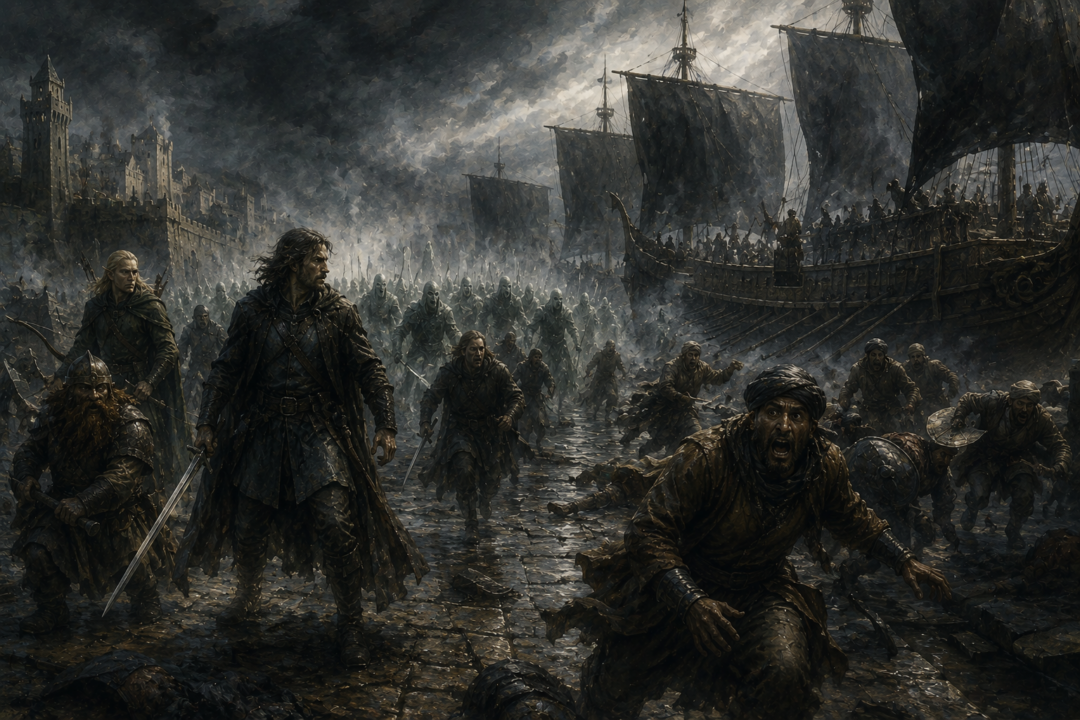
Aragorn has taken the Paths of the Dead with the Grey Company, Legolas, and Gimli. At the Stone of Erech he summons the Dead Men bound by their ancient oath to Isildur’s heir.
Their terror proves decisive in southern Gondor.
At Pelargir lies the Corsair fleet: fifty great ships and many smaller vessels. Aragorn brings the Dead against the enemy there, and the Corsairs are overwhelmed by fear. The captured ships can then be used for an entirely different purpose.
The Dead do not accompany Aragorn onward to the Pelennor Fields. Their oath fulfilled, he releases them.
Instead Aragorn gathers living men.
Those who sail north include his own companions and forces drawn from southern Gondor. Thus the very fleet intended to help destroy Gondor becomes the means by which Gondor’s scattered strength reaches its capital.
It is one of the most complete reversals in the war.
Sauron’s strategy had forced southern troops to remain away from Minas Tirith.
Aragorn defeats the threat responsible for their absence and then uses the enemy’s own ships to transport those troops directly to the battlefield.
But nobody at Minas Tirith knows this yet.
They can see only black sails.
Why Aragorn’s Standard Changes Everything
Then the meaning of the fleet changes in an instant.
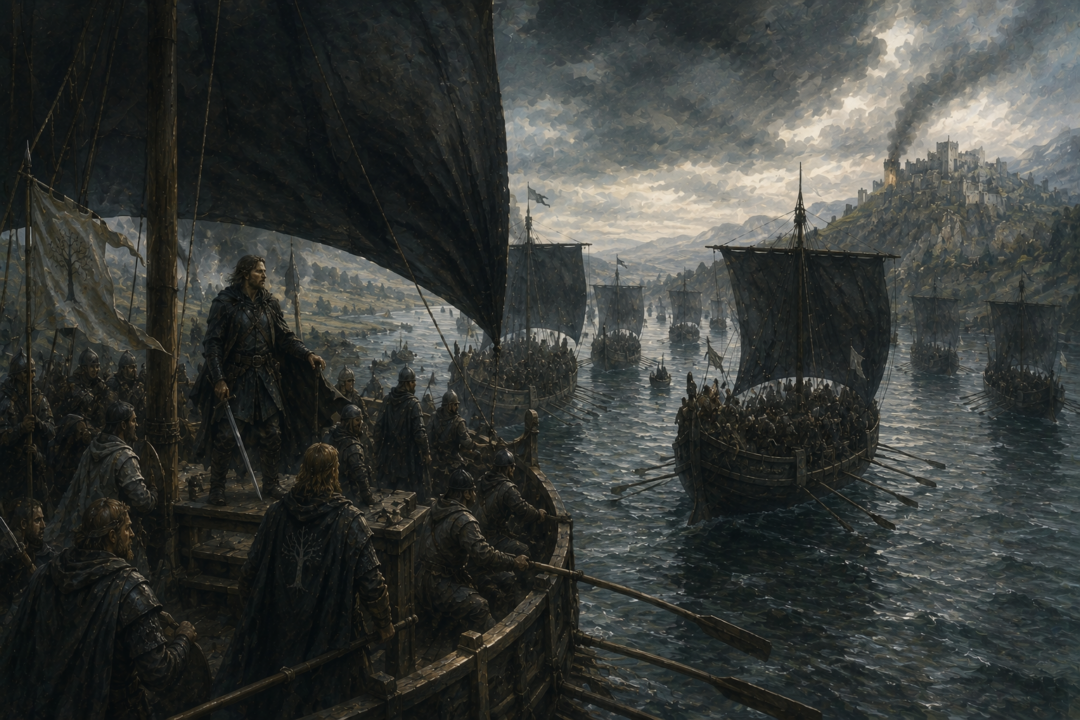
Upon the foremost ship a standard is unfurled.
It bears the White Tree, Seven Stars, and a crown: the emblems associated with the royal house of Gondor and the heirs of Elendil.
The ships have not changed.
The sails are still the sails Gondor feared.
What changes is the information available to those looking at them.
The supposed enemy fleet is carrying Aragorn.
And behind that revelation lies an even greater one: something extraordinary must have happened in the south for the Corsairs’ own vessels to arrive under the standard of Elendil’s heir.
What looked moments earlier like proof that Gondor’s southern lands had fallen becomes proof that the enemy there has been defeated.
The psychological reversal is enormous because the same object communicates both messages.
First: Umbar has broken Gondor.
Then: Gondor has taken Umbar’s weapon from it.
The Ships Become a Symbol of Sauron’s Failure
There is a broader pattern here.
Sauron’s power repeatedly depends upon fear, division, and the expectation that resistance is futile.
The Corsair fleet fits that strategy perfectly. Its existence forces Gondor to divide its resources. Its possible arrival threatens the defenders with encirclement. Its sails can create despair before its soldiers even fight.
Yet the fleet becomes useful to Aragorn for precisely the same reasons it was dangerous to Gondor.
Ships move men rapidly along the Anduin.
Once captured, they allow forces from the south to reach the Pelennor at the critical moment.
The instrument does not lose its power. Its allegiance changes.
There is also an important limit to the symbolism. The texts do not establish that Aragorn deliberately concealed his identity on the approach merely to create a dramatic battlefield revelation. The terror arises naturally because those observing from afar recognize the vessels and their sails before they can identify who commands them.
That distinction makes the moment stronger.
Gondor is not being theatrically deceived by its future king.
It is being deceived by its own entirely reasonable knowledge of the war.
Everything the defenders know tells them that black-sailed Corsair ships approaching from the south must mean disaster.
For once, their fear is logical—and wrong.
Gondor Sees Doom, Then Discovers Deliverance
The black sails are terrifying because they arrive carrying a story.
Before anyone can see the men aboard, the fleet seems to say that the Corsairs have triumphed, the southern fiefs have been broken, Pelargir has failed, and Minas Tirith is about to face another enemy.
That is why the reaction is so immediate.
Gondor does not fear the colour black by itself. It fears what those particular ships mean within centuries of conflict and within the desperate strategic situation of March 3019.
And that is why the revelation of Aragorn’s standard matters so much.
The sight does more than identify a friendly commander.
It rewrites the entire meaning of the horizon.
The southern lands are not necessarily lost. The Corsairs have not come to finish the siege. Men who could not reach Minas Tirith before are now coming to its aid.
A symbol of Sauron’s tightening grip has become the vehicle of his enemies.
For several terrible moments, Gondor looks down the Anduin and believes it is watching its destruction arrive.
Then the wind opens a standard above the black ships.
And doom becomes hope.
Sources & Notes
- https://tolkiengateway.net/wiki/Corsairs_of_Umbar — Tolkien Gateway: the long-standing naval threat to Gondor and the fleet assembled during the War of the Ring.
- https://tolkiengateway.net/wiki/Black_Fleet — Tolkien Gateway: the Corsair ships captured and sailed north by Aragorn and his allies.
- https://tolkiengateway.net/wiki/Grey_Company — Tolkien Gateway: the company’s route through the Paths of the Dead and seizure of the Corsair fleet.
- https://tolkiengateway.net/wiki/Battle_of_the_Pelennor_Fields — Tolkien Gateway: the black-sailed ships’ arrival and the revelation that Gondor’s allies are aboard.
Sources establish the Corsair threat, the captured fleet, Aragorn’s approach under black sails, and Gondor’s initial uncertainty.