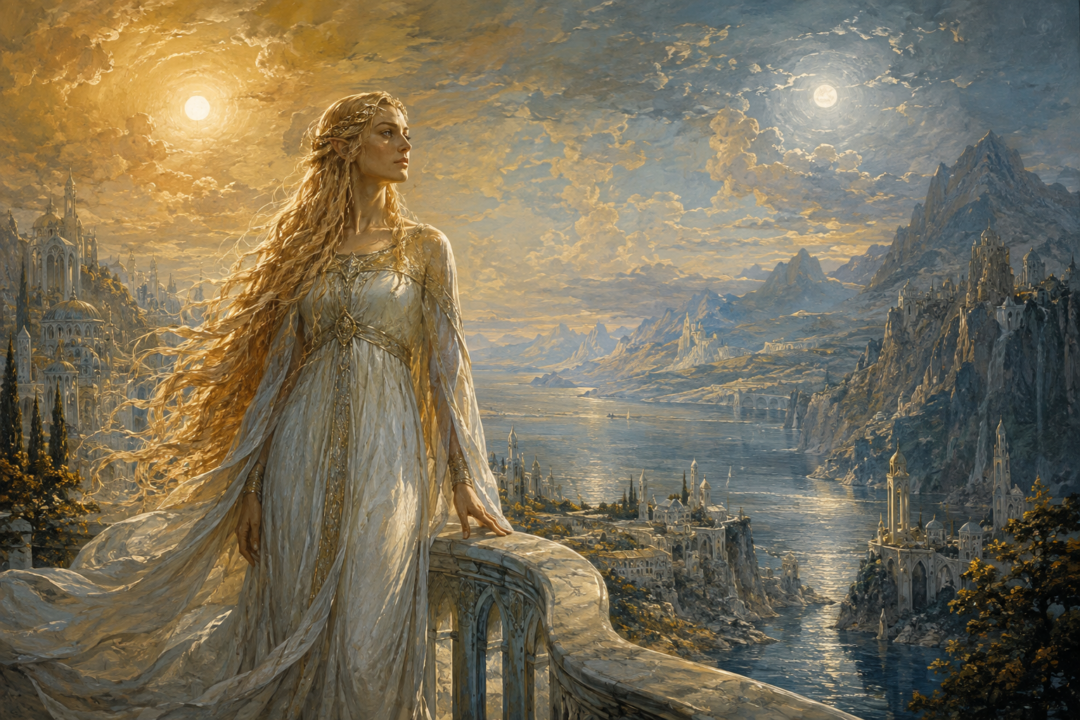
When Frodo meets Galadriel in Lothlórien, he encounters someone who seems almost beyond ordinary history. She is the Lady of the Golden Wood, one of the oldest and most formidable Elves remaining in Middle-earth, a bearer of one of the Three Rings, and a living memory of lands and peoples that vanished thousands of years before the War of the Ring.
Yet even her familiar name hides a problem.
Galadriel was not born Galadriel.
In later writings concerning her names and ancestry, several names gather around her: Artanis, Nerwen, Alatáriel or related forms, and finally Galadriel. They belong to different languages, relationships, and moments in her life. More importantly, the traditions explaining them do not always fit neatly with one another.
That makes Galadriel unusual even by the standards of Middle-earth. Her names do more than describe the same person from different angles. They preserve traces of different conceptions of her past.
To follow those names is therefore to follow Galadriel backward through the legendarium—from the Lady of Lórien to the proud Noldorin princess of Aman, and then into versions of her history that cannot all be made simultaneously true.
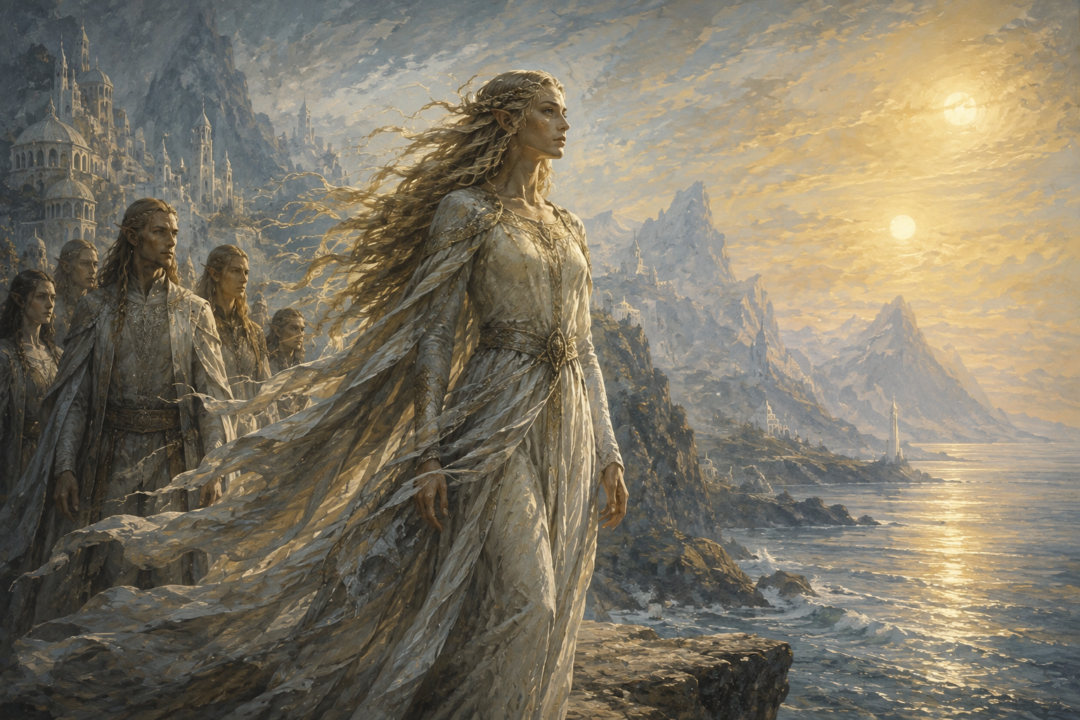
Galadriel Is the Name of Her Middle-earth Identity
The name known throughout The Lord of the Rings is Sindarin: Galadriel.
It is associated with her remarkable hair and derives from an earlier name whose sense is approximately that of a maiden crowned with a radiant garland. In the late account represented in “The Shibboleth of Fëanor,” this name originated as an epessë, an additional or given name, connected with Celeborn.
That matters because Galadriel’s public identity in the story is therefore not simply the name assigned to her at birth.
It is a name acquired through relationship and then adapted linguistically.
The Sindarin form belongs naturally to the linguistic world of Beleriand and later Middle-earth. The Noldor who returned from Aman increasingly used Sindarin in ordinary life, and many famous figures are consequently remembered by Sindarin forms rather than by the Quenya names of their youth.
Galadriel’s best-known name therefore reflects migration.
The woman whom Frodo meets is carrying a name shaped by the world into which she went.
But beneath it survive older names.
Artanis Belongs to the Daughter of Finarfin
In the late naming tradition, Galadriel’s father-name was Artanis, usually interpreted as “Noble Woman.”
This places her firmly inside the House of Finarfin.
Before Lórien, before Beleriand, before the revolt of the Noldor and the long wars against Morgoth, there was Artanis: the daughter of Finarfin and Eärwen, born in Aman during the Years of the Trees.
The name is striking because it seems almost restrained when compared with Galadriel’s later reputation. It identifies status and character without referring to the extraordinary history that follows.
Artanis belongs to the beginning.
She has not yet crossed the Helcaraxë. She has not yet watched kingdoms rise and fall in Middle-earth. Númenor has not existed, much less drowned. Sauron has not forged the One Ring.
Read retrospectively, “Noble Woman” almost sounds like the title of a person whose enormous future remains concealed.
But her mother gave her another name.
And that one reveals something much sharper.
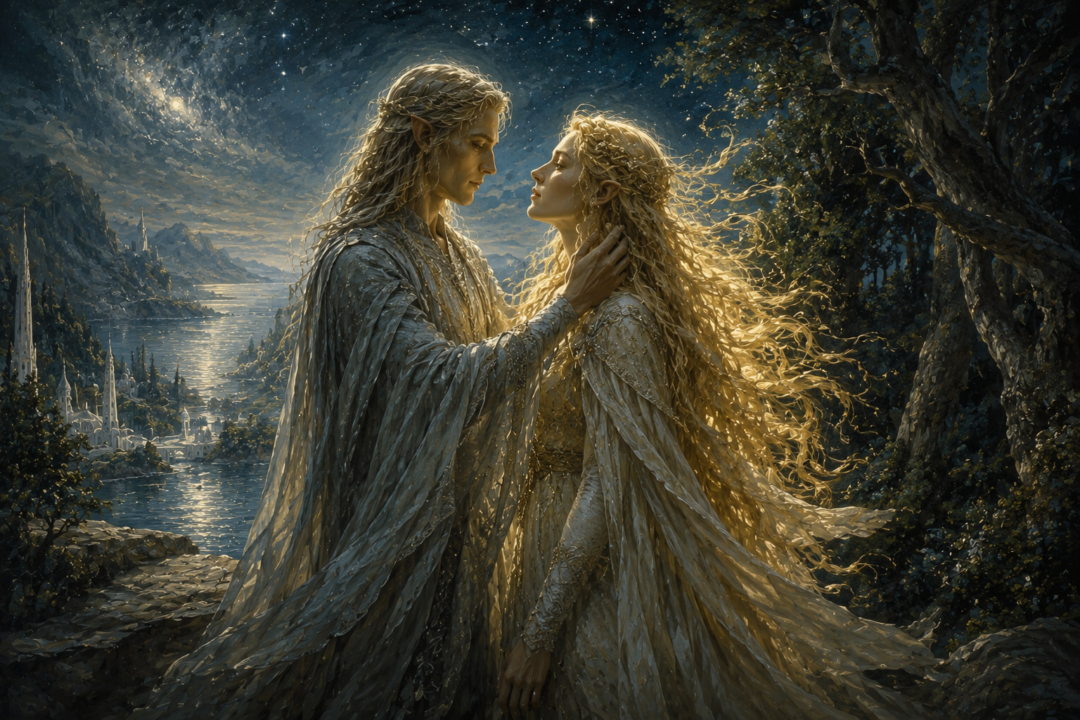
Nerwen Remembers Strength, Not Serenity
Eärwen’s name for her daughter was Nerwen, “Man-maiden.”
The explanation given in the late material is physical as well as temperamental: Galadriel was exceptionally tall and strong, and she possessed great strength of will.
This is a valuable corrective to the ethereal image readers may associate with the Lady of Lórien.
The Galadriel of the late First Age traditions is not conceived merely as a remote enchantress.
She is proud, vigorous, ambitious, intellectually powerful, and capable of resisting formidable personalities. The late account in “The Shibboleth of Fëanor” particularly emphasizes her hostility toward Fëanor. She perceived darkness in him and did not admire him, despite the fascination her hair apparently held for him.
Nerwen preserves that Galadriel.
It points toward someone who could survive the catastrophe of the Noldorin exile and remain a major power through three ages of the world.
This does not mean that the serene Galadriel of Lórien is false. Rather, the contrast reveals the distance she has travelled.
The Lady who refuses the One Ring has a name from childhood that remembers extraordinary strength.
Her final victory is not the discovery that she possesses no desire for greatness. It is her refusal to seize greatness through domination.
Alatáriel Creates the Celeborn Problem
The most complicated layer is the name behind Galadriel itself.
Late texts connect it with a Telerin form, commonly given as Alatáriel, bestowed by Celeborn and referring to her radiant hair.
Here the naming tradition collides with the changing history of Celeborn.
In the version familiar from the published Silmarillion and reflected in material associated with Unfinished Tales, Celeborn is connected with the Sindar of Doriath. Galadriel meets him in Beleriand.
But another late conception radically alters this.
In that version Celeborn is a Telerin Elf of Aman, named Teleporno in Telerin, and Galadriel already knows him before leaving the Blessed Realm. This allows the Telerin origin of Alatáriel to fit naturally into their relationship.
The difficulty is obvious.
Celeborn cannot simultaneously be an Elf whom Galadriel meets in Doriath and a Teler whom she knew in Aman before the Exile.
These are different versions of the character’s history.
Consequently, the name Alatáriel does something fascinating: it preserves a strand of Galadriel’s biography tied to a conception of Celeborn that differs from the more familiar Doriath tradition.
Trying to force every detail into one seamless chronology obscures what the evidence actually shows.
Galadriel’s history exists in layers.
Her names expose the seams.
Even Her Departure from Aman Changed
The problem goes deeper than Celeborn.
Different accounts also alter why and how Galadriel left Aman.
The published Silmarillion places her among the Noldorin leaders who departed during the rebellion following the Darkening of Valinor. She does not swear Fëanor’s oath, but she desires to leave Aman and have a realm of her own in Middle-earth.
Late writings develop her independence from Fëanor more strongly. In “The Shibboleth of Fëanor,” she is hostile to him and fights against his people during the Kinslaying at Alqualondë, defending her mother’s Telerin kin. Yet she still proceeds into exile, driven in part by pride and by her desire for lands of her own.
An even later conception moves further still. In that account, Galadriel and Celeborn intend to leave Aman independently of Fëanor’s revolt, sailing eastward and arriving in Middle-earth separately.
These versions cannot simply be stacked together as successive events.
They are alternative histories.
The broad Galadriel remains recognizable: proud, independent, resistant to Fëanor, desirous of Middle-earth, and ultimately destined to become one of its greatest Eldarin figures.
But the route changes.
And because her names are connected to particular relationships, languages, and locations, they preserve evidence of those changing routes.
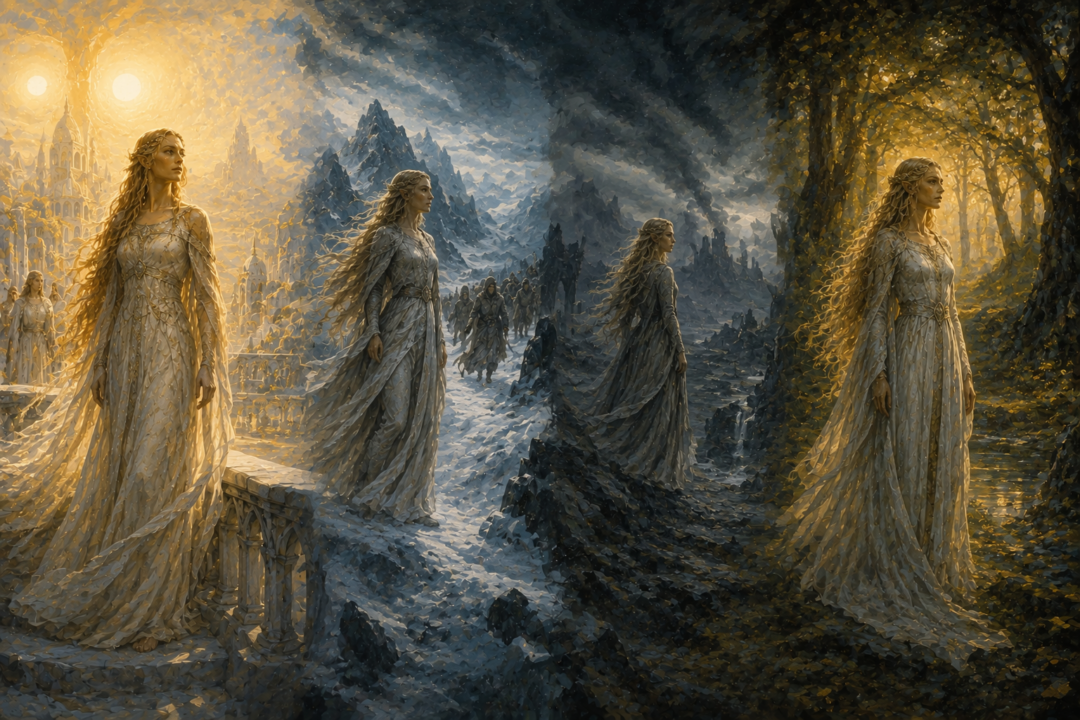
Her Names Are Almost Archaeological Layers
It is tempting to treat multiple Elvish names as if they were simply a decorative feature of the mythology.
With Galadriel, they are much more useful than that.
Artanis points toward her birth and paternal identity in Aman.
Nerwen preserves Eärwen’s perception of her daughter’s unusual stature and strength.
Alatáriel belongs to the tradition surrounding her hair and her relationship with Celeborn, particularly in accounts where Telerin language and identity are important.
Galadriel is the Sindarin form by which she becomes known in Middle-earth.
Placed beside one another, these names resemble archaeological strata.
They record family, language, migration, love, cultural adaptation, and competing biography.
That does not mean every name belongs exclusively to one incompatible narrative. Several elements recur across versions, and the linguistic relationships themselves were developed with considerable care.
The incompatibility emerges when the names are connected to the surrounding stories—especially the identity and location of Celeborn and the circumstances of Galadriel’s departure from Aman.
The names remain stable enough to recognize her.
The history around them moves.
The Lady of Lórien Contains All These Earlier Galadriels
This layered history unexpectedly suits the character readers finally encounter.
By the end of the Third Age, Galadriel is herself almost a surviving fragment of lost worlds.
She remembers Aman beneath the light of the Two Trees. She belongs to the House of Finwë. She crosses into the history of Beleriand, survives the ruin of the First Age, witnesses the long struggle against Sauron, and remains in Middle-earth until the end of the Third Age.
Almost everything around her changes.
Beleriand sinks.
Númenor rises and falls.
The kingdoms of the Dúnedain are founded, divided, diminished, and partly destroyed.
Languages change. Peoples migrate. Forests shrink. Memories become legends.
And Galadriel remains.
That gives the instability surrounding her earlier biography an almost accidental thematic power. The character known as Galadriel cannot be reduced to a single moment because her identity stretches across radically different worlds.
Artanis is not quite the Lady of Lórien.
Nerwen is not quite the figure standing before Frodo’s offered Ring.
Alatáriel belongs to an intimate naming tradition whose precise historical setting shifts depending on which account is followed.
Yet none of them is simply irrelevant.
Each preserves something recognizable.
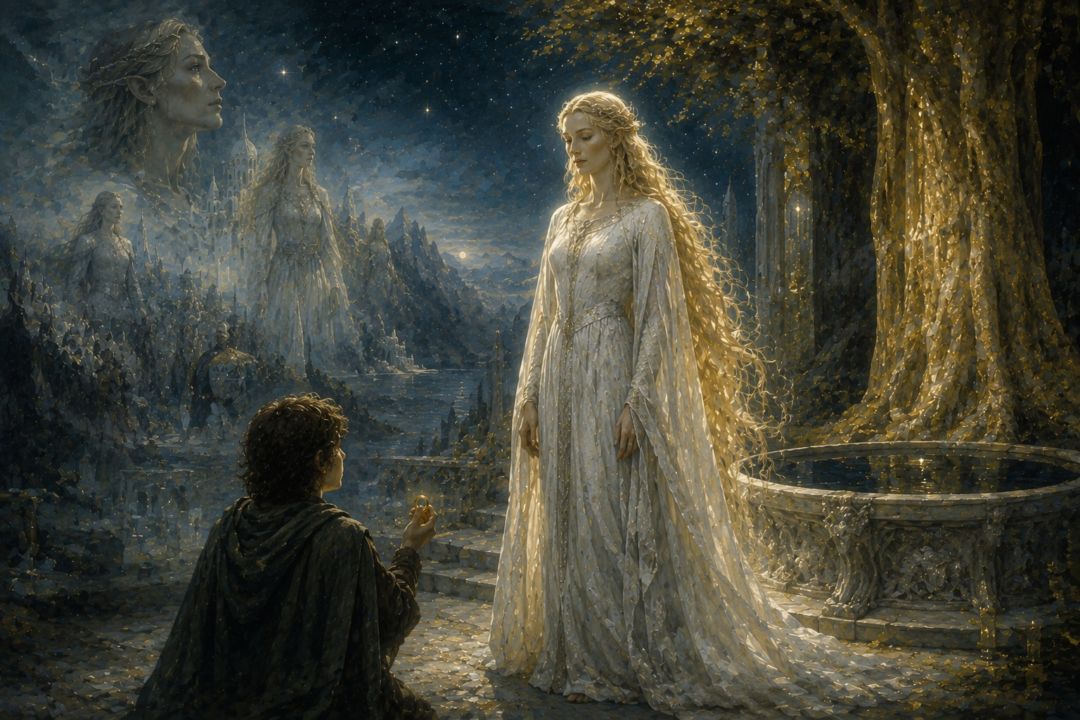
Her Final Test Makes the Earlier Names Matter
The most important Galadriel scene in The Lord of the Rings is also the one that makes these older layers meaningful.
Frodo offers her the One Ring.
Galadriel does not respond as someone who has never wanted power. Her temptation matters precisely because the desire to order, preserve, and rule has deep roots in her character. Some late accounts explicitly connect her departure for Middle-earth with a desire for a realm of her own.
The Ring offers an unbearable shortcut to that old ambition.
She refuses it.
Whatever version of her First Age history one prefers, the Galadriel of the Third Age has reached a point where possession is no longer worth domination. She accepts diminution and the possibility of returning West rather than taking the instrument that could make her overwhelmingly powerful.
That is why her many names feel like more than linguistic trivia.
Artanis remembers nobility.
Nerwen remembers strength.
Alatáriel remembers beauty seen and named by another.
Galadriel is the name carried through Middle-earth.
They do not produce one perfectly seamless biography, because the surviving traditions behind them do not produce one either.
Instead they preserve something stranger and, in its own way, more appropriate: a character so ancient that even her name has a history, and a history so deep that its different layers no longer fit perfectly together.
By the time the Lady of Lórien stands beside her Mirror, thousands of years lie behind the name Frodo knows.
And beneath Galadriel, the older names are still there.
Sources & Notes
- https://tolkiengateway.net/wiki/Galadriel — Tolkien Gateway: Galadriel’s names, etymologies, biography, and variant legendarium histories.
- https://tolkiengateway.net/wiki/The_Shibboleth_of_F%C3%ABanor — Tolkien Gateway: Tolkien’s late essay containing a revised account of Galadriel and her family.
- https://tolkiengateway.net/wiki/Alat%C3%A1riel — Tolkien Gateway: the Telerin form behind the Sindarin name Galadriel and its textual history.
- https://tolkiengateway.net/wiki/Nerwen — Tolkien Gateway: Galadriel’s mother-name, its meaning, and its relationship to her characterization.
Sources document Galadriel’s Quenya and Sindarin names and Tolkien’s changing accounts of their origins.