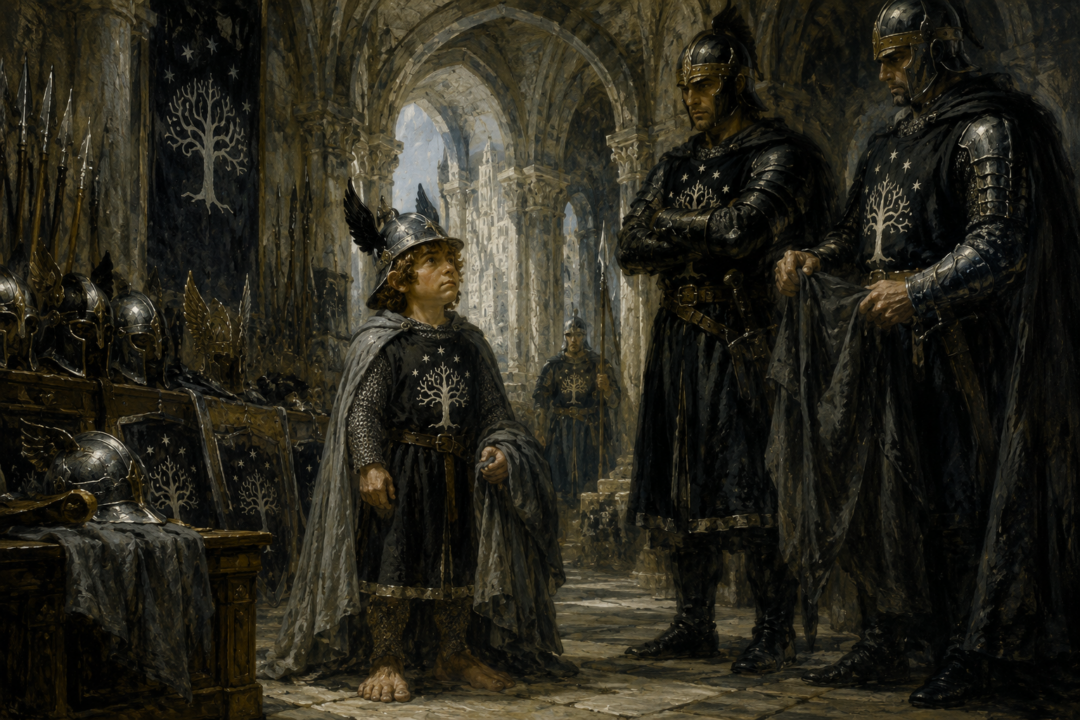
When Peregrin Took arrives in Minas Tirith, he is still recognizably the wandering hobbit who left the Shire: curious, impulsive, frequently hungry, and accustomed to travelling among companions rather than living under military discipline.
Then Denethor accepts his service.
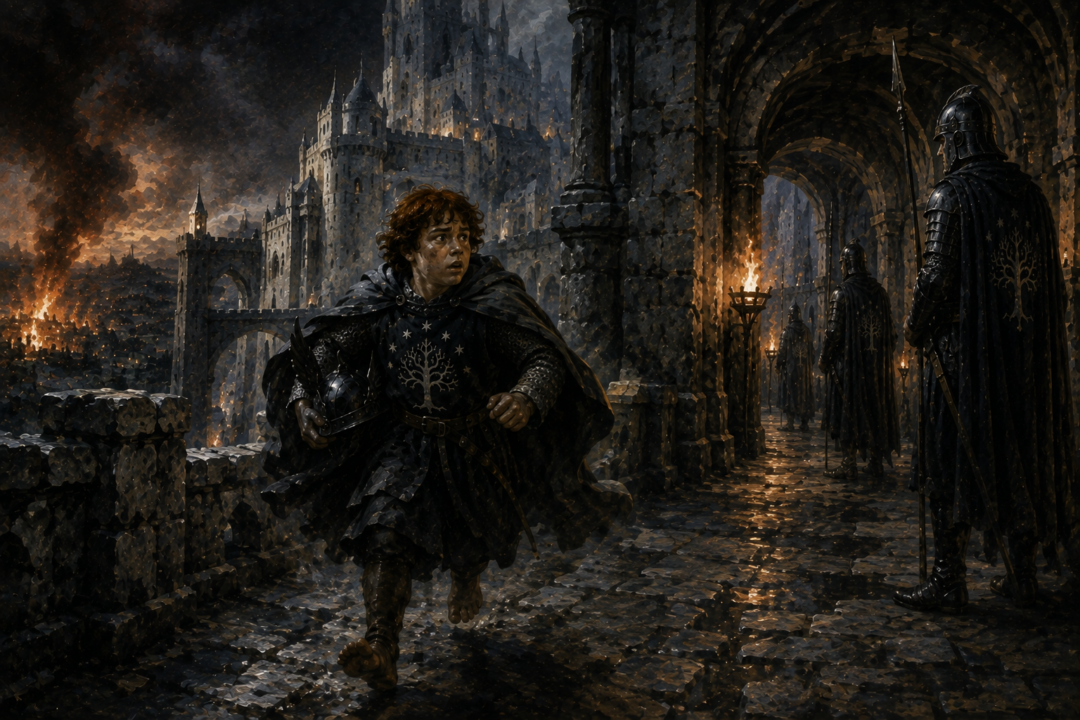
Soon Pippin is wearing black and silver, bearing the emblems of Gondor, learning passwords from a soldier named Beregond, and discovering something that is easy to miss amid the approaching siege.
His new clothes are not merely ceremonial.
The livery makes visible a change that has already happened through Pippin’s oath. He has entered a hierarchy in which movement, duty, obedience, and even access to parts of the city are governed by authority.
For perhaps the first time since leaving the Shire, Pippin is no longer simply travelling through somebody else’s realm.
He belongs to its service.
And that makes his later decision to oppose Denethor far more significant.
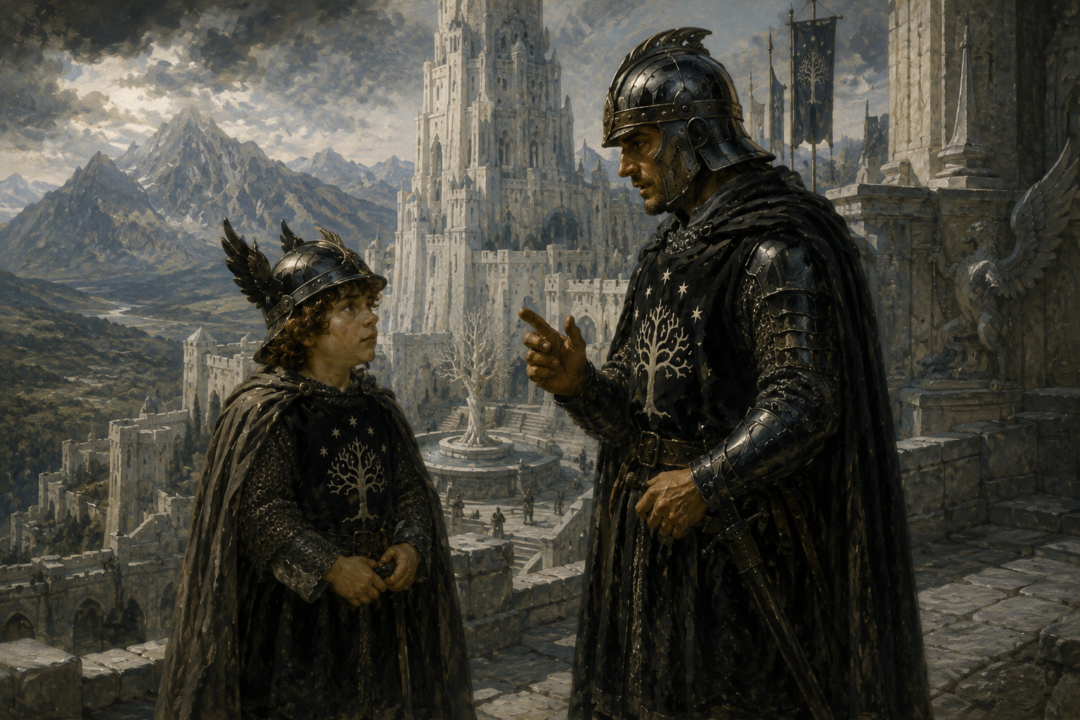
The Oath Comes Before the Uniform
Pippin does not originally travel to Minas Tirith intending to become a soldier of Gondor.
Gandalf brings him there after the disastrous incident with the palantír of Orthanc. When they meet Denethor, however, Pippin is confronted by the memory of Boromir.
Boromir died defending Merry and Pippin from Orcs at Amon Hen. Pippin knows this, and his gratitude becomes personal obligation.
Before Denethor, he offers his sword in payment of that debt.
Denethor accepts.
This is the decisive moment. The uniform that follows does not create the obligation; it embodies it.
Pippin has sworn service to the Steward of Gondor. Denethor in turn accepts him into his household and authority. What began as gratitude toward Boromir has therefore become a formal relationship between Boromir's father and one of the hobbits Boromir died defending.
That transformation matters because Pippin's adventures before Minas Tirith had generally preserved an unusual degree of personal movement. Even when danger constrained him, he remained fundamentally one of a travelling company.
In Gondor, he enters an institution.
The Black and Silver Mean Something
The Guard of the Citadel is not presented as an ordinary collection of soldiers.
Its members guard the highest level of Minas Tirith and serve close to the seat of the Steward. Their distinctive clothing carries the ancient symbols of Gondor.
When Pippin is equipped, he receives clothing suitable to his extraordinary new status: a small hauberk, black garments bearing the device of the Tree, and a high-crowned helmet adapted to his size. The visual effect is striking enough that stories about the mysterious halfling in the city grow still further.
There is a deliberate irony here.
Pippin looks increasingly important at precisely the moment when his personal independence has narrowed.
To citizens who see him, the livery elevates him. It associates this tiny stranger with the authority, memory, and military dignity of Gondor.
But from Pippin's perspective, it also means that he has become answerable to that authority.
The uniform is therefore both an honour and a boundary.
Beregond Shows Pippin What Service Actually Means
Denethor does not personally explain every practical consequence of Pippin's oath.
Beregond does.
A man of the Third Company of the Citadel, Beregond is assigned to instruct the new guardsman. Through him, Pippin begins learning passwords and the routines surrounding service in the Citadel.
Their conversation gives the reader something more valuable than a formal description of Gondor's military organization: it shows what membership feels like from inside.
Beregond is not a great captain. He explicitly presents himself as an ordinary man-at-arms. His life is structured by watches, commands, meals, company arrangements, and permissions.
One particularly important rule concerns movement.
Members of the Guard cannot simply wander away from the Citadel whenever they please. Beregond explains that leaving requires permission from the appropriate authority.
This is a small logistical detail with enormous thematic importance.
Pippin has crossed half of Middle-earth through astonishing circumstances. He has travelled through the Old Forest, Moria, Lórien, Rohan, Fangorn, and Isengard.
Now he can be prevented from walking down a few levels of a city because he has given his word.
That is not imprisonment.
It is service.
And the distinction becomes central to what follows.
Pippin Still Has Freedom—But It Is No Longer Casual Freedom
It would be inaccurate to imagine Pippin confined permanently to a barracks.
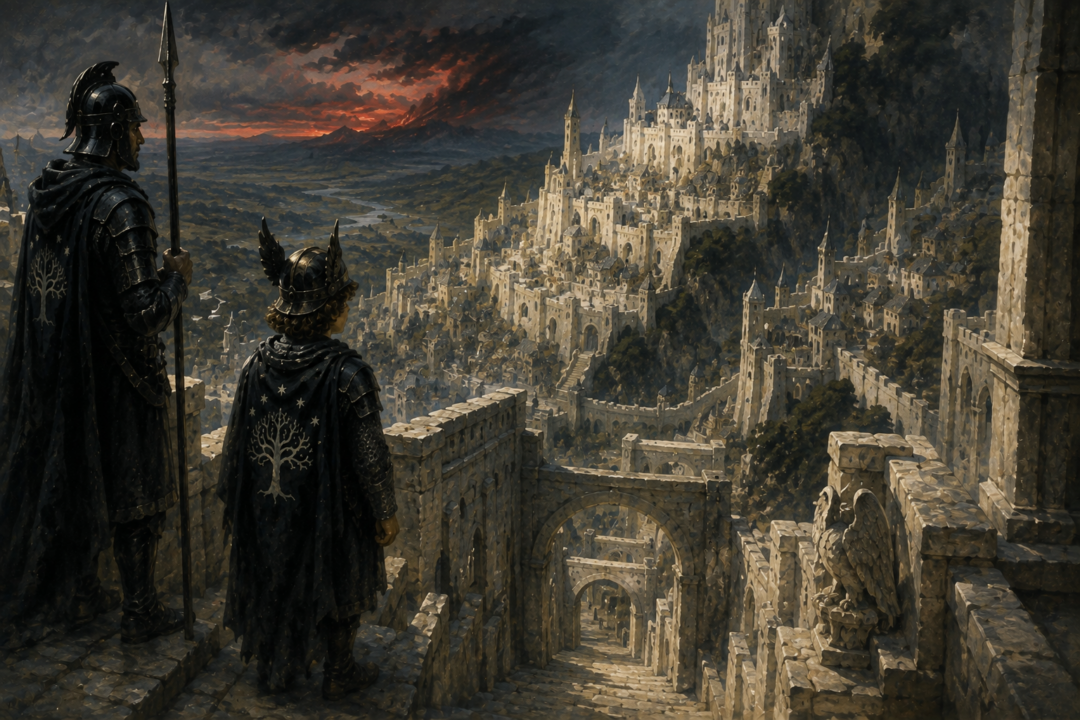
He moves around Minas Tirith. He eats with Beregond, talks with soldiers, meets Beregond's son Bergil, and goes with the boy to watch forces arriving from Gondor's outlying regions.
But these movements now take place within a framework of military belonging.
The important change is therefore not that Pippin loses all freedom.
He loses the assumption that his movements belong entirely to himself.
That is a subtle but important difference.
A traveller asks, "Where shall I go?"
A guardsman must also ask, "Am I permitted to go?"
The contrast becomes especially sharp because Pippin remains culturally a hobbit. The Shire has offices and customs, but ordinary hobbit life is profoundly unlike the wartime hierarchy of Minas Tirith. Pippin has suddenly stepped into an ancient state preparing for siege, where gates, passwords, watches, ranks, and commands matter immediately.
His uniform tells everyone else that he belongs to that system.
Gradually, Pippin understands it too.
Denethor Has Turned Gratitude Into Duty
There is another uncomfortable layer to Pippin's position.
His oath was emotionally motivated.
He wishes to honour Boromir.
Yet the man who receives that oath is Denethor, whose grief over Boromir and complicated relationship with Faramir increasingly shape events inside the city.
Pippin therefore discovers that loyalty is much more difficult once it becomes attached to a real authority rather than an abstract ideal.
Serving Gondor sounds straightforward.
Serving Denethor during Denethor's collapse is not.
Pippin respects the Steward's power and intelligence, but he also becomes increasingly disturbed by him. The crisis reaches its terrible conclusion when Denethor, believing resistance hopeless and Faramir beyond saving, prepares a funeral pyre for himself and his still-living son.
At that point Pippin faces the real test of his oath.
Not whether he can obey.
Whether obedience is still the same thing as faithfulness.
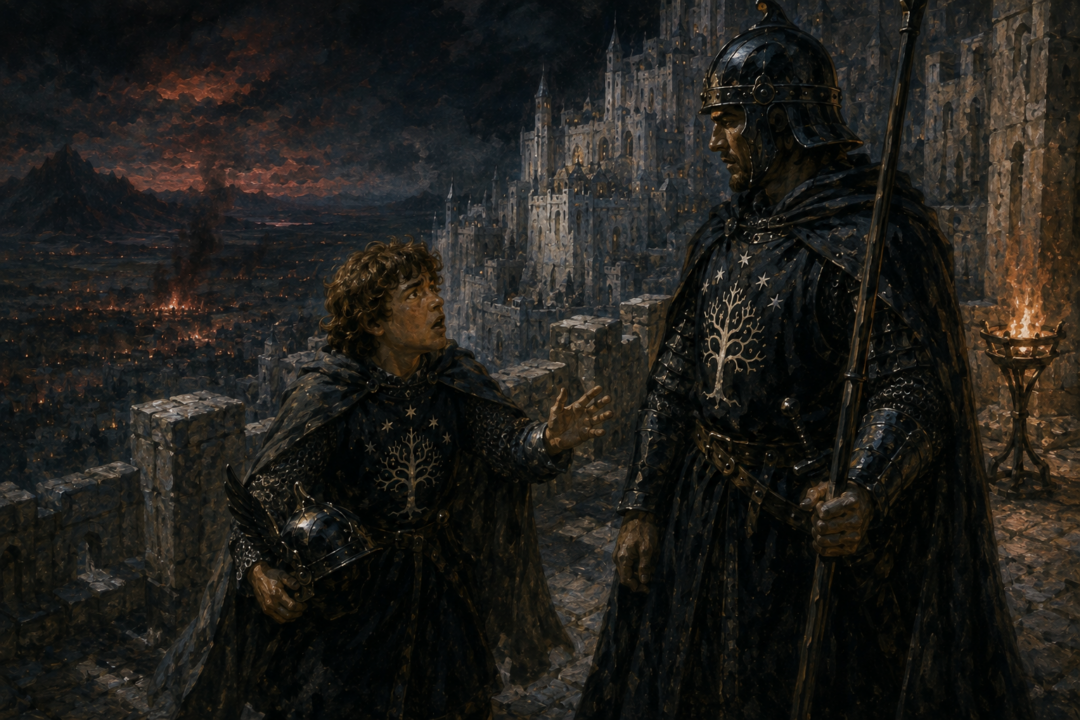
The Uniform Makes Pippin’s Defiance More Costly
When Pippin realizes what Denethor intends, he does not simply shrug off his allegiance.
He tries to act within it.
He begs Denethor to remember Faramir's duty to his people. He attempts to reason with him. Eventually Denethor releases Pippin from his immediate attendance.
Pippin then runs for Gandalf.
This matters because Pippin is not an outsider interfering in Gondorian affairs. He is Denethor's sworn servant and a member of the Citadel's guard.
His intervention therefore carries moral weight precisely because the bond is real.
The same tension becomes even more severe with Beregond.
Pippin warns Beregond about Faramir. Beregond then abandons his assigned post and ultimately uses force to prevent Denethor's servants from carrying out the Steward's command.
For a Guard of the Citadel, leaving a post without authorization is not a trivial breach of discipline.
Later, Aragorn must judge Beregond for what he has done.
The judgment preserves both sides of the problem: Beregond has broken the law governing his service, yet his disobedience helped save Faramir's life. Aragorn does not simply pretend the violation never happened. Beregond is removed from the Guard of the Citadel, but he is spared and appointed to serve Faramir as Captain of the White Company in Ithilien.
The law mattered.
So did the reason it was broken.
Pippin and Beregond Face the Same Question
Their situations are not identical, but Pippin and Beregond are caught in versions of the same moral problem.
What does a good servant owe a failing lord?
Neither man concludes that loyalty means passive obedience to destruction.
Yet neither treats vows and commands as meaningless.
That balance is crucial.
If their service meant nothing, their resistance would cost nothing.
Beregond's abandonment of his post matters because he is a real guardsman under real law. Pippin's frantic attempt to save Faramir matters because he has genuinely sworn himself to Denethor.
Their choices are powerful because obligation remains present even when conscience forces them to act against the immediate will of the authority they serve.
The Citadel livery makes Pippin's side of that conflict visible.
He is dressed as Denethor's man while trying to prevent Denethor from committing an irreversible wrong.
The Clothes Also Change How Minas Tirith Sees Him
There is a lighter consequence to Pippin's transformation.
Rumours about halflings already circulate in Minas Tirith, magnifying these mysterious northern travellers into figures far grander than ordinary hobbits would recognize.
Pippin's appearance in the livery of the Citadel only strengthens the misunderstanding.
To Gondorian eyes, he is not merely a small foreign visitor.
He appears connected to the highest authority of the city.
The comedy conceals something real: clothing in Minas Tirith communicates political belonging.
Pippin may still think about breakfast, pipe-weed, and the Shire, but the people around him see the Tree and stars.
The livery speaks before he does.
Pippin Does Not Become Less Free—He Learns What Chosen Duty Costs
The deepest change is not that Minas Tirith takes Pippin's freedom away.
Pippin voluntarily gives part of his freedom away.
He makes a promise.
That is why the episode marks such an important stage in his growth.
Earlier Pippin repeatedly acts first and discovers consequences afterward. His curiosity about the palantír is the most dangerous example.
In Minas Tirith, the pattern begins to reverse.
Now he understands that actions can bind a person.
His promise to Denethor places him inside Gondor's order. His uniform makes that promise public. The rules of the Guard give it practical consequences.
And when Denethor falls into despair, Pippin discovers that responsibility is harder than either obedience or rebellion.
He must remain faithful to what was good in his oath without becoming an instrument of what has gone wrong in the man who received it.
That is what makes the black-and-silver livery more than a memorable costume.
When Pippin puts it on, he gains honour, status, comradeship, and a place within one of Middle-earth's oldest realms.
He also loses something.
He can no longer behave as though every road is simply his to take.
From that moment onward, freedom has acquired another companion:
duty.
Sources & Notes
- https://tolkiengateway.net/wiki/Peregrin_Took — Tolkien Gateway: Pippin’s oath to Denethor, service as a Guard of the Citadel, and actions in Minas Tirith.
- https://tolkiengateway.net/wiki/Guard_of_the_Citadel — Tolkien Gateway: the elite company’s livery, duties, command, and institutional position.
- https://tolkiengateway.net/wiki/Tower_Guard — Tolkien Gateway: the Tower Guard’s role in protecting the Citadel and serving Gondor’s ruler.
- https://tolkiengateway.net/wiki/Minas_Tirith — Tolkien Gateway: the city’s seven-level organization, Citadel, government, and wartime conditions.
Sources cover Pippin’s oath, his Citadel uniform, Guard duties, and place within Minas Tirith’s hierarchy.