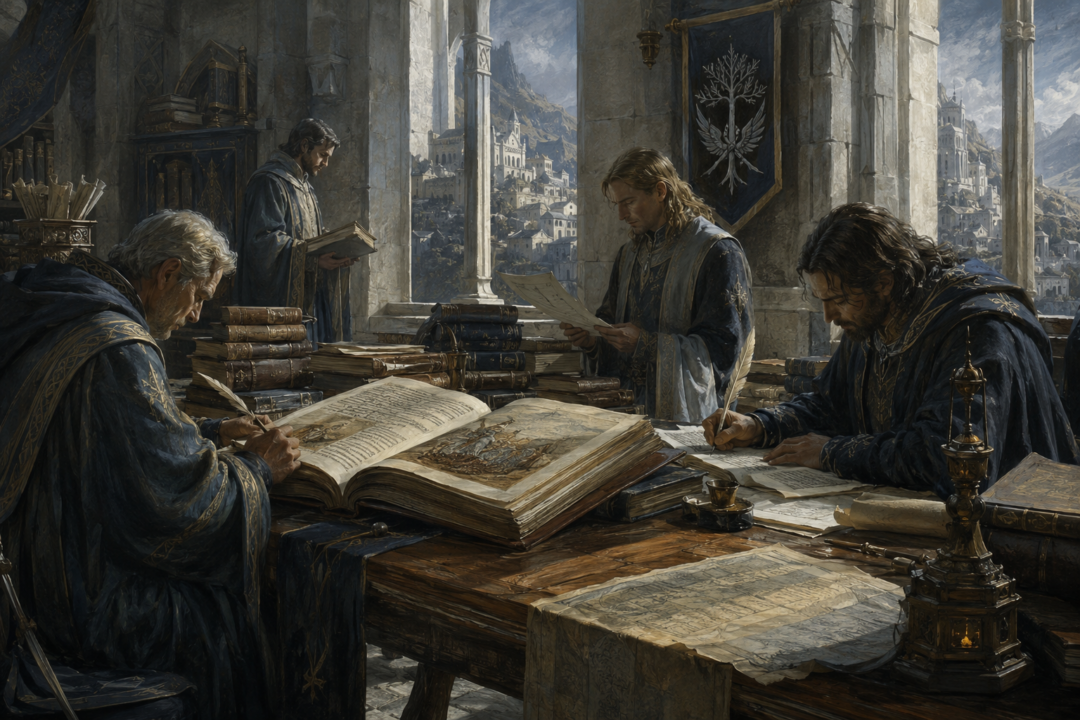
The Red Book of Westmarch seems, at first, like the most Hobbitish historical object imaginable: a collection begun by Bilbo, continued by Frodo, completed in part by Sam, and eventually preserved by their descendants. Yet one of the strangest details in the history of that book is that the version most valuable to later readers was not simply the manuscript that remained in the Shire.
It was a copy that went south.
In Gondor, the text inherited from the Hobbits encountered another tradition of memory: royal archives, learned scribes, knowledge of ancient languages, and records belonging to peoples whom Frodo and Bilbo had encountered only briefly. The resulting manuscript—the Thain’s Book—received annotations and corrections, especially concerning Elvish names, words, and quotations.
Then, generations later, those southern corrections came back to the Shire in another copy.
That small piece of textual history reveals something easily overlooked about the supposed source behind The Lord of the Rings. The story was not imagined as surviving through one perfect manuscript. It survived through copying, annotation, correction, preservation, and the meeting of different traditions.
The Red Book Was Already a Layered History
The Red Book of Westmarch was never merely Frodo’s memoir.
Its origins lay partly in Bilbo’s writings. After the War of the Ring, Frodo continued the account, and Sam also had a role in the final history of the manuscript. Alongside the narrative of Bilbo’s adventure and the War of the Ring were Bilbo’s three volumes of “Translations from the Elvish,” prepared during his years in Rivendell.
Later material was also associated with the collection, including genealogical and historical information concerning the Shire.
The “Note on the Shire Records” in the Prologue to The Lord of the Rings makes an especially important distinction: the original Red Book was not preserved. Copies were made, and those copies did not all contain precisely the same material.
That means the textual history of Middle-earth immediately becomes more complicated than a simple chain of author to reader.
Some things could be preserved.
Others could be omitted.
Still others could be corrected by people with access to better information.
And the most important surviving version would eventually owe part of its authority to Gondor rather than the Shire.
Why the Thain’s Book Went to Gondor
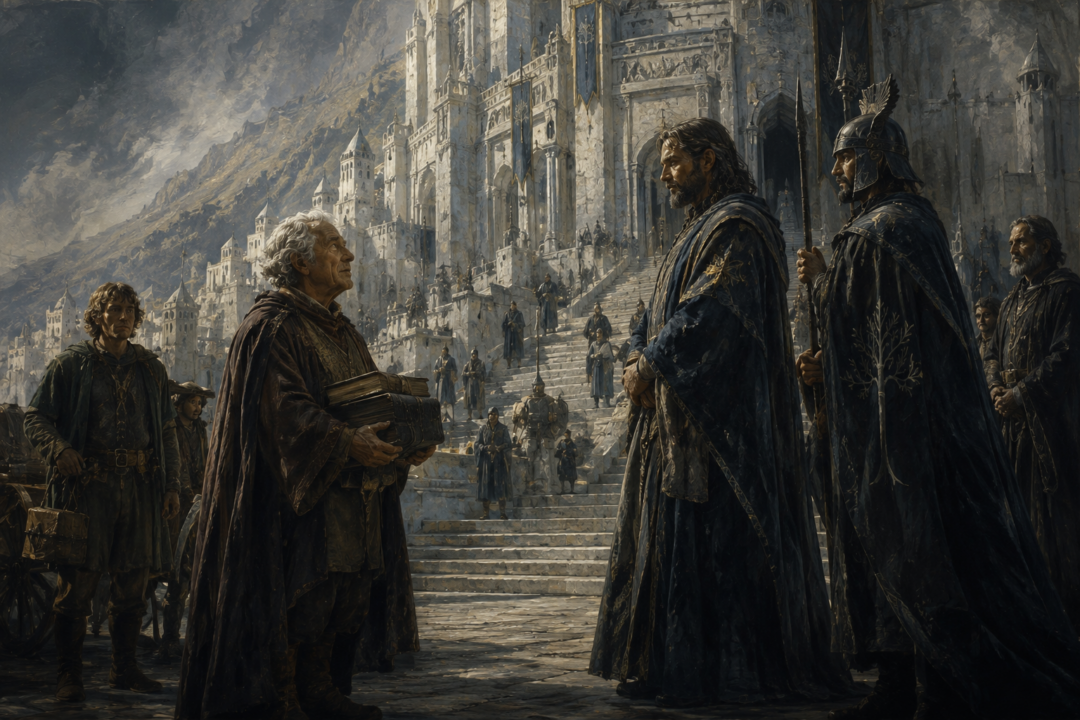
King Elessar requested a copy of the Red Book of the Periannath.
The first copy made from the Red Book became known as the Thain’s Book. Peregrin Took, by then Thain, brought it to Gondor when he went south late in his life. The Prologue dates his retirement to Gondor to Fourth Age 64.
This was significant because the Thain’s Book contained material that later copies lost or omitted.
But its importance did not end with what the Hobbits had copied into it.
Once the manuscript reached Minas Tirith, it entered a very different scholarly environment.
The Shire possessed its own records and traditions. The Prologue mentions such sources as the Yearbook of Tuckborough, and Hobbit families clearly cared about genealogies and local history. But Gondor possessed records extending into the history of Númenor, the kingdoms in exile, and the long struggles of the Dúnedain. Its learned tradition also had linguistic knowledge unavailable to most Hobbits.
So when Gondorian readers examined the Hobbit account, they could sometimes recognize problems the original compilers could not.
Gondor Corrected the Elvish
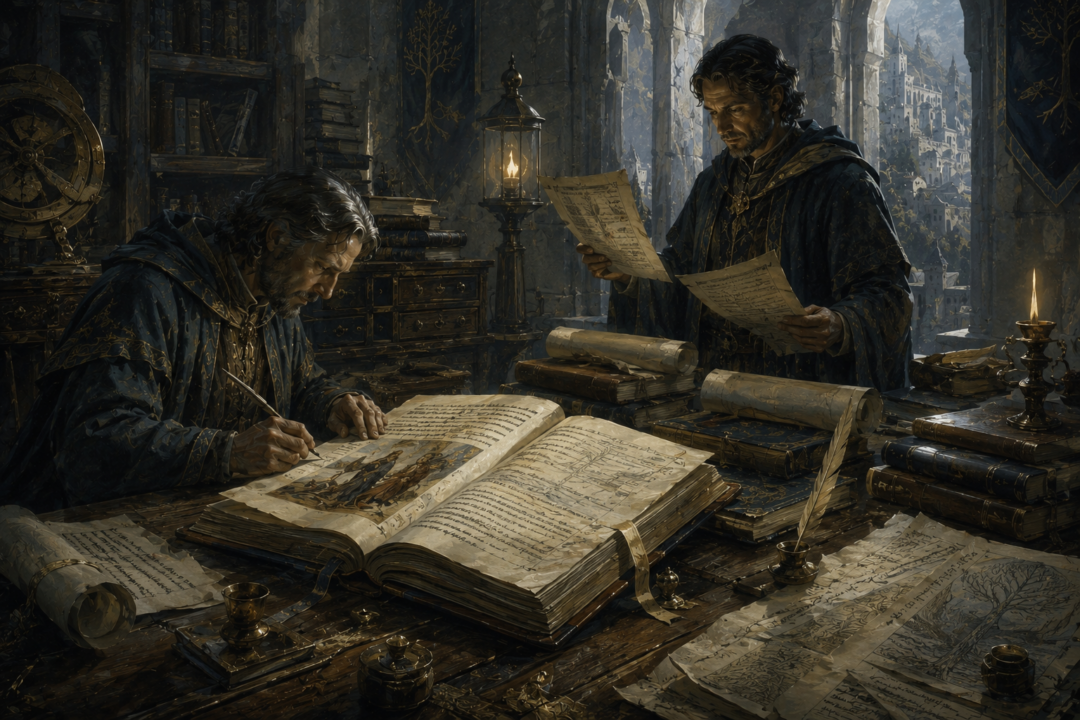
The Prologue states explicitly that in Minas Tirith the Thain’s Book received “much annotation” and “many corrections,” especially involving names, words, and quotations in the Elvish languages.
This is one of the clearest examples of the difference between the manuscript tradition preserved in the Shire and the revised textual tradition that developed in Gondor.
The corrections do not mean Frodo was an unreliable narrator in the ordinary sense. He was recording an extraordinary journey through cultures and languages far beyond his upbringing.
Before leaving the Shire, Frodo was educated by Hobbit standards and had learned something from Bilbo, but he was not a Gondorian loremaster or an Elvish philologist. During the Quest he heard unfamiliar languages under circumstances hardly suited to careful textual scholarship.
Appendix F even preserves a revealing example of later commentary. Discussing the speech of the Elves of Lórien, the text notes that Frodo had difficulty understanding their spoken Sindarin. A Gondorian commentator attributed this partly to differences in the manner of speech in Lórien.
The important point is not that Frodo recorded everything incorrectly. It is that the manuscript tradition openly acknowledges the limitations of its witnesses.
The story can be true while individual linguistic details still require correction.
The Shire and Gondor Remembered Different Things
This creates an elegant division between two kinds of historical memory.
The Hobbits possessed something Gondor could never recreate from its archives: the testimony of the people who had actually carried the Ring.
Frodo knew what happened in Bag End, Bree, Rivendell, Moria, Lórien, and Mordor because he had lived through much of it. Sam could preserve experiences known to almost no one else. Merry and Pippin carried their own memories of Rohan, Gondor, Fangorn, and the final battles.
But Gondor possessed context.
Its scribes could check names. Its traditions preserved information about kings, Stewards, Númenor, Arnor, Gondor, and the Dúnedain. People associated with the Reunited Kingdom could supplement a Hobbit-centered narrative with material the original authors did not possess.
Neither tradition was sufficient by itself.
The Shire preserved the eyewitness story.
Gondor helped preserve and correct the larger historical frame around it.
Gondor Added More Than Corrections
The Thain’s Book was not merely proofread in Minas Tirith.
Material was added.
Most notably, it received an abbreviated version of portions of “The Tale of Aragorn and Arwen” lying outside the account of the War of the Ring. The full tale was said to have been written by Barahir, a grandson of Faramir, after the death of King Elessar.
This matters because Frodo’s account naturally centers upon the War of the Ring.
Aragorn enters the Hobbits’ story as Strider. His ancestry and destiny gradually become clearer, but much of his personal history lies outside Frodo’s direct experience.
A Gondorian tradition could preserve what a Hobbit memoir could not.
The manuscript therefore expanded from the record of participants into something closer to a historical archive assembled from multiple traditions.
That process should make us cautious about treating every part of the surviving narrative as though it came from a single narrator at a single moment.
Within the fictional manuscript framework, different sections can rest on different sources.
Findegil Brought the Corrected Tradition Back North
The decisive step came more than a century later.
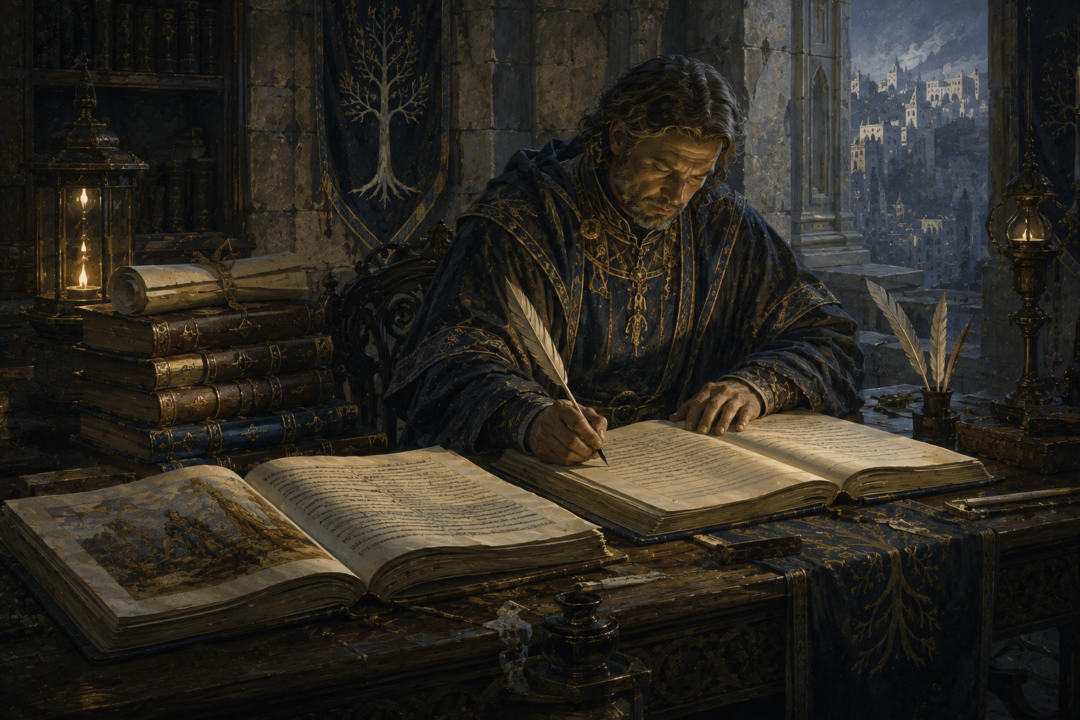
The most important surviving copy described in the Prologue was written in Gondor and completed in Fourth Age 172. Its scribe was Findegil, identified as the King’s Writer.
Findegil stated that his manuscript was an exact copy of the Thain’s Book in Minas Tirith.
That distinction is crucial.
He was not simply making another copy directly from the old Red Book in the Shire. He was reproducing the version that had already passed through Gondorian annotation and correction.
His copy was then kept at Great Smials, the ancestral home of the Tooks.
So the textual journey had effectively formed a circle:
the Hobbit tradition went south to Gondor, was checked and expanded there, and then returned north in a more heavily annotated form.
The Shire eventually possessed a manuscript containing scholarship that had not originated in the Shire at all.
What Was Absent from the Earlier Shire Tradition?
This is where the claim that the Thain’s Book preserves “Gondorian corrections absent from the Shire copy” needs careful wording.
The original Red Book and the first Shire-derived textual tradition preceded the corrections made in Minas Tirith. Those Gondorian annotations therefore could not have been part of the manuscript before it went south.
But a later manuscript physically kept in the Shire—Findegil’s copy at Great Smials—did preserve them, because it was copied from the annotated Thain’s Book.
So “Shire copy” can be misleading if it is taken to mean every manuscript located in the Shire.
The real contrast is chronological and textual.
There was the Hobbit manuscript tradition as it existed before Gondorian revision, and there was the corrected Thain’s Book tradition that emerged after the manuscript had been studied in Minas Tirith.
Findegil’s copy brought that second tradition back into the Shire.
The Most Complete Record Was Not the Original
There is a quiet irony here.
Modern readers instinctively value originals. The manuscript written closest to the events feels as though it ought to be the most authoritative.
But the history of the Red Book complicates that assumption.
The original contained the testimony nearest to Bilbo, Frodo, and Sam, yet it was eventually lost. Copies could omit material. Later scholars could also possess information unavailable to the original writers.
The Thain’s Book combined early Hobbit testimony with later Gondorian learning.
Findegil’s copy then preserved that combination.
Its importance was especially great because, according to the Prologue, it alone among the important surviving copies described there contained the whole of Bilbo’s “Translations from the Elvish.”
The richest surviving textual tradition was therefore not simply the oldest.
It was the one that had travelled.

Middle-earth’s History Survives Through Cooperation
The journey of the Thain’s Book mirrors something larger in the story of the War of the Ring.
No single people possesses everything necessary.
Hobbits accomplish what the Wise cannot accomplish. Gondor preserves knowledge stretching back through Númenor. Elves retain memories reaching into the Elder Days. Dwarves maintain traditions of their own houses. Rohan remembers through another cultural inheritance altogether.
The preservation of history works similarly.
The Hobbits provide memories that the great archives could never manufacture. Gondorian scholars provide corrections the Hobbits could not easily make. Elvish learning stands behind much of Bilbo’s work in Rivendell.
The record becomes stronger because these traditions meet.
That may be the most interesting implication of the Thain’s Book.
The great history of the end of the Third Age does not survive because one flawless chronicler wrote everything down correctly the first time.
It survives because people remembered, copied, compared, corrected, and refused to let what mattered disappear.
And in the end, one of the Shire’s greatest treasures was a book that had become more complete only after leaving home.
Sources & Notes
- The Encyclopedia of Arda, “Thain’s Book” — https://www.glyphweb.com/arda/t/thainsbook.html
- The Encyclopedia of Arda, “Red Book of Westmarch” — https://www.glyphweb.com/arda/r/redbook.html
- The Encyclopedia of Arda, “Gondor” — https://www.glyphweb.com/arda/g/gondor.html
Reference entries document the people, places, events, and objects directly discussed in this article.