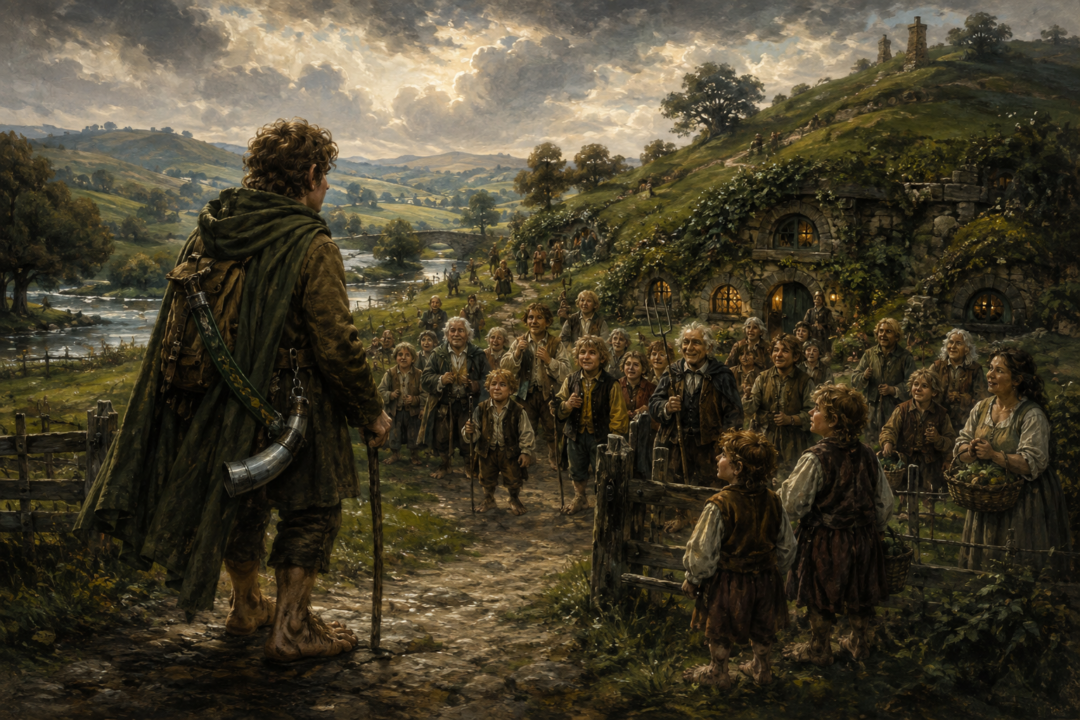
When Meriadoc Brandybuck rides back into the Shire after the War of the Ring, he is not yet the Master of Buckland.
His father, Saradoc Brandybuck, still holds that office.
Yet Merry returns as something Buckland has probably never seen before: a hobbit who has served a king, ridden with the Rohirrim, fought on the Pelennor Fields, stood beside the dying Théoden, helped overthrow the ruffians occupying the Shire, and brought home a horn whose sounding would become part of Buckland's own memory.
That creates an important distinction in Merry's later story.
He does not simply inherit authority.
Long before he formally becomes Master of Buckland, he has already acquired a kind of authority that inheritance alone could never provide.
Merry Was Already Part of Buckland’s Leading Family
Merry was never an ordinary Bucklander socially.
He was the son of Saradoc Brandybuck, known as "Scattergold," the Master of Buckland during the War of the Ring. The Brandybucks had long occupied an unusual position within hobbit society. Their ancestor Gorhendad Oldbuck had crossed the Brandywine centuries earlier, established Buckland, and begun the great dwelling of Brandy Hall.
The head of the family became known as the Master of the Hall or Master of Buckland.
So Merry grows up close to one of the Shire's traditional centers of authority. His familiarity with Buckland is apparent even before the Fellowship begins its journey. He understands its roads, people, geography, and dangers, and he plays a central role in preparing Frodo's apparent move to Crickhollow.
But being the heir of an important family is not the same thing as being its leader.
The War of the Ring changes that distinction dramatically.
He Returns as a Hobbit Who Has Seen Kings Die
The Merry who leaves Buckland and the Merry who returns are separated by experiences almost unimaginable to most hobbits.
He has crossed Moria and Lórien. He has been captured by Orcs. He has encountered Treebeard and witnessed the fall of Isengard. Most importantly for his later identity, he enters the service of Théoden of Rohan.
Merry offers Théoden his sword and becomes the king's esquire.
That bond matters because it gives Merry an identity outside the social structures into which he was born. He is no longer significant merely because he is Saradoc's son.
He becomes a servant of the King of the Mark.
At the Battle of the Pelennor Fields, Merry fights beside Éowyn against the Lord of the Nazgûl. The texts do not make Merry solely responsible for the Witch-king's destruction: Éowyn strikes the final blow, while Merry's attack with the ancient blade from the Barrow plays a crucial part in breaking the power that protected their enemy.
The victory nearly destroys Merry as well. The Black Breath affects him severely, and he must be healed afterward.
He therefore returns to the Shire carrying something no hereditary title could have given him: proven courage in one of the great battles of the age.
The Scouring Reveals What Merry Has Become
The clearest evidence of Merry's changed position appears not in Rohan or Gondor but back in the Shire.
When the four travellers discover that their homeland has been dominated by Sharkey's Men, Merry and Pippin immediately stand out.
They are physically remarkable after drinking Ent-draughts, but their deeper transformation is practical. They have seen armies, sieges, military organization, fear, and resistance. When violence becomes unavoidable, Merry understands how to organize hobbits who have almost no experience of warfare.
At the Battle of Bywater, Merry and Pippin are among the principal leaders of the resistance. Merry helps plan the hobbits' defense and fights in the battle itself.
This is a striking reversal.
Before the journey, Merry had been part of a secret conspiracy designed to prevent Frodo from leaving his friends behind.
Now he helps organize the defense of the entire Shire.
And the symbol connecting his foreign experiences to his homeland is the horn given to him by Éowyn.
The Horn of the Mark Becomes a Buckland Tradition
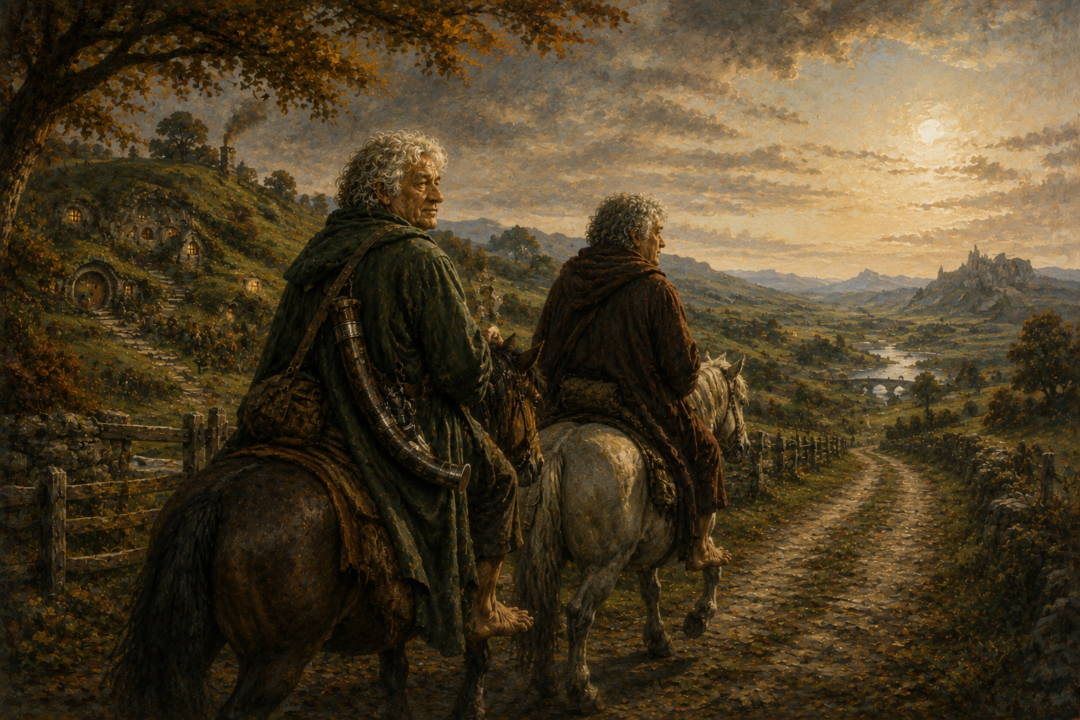
Before Merry leaves Rohan, Éowyn gives him an ancient horn.
It had come from the hoard of Scatha the Worm and had been brought south from the North by Eorl. It is described as a small silver horn with a green baldric, marked with horsemen and runes.
Its significance becomes clear almost immediately after Merry's return.
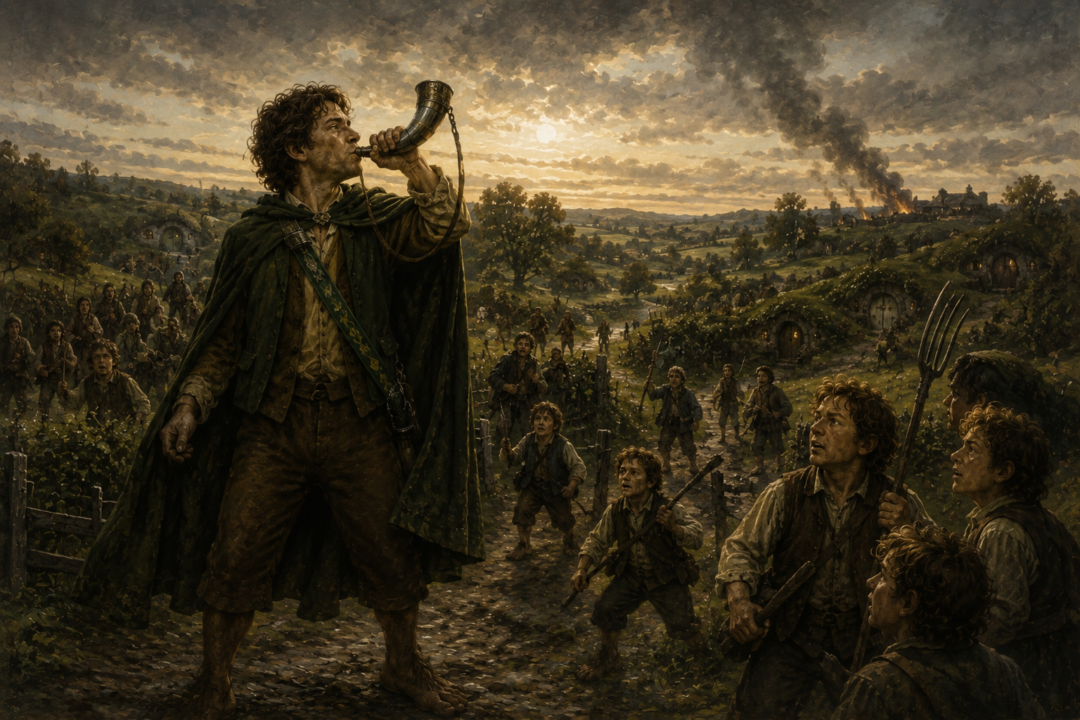
During the rising against the ruffians, Merry blows the horn, and its call helps summon the hobbits.
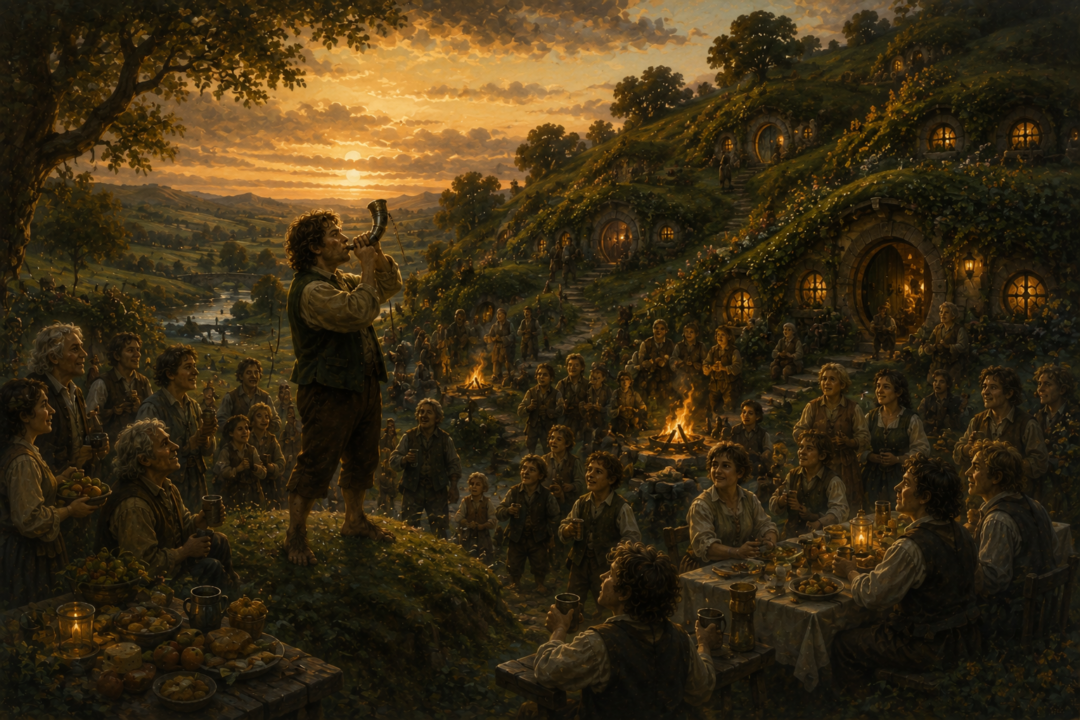
The appendices later record that the Horn of the Mark became associated particularly with Buckland. Its sounding was remembered there each year, accompanied by bonfires and feasting.
This is one of the most revealing details of Merry's later life.
Something from the heroic history of Rohan becomes woven into the local traditions of Buckland.
The horn does not transform Buckland into Rohan. Buckland remains thoroughly hobbitish. Yet the memory of the War of the Ring is no longer merely a distant tale about kings and armies.
Through Merry, part of that history becomes Buckland's own history.
Merry Does Not Immediately Become Master
There is an important chronological point that is easily missed.
Merry does not replace his father immediately after the war.
Saradoc remains Master of Buckland for years afterward. According to the chronology in the appendices, Saradoc dies in Shire-reckoning 1432, eleven years into the Fourth Age. Only then does Merry become Master.
That means Merry spends a significant period in an unusual position.
He is the heir of Buckland's traditional leader, but he is simultaneously one of the most famous living hobbits.
The texts do not describe the everyday political relationship between Merry and Saradoc during these years, so it would be unsafe to invent rivalry or a division of authority between them. Nothing indicates such a conflict.
What can be said is that Merry's public stature has changed before his formal office does.
By the time he inherits the Mastership, his reputation already extends far beyond the borders of Buckland.
Meriadoc the Magnificent
When Merry becomes Master of Buckland, he is remembered as "Meriadoc the Magnificent."
The title fits a remarkable transformation.
The young hobbit who once helped arrange Frodo's escape from Hobbiton now presides over the same country from which he began his adventure, but with relationships reaching into the restored kingdoms beyond the Shire.
When he becomes Master, King Éomer sends him great gifts.
So does Éowyn, now the Lady of Ithilien.
These gifts are more than curiosities from famous friends. They demonstrate the extraordinary geographical range of Merry's personal connections.
The Master of Buckland is now a friend of the royal house of Rohan.
The old local office remains, but its holder belongs to a much larger world.
Buckland’s Master Becomes a Counsellor of the Northern Kingdom
Merry's position expands still further.
In Shire-reckoning 1434, King Elessar makes the Master of Buckland, the Thain, and the Mayor Counsellors of the North-kingdom.
This should not be exaggerated into direct royal government of the Shire. The Shire retains its own institutions and customs, and the title does not mean Merry suddenly rules a large portion of Arnor.
But symbolically and politically, the development is significant.
The traditional offices of hobbit society are now recognized within the restored northern realm.
Merry therefore occupies two worlds at once.
Inside Buckland, he is the hereditary Master.
Beyond it, he is recognized by the King of the Reunited Kingdom as a counsellor.
The adventurous young Brandybuck has become part of the connection between the Shire's ancient local order and the renewed political world beyond its borders.
Merry Also Becomes a Scholar
His transformation is not merely military or political.
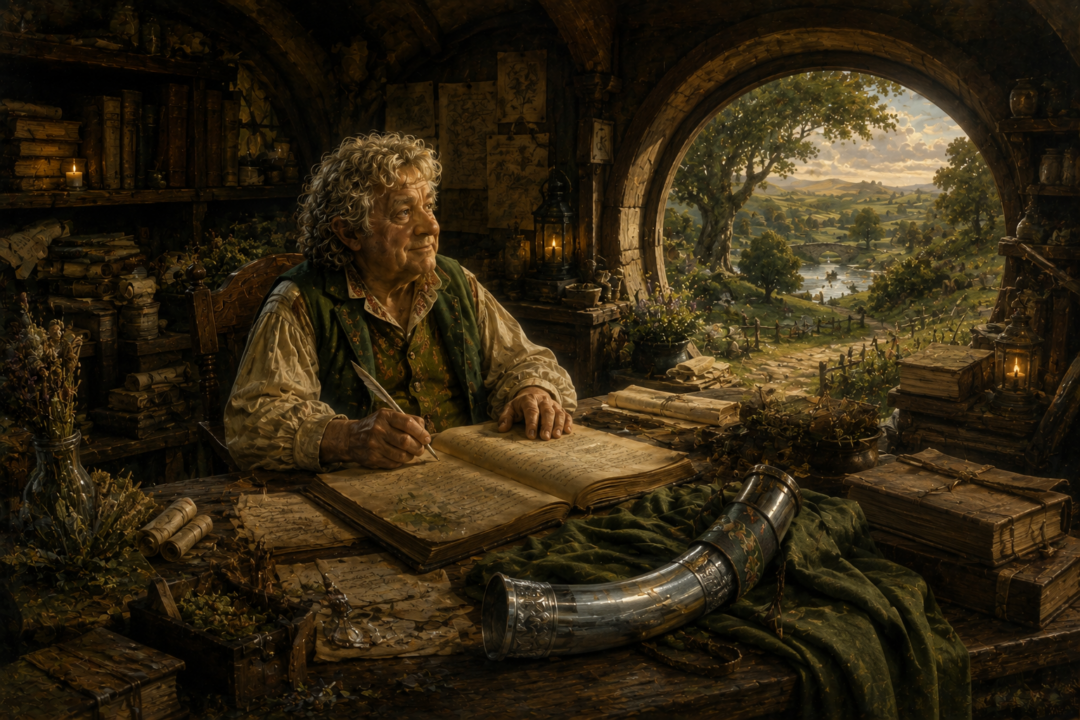
The introductory material concerning the Shire records associates Merry with scholarship, especially subjects connected with language, chronology, and local history. He is credited with works including Herblore of the Shire and Old Words and Names in the Shire, while the Shire's learned traditions also benefited from contacts with records preserved elsewhere.
This side of Merry is easy to overlook because the Battle of the Pelennor Fields is more dramatic.
But it may be equally important to understanding his later position.
Merry brings knowledge home.
His travels have shown him that the Shire is part of a history far larger than most hobbits realize. In his later years, he helps preserve connections between local traditions and the histories and languages beyond the Shire.
The warrior becomes an antiquarian.
The traveller becomes a keeper of memory.
The Master of Buckland Never Becomes Entirely Provincial Again
Merry's final departure shows how permanently his horizons have expanded.
In Shire-reckoning 1484, when Merry and Pippin are both elderly, they hand their goods and offices to their sons and leave the Shire.
Merry goes first to Rohan after receiving word from Éomer.
He is with the old king before Éomer dies.
Afterward Merry and Pippin travel to Gondor, where they spend the remainder of their lives. They are eventually buried in Rath Dínen among the great of Gondor.
It is an extraordinary ending for two hobbits who began as members of families rooted deeply in the Shire.
Yet Merry's story does not suggest that he outgrows Buckland or regards it as insignificant.
The opposite seems closer to the truth.
He returns to it.
He leads its people when danger reaches their homeland. He eventually becomes its Master. He preserves its lore. The horn he carries home becomes part of its tradition. And only after decades of life and service there does he depart once more.
That is the deeper change in Merry's position after the War.
He begins as the heir to Buckland.
He returns as one of its defenders.
He becomes its Master.
But by then "Master of Buckland" means something different when attached to Meriadoc Brandybuck. The title belongs to an old hobbit institution, while the hobbit holding it has stood in the halls of kings and on the fields where an age ended.
Merry does not abandon the small world for the great one.
He brings the memory of the great world home.
Sources & Notes
- The Encyclopedia of Arda, “Meriadoc Brandybuck” — https://www.glyphweb.com/arda/m/meriadocbrandybuck.html
- The Encyclopedia of Arda, “Buckland” — https://www.glyphweb.com/arda/b/buckland.html
- The Encyclopedia of Arda, “Thain” — https://www.glyphweb.com/arda/t/thain.html
Reference entries document the people, places, events, and objects directly discussed in this article.