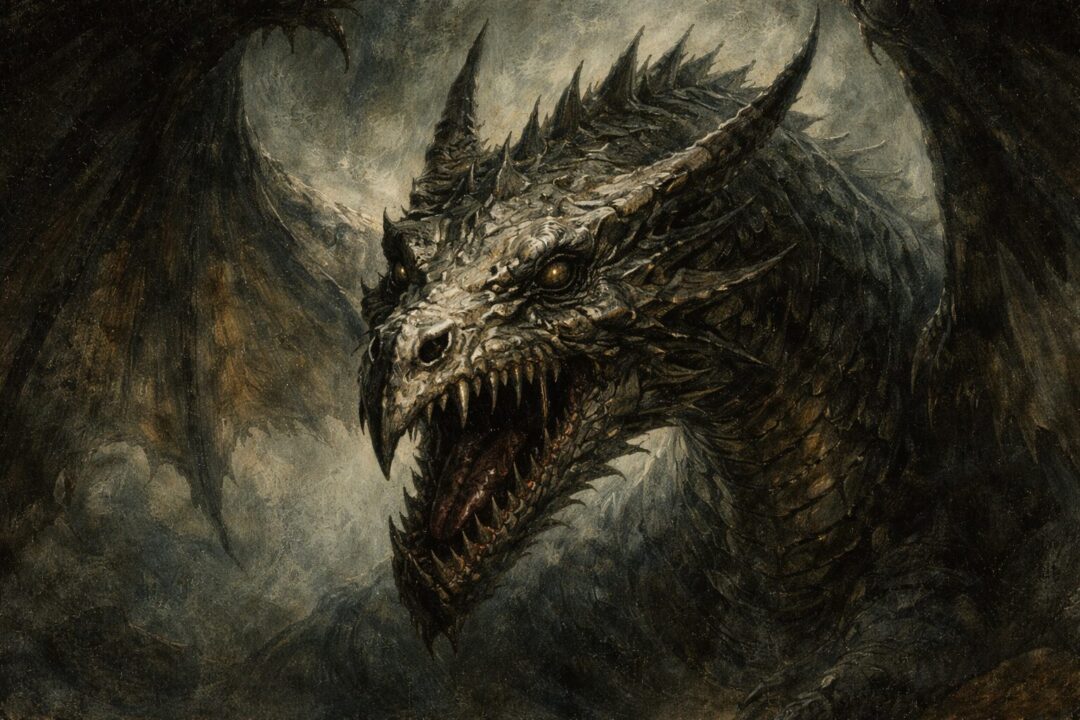
Few images in The Lord of the Rings are as unsettling as the arrival of the Nazgûl on winged mounts. When the Witch-king of Angmar descends upon Minas Tirith, blotting out the sky with vast pinions and piercing cries, many readers instinctively assume they are witnessing a dragon in flight.
The assumption is understandable.
The creature is enormous.
It inspires terror simply by existing.
It arrives at a turning point of the war.
But it is also wrong.
Tolkien is unusually careful with his monsters, and dragons occupy a very specific—and very rare—place in Middle-earth. The creatures ridden by the Nazgûl belong to an entirely different category of evil, one that reveals far more about power, obedience, and corruption than sheer physical destruction ever could.
Understanding the difference between dragons and fell beasts is not a matter of taxonomy. It is a window into how evil functions in Tolkien’s world—and why some horrors are more disturbing than others.
Dragons Are Independent Evils
Dragons are among the most ancient and formidable beings to appear in Middle-earth. From the First Age onward, they are never portrayed as simple tools or mindless monsters. They are actors—entities with will, intelligence, and purpose.
Glaurung speaks and deceives, wielding not only fire but psychological domination. His words twist minds, unravel loyalties, and leave lasting scars long after his physical presence is gone.
Smaug bargains, taunts, and probes for weakness. He understands fear, pride, and greed—and uses them deliberately. He does not merely guard treasure; he defines himself by it.
Ancalagon the Black commands terror on a scale so immense that his fall reshapes the landscape itself.
These are not creatures that wait to be directed.
Dragons choose evil.
They align themselves with dark powers because their desires already mirror domination, possession, and destruction. Even when they serve greater evils, they do so as partners of convenience, not as slaves. Their loyalty is never guaranteed, and their obedience is always conditional.
This distinction matters profoundly.
A dragon can be influenced.
A dragon can be manipulated.
But a dragon cannot be owned.
That alone disqualifies them as mounts for the Nazgûl.
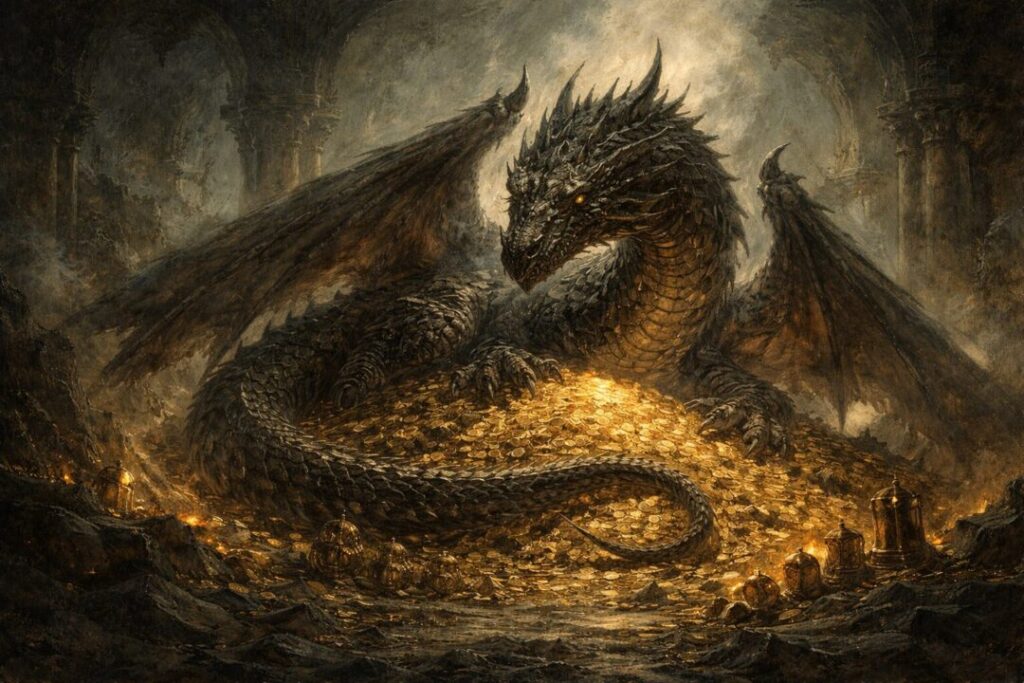
Why Dragons Would Never Serve the Nazgûl
The Nazgûl are not generals commanding allies. They are extensions of a single will: that of Sauron. Their power lies not in independent judgment but in absolute submission. Every action they take is bound to the Ring that enslaves them.
Dragons would never tolerate this kind of relationship.
To carry a Nazgûl would mean surrendering autonomy—becoming a vehicle rather than an agent. That level of subjugation runs contrary to everything dragons represent in Tolkien’s legendarium.
Even Morgoth, at the height of his power, did not truly control dragons. He unleashed them. He relied on them. But they remained beings of appetite and will.
The Nazgûl require something else entirely.
What the Nazgûl Actually Ride
The creatures borne beneath the Ringwraiths are referred to only as fell beasts.
They are never given names.
They are never granted speech.
They are never described as having motives.
Tolkien presents them in fragments and impressions rather than full descriptions: vast wings without feathers, naked leathery skin, a foul stench, and a cry so piercing that it breaks courage rather than flesh.
Most importantly, they are utterly obedient.
Where dragons dominate their surroundings through presence and will, fell beasts function as amplifiers. They extend the Nazgûl’s terror across distance and sky. They do not inspire fear independently; they magnify the fear already radiating from their riders.
This is a crucial distinction.
Dragons reshape the world by existing within it.
Fell beasts reshape perception by carrying terror farther, faster, and higher.
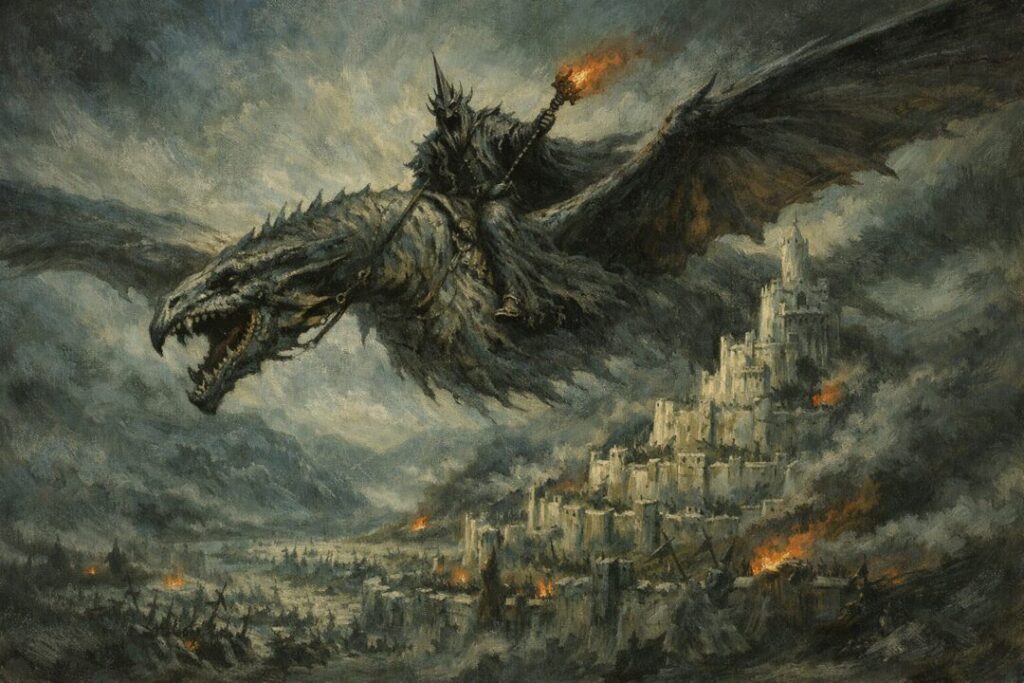
Horses, Then Wings: Why Secrecy Matters
Early in the story, the Nazgûl ride horses.
This detail is often overlooked, but it is deeply significant. The Ringwraiths begin their hunt quietly, blending into the roads and settlements of the Shire. They rely on stealth, whispers, and fear felt but not seen.
Only later—once secrecy has failed and open war begins—do they take to the air.
This shift mirrors Sauron’s own strategy. When concealment is no longer possible, intimidation replaces subtlety. The sky itself becomes a weapon.
Fell beasts are not subtle creatures. Their cries echo across leagues. Their shadows fall over armies. They announce the presence of the Nazgûl long before swords ever clash.
A dragon, with its own will and instincts, would disrupt this strategy. It might choose battle where fear would suffice. It might pursue its own desires rather than serve the precise psychological purpose required.
Fell beasts do exactly what they are meant to do.
Nothing more.
Nothing less.
The Question of Origin—and Why It Remains Unanswered
Tolkien gives us extensive origins for dragons. We know where they come from, how they were bred, and what role they played in the wars of the Elder Days.
He gives us none of that for fell beasts.
This is not an oversight.
Dragons belong to the mythic foundation of the world. Their history is woven into the grand narrative of creation, rebellion, and catastrophe. They feel ancient because they are ancient.
Fell beasts feel different.
They feel manufactured.
They feel like products of corruption rather than participants in it—creatures twisted, bred, or altered to fulfill a single purpose. Whether they were once animals, ancient beings reshaped beyond recognition, or something else entirely is never stated.
And that uncertainty is intentional.
To define them too clearly would make them familiar.
To make them familiar would lessen their horror.
Tolkien often leaves the most disturbing things unexplained, allowing fear to linger in the imagination rather than be resolved by knowledge.
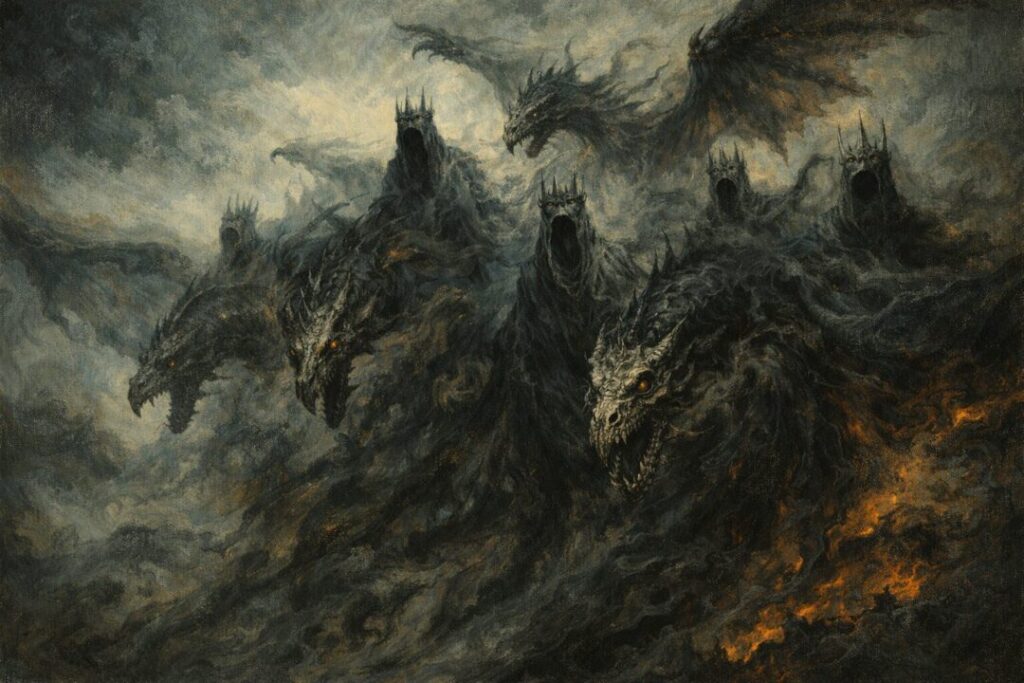
Why Fell Beasts Are More Disturbing Than Dragons
Dragons choose evil.
Fell beasts exist only to serve it.
They have no stories.
No hoards.
No ambitions.
They do not desire conquest or wealth. They do not boast or bargain. They function as extensions of the Nazgûl themselves—much as the Nazgûl are extensions of Sauron.
This parallel is not accidental.
Just as the Ringwraiths were once kings reduced to shadows of will, their mounts feel like creatures reduced to motion and obedience. Both have been stripped of identity until nothing remains but function.
In Tolkien’s moral universe, this is a deeper tragedy than open malice.
Evil that chooses is dangerous.
Evil that erases is horrifying.
Enslavement Versus Corruption
Throughout his work, Tolkien draws a clear line between corrupted beings and enslaved ones.
Dragons sit firmly on the side of corruption. They are twisted, dangerous, and destructive—but they remain themselves.
Orcs, Ringwraiths, and fell beasts fall on the other side of the line. Their wills are overridden, their identities consumed, their existence reduced to utility.
The more total the control, the more tragic—and terrifying—the result.
This is why the Nazgûl do not ride dragons.
They ride something worse.
Something that has already lost everything that once made it alive.
And Tolkien, wisely, leaves that horror undefined—allowing it to linger long after the wings have passed from the sky.
Sources & Notes
- J.R.R. Tolkien, The Lord of the Rings, Book IV, Chapter 2, “The Passage of the Marshes” — Frodo and Sam see a winged Nazgûl mount: featherless, bat-like, and terrifying, but not named as a dragon.
- J.R.R. Tolkien, The Lord of the Rings, Book V, Chapter 6, “The Battle of the Pelennor Fields” — the Witch-king’s steed is a fell creature with leathery pinions and foul stench, distinct from Tolkien’s dragons.
- J.R.R. Tolkien, The Lord of the Rings, Book I, Chapter 11, “A Knife in the Dark” — the Black Riders’ earlier use of horses supports the story’s shift from secret pursuit to open terror.
- J.R.R. Tolkien, The Silmarillion, “Of Túrin Turambar” — Glaurung is a speaking, manipulative dragon whose evil operates through will, cunning, and domination.
- J.R.R. Tolkien, The Hobbit, Chapter 12, “Inside Information” — Smaug’s exchange with Bilbo shows a dragon’s pride, intelligence, and independent appetite rather than simple obedience.