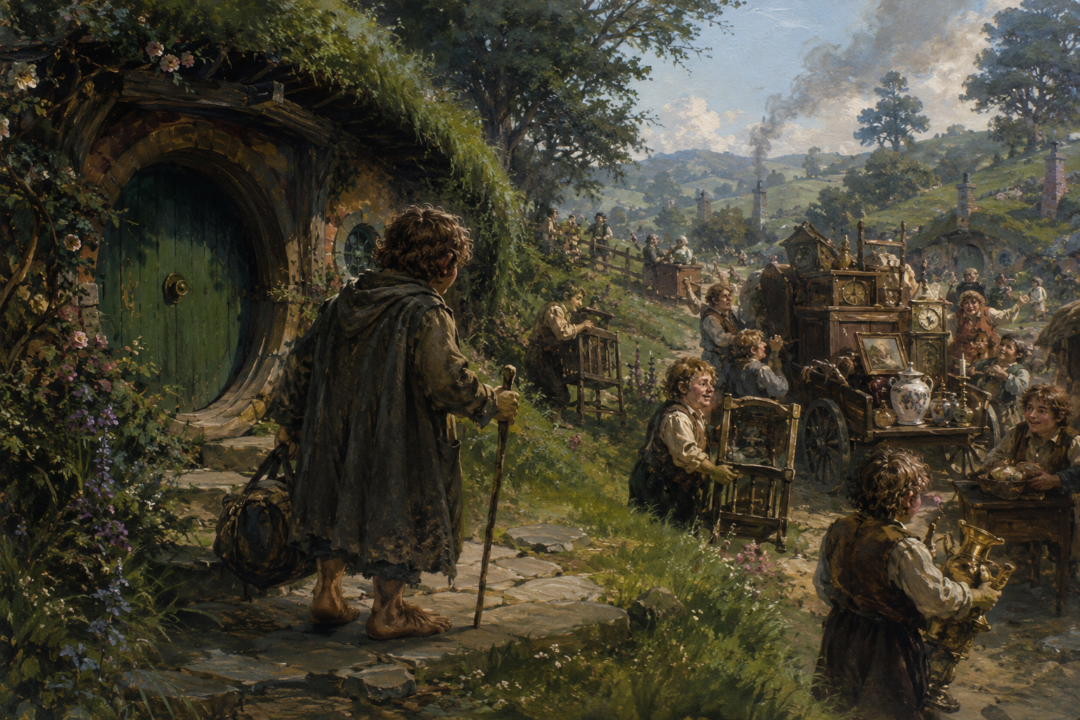
When Bilbo Baggins finally returned to Bag End, he had survived trolls, goblins, giant spiders, imprisonment, a conversation with Smaug, and the Battle of Five Armies. He had become an Elf-friend. Dwarves knew his name. A king beneath the Mountain had called him friend before dying.
And in Hobbiton, people were selling his furniture.
That contrast is one of the sharpest jokes in The Hobbit, but it is more than a joke. Bilbo’s strange reputation only fully makes sense when we remember how enormously far the Shire stands—geographically and culturally—from Erebor.
In the East, Bilbo had participated in events that changed kingdoms. At home, almost none of that carried the kind of social authority we might expect.
The distance between those two worlds turns Bilbo’s “fame” into something wonderfully peculiar: the farther he travels from the Shire, the more impressive he becomes; the closer he gets to his own front door, the less respectable he appears.
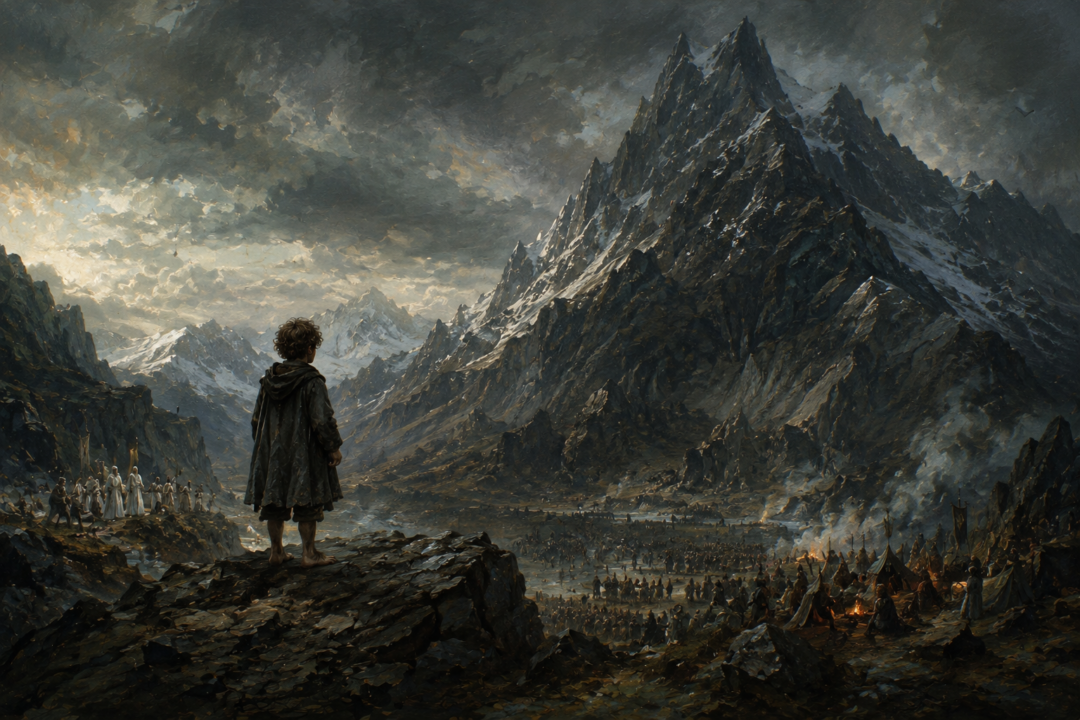
Bilbo Leaves as a Respectable Nobody
At the beginning of The Hobbit, Bilbo possesses exactly the sort of reputation his society values.
The Bagginses are respectable. They are comfortable, predictable, and associated with a settled life. Bilbo himself has no public record of heroism because, from the perspective of Hobbiton, heroism is hardly an obvious qualification for a good neighbor.
Then Gandalf and thirteen Dwarves arrive.
The quest that follows carries Bilbo eastward through increasingly unfamiliar worlds: beyond the settled country near the Shire, across the Trollshaws, through Rivendell, beneath the Misty Mountains, into Wilderland, through Mirkwood, and eventually to the Lonely Mountain.
That physical journey also removes Bilbo from the social system that originally defined him.
Nobody at Erebor cares whether Bilbo Baggins once had a spotless reputation in Hobbiton.
There, reputation has to be earned again.
The Farther East Bilbo Goes, the Greater His Reputation Becomes
One of the quiet patterns of The Hobbit is that Bilbo accumulates identities as he travels.
He begins as the supposedly professional “burglar” whom Gandalf has selected for Thorin’s company, despite Bilbo himself being thoroughly unconvinced by the description.
But eventually he actually becomes indispensable.
He escapes from the goblin tunnels. He helps rescue the Dwarves from the spiders of Mirkwood. He devises the barrel escape from the Elvenking’s halls. He enters Erebor while the Dwarves hesitate outside. He speaks directly with Smaug and survives.
By the time the company reaches its crisis at the Mountain, Bilbo is no longer simply baggage being carried by Thorin’s expedition.
He has judgment of his own.
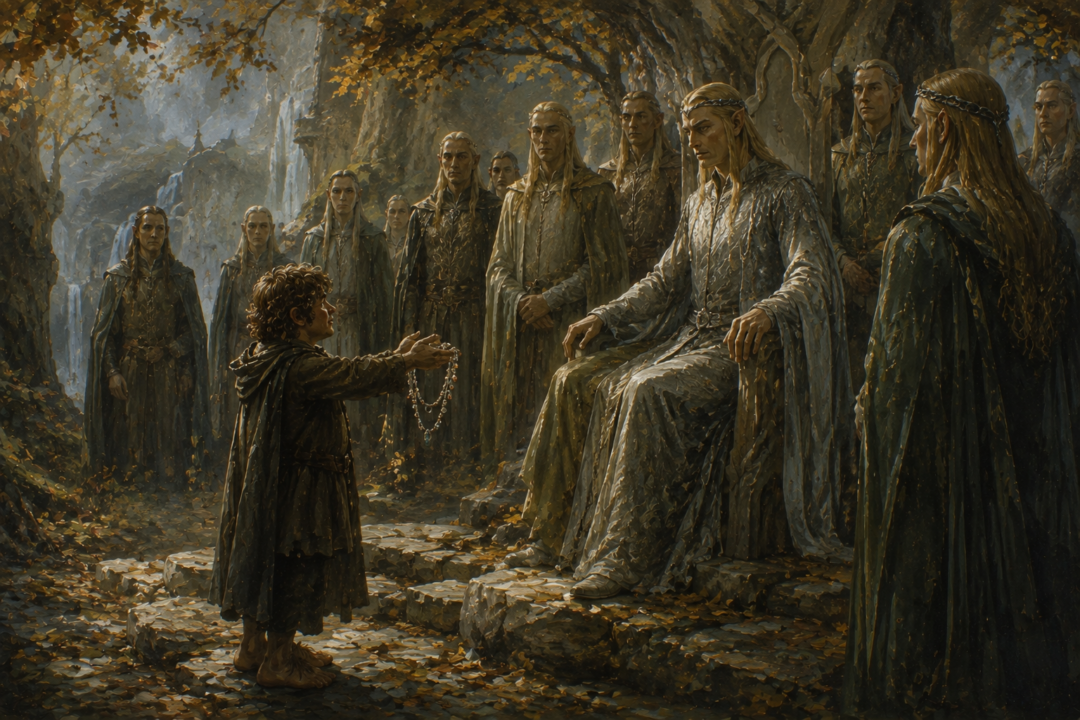
His greatest act may actually be the one least compatible with conventional heroic glory. When Thorin refuses to compromise with Bard and the Elvenking, Bilbo secretly gives the Arkenstone to Thorin’s opponents in an attempt to create leverage for a settlement.
The act enrages Thorin. Yet Bilbo accepts the consequences because he believes preventing bloodshed matters more than loyalty to Thorin’s increasingly possessive claim upon the treasure.
Then comes the Battle of Five Armies. Bilbo is present when the conflict over Erebor is overtaken by the arrival of the goblin and wolf armies, though he is knocked unconscious before seeing the victory completed.
This is the world in which Bilbo has become significant.
And then he walks away from it.
Erebor Knows a Bilbo That Hobbiton Never Sees
After Thorin’s death, Bilbo does something important for understanding his character: he does not attempt to convert adventure into maximum wealth.
Although treasure is offered to him, he ultimately returns west carrying only a comparatively modest portion of what he might have claimed. He also parts from the Elvenking with honor, having been named an Elf-friend.
This creates two radically different versions of Bilbo Baggins.
Among those connected with his adventures, Bilbo is someone who has faced a dragon, crossed dangerous lands, dealt with kings, and demonstrated courage and mercy.
Among many hobbits at home, none of those experiences can be independently understood in quite the same way.
Erebor is not the neighboring village.
It belongs to a distant world beyond mountains and wilderness, populated by peoples whom ordinary Shire-hobbits rarely encounter. Even much later, when troubling reports begin arriving from outside, distant names such as Mordor mean little to many hobbits except as fragments of old stories.
Bilbo therefore returns with a problem familiar to anyone who has crossed between radically different worlds:
the people who could best confirm what he has become are mostly somewhere else.
His Homecoming Is an Anti-Triumph
A more conventional heroic story might have Bilbo return to cheering crowds.
Instead, The Hobbit gives him an auction.
His long absence has caused him to be presumed dead. Bag End and its contents are being sold, and Bilbo must struggle even to re-establish the mundane fact that he is alive. Some possessions have to be bought back. The legal complications continue for years. Flipbuilder
Then comes the deeper loss.
Bilbo has lost his reputation.
The narrator makes the reversal explicit: although Bilbo retains the friendship and honor of Elves, Dwarves, Wizards, and other remarkable travelers, the hobbits around him no longer regard him as properly respectable. He is considered “queer.” somersetcentral.org
That is the real cost of his journey.
Bilbo returns richer in experience, friendships, knowledge, and material wealth, yet poorer in the particular social currency Hobbiton once gave him automatically.
The Shire does not crown its returning adventurer.
It downgrades him.
Distance Turns History Into Rumor
This is where the distance from Erebor becomes essential.
Imagine Bilbo living in Dale after the quest.
His stories would exist among witnesses and survivors. Bard’s people had experienced Smaug’s destruction firsthand. Dáin’s folk knew what had happened at the Mountain. Elves and Dwarves could place Bilbo inside a recognizable chain of events.
In the Shire, the same stories become almost unbelievable.
A dragon under a mountain.
Talking ravens.
A hidden Elven kingdom.
Goblin armies.
A bear-like Beorn entering battle.
Treasure.
A magic ring that makes its wearer invisible.
Bilbo is telling truths that sound like folklore to people whose lives have been deliberately insulated from such events.
The texts do not say that every hobbit rejected every detail of Bilbo’s account. But they clearly establish the broader result: few believed his tales, while many regarded him as eccentric. somersetcentral.org
Distance has transformed testimony into story.
And eventually story transforms Bilbo himself.
“Mad Baggins” Becomes More Famous Than the Hero of Erebor
By the opening of The Lord of the Rings, Bilbo is certainly famous in the Shire—but not primarily in the manner a king or warrior would understand fame.
He is wealthy, peculiar, unusually preserved for his age, associated with Gandalf and Dwarves, and surrounded by rumors.
His extraordinary 111th birthday party intensifies the legend. After giving his speech, Bilbo vanishes before the assembled guests by secretly using the Ring.
That disappearance becomes attached to the legend of “Mad Baggins.”
In later Shire imagination, Bilbo becomes a figure of fireside tales: the strange hobbit who vanished and was associated with bags of jewels and gold.
Notice what has happened.
The Shire remembers the visible evidence better than the historical meaning.
Treasure can be seen.
Dwarves arriving at Bag End can be seen.
Bilbo disappearing at his party can certainly be seen—or rather, everyone can see that he suddenly cannot be seen.
But Bilbo’s moral courage before Erebor is much harder to preserve as village gossip.
The Arkenstone decision has no obvious monument in Hobbiton.
His pity, restraint, resourcefulness, and willingness to risk Thorin’s anger belong to a distant narrative that must be told and believed.
So the legendary Bilbo of the Shire is not quite the Bilbo known in the East.
His Two Reputations Measure Two Different Kinds of Greatness
The irony becomes even stronger because Bilbo himself eventually stops needing Hobbiton’s approval.
At the beginning of The Hobbit, respectability matters deeply to him.
By the end, he is content despite losing it.
His altered reputation is therefore not simply a punishment. It reveals that Bilbo’s standards have changed. He still loves home, food, comfort, conversation, and his own fireside. The adventure does not transform him into a warrior seeking endless danger.
Instead, he returns able to enjoy ordinary life without being ruled by ordinary opinion.
That distinction matters.
Bilbo does not discover that the Shire is worthless.
He discovers that respectability is not the same thing as goodness.
Indeed, Thorin’s final reconciliation with Bilbo points toward the same idea from the opposite direction. A great Dwarven lord who has been consumed by conflict over treasure recognizes, at death, the value of simpler things Bilbo has represented throughout the story: food, cheer, song, and a life not dominated by hoarded wealth.
The hobbit who loses status at home has gained something more difficult to measure.
Perspective.
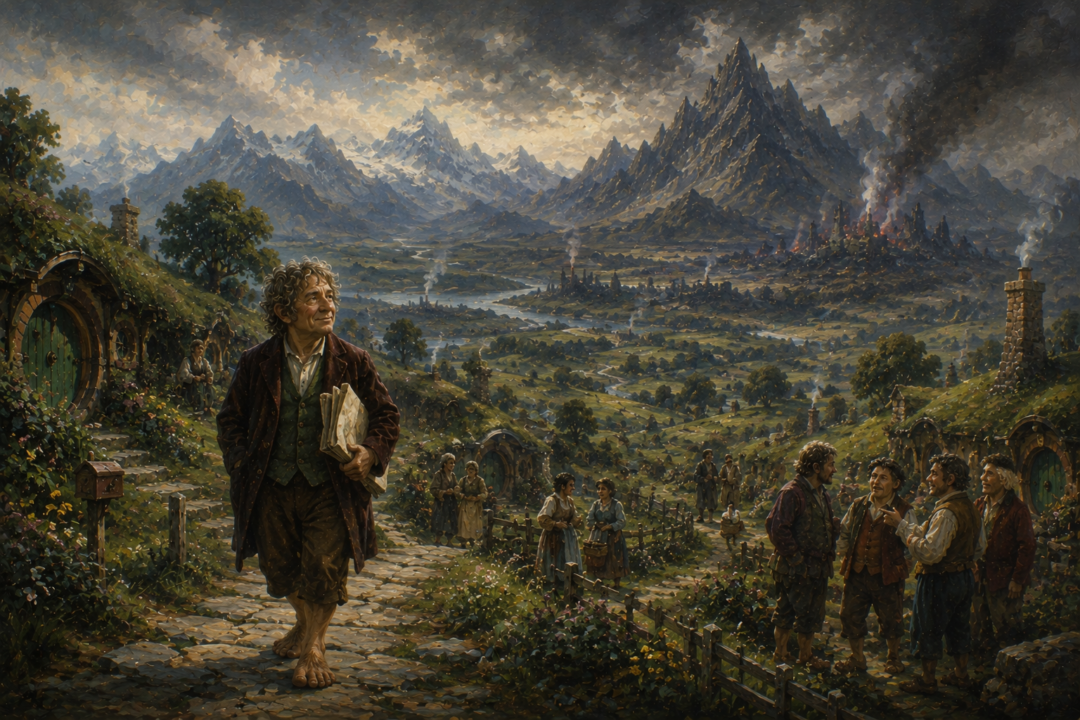
Bilbo’s Fame Depends on Where You Stand
Bilbo’s reputation is therefore almost geographical.
Near Erebor, his smallness makes his deeds extraordinary.
In Rivendell and among those connected with the wider world, his knowledge and experiences have meaning. Years after the quest, Gandalf and Balin even visit Bilbo at Bag End, bringing news of how matters have developed around Erebor and Dale.
But within ordinary Shire society, the same history becomes eccentricity.
That contradiction survives for decades.
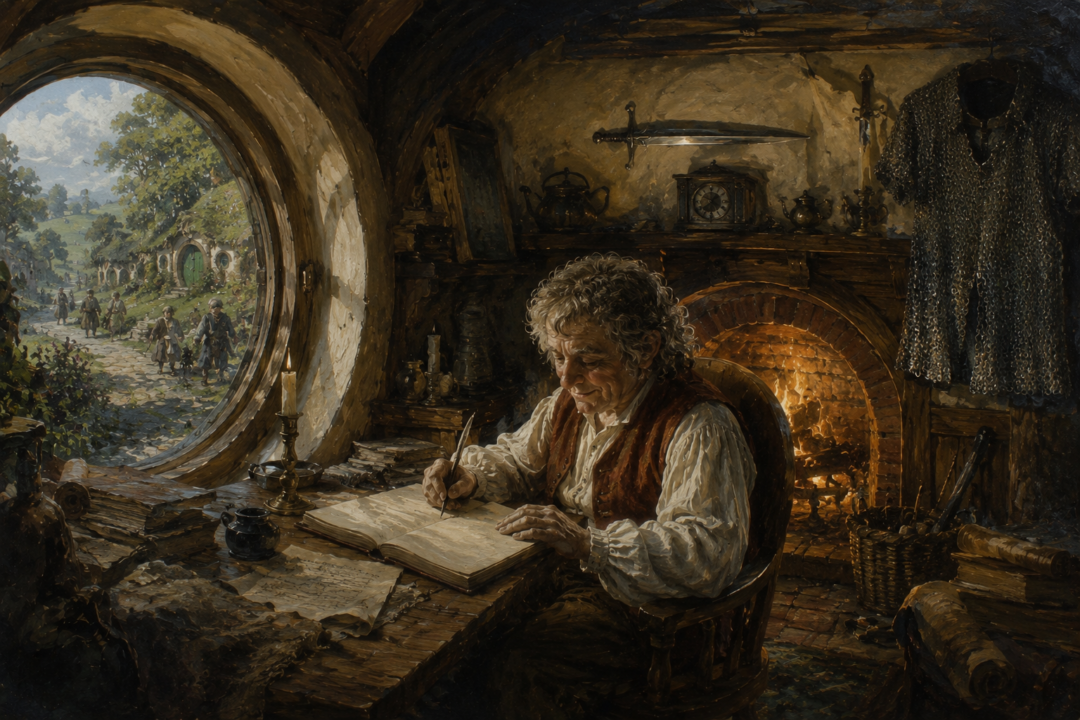
Bilbo writes his account of his travels, There and Back Again, preserving the adventure in a form that eventually becomes part of the Red Book tradition.
The neighbors have gossip.
Bilbo has history.
And because Erebor is so distant, the two can coexist.
That may be the most interesting meaning of Bilbo’s fame. He does not return from the Lonely Mountain as a universally recognized hero. He becomes something stranger: a great figure in one world and an eccentric old bachelor in another.
The distance between the Shire and Erebor protects that contradiction.
Bilbo can sit beside his kettle while somewhere beyond the mountains Dwarves remember what he did.
He can be “Mad Baggins” in Hobbiton and an Elf-friend beyond its borders.
And perhaps that is precisely why his homecoming works so well.
Bilbo went farther than almost anyone around him could imagine, came home with experiences they could barely believe—and discovered that being understood was no longer necessary for him to know who he was.
Sources & Notes
- The Encyclopedia of Arda, “The Shire” — https://www.encyclopedia-of-arda.com/s/shire.html
- The Encyclopedia of Arda, “Bilbo Baggins” — https://www.encyclopedia-of-arda.com/b/bilbobaggins.html
- The Encyclopedia of Arda, “Erebor” — https://www.encyclopedia-of-arda.com/e/erebor.html
Reference entries document the characters, places, events, and textual details discussed in this article.