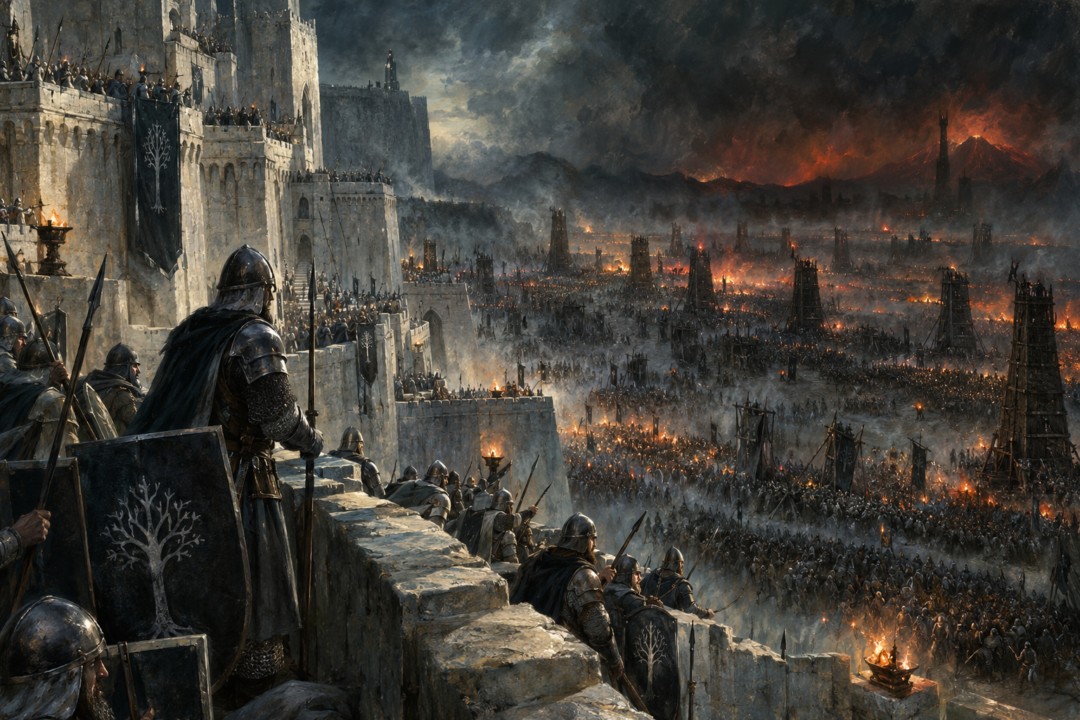
When Minas Tirith is surrounded by the armies of Mordor, the defenders possess nearly everything we associate with a fortified medieval war: walls, gates, armour, shields, cavalry, engines, disciplined troops, and a carefully prepared chain of command.
Yet one of the most consequential struggles inside the city is decided by something far simpler.
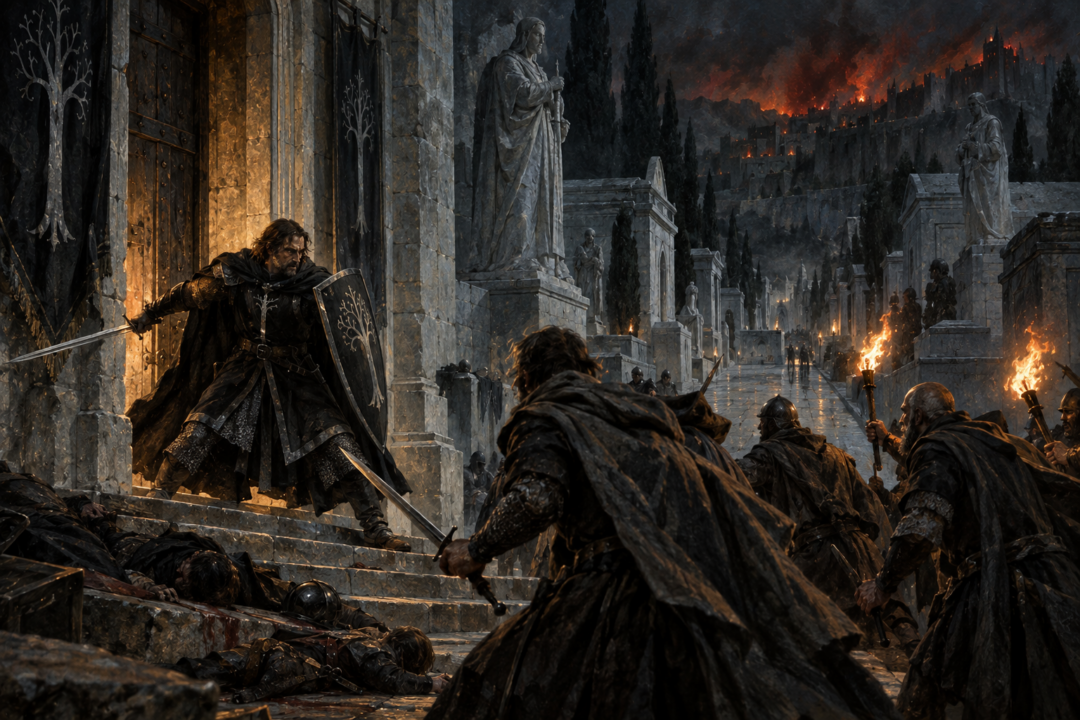
A man with a sword stands in a doorway.
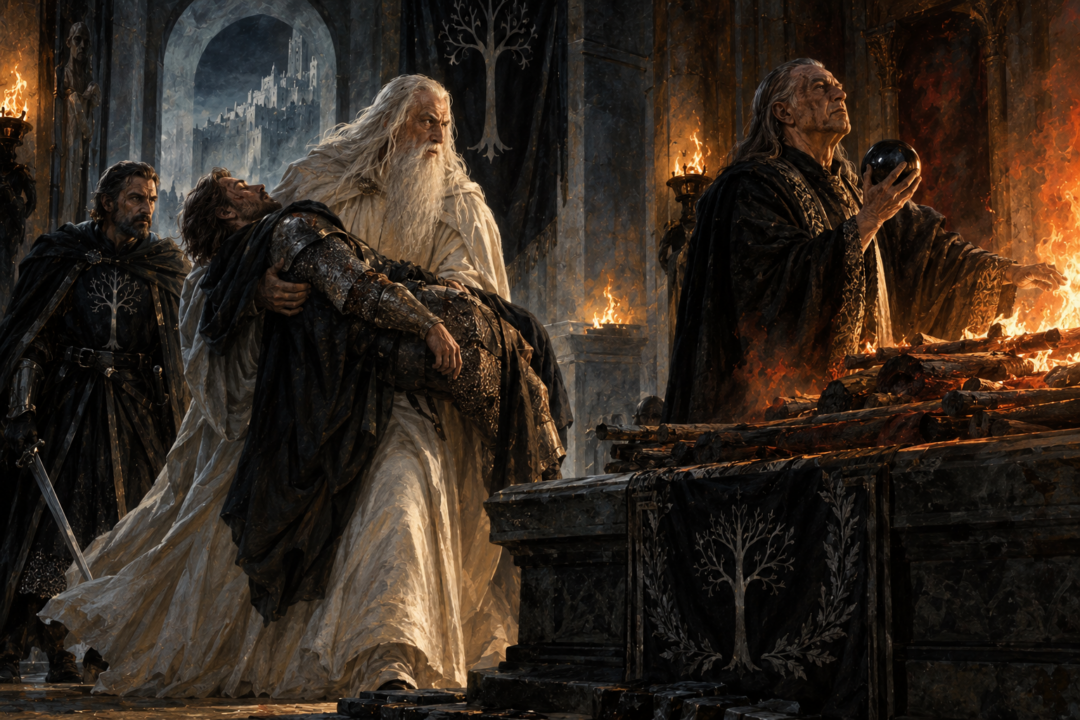
Beregond, Guard of the Citadel, is trying to prevent Denethor’s servants from carrying out their lord’s command to burn Faramir alive. By the time Gandalf arrives at the House of the Stewards, Beregond has already killed two of his fellow Gondorians while defending the entrance.
It is tempting to read Denethor’s death only as a story about despair. It certainly is that. But the surrounding chapters of The Return of the King reveal something else: Tolkien’s battles repeatedly emphasize how dependent ordinary warriors are upon fortifications, armour, shields, horses, missile weapons, disciplined formations, and siege machinery.
Against Orcs and other servants of Mordor, courage matters enormously.
Courage by itself is not equipment.
Minas Tirith Is Not Defended by Heroism Alone
The defence of Gondor is highly organized before the siege begins.
Denethor has not simply waited for Mordor to arrive. He summons forces from Gondor’s southern fiefs, strengthens the city’s defence, and maintains forces beyond Minas Tirith. The Rammas Echor encloses the Pelennor, while Osgiliath and the Causeway Forts form forward positions intended to delay the Enemy.
The city itself is a gigantic defensive machine.
Its successive walls force an attacker to penetrate one level after another. Its defenders can fight from protected positions rather than meeting Mordor’s vastly larger host on equal ground.
This matters because Tolkien never presents the Orcs attacking Minas Tirith as individually unbeatable warriors. Their danger comes from numbers, organization under stronger powers, siege equipment, darkness, terror, and the other forces accompanying them.
The host attacking Gondor includes not merely Orcs but Men allied to Sauron, trolls, Nazgûl, and specialized siege forces.
That distinction is important. Minas Tirith does not need enormous walls because every Orc is a match for a legendary hero. It needs enormous walls because even brave soldiers can be overwhelmed when an enemy can concentrate thousands of bodies, missiles, engines, and psychological pressure against them.
The equipment changes the odds.
Faramir’s Retreat Shows What Happens Outside the Walls
Faramir’s last operations before the siege make this painfully clear.
Denethor sends him back toward the threatened outer defences. Faramir obeys despite the bitter exchange with his father and despite the worsening military situation.
The defenders cannot hold indefinitely.
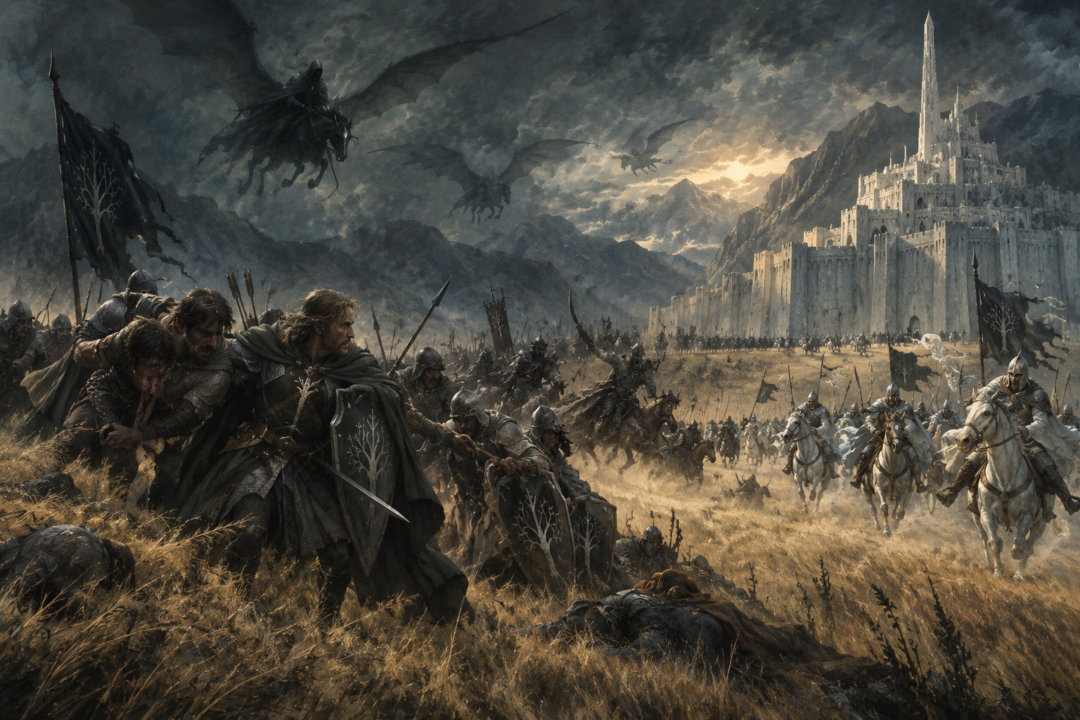
After the Causeway Forts are lost, the surviving Gondorians retreat across the Pelennor toward Minas Tirith. They are pursued while the Nazgûl circle overhead, spreading supernatural terror.
This is precisely the kind of situation in which individual bravery becomes insufficient.
Men who might stand firmly behind walls or in ordered formations can be destroyed while retreating across open ground. Their horses panic beneath the Nazgûl. Their formation deteriorates. The pursuing Enemy can exploit that vulnerability.
Gondor answers with another military tool: cavalry.
Denethor sends mounted men from the city to protect the retreat, while Gandalf rides out with them. The intervention allows the survivors to reach Minas Tirith.
Faramir himself does not escape unharmed. He is brought back gravely wounded and afflicted by the Black Shadow.
The episode demonstrates a recurring reality of the siege: survival depends on combining courage with the right tactical advantages.
Walls protect infantry. Horses provide speed and shock. Armour reduces vulnerability. Missile weapons allow killing at distance. Fortifications multiply the effectiveness of smaller forces.
Take those advantages away, and even excellent soldiers become frighteningly mortal.
Mordor Understands Equipment Perfectly
The attackers are equally dependent on technology and preparation.
Mordor does not simply order masses of Orcs to climb the walls with swords.
The besiegers dig trenches and establish positions beyond the effective reach of Gondor’s defenders. Siege engines bombard the city. Projectiles crash into Minas Tirith, and fires begin spreading through the lower circle.
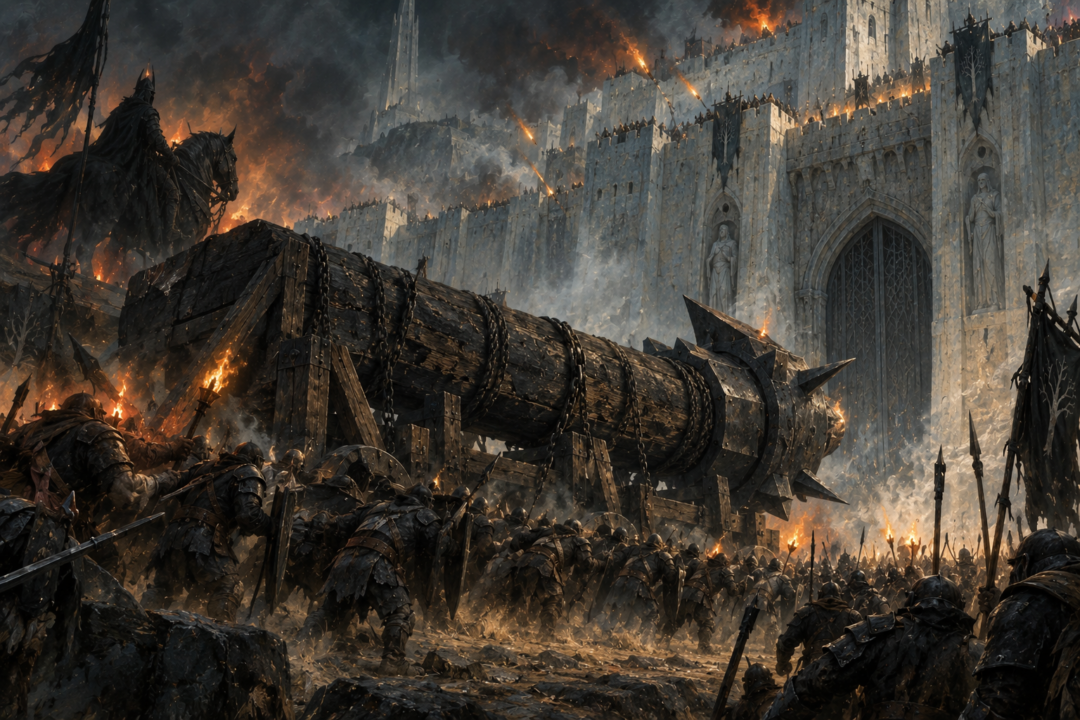
Then comes a weapon designed for one specific task: Grond.
The enormous battering ram is brought against the Great Gate under the direction of the Witch-king. The attack also involves supernatural power, and Tolkien does not reduce the breaking of the Gate to ordinary engineering alone. But the basic military logic remains unmistakable.
The strongest entrance to Minas Tirith is not defeated by an Orc with a blade.
It is attacked by a massive purpose-built siege engine.
The defenders have fortifications.
The attackers bring machinery capable of defeating fortifications.
The contest therefore escalates beyond personal combat.
Armour Helps — but It Cannot Solve Every Threat
The defenders of Gondor are not lightly equipped adventurers. The Guard of the Citadel, for example, is described with black garments bearing the emblem of the White Tree, and Pippin receives Gondorian military equipment when he enters Denethor’s service.
Across the wider narrative, mail, helmets, shields, spears, swords, bows, and horses repeatedly shape who survives an encounter.
But equipment has limits.
Boromir’s death is an obvious earlier example. He is an exceptionally formidable warrior, yet while defending Merry and Pippin at Amon Hen he is struck repeatedly by Orc-arrows. His strength allows him to continue fighting after wounds that would have stopped many others, but courage cannot make him invulnerable.
The same principle appears on a larger scale at Minas Tirith.
Armour can help against blades and arrows.
A shield can intercept a missile.
A wall can prevent an enemy from reaching you.
None of these things can fully answer the terror of a Nazgûl.
And no ordinary suit of armour can save a commander whose judgment has collapsed.
That is where Denethor’s story becomes especially revealing.
Denethor’s Final Battlefield Is Inside His Own City
Denethor does not die fighting an Orc.
He dies in Rath Dínen, the Silent Street where Gondor’s dead rulers are laid.
That contrast is deliberate and terrible.
Outside, Gondor is engaged in one of the greatest defensive battles of the Third Age. Soldiers are using walls, weapons, horses, siege defences, and formations to keep Mordor from destroying the city.
Inside, the Steward abandons that struggle.
After Faramir is brought back apparently dying, Denethor withdraws from active command. His despair has been deepened by what he has seen through the palantír. The information available to him is not simply fabricated by Sauron, but Denethor interprets what he sees without the hope or wider knowledge necessary to understand how events might still change.
He decides that defeat is inevitable.
Then he attempts to take Faramir with him into death.
At this point the military machinery of Gondor becomes almost irrelevant.
No siege tower is needed.
No battering ram is required.
The immediate danger is a command issued by Gondor’s own lawful Steward.
Beregond Pays the Price of Stopping Him
Pippin realizes that Faramir is still alive and seeks help.
Beregond makes the decisive choice.
He abandons his assigned post and eventually stands before the door of the House of the Stewards, preventing Denethor’s servants from entering to complete the pyre. In doing so, he draws his sword against fellow servants of Gondor.
Two are killed.
This is not a triumphant combat scene. Beregond is defending an innocent life, but he is also violating the discipline upon which the defence of Minas Tirith depends.
Later, Aragorn judges him for leaving his post and shedding blood in the Hallows. Beregond is spared the death penalty because his actions saved Faramir, but the transgression itself is not pretended away.
That is one of the sharpest distinctions in Tolkien’s treatment of war.
Sometimes the morally necessary action still carries a cost.
Heavy Equipment Cannot Protect a Society from Despair
The title’s idea therefore has a limit.
Denethor’s death does not literally demonstrate that Gondor lost because its soldiers lacked sufficiently heavy armour or weapons. The texts give no such claim.
What his death does is expose the boundary between material and moral defence.
Minas Tirith possesses immense fortifications.
Its soldiers possess military equipment.
Its commanders understand strategy.
Its enemies still find ways around those protections.
Mordor attacks bodies with arrows and blades, walls with siege engines, horses and soldiers with terror, and leadership with despair.
The strongest armour in Gondor cannot protect Denethor from what he believes he has seen.
The thickest wall cannot stop a Steward from ordering his own funeral pyre.
And when authority itself becomes dangerous, the final barrier protecting Faramir is not stone or steel infrastructure.
It is Beregond deciding that obedience has reached its moral limit.
The Real Cost of Fighting Mordor
The War of the Ring repeatedly rejects the fantasy that great wars are decided merely by the strongest swordsman.
Aragorn, Éomer, Imrahil, Faramir, and the other captains matter enormously, but so do roads, horses, walls, gates, supplies, signals, fortifications, bows, shields, and organized bodies of soldiers.
Mordor understands the same truth.
Its armies bring siege engines because courage does not break masonry.
Gondor sends cavalry because exhausted infantry cannot simply outrun pursuit.
Soldiers wear armour because flesh remains flesh, however brave the person inside it.
Yet Denethor’s end reveals the darker half of the equation.
Material protection can keep an Orc’s sword away from a man’s body.
It cannot guarantee that the man still believes resistance has meaning.
That is why the struggle in Rath Dínen belongs beside the Battle of the Pelennor Fields rather than outside it. While thousands fight over walls and open ground, another battle is being fought over whether despair will be permitted to turn defeat from a possibility into a choice.
Faramir survives because Pippin refuses to remain silent, Beregond refuses to obey blindly, and Gandalf turns away from the breached Gate long enough to intervene.
Denethor chooses the fire.
Outside, the soldiers of Gondor keep fighting.
And in that contrast lies one of the siege’s most uncomfortable lessons: weapons and fortifications can keep an army alive, but no amount of heavy equipment can replace the decision to continue resisting when defeat appears certain.
Sources & Notes
- The Encyclopedia of Arda, “Denethor II” — https://www.encyclopedia-of-arda.com/d/denethor.php
- The Encyclopedia of Arda, “Siege of Gondor” — https://www.encyclopedia-of-arda.com/s/siegeofgondor.php
- The Encyclopedia of Arda, “Orcs” — https://www.encyclopedia-of-arda.com/o/orcs.php
- The Encyclopedia of Arda, “Rath Dínen” — https://www.encyclopedia-of-arda.com/r/rathdinen.php
Reference entries document the people, places, events, and textual details discussed in this article.