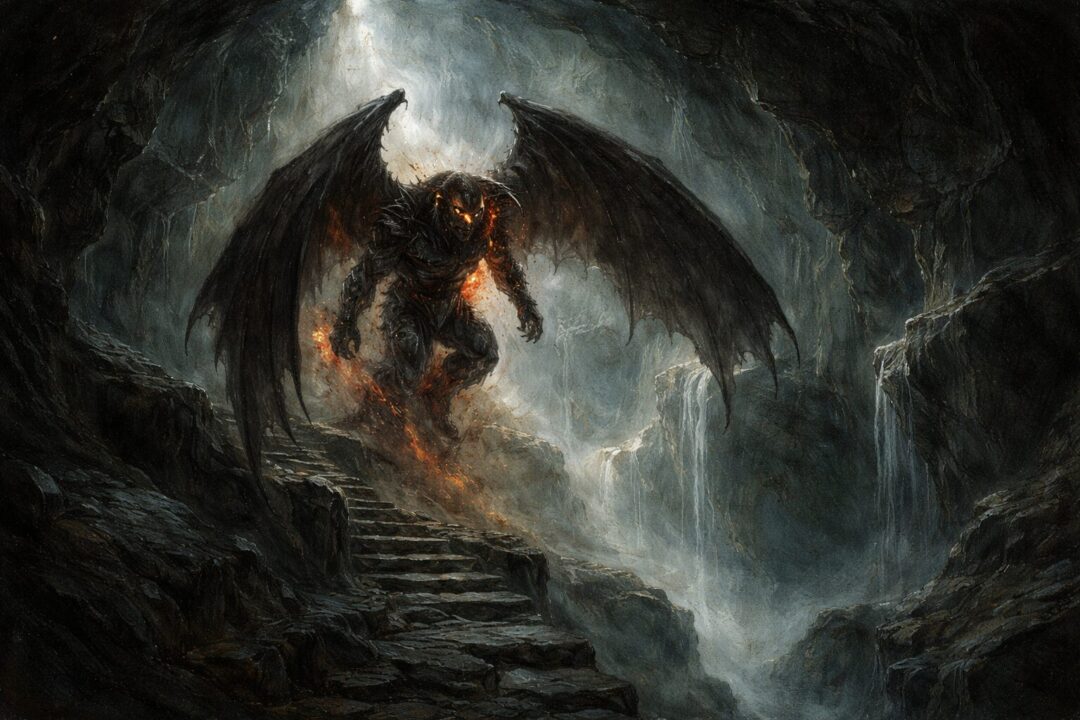
When the Fellowship enters the mines of Moria, they believe the greatest danger lies in Orcs, cave-ins, or the suffocating dark itself.
They are wrong.
The true horror of Moria is not something that followed them inside. It is not a trap laid for them, nor a creature stirred by the Ring’s passing.
It is something that has been waiting there since before the world was broken and remade.
The being Gandalf names Durin’s Bane is not merely a monster lurking in abandoned halls. It is one of the last surviving Balrogs—fire-spirits corrupted in the service of Morgoth during the First Age, older than the kingdoms of Elves and Dwarves alike.
Its presence beneath the Misty Mountains is not coincidence.
It is the result of survival, fear, and a world that changed faster than even ancient evils could adapt to.
A Survivor of the First Age
In the earliest ages of Arda, Balrogs were not creatures of shadowed corridors and ruined halls. They were weapons of open terror.
Originally Maiar—lesser divine spirits—they were drawn into Morgoth’s service and corrupted into beings of flame and darkness. In the wars of Beleriand, they strode openly across battlefields, shattering armies, slaying Elf-lords, and standing as captains of dread beneath Morgoth’s banners.
They were creatures meant for a world shaped by cataclysmic war.
But that world ended.
When Morgoth was finally defeated in the War of Wrath, the powers of the West intervened directly. The struggle did not merely topple a Dark Lord—it reshaped the geography of the world itself. Vast regions of Beleriand were broken and swallowed by the sea. Strongholds fell. Mountains were torn apart.
Most of Morgoth’s servants were destroyed.
Not all.
The texts are careful but clear: some creatures fled rather than fight to the end. The Balrog that would later be known as Durin’s Bane was one of them.
But unlike Sauron, who escaped east and began the long work of rebuilding power and influence, this Balrog chose a different path.
It did not seek a new dominion.
It went down.
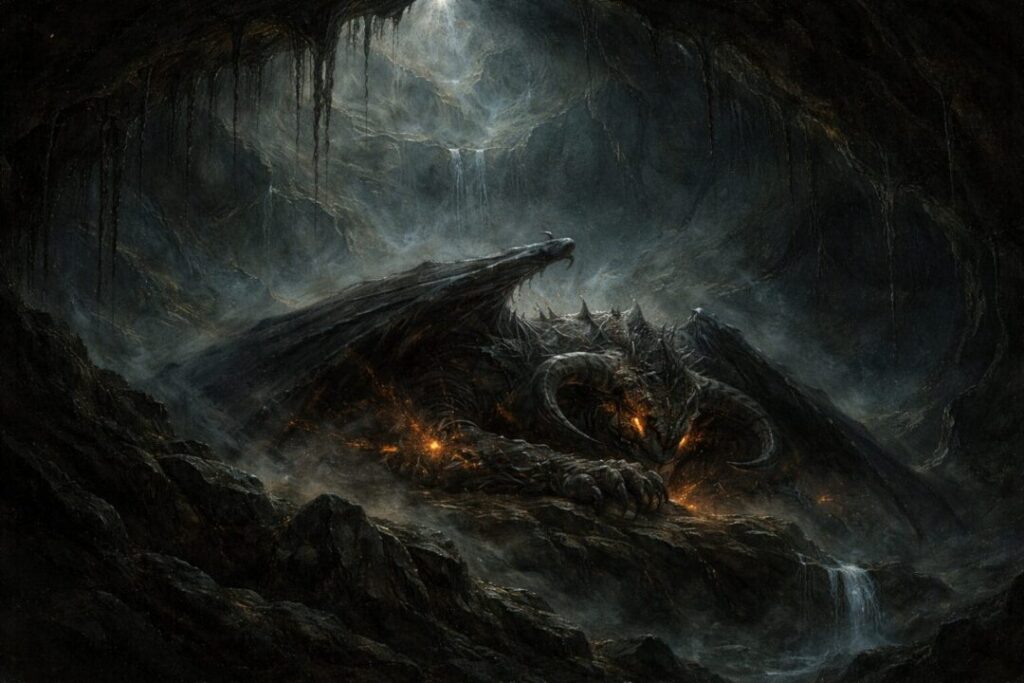
Why the Balrog Chose the Deeps
The Misty Mountains are ancient—older than most realms of Elves, older than any Dwarven kingdom. Beneath them lay vast natural caverns and chasms, shaped by fire, water, and time long before any people delved there.
For a being hunted by powers far greater than itself, this was the perfect refuge.
The Balrog did not flee to gather strength. It fled to escape notice.
Deep underground, it would not blaze in the Unseen World. It would not draw the eyes of the West. No heralds would proclaim its presence. No armies would be sent against it.
Time itself would lose meaning.
So the Balrog hid.
And it slept.
This choice reveals something essential about Balrogs that is often overlooked. They are not strategists like Sauron. They are not patient manipulators or builders of empires. Their terror lies in their presence, not their plans.
Survival, not ambition, guided this flight.
Khazad-dûm Rises Above a Sleeping Terror
Long ages passed.
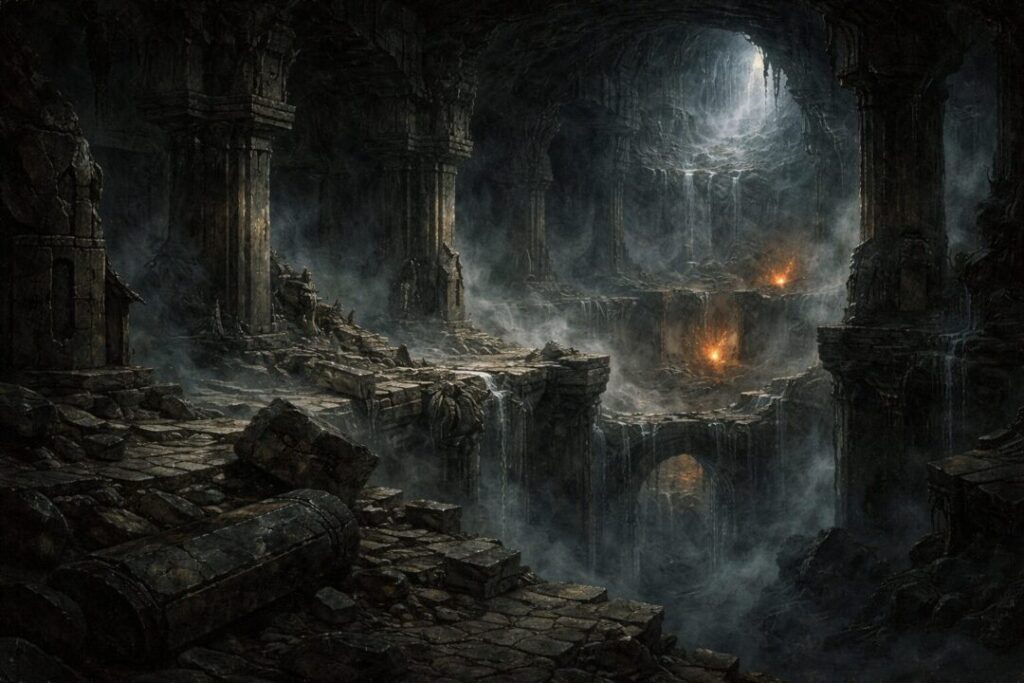
The Dwarves came to the Misty Mountains and founded Khazad-dûm, delving halls of stone beneath Celebdil, Fanuidhol, and Caradhras. Their city became the greatest of all Dwarven realms, unmatched in wealth, craft, and endurance.
They mined deep, but not yet too deep.
For thousands of years, the Balrog lay dormant beneath them. It did not rule Moria. It did not whisper to the Dwarves or bend their will. There is no sign in the texts that it exerted any influence at all.
This is important.
Durin’s Bane is not a corrupter like the Ring, nor a deceiver like Sauron. It does not seduce or poison slowly.
It waits.
Its silence is not strategy. It is instinct.
Above it, Khazad-dûm flourished. Mithril was discovered—silver light drawn from the bones of the mountain. Trade prospered. Halls expanded ever downward in pursuit of wealth and glory.
All the while, something ancient slept in the dark below.
“They Delved Too Deep”
The fall of Moria was not sudden, but its cause was.
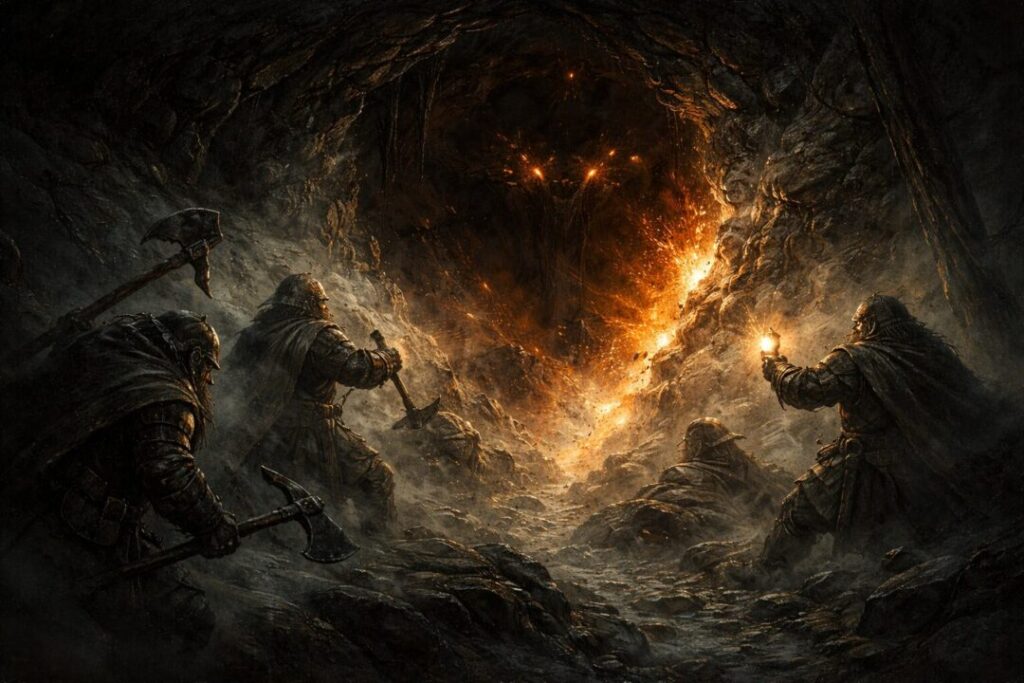
When the Dwarves finally breached the deepest barriers separating their mines from the primordial deeps, the result was immediate and catastrophic.
The Balrog awoke.
Not summoned.
Not commanded.
Awakened.
Fire and shadow poured into halls never meant to contain such forces. Kings were slain. The city was abandoned in terror. The Dwarves did not fight a war—they fled a disaster.
Durin VI fell. His son Náin I followed him soon after. The greatest Dwarven kingdom east of the Blue Mountains became a place of whispers and fear.
This was not conquest.
It was infestation.
The Balrog did not claim a throne or issue decrees. It simply existed, and that was enough to make Moria uninhabitable.
Why Orcs Came — And Why the Balrog Remained Hidden
In later centuries, Orcs crept into Moria’s ruins. They did not serve the Balrog, nor were they commanded by it. They were drawn by the vacuum left behind, settling in abandoned halls beneath a terror they could sense but did not control.
The Balrog allowed this, not out of alliance, but indifference.
It ruled the depths simply by being there.
And still, it did nothing more.
Why Durin’s Bane Did Nothing for Centuries After
One of the strangest aspects of Durin’s Bane is how inactive it remains after the fall of Moria.
It does not lead armies.
It does not march to war.
It does not join Sauron’s cause.
Why?
Because Balrogs are not Dark Lords.
They are relics.
Creatures of a vanished age whose time has passed. The world of the Third Age is smaller, quieter, and less capable of sustaining beings of such raw, elemental terror.
Durin’s Bane remains underground because that is the only place it still belongs.
The surface world has moved on without it.
A Horror Out of Time
When Gandalf finally confronts the Balrog, it is not a battle between equal participants in the present age.
It is a collision between eras.
Two survivors of the Elder Days meet in the ruins of a world that no longer has room for either of them. Their struggle echoes with the violence of the First Age, far removed from the quiet heroism of Hobbits and Men.
And when both fall into the abyss, something profound happens.
The last echo of Morgoth’s war is extinguished.
Not with a great war.
Not with a song.
But with fire quenched in darkness.
Why This Story Matters
The Balrog of Moria is not just a monster guarding a dungeon.
It is a reminder that Middle-earth is layered—built upon forgotten ages, buried horrors, and consequences that wait patiently for centuries before returning.
Durin’s Bane did not invade Moria.
It was there first.
And the world simply dug too deep.
Sources & Notes
- J.R.R. Tolkien, The Silmarillion, “Valaquenta” — identifies the Balrogs as Maiar spirits corrupted into Morgoth’s demons of fire and shadow.
- J.R.R. Tolkien, The Silmarillion, “Of the Voyage of Eärendil and the War of Wrath” — after Morgoth’s defeat, some Balrogs escaped and hid in deep places at the roots of the earth.
- J.R.R. Tolkien, The Lord of the Rings, Appendix A, “Durin’s Folk” — the Dwarves of Khazad-dûm delved for mithril, awoke Durin’s Bane in T.A. 1980, and lost Durin VI and Náin I.
- J.R.R. Tolkien, The Lord of the Rings, Book II, Chapter 5, “The Bridge of Khazad-dûm” — Gandalf names the Balrog of Moria as Durin’s Bane and confronts it on the bridge.
- J.R.R. Tolkien, The Lord of the Rings, Book III, Chapter 5, “The White Rider” — Gandalf’s account of the battle from Moria’s abyss to the peak of Zirakzigil shows the Balrog as an ancient power surviving in the deep world.