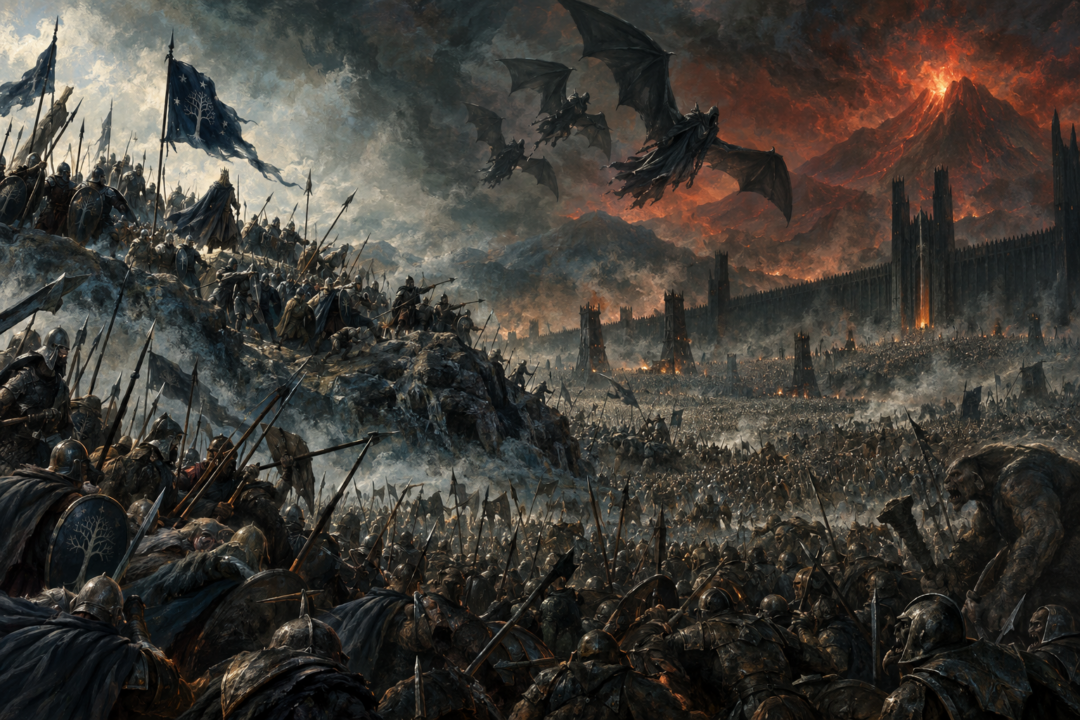
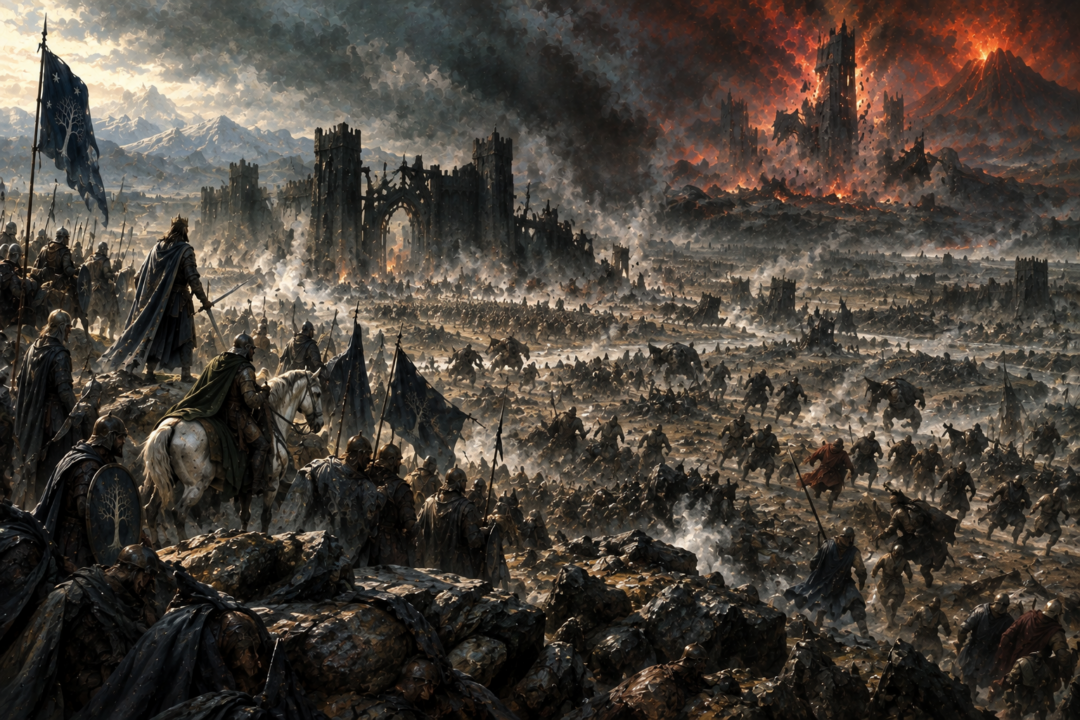
At the Black Gate, the Captains of the West are already losing when something stranger than reinforcements changes the battle.
Sauron has surrounded Aragorn's far smaller host. Orcs and Trolls press inward. Easterlings and Southrons fight alongside them. The Nazgûl circle above the battlefield, spreading terror. The march from Minas Tirith has achieved its real purpose—Sauron's attention has been drawn away from the two Hobbits approaching Mount Doom—but for the soldiers at Morannon, that success appears likely to end in annihilation.
Then the structure holding Mordor's war machine together begins to fail.
First Sauron's attention is wrenched away from the battle when Frodo claims the Ring in Sammath Naur. The Nazgûl abandon Morannon and race toward Orodruin. Moments later the Ring is destroyed. Sauron's power collapses, Barad-dûr falls, and his creatures scatter.
It looks like a sudden failure of morale. But the text suggests something deeper. Mordor has not merely lost a fortress or even a commander. It has lost the dominating will around which much of its military power was organized.
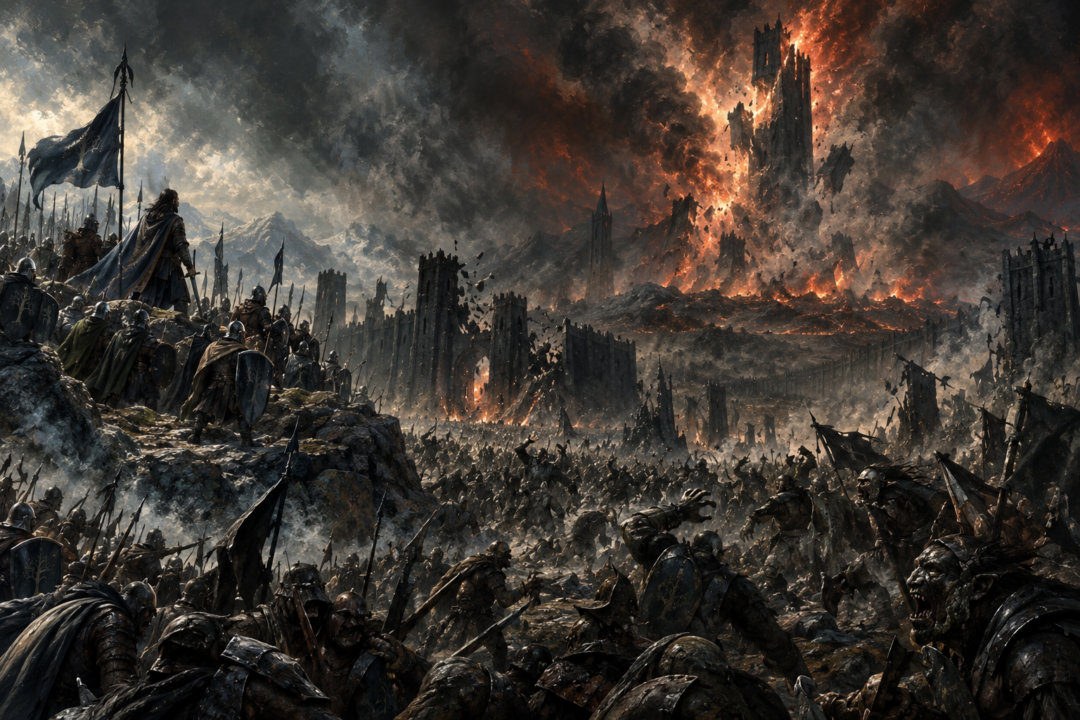
The Battle Was Designed Around Sauron's Attention
The Army of the West never marches to Morannon expecting to conquer Mordor conventionally.
After the Pelennor Fields, Aragorn, Gandalf, Éomer, Imrahil and the other leaders understand that their military victory has not altered the fundamental balance of power. Sauron still possesses forces vastly greater than theirs. The assault on the Black Gate is therefore deliberately sacrificial in character.
Its strategic purpose is deception.
The Captains hope Sauron will believe that Aragorn has obtained the One Ring and, swollen with confidence, is coming to challenge him. If Sauron concentrates on this apparent threat, Frodo and Sam may cross Mordor unnoticed.
The plan succeeds.
Sauron sends overwhelming forces against the western army. By the time battle is joined outside Morannon, Aragorn's host is encircled on two hills and facing destruction.
Yet this concentration creates an extraordinary vulnerability. Sauron has gathered enemies and servants alike around one decisive confrontation while personally directing his attention toward the supposed Ring-lord outside his Gate.
Then the real Ring reveals itself somewhere else.
The First Command Shock Comes Before Barad-dûr Falls
The disruption begins when Frodo puts on the Ring inside Mount Doom.
At that instant Sauron finally understands the deception.
The threat standing before the Black Gate was never the true danger. The Ring is inside the very mountain where it can be destroyed.
The effect at Morannon is immediate. Sauron's attention turns toward Orodruin, and the Nazgûl are summoned away from the battlefield. The forces attacking the West falter. The Orcs' triumph turns to uncertainty, while their human allies hesitate.
This matters because the Nazgûl are more than battlefield monsters.
Throughout the War of the Ring they act as powerful agents of Sauron's authority. They carry his commands, direct operations and weaponize supernatural terror. Their sudden departure therefore removes important instruments of command and psychological domination at exactly the moment Sauron's own attention is elsewhere.
For a brief interval, Mordor's army still physically exists, but the intelligence guiding it has been disrupted.
The destruction of the Ring turns that disruption into catastrophe.
Barad-dûr's Fall Is the Visible Collapse of Sauron's System
When the Ring perishes, Sauron is not simply killed like a mortal general.
The power he invested in the Ring is lost beyond recovery, leaving him unable ever again to take effective shape or dominate Middle-earth as he had done. At the same moment, the physical symbols of his rule collapse.
Barad-dûr falls. The Towers of the Teeth and the Black Gate are thrown down amid the convulsion of Mordor.
The fall of Barad-dûr is therefore important at Morannon not because the fortress must be imagined as a conventional headquarters full of officers issuing tactical orders. The texts do not provide that kind of detailed command structure, and it would go beyond the evidence to invent one.
Its significance is greater.
Barad-dûr is the seat of Sauron's power, and its destruction visibly announces that the power behind Mordor's entire military system has vanished.
The battlefield has lost its Dark Lord, his Ring, his Ringwraiths and the physical center of his realm almost simultaneously.
There is no replacement.
Mordor's Army Was Not One Uniform Kind of Force
What happens next reveals something crucial about Sauron's armies.
Not everyone reacts in the same way.
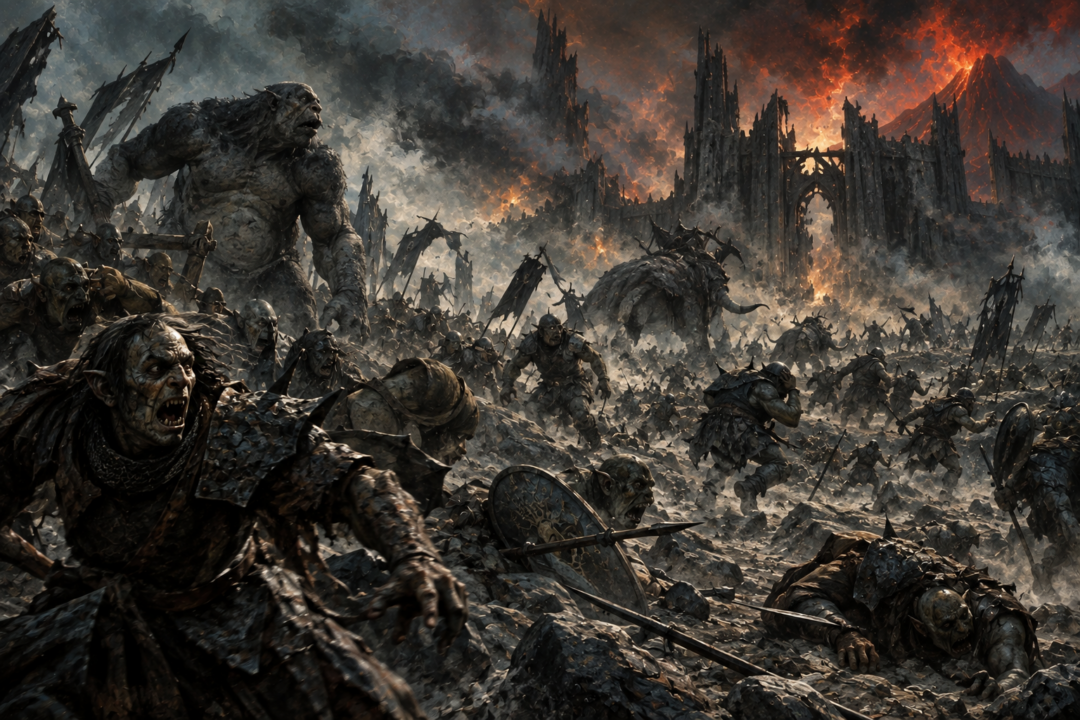
The Orcs, Trolls and "spell-enslaved" beasts are described as becoming effectively purposeless. The narrative compares Sauron's creatures to ants whose controlling central presence has suddenly been destroyed. They run about without direction; some flee into hiding, while others destroy themselves.
That language makes the collapse more than an ordinary rout.
The texts do not establish that every Orc was literally receiving Sauron's moment-to-moment mental commands. Nor should the scene be reduced to a simple magical hive mind. Orcs elsewhere display individual speech, quarrels, ambitions and independent decisions.
But at Morannon, Sauron's overthrow clearly removes a dominating power that had been holding his creatures in coordinated service.
The human forces respond differently.
Easterlings and Southrons Prove the Difference
The Men fighting for Sauron do not simply become mindless when he falls.
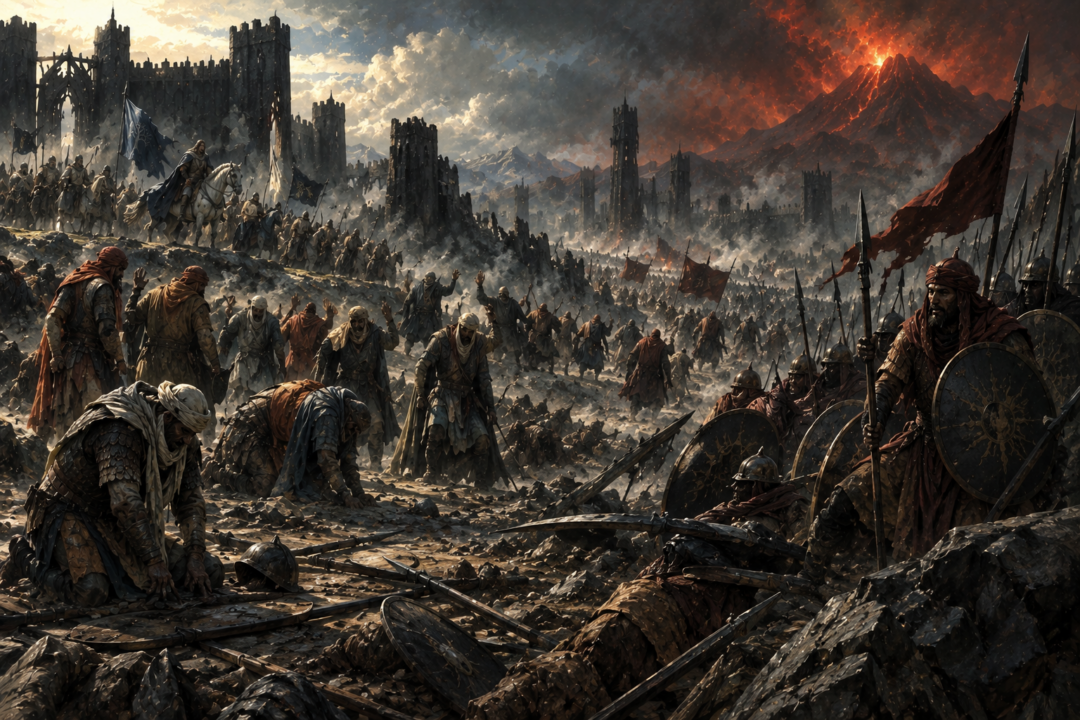
Some flee eastward. Some throw down their weapons and ask for mercy. Others—especially those portrayed as deeply committed to Sauron's cause—gather themselves for a final desperate resistance.
That contrast is one of the most revealing details in the entire battle.
If Barad-dûr's destruction merely transmitted a universal magical "retreat" command, everyone should behave alike. They do not.
The Orcs, Trolls and enslaved creatures suffer catastrophic disorientation. Men retain enough independent will to evaluate what has happened and choose among flight, surrender and continued battle.
This is why "command vacuum" is a useful description, provided it is used carefully.
Sauron's fall does not erase every hostile soldier's capacity for action. It destroys the central power capable of turning Mordor's enormously varied forces into one coherent instrument.
Afterward, local groups can still fight.
Mordor can no longer fight as Mordor.
Aragorn's Army Suddenly Has the Advantage That Matters
Minutes earlier, numbers overwhelmingly favored Sauron.
After the Ring's destruction, numbers become far less important because the two armies are no longer functioning in comparable ways.
The West still has Aragorn.
It still has Éomer, Imrahil and its other captains. Units still recognize their leaders. Commands can still be issued. Soldiers still understand the cause for which they are fighting.
The opposing army has lost the will at the center of its entire war.
That is why the battlefield can reverse so quickly without requiring the Host of the West suddenly to become physically stronger.
Its command system survives the crisis.
Sauron's does not.
The surviving Men of Rhûn and Harad who continue resisting can form localized pockets of opposition, but there is no higher authority capable of reorganizing the scattered armies into a new battle plan. No second Dark Lord assumes command. No Nazgûl remains to rally them. No order arrives from Barad-dûr.
The hierarchy terminates in emptiness.
The Victory Still Requires Fighting
It would be misleading to say that every enemy simply runs away when the Tower falls.
Some of Sauron's human allies make a last stand, and the Captains of the West must still deal with the remaining battle. The end of Sauron's command does not instantly end every sword-stroke.
But strategically, the war has already changed beyond recovery.
Gandalf can leave "matters of battle and command" to Aragorn and the other lords and depart with Gwaihir toward Mount Doom. That detail quietly demonstrates how complete the reversal has become.
Before the Ring's destruction, the West is surrounded and facing death.
Afterward, its surviving commanders are sufficiently in control that Gandalf can turn his attention to finding Frodo and Sam.
The battlefield has not become peaceful.
It has become manageable.
The Greatest Fortress in Mordor Was Never the Real Center
There is a final irony in Barad-dûr's destruction.
The Dark Tower appears to be the ultimate expression of Sauron's strength: enormous, fortified and dominating the land around it. Yet its survival depends upon something much smaller.
The Ring.
The foundations of Barad-dûr had been made with the power of the Ring, and when that power is undone the fortress cannot endure. The same pattern is reflected, less mechanically but just as dramatically, in Sauron's armies.
His empire looks vast because its visible structures are vast—fortresses, gates, armies, Trolls, siege engines and subject peoples.
But its unity depends upon Sauron.
Once that central will disappears, the apparent solidity of Mordor proves deceptive.
The Tower falls.
The Gate falls.
The Nazgûl perish.
The enslaved creatures scatter.
The human allies make their own separate choices.
And an army that had moments earlier surrounded the Captains of the West ceases to exist as a unified strategic force.
That is the hidden military significance of Barad-dûr's destruction at Morannon. The fortress does not simply collapse in the distance as a symbol that the heroes have won. Its fall coincides with the destruction of the system that made Sauron's overwhelming numbers useful.
Aragorn wins the final battlefield not because he somehow destroys Mordor's entire army.
He is still commanding an army when the enemy ceases to have a master capable of commanding an empire.
Sources & Notes
- The Encyclopedia of Arda, “Barad-dûr” — https://www.encyclopedia-of-arda.com/b/baraddur.php
- The Encyclopedia of Arda, “Morannon” — https://www.encyclopedia-of-arda.com/m/morannon.php
- The Encyclopedia of Arda, “Sauron” — https://www.encyclopedia-of-arda.com/s/sauron.php
- The Encyclopedia of Arda, “Mordor” — https://www.encyclopedia-of-arda.com/m/mordor.php
Reference entries document the people, places, events, and textual details discussed in this article.