The Silmaril that Beren once cut from Morgoth’s iron crown eventually came back into his hands under circumstances almost as violent as those in which he first won it.
This time there was no journey into Angband. The enemy was retreating from Doriath.
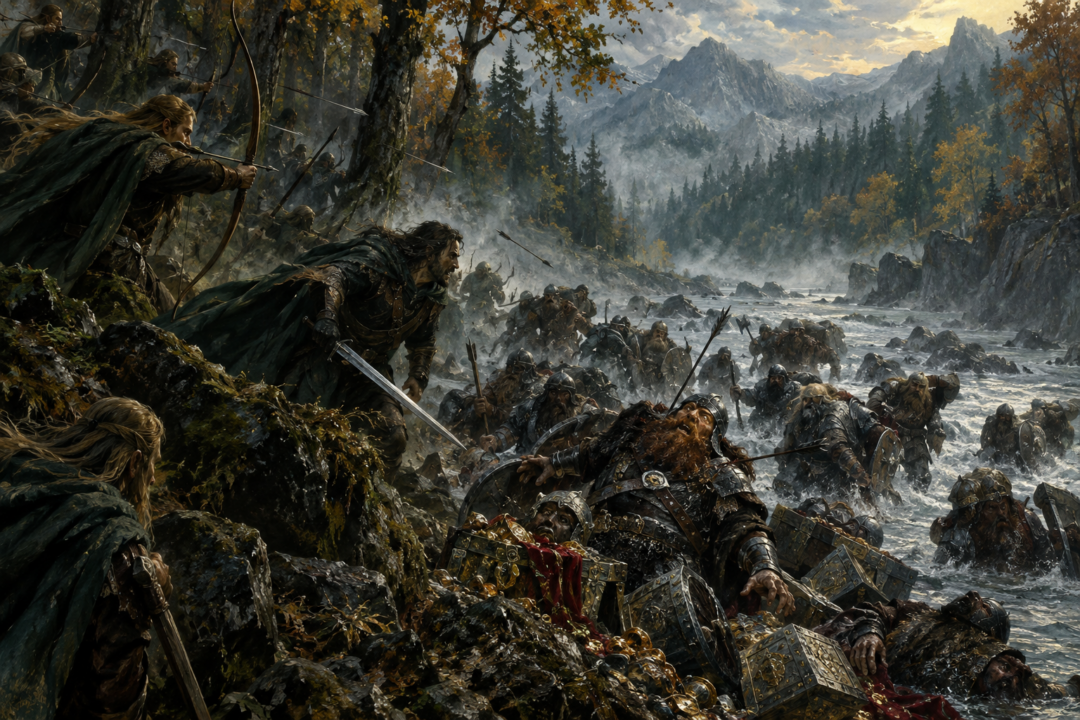
After the Dwarves of Nogrod sacked Menegroth, they carried its treasures eastward toward the Blue Mountains. Beren came north from his secluded life with Lúthien in Ossiriand, gathered Green-elves, and waited for the returning host at Sarn Athrad, the Ford of Stones. The ambush was devastating. The Dwarven force was destroyed, its lord slain, and the Nauglamír with the Silmaril recovered.
It sounds like the ending of a restoration story.
It was not.
The crucial distinction is that Beren could recover what had been carried out of Doriath, but he could not recover what had made Doriath what it was. Thingol was dead. Melian had departed. The Girdle that had protected the kingdom was gone. Menegroth had been plundered and its people devastated.
Sarn Athrad avenged a catastrophe. It did not reverse one.
Doriath Had Already Lost More Than Treasure
To understand the limits of Beren's victory, the sequence begins with Thingol.
After the Silmaril was recovered from the wolf Carcharoth, it remained with Thingol in Doriath. Later, the king commissioned Dwarven craftsmen to set it in the Nauglamír, the famed Necklace of the Dwarves. The dispute that followed ended in Thingol's death.
That death was far more consequential than the loss of a king.
Melian, Thingol's queen, was one of the Maiar. For long ages her power had maintained the Girdle of Melian around Doriath, preventing hostile outsiders from entering the protected realm except through a fate and power greater than her own.
After Thingol's death, Melian withdrew from Middle-earth.
With her departure, the protection surrounding Doriath vanished.
That meant the later army from Nogrod did not merely find a kingdom whose ruler happened to be dead. It found a realm from which one of its defining supernatural defenses had disappeared.
The Dwarves entered Doriath, fought its people, plundered Menegroth, and departed carrying its wealth.
By the time Beren acted, therefore, Doriath's disaster had already occurred on several different levels: its king was dead, its queen was gone, its ancient protection had ended, many of its people had been slain, and its capital had been despoiled.
Gold could be intercepted on a road.
None of those losses could.
Why Sarn Athrad Was the Perfect Place for an Ambush
The Dwarves still had to get home.
Their road east led toward the Blue Mountains, crossing the River Gelion at Sarn Athrad, the Ford of Stones. Beren learned what had happened and came north with Dior and many of the Green-elves of Ossiriand.
The circumstances strongly favored an ambush.
The Dwarven host had already fought in Doriath and was returning burdened with captured treasure. As the Dwarves crossed the river and climbed its banks, the concealed attackers struck.
The account emphasizes surprise. Elven horns sounded from the woods and arrows came upon the Dwarves from around them. Many fell in the initial attack.
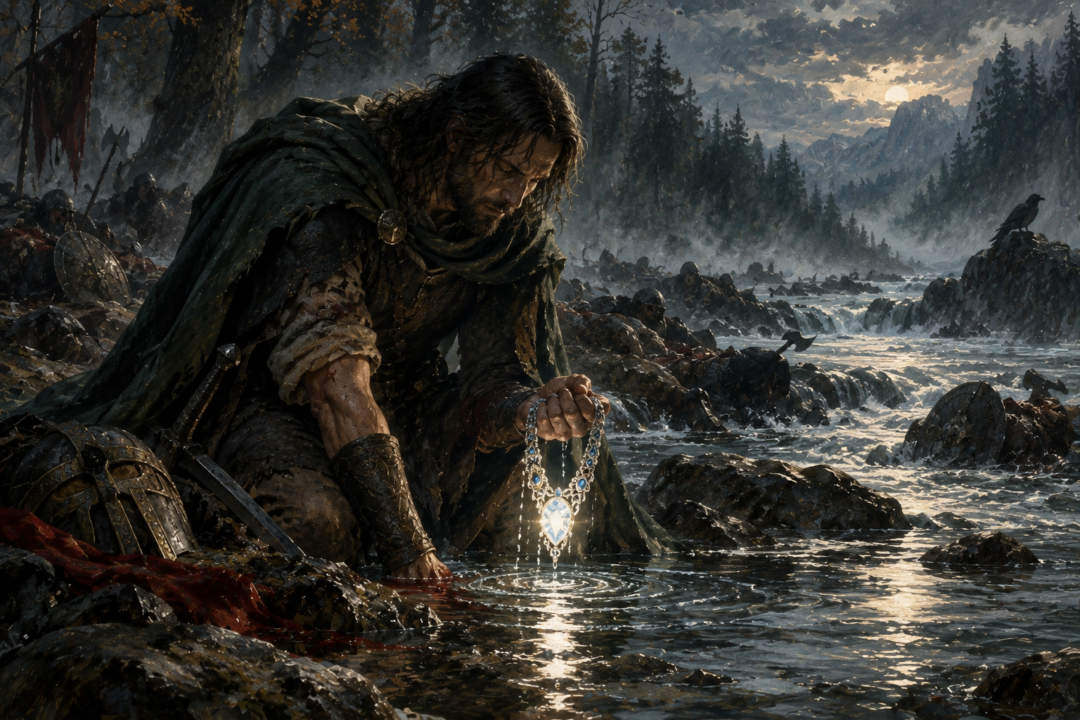
Beren himself fought in the battle, described as his last fight, and slew the Lord of Nogrod. From him he recovered the Nauglamír.
Some Dwarves escaped the immediate slaughter and fled east toward the mountains, but even they did not reach safety. As they approached the slopes beneath Mount Dolmed, the Shepherds of the Trees came against them and drove them into the woods. The narrative says that none returned over the high passes to their homes.
The army that had sacked Menegroth was effectively annihilated.
Militarily, Beren's retaliation was overwhelming.
Politically, it solved remarkably little.

The Treasure Is Recovered — and Then Thrown Away
The treatment of Doriath's recovered treasure makes the point especially sharply.
The Lord of Nogrod, dying, laid a curse upon the treasure. After the battle, the wealth taken from Doriath was cast into the River Ascar. The river thereafter received the name Rathlóriel, the Goldenbed.
Beren kept one extraordinary object: the Nauglamír containing the Silmaril.
He washed the blood from it and carried it back to Lúthien at Tol Galen.
So it would be misleading to imagine Beren marching triumphantly into Menegroth with carts of recovered wealth to refill Thingol's halls. The bulk of the treasure does not become the financial foundation of a rebuilt kingdom. It disappears beneath the river.
And the greatest treasure of all does not initially return to Doriath either.
The Nauglamír goes with Beren to Lúthien.
For a time, the Silmaril that had stood at the center of Doriath's catastrophe shines instead in the remote country where Beren and Lúthien spend their second lives.
That separation matters. The recovery at Sarn Athrad and the restoration attempted in Doriath are related events, but they are not the same event.
Dior Could Inherit a Crown, but Not Thingol's Doriath
The task of returning to Menegroth fell instead to Dior.
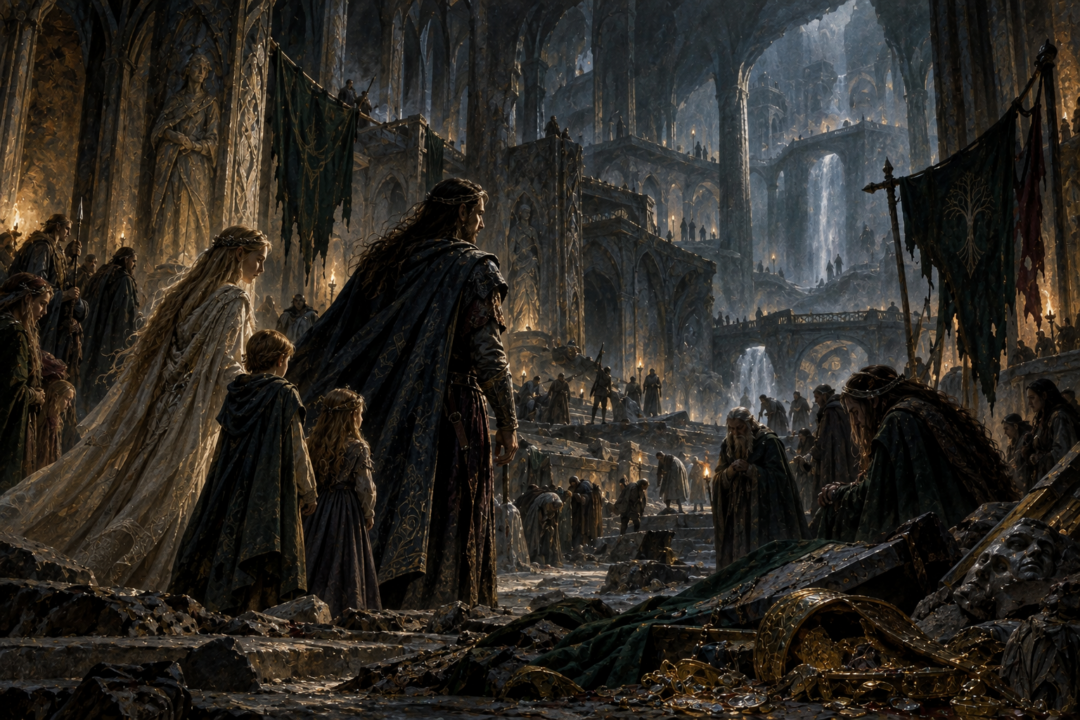
Dior was Beren and Lúthien's son and Thingol's heir. After Sarn Athrad he departed for Doriath with his wife Nimloth and their children. The surviving Sindar welcomed them, and Dior attempted to raise the kingdom again from its grief.
This is the closest the story comes to a restoration.
But "restoration" needs qualification.
Dior could occupy Menegroth. He could inherit Thingol's royal line. He could gather survivors and renew hope among a people who had lost their king and queen.
He could not recreate the conditions under which old Doriath had existed.
Most importantly, Melian did not return.
The Girdle of Melian had been one of Doriath's great strategic realities. For centuries the kingdom's security was inseparable from the presence and power of its queen. Dior inherited Thingol's realm without inheriting Melian's power.
That makes his renewed Doriath fundamentally more vulnerable than the kingdom that preceded it.
The old realm had been protected by something no ordinary army, fortification, or royal succession could reproduce.
Dior was rebuilding inside the ruins of a world whose central safeguard had disappeared.
The Silmaril Returns — and Brings Another Danger
There is a further tragic irony.
Eventually the Nauglamír did come to Dior.
Its arrival served as the sign that Beren and Lúthien had died their final deaths. Dior then possessed the necklace and the Silmaril.
For Doriath, this might look like the final piece of restoration: Thingol's heir ruling in Menegroth while once again possessing the jewel that had belonged to his grandfather.
Instead, the Silmaril exposed the kingdom to another unresolved claim.
The Sons of Fëanor remained bound by their oath concerning the Silmarils. When they learned that Dior possessed the jewel, they demanded it from him.
Dior gave no answer.
The result was another assault upon Doriath: the Second Kinslaying.
Dior was killed, as was Nimloth. Celegorm, Curufin, and Caranthir also fell. Dior's young sons Eluréd and Elurín were seized and abandoned in the forest by servants of Celegorm; the text leaves their fate as death in the woods. Elwing escaped with survivors and ultimately carried the Silmaril away.
Thus the jewel recovered by Beren survived.
Doriath did not.
Sarn Athrad Wins Justice of a Kind, Not Reversal
This is why the battle works so powerfully as an aftermath rather than a rescue.
Beren accomplishes exactly what force can still accomplish.
The army responsible for carrying away Doriath's wealth is intercepted. The Lord of Nogrod falls. The Nauglamír and Silmaril are recovered. The surviving enemy does not escape to enjoy the fruits of Menegroth's destruction.
But none of that makes the previous events unhappen.
Beren cannot bring Thingol back.
He cannot call Melian back from the West.
He cannot restore the Girdle.
He cannot return the slain Elves of Doriath to life.
He cannot make Menegroth untouched again.
Even the material treasure proves largely unusable as restoration: it is cast into the river rather than brought home.
The distinction is one that appears repeatedly throughout the history of Middle-earth. Victory over the agent of destruction does not necessarily heal what that agent destroyed.
Sarn Athrad is an unusually concentrated example.

Beren's Last Battle Is Therefore a Bitter Victory
There is something fitting about this being Beren's final recorded battle.
His greatest earlier deed had been to recover a Silmaril from the place where recovery seemed impossible. He entered Morgoth's stronghold with Lúthien and returned with one of the Great Jewels.
At Sarn Athrad he recovers that same Silmaril again.
Yet the second recovery demonstrates the limits of heroic action more clearly than the first.
The jewel can be reclaimed because it is an object. A retreating army can be defeated because it can be caught. A stolen necklace can pass from one hand to another.
A kingdom is different.
Doriath was not merely Thingol's treasury beneath the earth. It was a people, a royal house, Melian's presence, the safety created by her Girdle, and the long continuity of a realm that had endured through much of the First Age.
Once those things were broken apart, possession of the old treasures could not simply assemble them again.
Dior tried to raise Doriath anew, and for a brief time hope returned to Menegroth. But what he ruled was already a more fragile realm, and the Silmaril itself soon drew another catastrophe toward it.
That is the deeper consequence of Sarn Athrad.
Beren wins the battle. He recovers the greatest piece of the plunder. The Dwarves who sacked Menegroth do not carry their victory safely home.
But the old Doriath had already ended.
Sarn Athrad could punish its destroyers.
It could not turn history backward.
Sources & Notes
- The Encyclopedia of Arda, “Beren” — https://www.encyclopedia-of-arda.com/b/beren.php
- The Encyclopedia of Arda, “Sarn Athrad” — https://www.encyclopedia-of-arda.com/s/sarnathrad.php
- The Encyclopedia of Arda, “Nauglamír” — https://www.encyclopedia-of-arda.com/n/nauglamir.php
- The Encyclopedia of Arda, “Doriath” — https://www.encyclopedia-of-arda.com/d/doriath.php
Reference entries document the people, places, events, and textual details discussed in this article.