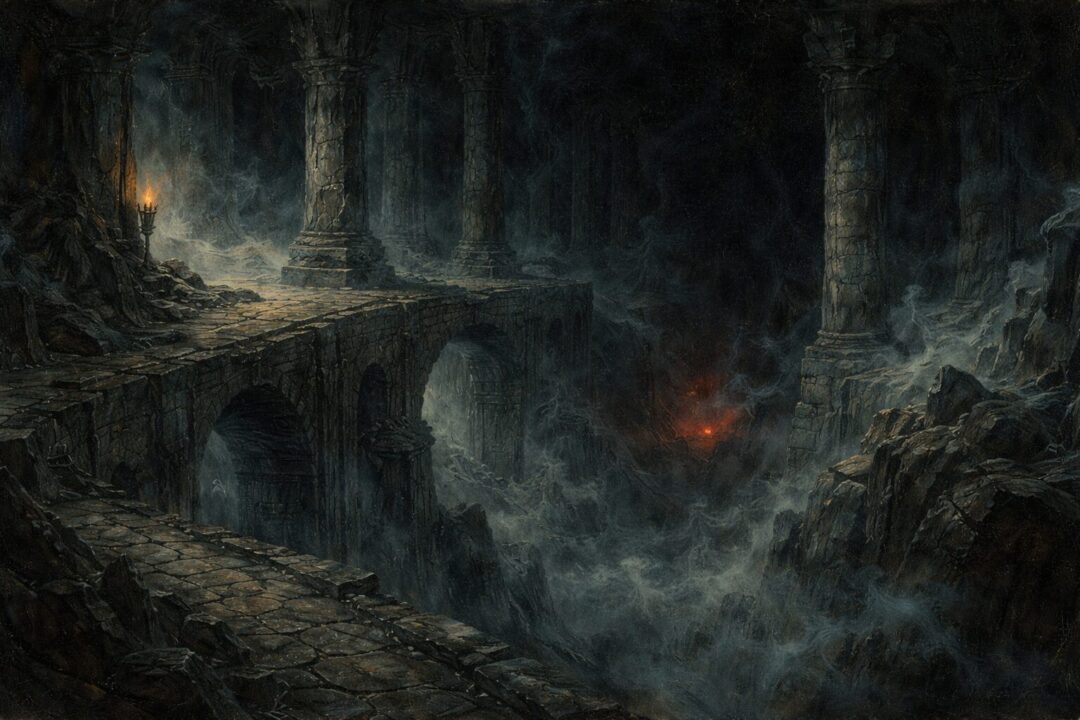
Moria is often treated as a single catastrophe.
A city delved too deep.
A monster awakened.
A kingdom destroyed.
It is a neat version of events—simple, dramatic, and easy to remember.
But it is not the whole truth.
Because Moria did not fall once.
It fell, was abandoned, and then—quietly—fell again.
And that second failure is the reason the truth remained buried for so long.
The First Silence: The Fall of Khazad-dûm
When the Dwarves awakened Durin’s Bane in the depths of Khazad-dûm, the city did not collapse overnight.
There was no final siege.
No last stand sung into memory.
No moment that forced the outside world to reckon with what had happened.
Instead, the disaster unfolded slowly.
First came the death of King Durin VI, slain by the terror that had stirred beneath the mountain. Years later, his son Náin Imet the same fate.
Only then did the Dwarves abandon the city.
This matters, because it means there was no sudden flood of refugees carrying a clear account of the horror. The withdrawal was gradual, grim, and heavy with uncertainty.
The survivors fled east and west, bearing fear—but very little clarity.
They knew something ancient had awakened.
They knew it could not be defeated by arms.
But even among them, the true nature of the terror was poorly understood.
And Dwarves do not speak easily of shame.
To admit what had been unleashed beneath their greatest city would have meant admitting fault—not just a mistake, but a wound to their deepest pride.
So the story dimmed.
What could not be named was left vague.
What could not be faced was left behind.
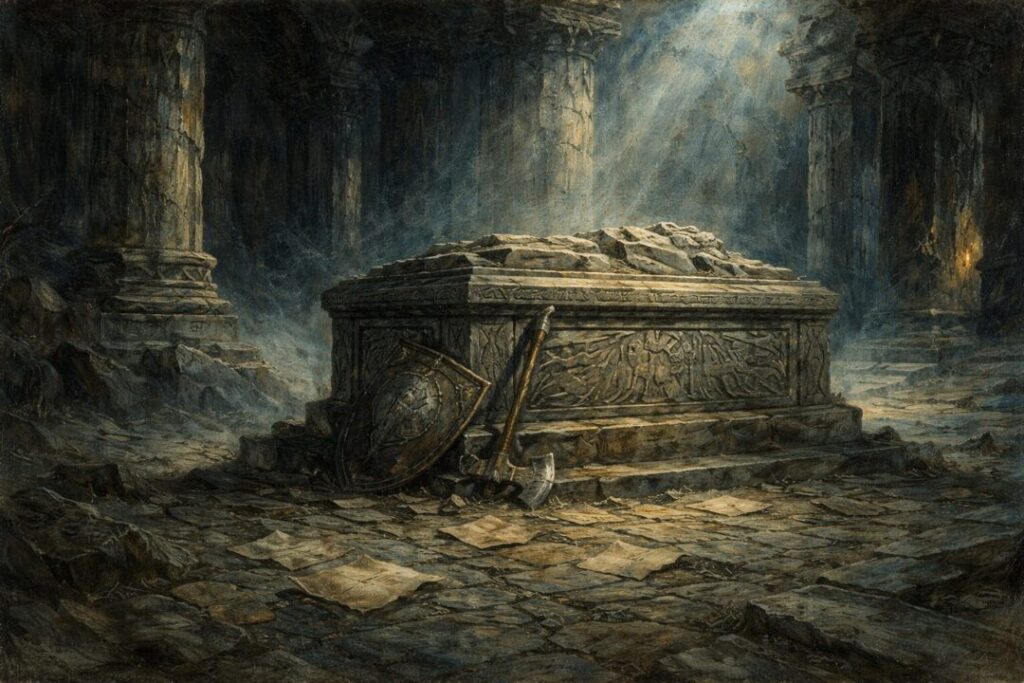
Centuries of Avoidance, Not Investigation
Khazad-dûm was not hidden from the world.
It lay beneath a major mountain pass. Elves once walked its halls freely. Trade had flowed through its gates for generations.
And yet, once the Dwarves left, others stayed away.
Orcs moved in.
Dark things gathered.
And curiosity slowly gave way to fear.
This is one of the quiet truths of Middle-earth: knowledge does not spread where people refuse to go.
No army marched to reclaim the city.
No council demanded a full accounting of its fall.
No great effort was made to uncover the truth.
Instead, Moria became a place people avoided—not a mystery they sought to solve.
Over time, certainty eroded into rumor.
Drums in the deep.
Shadows beneath stone.
A nameless terror sleeping in the dark.
Each retelling grew less precise. Fear replaced fact.
Then Balin Returned — and Changed Everything
Nearly a thousand years later, something extraordinary happened.
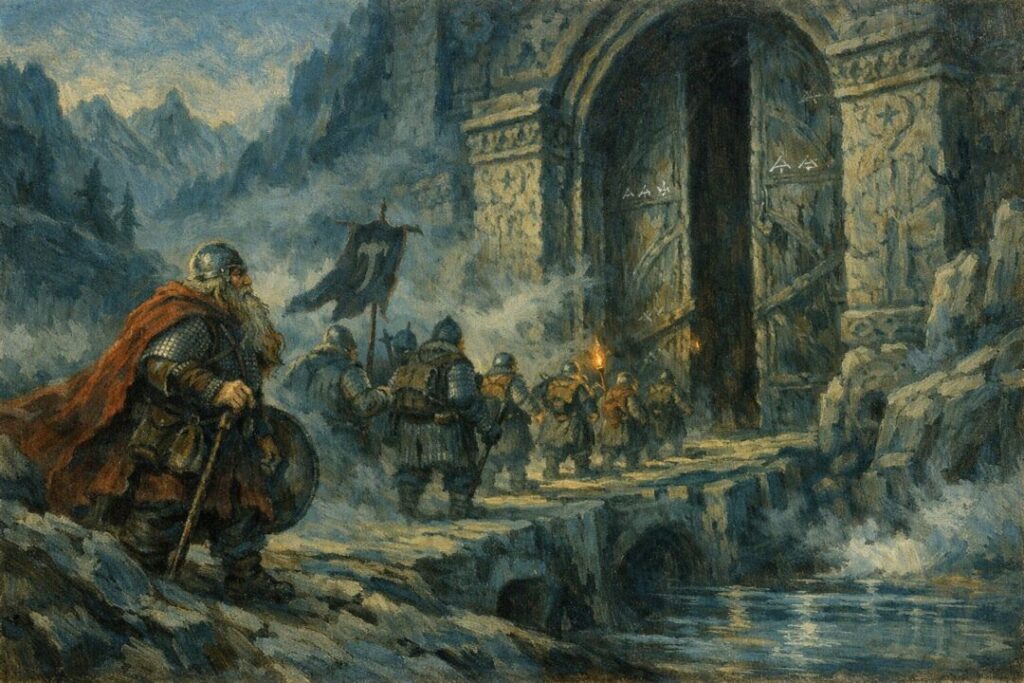
Balin, lord of the Dwarves of Erebor and a veteran of earlier adventures, led a small colony back into Moria.
This was not a secret mission.
News of the attempt spread. Hope followed.
For the first time in centuries, it seemed possible that the greatest Dwarven city might be reclaimed. If Balin succeeded, Khazad-dûm could live again—not as legend, but as home.
For a time, there were even signs of success.
The West-gate was opened.
Halls were explored.
A foothold was established.
And then… nothing.
No messengers returned.
No trade resumed.
No confirmation—good or ill—ever reached the outside world.
Only silence.
And this second silence was worse than the first.
Because now there had been hope.
Why Balin’s Failure Explained Nothing
When the Fellowship later enters Moria, they find the truth locked behind stone.
Balin is dead.
His colony destroyed.
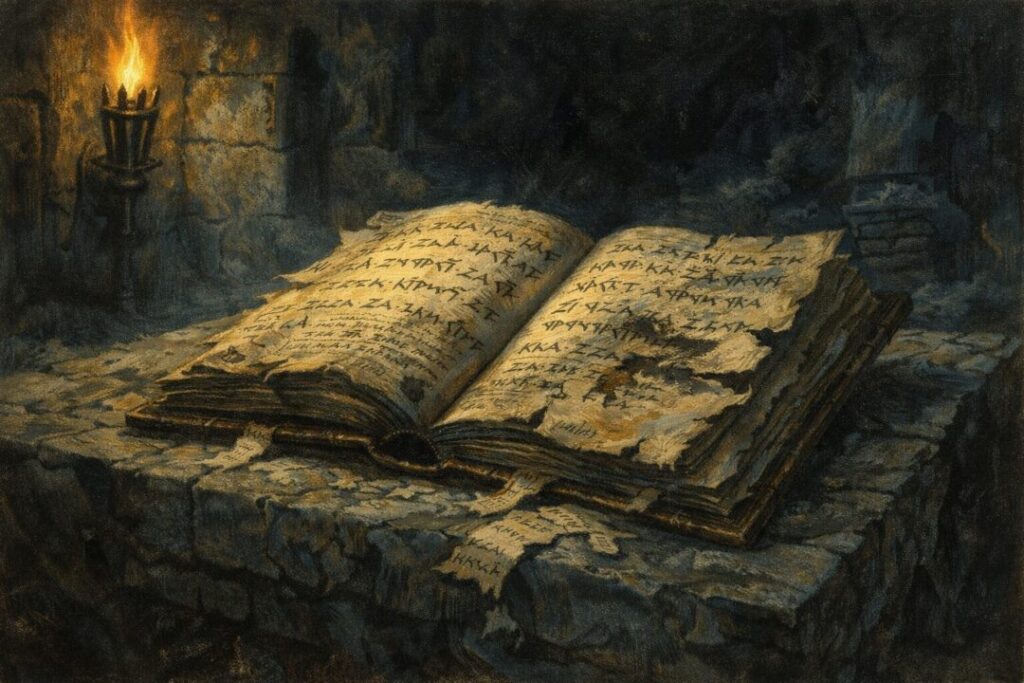
And the only surviving account—the Book of Mazarbul—ends abruptly in fear and confusion.
What is striking is not only what the record contains, but what it does not.
The Dwarves write of Orcs.
They record the Watcher in the Water.
They speak of being trapped, hunted, and driven inward.
But they never name Durin’s Bane.
They never describe a Balrog.
They never show clear understanding of what truly stalks the depths.
Even within Moria itself, the deepest truth remains hidden.
The terror that destroyed Khazad-dûm is still unnamed, even by those who die beneath its shadow.
This is crucial.
It means that Balin’s colony did not fail with full knowledge of its enemy. They were worn down by visible threats while something far greater remained unseen.
No Survivors Means No Answers
This is the key reason knowledge never spread.
Balin’s colony did not fall in a single battle that produced witnesses. It was eroded over time.
Attacks increased.
Routes were cut off.
Retreat became impossible.
The Dwarves were driven deeper into the city, cornered, and finally extinguished.
No one escaped to carry the full account back to Erebor or beyond.
So the outside world was left with questions—but no voices to answer them.
Silence does not invite understanding.
It invites assumption.
And assumption hardens into myth.
Why Even the Wise Knew So Little
By the time of the Council, all that was truly known was this:
- Khazad-dûm had fallen long ago
- Balin had entered and vanished
- Moria was once again sealed and avoided
Some suspected what Durin’s Bane truly was.
But suspicion without confirmation fades into legend.
In Middle-earth, ancient evils belong to the past unless proven otherwise. A terror from the First Age surviving into the present strains belief—even among the Wise.
The truth was not merely forgotten.
It was physically buried—behind locked doors, beneath miles of stone, guarded by fear and distance.
Moria Was Lost by Silence, Not Fire
This is what makes Moria different from other ruins in Middle-earth.
Its downfall was not witnessed.
Its horror was not fully explained.
Its warning was never clearly heard.
Twice, the Dwarves entered.
Twice, they vanished.
And twice, the world was left with echoes instead of answers.
Moria did not become a legend because people forgot it.
It became a legend because no one survived to tell the whole truth.
And sometimes, in Middle-earth, that is the most dangerous fate of all.
Sources & Notes
- J.R.R. Tolkien, The Lord of the Rings, Appendix A, “Durin’s Folk” — records Durin VI and Náin I slain by Durin’s Bane, the abandonment of Khazad-dûm, and Balin’s later return.
- J.R.R. Tolkien, The Silmarillion, “Of the Rings of Power and the Third Age” — summarizes how the Dwarves of Moria uncovered the hidden Balrog and fled from its terror.
- J.R.R. Tolkien, The Lord of the Rings, Book II, Chapter 4, “A Journey in the Dark” — shows that no word from Balin’s colony had reached the outside world before the Fellowship entered Moria.
- J.R.R. Tolkien, The Lord of the Rings, Book II, Chapter 5, “The Bridge of Khazad-dûm” — the Book of Mazarbul gives the colony’s final, fragmentary record before the Balrog is revealed.