
When the armies of Sauron march west in The Lord of the Rings, they do not come from Mordor alone. Men arrive from the East and South, reminders that the War of the Ring is larger than the lands shown on familiar maps. Yet those distant peoples raise an obvious question: if Sauron possessed such enormous influence beyond Mordor, why were the armies of the East not even greater?
One of the most intriguing answers lies with the two Wizards who disappear almost completely from the history of the West.
The Blue Wizards are among Middle-earth’s great unresolved mysteries. In one strand of the writings, their mission appears to end badly—or at least under the shadow of possible failure. In a much later conception, however, their role changes dramatically. Instead of becoming lost missionaries on the edge of the story, they may have spent centuries weakening Sauron where western chronicles could scarcely see them.
The difference transforms what their disappearance into the East might mean.
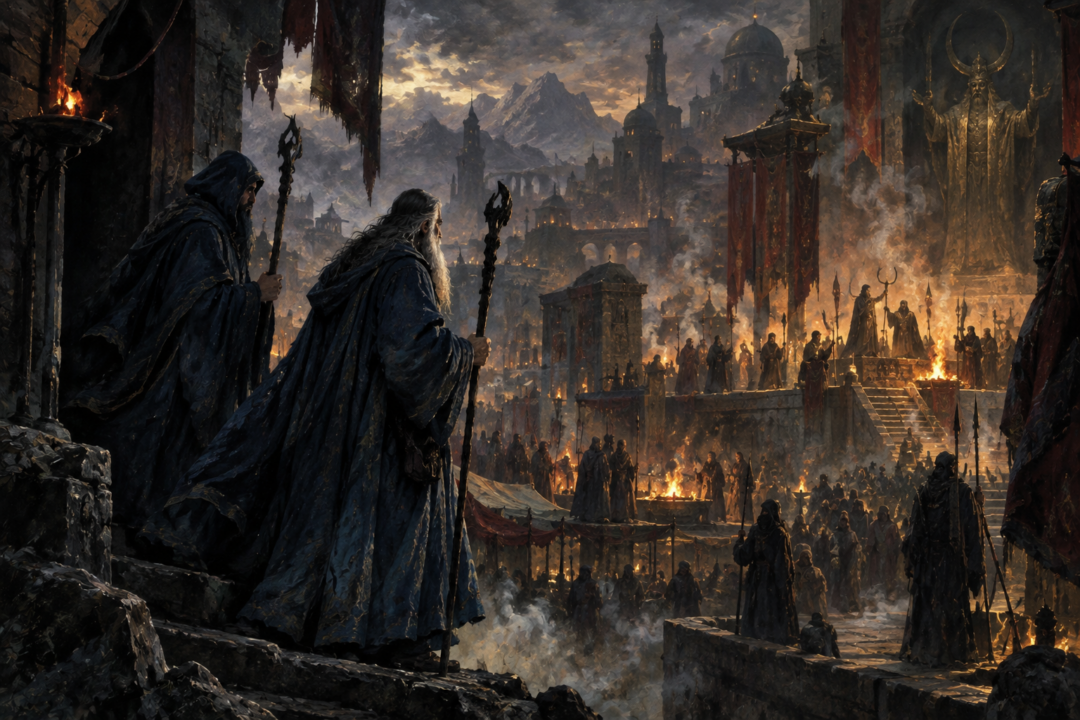
The Two Wizards Who Vanished From Western History
The Istari were emissaries sent to Middle-earth to oppose Sauron without simply conquering his servants through overwhelming supernatural force. Gandalf, Saruman, and Radagast are familiar because their stories intersect with the peoples of northwestern Middle-earth.
The other two did not.
In the account published in Unfinished Tales, they are collectively called the Ithryn Luin, the Blue Wizards, because of their sea-blue clothing. They pass into the East with Saruman, but unlike him they do not return to the western lands.
That geographical separation matters.
The surviving narratives of The Hobbit and The Lord of the Rings are overwhelmingly concerned with the Northwest: the Shire, Eriador, Rohan, Gondor, Mordor, and neighboring regions. What happened far beyond those lands could therefore be immensely important without appearing directly in the stories.
Even their names vary between different writings.
One tradition names them Alatar and Pallando. A much later set of notes calls them Morinehtar and Rómestámo, usually translated as “Darkness-slayer” and “East-helper.”
These are not simply two complete biographies that fit neatly together. They belong to different stages of the conception of the Wizards, and the differences between them are substantial.
The Earlier Picture Was Dark
The mysterious fate of the Blue Wizards initially carried a distinctly pessimistic possibility.
Unfinished Tales preserves uncertainty about what happened after they entered the East. They might have continued their appointed work. They might have died. They might even, according to speculation within the tradition, have been ensnared by Sauron.
A 1958 letter presents an even darker possibility.
There the two Wizards are imagined as emissaries to remote regions of the East and South, territories largely outside the experience of Númenórean and western history. Their mission is compared to work within lands already dominated by the Enemy.
But their success is explicitly uncertain.
The letter says, in cautious language, that they may have failed in ways different from Saruman and speculates that they could have become founders of secret cults and magical traditions that survived Sauron’s downfall.
That distinction is important: this is not a narrated canonical event in which readers actually see the Blue Wizards betray their mission. It is speculation about their unknown fate.
Nevertheless, the implication is bleak.
Saruman failed through pride, domination, and his desire to rival Sauron. The Blue Wizards, under this earlier possibility, might have suffered some different corruption in distant lands.
For decades, that became one of the most memorable explanations for their disappearance.
Yet the story did not remain there.
The Later Version Changes Almost Everything
Much later writings collected in The Peoples of Middle-earth offer a strikingly different conception.
Here the two Wizards are called Morinehtar and Rómestámo. More surprisingly, their arrival is moved backward from the Third Age to the Second Age, around the period when Sauron’s power was becoming extraordinarily dangerous.
Their mission is also described more specifically.
They were to work against Sauron beyond the main western fronts, assisting peoples who resisted the ancient domination associated with Melkor, encouraging opposition, and producing disruption among Sauron’s eastern power base.
They were also supposed, after Sauron’s first overthrow, to seek out his hiding place.
On that particular task, the notes say they failed.
So even the more favorable version does not turn them into flawless heroes.
But the larger judgment is dramatically more positive: their activities are said to have had very great influence on the Second and Third Ages by weakening and disorganizing the forces of the East.
That is the crucial change.
Their obscurity no longer means irrelevance.
It may mean that their battlefield was somewhere the western histories barely recorded.
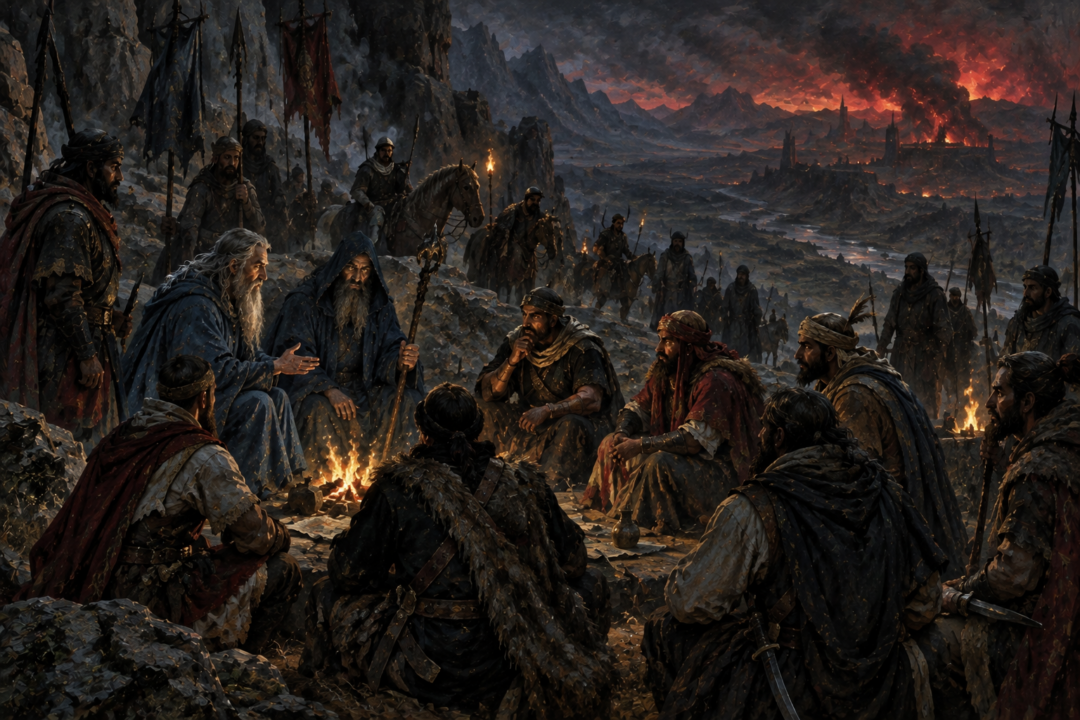
Sauron’s Greatest Resource Was Not Mordor Alone
Sauron’s strength depended on far more than Orcs gathered beneath the towers of Mordor.
The histories repeatedly show his ability to dominate, deceive, or recruit Men across enormous distances. Easterlings fought for the powers of darkness as early as the First Age, while in later ages Sauron extended his influence across eastern and southern Middle-earth.
The War of the Ring still shows that influence clearly. Easterlings and Haradrim fight for Sauron, and Mordor possesses enormous reserves of military manpower.
The later Blue Wizard conception does not claim that they liberated the East.
That would plainly go beyond the evidence.
Instead, their possible achievement is subtler and strategically more believable: they weakened Sauron’s ability to unite the eastern peoples completely behind him.
Rebellions, rival loyalties, resistant peoples, and political disorder could force the Enemy to spend strength controlling territories that might otherwise have supplied him with still larger armies.
The western heroes would never need to meet the Blue Wizards for this work to matter.
They would experience its consequences simply because certain armies never arrived.
The Hidden Mathematics of the War
This gives the later conception enormous strategic significance.
At the end of the Third Age, the West is already desperately outnumbered. Gondor has been diminished by centuries of war, plague, internal conflict, and demographic decline. Rohan can provide only a limited host. The northern Dúnedain are few. The great Elven realms are fading.
Sauron, meanwhile, has prepared for overwhelming conventional victory.
The destruction of the One Ring ultimately defeats him, but the military situation matters because Frodo and Sam need time to reach Mount Doom.
If Sauron had possessed vastly greater eastern forces, the already desperate defense of the West could have become even more impossible.
The late notes specifically connect the Blue Wizards with weakening forces that otherwise would have outnumbered the West still more severely.
This does not mean they secretly “won” the War of the Ring.
Frodo, Sam, Gollum, Gandalf, Aragorn, the defenders of Gondor, the Rohirrim, and many others remain indispensable within the narrative.
The more careful conclusion is that the Blue Wizards may belong to the enormous unseen network of resistance that prevented Sauron from bringing his full potential strength against them.
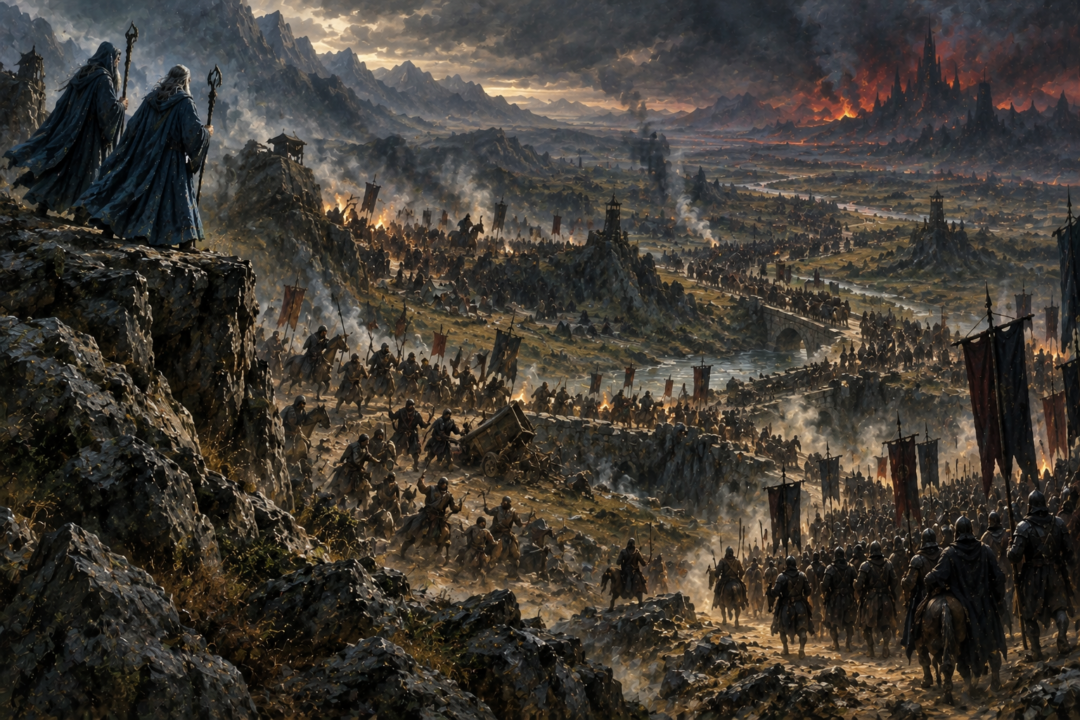
The East Was Never Simply Sauron’s
There is another important implication.
The peoples east and south of the familiar maps should not be treated as a single naturally evil civilization.
The texts show Men serving Sauron, but they also make clear that domination, deception, inherited hostility, and fear shaped his power over human societies. Sam’s famous reaction to the dead Southron in Ithilien reinforces this moral complexity: he wonders about the fallen man’s name, home, and whether he truly wished to come to war.
The later Blue Wizard material makes the picture even less uniform.
If they were helping peoples who had already resisted the religious and political legacy of the Dark Powers, then resistance existed inside regions usually seen by western characters primarily through enemy armies.
That means Sauron faced opposition on both sides of Mordor.
Gondor and its allies resisted him openly in the West.
Far away, other peoples may have resisted him without ever entering the chronicles preserved by Hobbits, Gondorians, or Elves.
The Blue Wizards become the connection between those two struggles.
Why Gandalf Could Succeed While Remaining Almost Ignorant of Them
One of the fascinating features of this interpretation is that the resistance to Sauron does not require a perfectly coordinated alliance.
Gandalf does not need regular reports from the Blue Wizards.
Aragorn does not need to know their strategy.
Elrond does not need eastern representatives sitting at his Council.
The Istari were sent into a vast world. Their missions could operate across different societies and centuries while serving the same ultimate purpose: resistance to Sauron.
Gandalf works largely through counsel, friendship, courage, and the free choices of others in the Northwest.
The later Blue Wizards appear to have pursued something comparable under radically different conditions—encouraging resistance among peoples living much closer to Sauron’s sphere of domination.
Their success, if this later conception is followed, was therefore almost invisible from the Shire or Gondor.
That invisibility is not evidence that nothing happened.
Success Does Not Mean Their Fate Is Known
There is still a major limit to what can responsibly be claimed.
No complete narrative tells us what Morinehtar and Rómestámo actually did.
We do not know which rulers they met, which peoples they aided, where they lived, how their resistance movements operated, or what ultimately became of them. Even the chronology differs between the earlier and later conceptions.
It would therefore be misleading to combine every version into one seamless biography.
The strongest conclusion is narrower.
An earlier conception leaves the Blue Wizards’ fate uncertain and entertains the possibility that they failed or became corrupted. A much later conception instead assigns them an important mission against Sauron in the East and judges their influence on the Second and Third Ages to have been substantial, despite at least one acknowledged failure.
That is an extraordinary reversal.
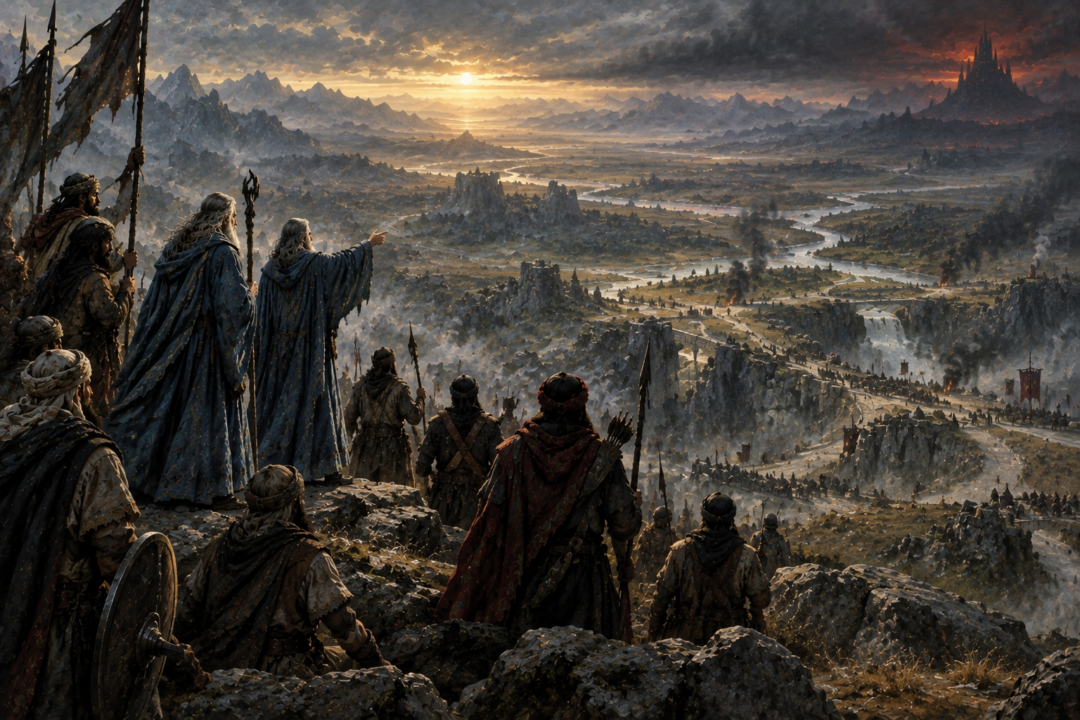
Middle-earth May Have Been Saved by People Its Heroes Never Knew
The Blue Wizards become most compelling when viewed not as missing members of Gandalf’s adventuring party, but as evidence of how enormous the struggle against Sauron really was.
The War of the Ring follows a tiny geographical and narrative window.
Beyond it were kingdoms, tribes, wars, rebellions, alliances, religions, and histories that the people of the West scarcely understood.
In the darker conception, two Wizards vanished into that unknown world and may have lost themselves there.
In the later conception, they vanished because that unknown world was precisely where they were needed.
They could not destroy Sauron. They did not apparently break his power over every eastern people. They even failed to discover him during one stage of their mission.
But they may have accomplished something less spectacular and strategically vital: ensuring that Sauron never commanded the East as completely as he wished.
If so, when the Captains of the West stood before the Black Gate believing themselves hopelessly outnumbered, the imbalance might have been far worse.
Somewhere far beyond their knowledge, resistance may already have been fighting the same Shadow for centuries.
And two forgotten Wizards in sea-blue may have helped keep that resistance alive.
Sources & Notes
- The Encyclopedia of Arda, “Blue Wizards” — https://www.encyclopedia-of-arda.com/b/bluewizards.php
- The Encyclopedia of Arda, “Istari” — https://www.encyclopedia-of-arda.com/i/istari.php
- The Encyclopedia of Arda, “Rhûn” — https://www.encyclopedia-of-arda.com/r/rhun.php
- The Encyclopedia of Arda, “Haradrim” — https://www.encyclopedia-of-arda.com/h/haradrim.php
Reference entries document the people, places, events, and textual details discussed in this article.