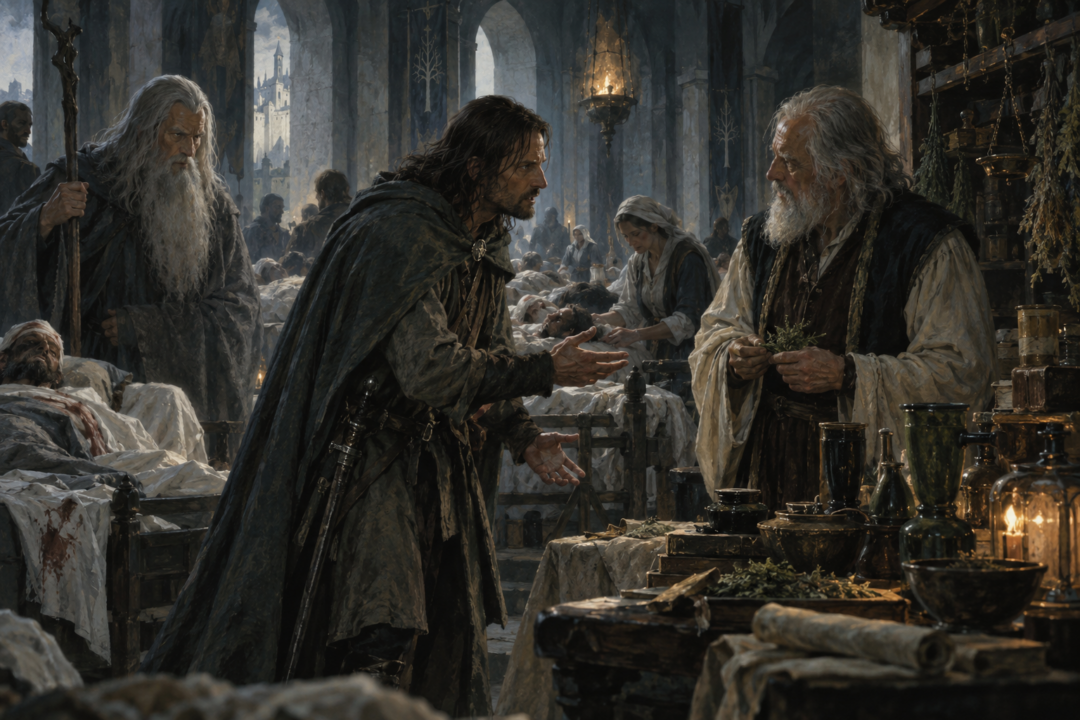
Athelas should have been one of the most valuable medicines in Minas Tirith.
When the wounded of the Pelennor are carried into the Houses of Healing, Faramir is slipping beneath the Black Shadow, Éowyn lies gravely stricken after confronting the Lord of the Nazgûl, and Merry has also been touched by that same deadly darkness. Aragorn asks for one thing: athelas, the plant commonly called kingsfoil.
The strange part is not that the healers have run out.
They do not keep it at all.
The herb-master knows the plant's names, knows the old traditions surrounding it, and even remembers a rhyme connecting it with the Black Breath. Yet he regards athelas as possessing virtually no medicinal value beyond minor uses.
That contradiction reveals something larger than one learned man's mistake. Gondor has preserved information about athelas while losing the practical tradition that made the information meaningful.
The Herb-Master Actually Knows a Great Deal
It is easy to read the herb-master as simply incompetent, but that misses the sharper point of the scene.
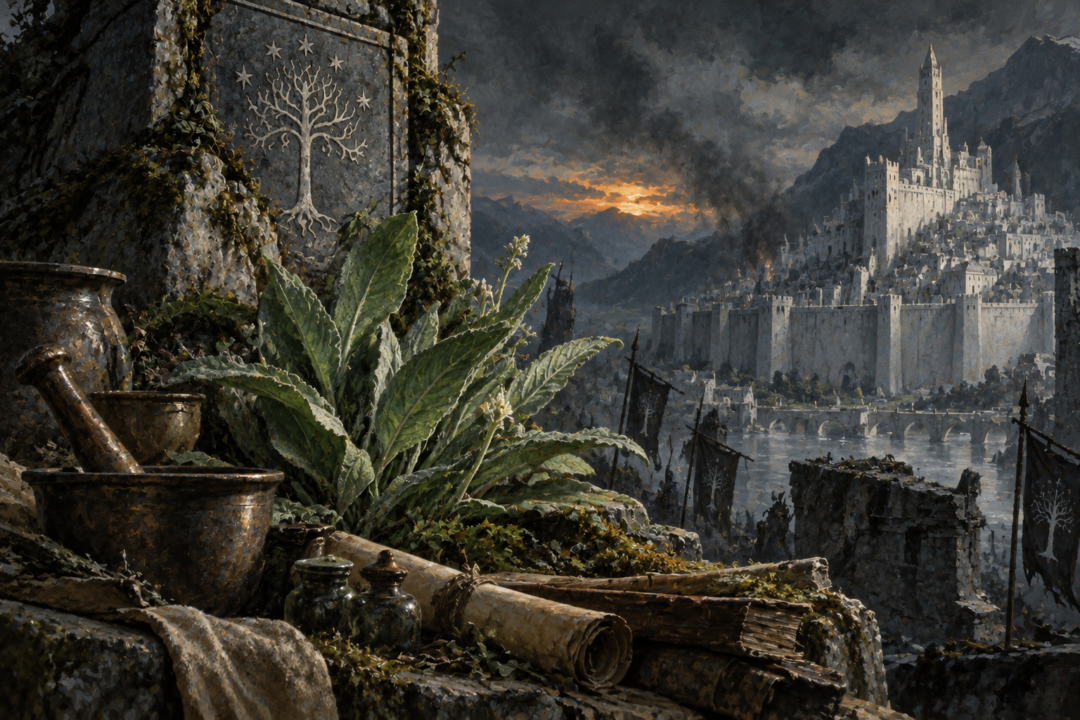
When Aragorn asks for kingsfoil, the herb-master immediately identifies it as athelas and knows another ancient name for it, asëa aranion. Aragorn, under desperate pressure, has little patience for this display of terminology. What matters to him is whether the Houses possess the plant.
They do not.
The herb-master explains that athelas is not stocked because the healers know of no significant virtue in it. At most, according to their surviving knowledge, it may freshen foul air, relieve a passing heaviness, and be used by old people in an infusion for headaches.
This is therefore not ignorance in the simplest sense.
The herb-master can classify the plant. He can discuss its names. He knows something of its traditional uses. He even knows folklore attached to it.
What he cannot do is recognize that the old lore describes exactly the emergency occurring around him.
That distinction matters.
Minas Tirith has retained the vocabulary of an older medical tradition while losing confidence in its central claim.
The Old Rhyme Describes the Crisis
The irony becomes almost painfully obvious when the herb-master recalls the traditional rhyme about athelas.
Its essential message is that when the Black Breath comes and death approaches, athelas should be brought forth, with life associated particularly with the herb in the hands of the king.
The herb-master dismisses the verse as corrupted folk doggerel, preserved by elderly women such as Ioreth without understanding.
Yet Faramir, Éowyn, and Merry are suffering after encounters with precisely the power described by the old tradition.
The rhyme is not merely vague praise of a healing plant. It connects athelas to the Black Breath and to the king.
The herb-master possesses the clue but has already decided what category that clue belongs in: folklore rather than useful medicine.
This does not mean every old rhyme in Middle-earth should automatically be treated as literal truth. The text gives no such general rule. Rather, this particular episode shows a society whose surviving folklore happens to contain genuine knowledge that its professional learning no longer recognizes.
Gandalf's exasperation makes the contrast explicit. What Minas Tirith needs at that moment is not another explanation of terminology but someone who actually has the herb.
Gondor Has Been Without a King for Centuries
There is a historical reason why the most important part of the athelas tradition could have become difficult to verify.
By the War of the Ring, Gondor has been ruled by the Stewards for nearly a thousand years. Its last king, Eärnur, disappeared after accepting the Witch-king's challenge and riding to Minas Morgul in Third Age 2050.
The Stewards preserved Gondor with extraordinary endurance, but the absence of the king created a practical problem for a tradition specifically connecting healing with royal hands.
If athelas had exceptional efficacy particularly when used by a rightful king or someone possessing Aragorn's peculiar healing gifts, generations of healers in Minas Tirith had little opportunity to test that claim.
The precise mechanics should not be pushed further than the text permits. The story does not give us a pharmacological rule explaining exactly how much of athelas's power lies in the plant itself and how much depends upon the healer.
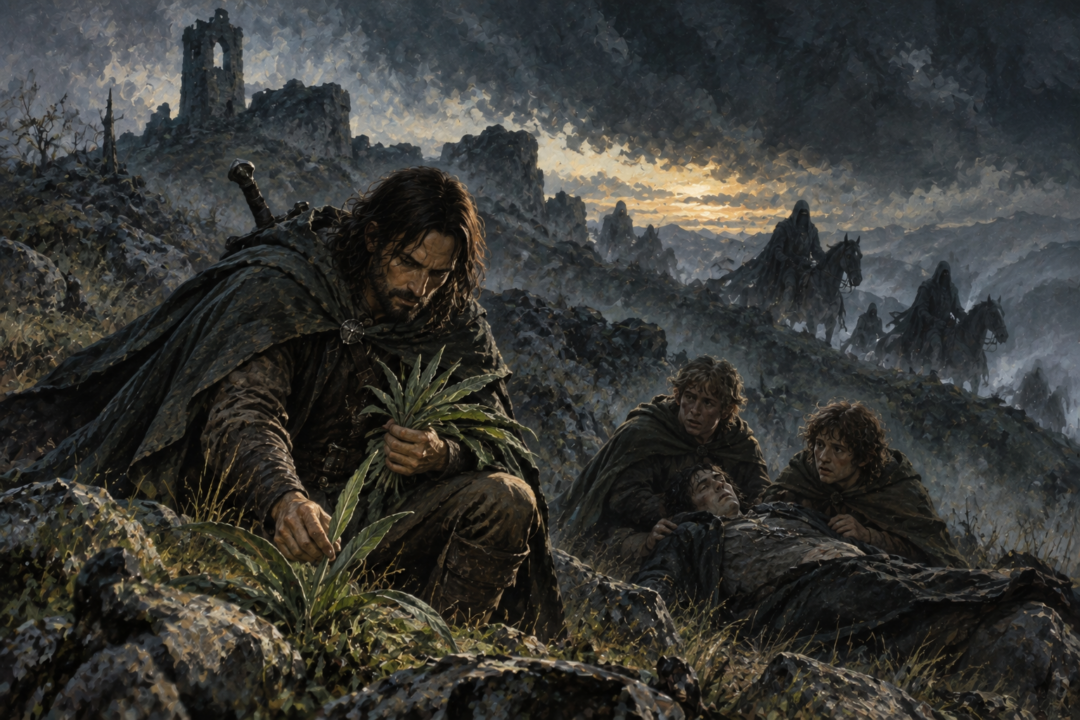
Indeed, Aragorn had already used athelas after Frodo was wounded on Weathertop. There he says that its healing virtue is small in his hands compared with Elrond's, while also identifying it as a healing plant brought to Middle-earth by the Men of Westernesse.
So athelas is not presented merely as an inert object activated by a royal bloodline.
What the narrative does establish is that Aragorn's knowledge and healing ability make an enormous difference, and Gondor's old traditions specifically associate the plant with the hands of the king.
Remove the kings long enough, and the tradition becomes increasingly difficult for ordinary healers to confirm.
Athelas Is a Númenórean Survival
The history of the plant makes Gondor's forgetfulness even more striking.
At Weathertop, Aragorn explains that athelas was brought to Middle-earth by the Men of Westernesse. It grows near places where they once lived or camped and is not known to most people except some of those who wander in the Wild.
Athelas is therefore part of the surviving inheritance of Númenor.
So is Gondor.
That creates a powerful parallel. The kingdom has inherited monuments, names, bloodlines, traditions, and fragments of knowledge from a greater past. But inheritance does not guarantee understanding.
The herb-master can preserve an ancient name while missing the ancient use.
This pattern appears elsewhere in Gondor's late Third Age condition. Minas Tirith remains magnificent and learned, yet much has diminished. Its rulers look backward toward Númenor while defending a shrinking realm against an Enemy whose history stretches into that same ancient past.
Athelas condenses that larger decline into a single plant.
The knowledge has not vanished completely.
It has become fragmented.
Aragorn Knows Because His Tradition Never Broke in the Same Way
Aragorn approaches athelas from a very different chain of knowledge.
He is the heir of Isildur, but he is also a Ranger who has spent decades travelling beyond the settled boundaries of Gondor. He was raised in Rivendell and possesses knowledge unavailable to most inhabitants of Minas Tirith.
At Weathertop, long before his kingship is publicly acknowledged, he can identify athelas growing wild and knows how it may help Frodo.
That scene is crucial because it prevents an overly simple reading of the Houses of Healing.
Aragorn does not suddenly discover kingsfoil because he has arrived to claim a throne. He already knows the plant through living experience.
The contrast is therefore between two kinds of preservation.
The herb-master possesses institutional learning. Aragorn possesses inherited lore joined to practical knowledge.
Neither learning nor scholarship is condemned in itself. Aragorn is plainly learned. The joke works precisely because the herb-master's impressive knowledge of names has become detached from the urgent reality those names are supposed to describe.
He knows what athelas is called.
Aragorn knows what to do with it.
The Houses of Healing Are Prepared for Ordinary Wounds
The herb-master also gives an important reason for not stocking kingsfoil: the Houses are intended for the gravely hurt or sick, and athelas is not believed to possess virtues appropriate to such cases.
From his perspective, the decision is internally consistent.
If generations of Gondorian practitioners have observed only modest effects from kingsfoil, allocating precious medical stores to more reliably useful remedies would make sense.
The disaster comes because the Battle of the Pelennor has produced injuries outside the ordinary assumptions of their medicine.
Faramir's condition is not merely a fever. Éowyn and Merry have suffered through direct confrontation with the Witch-king. Aragorn recognizes the Black Shadow at work and understands that conventional treatment is insufficient.
The Houses are excellent enough to preserve the wounded, but their existing knowledge cannot fully address the spiritual terror inflicted by the Nazgûl.
That is why athelas suddenly becomes emergency medicine.
The emergency itself belongs to an older world than the herb-master's working assumptions.
The Plant Does Not Replace the Healer
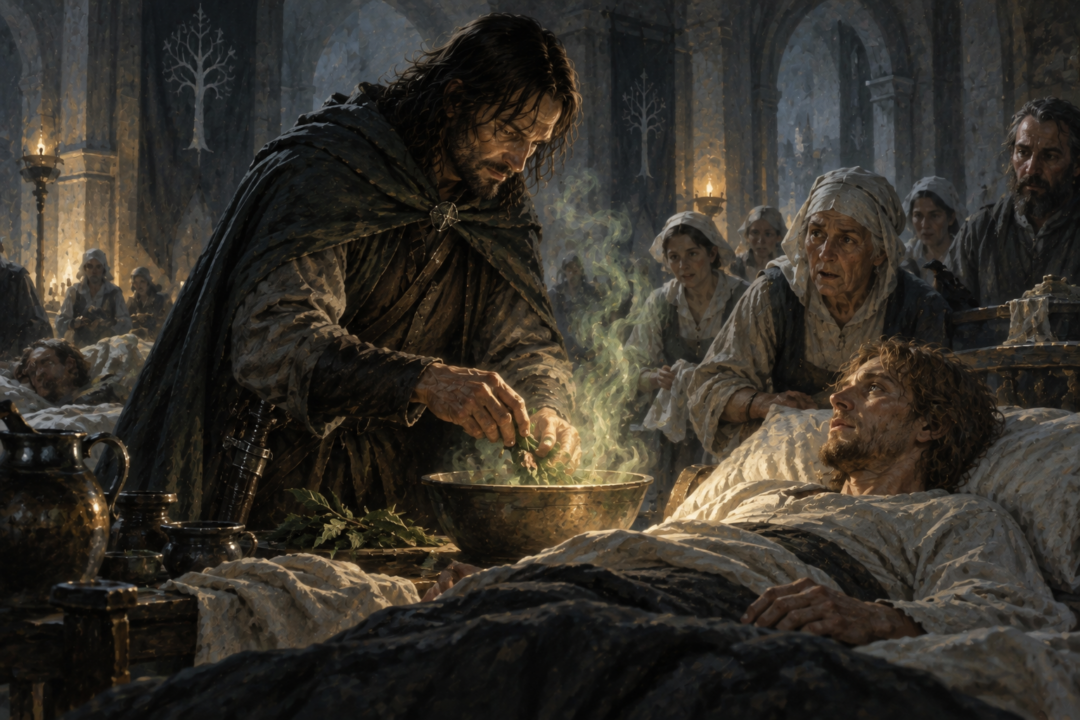
When athelas finally arrives, Aragorn bruises the leaves and places them in steaming water.
Its fragrance transforms the room. The description emphasizes freshness, living air, and memory of clean lands beyond the darkness of war.
Faramir responds. Later Aragorn tends Éowyn and Merry as well.
But the scene never presents this as a simple recipe that any healer could reproduce with identical results.
Aragorn examines each patient carefully. He calls them back differently. His healing involves perception, authority, knowledge, and personal effort alongside the herb.
Athelas is part of the healing, not an automatic cure detached from the person using it.
This helps explain why the herb-master's mistake could persist.
If kingsfoil's extraordinary reputation was bound up with healers no longer present in Gondor, ordinary experience might genuinely appear to contradict the old tradition.
The institution did not necessarily forget that athelas existed.
It forgot the circumstances under which athelas mattered most.
Ioreth Remembers What the Experts Dismiss
There is another layer of irony.
Ioreth is talkative and sometimes comic, but she remembers the saying that the hands of the king are the hands of a healer.
That saying becomes politically significant because Aragorn's actions make it suddenly visible as more than an old proverb.
The return of healing and the return of kingship occur together.
This does not mean Aragorn becomes king merely because he possesses a secret herbal technique. His claim rests on lineage, history, action, recognition, and the wider events of the War of the Ring.
But the healing scenes reveal something about what restored kingship is supposed to mean.
Aragorn enters Minas Tirith after victory on the battlefield and spends the night saving lives rather than claiming a crown.
His authority appears first as restoration.
That is exactly what the herb-master cannot recognize beforehand, because the surviving institutional categories no longer have room for it.

The Real Failure Is Knowledge Without Recognition
The herb-master's error is more interesting than simple foolishness.
He knows the names.
He knows the rhyme.
He knows the minor folk uses.
He presumably belongs to one of the greatest healing institutions among the Men of the West.
Yet when the Black Breath is actually killing people inside his own Houses, he cannot connect the inherited words with the reality before him.
That is why the scene is simultaneously funny and unsettling.
Civilizations do not always lose knowledge by burning libraries or forgetting names. Sometimes they preserve the words perfectly while changing their judgment about what those words mean.
Athelas survives.
Its Númenórean names survive.
The rhyme survives.
The belief that the king's hands heal survives.
What has nearly disappeared is the living connection among them.
Then Aragorn arrives, and suddenly every discarded fragment fits together.
The old rhyme is standing beside the sickbed. The forgotten herb is in his hands. The Black Shadow is in the patients. And the king whose absence helped turn ancient knowledge into folklore has returned before anyone has formally crowned him.
The herb-master's failure is therefore not that he has learned too little.
It is that Gondor has remembered just enough of its past to preserve the answer—and forgotten enough that it no longer recognizes the answer when death comes through the door.
Sources & Notes
- Tolkien Gateway, “Athelas” — https://tolkiengateway.net/wiki/Athelas
- Tolkien Gateway, “Herb-master” — https://tolkiengateway.net/wiki/Herb-master
- Tolkien Gateway, “The Houses of Healing” — https://tolkiengateway.net/wiki/The_Houses_of_Healing
- The Encyclopedia of Arda, “Athelas” — https://www.encyclopedia-of-arda.com/a/athelas.php
Sources cover athelas, Gondor’s lost herb-lore, the herb-master’s response, and Aragorn’s healings in the Houses of Healing.