One of the most uncomfortable truths in The Lord of the Rings is that its victory depends on failure.
Not Sauron’s failure—but Frodo’s.
At the Cracks of Doom, after years of suffering, sacrifice, and endurance, Frodo Baggins does what no hero is supposed to do. He cannot destroy the Ring. Standing at the very brink of success, he claims it for himself.
By every conventional rule of storytelling, this should be the end.
The quest collapses.
The Ring survives.
Evil wins.
And yet, the Ring is destroyed anyway.
This contradiction lies at the heart of the story—and it cannot be understood without Gollum. Not as a footnote, not as a villain who happens to be nearby, but as a direct consequence of mercy shown long before Frodo ever reached Mordor.
The Mercy That Begins Everything
The chain of events begins not in Mordor, but beneath the Misty Mountains, in The Hobbit.
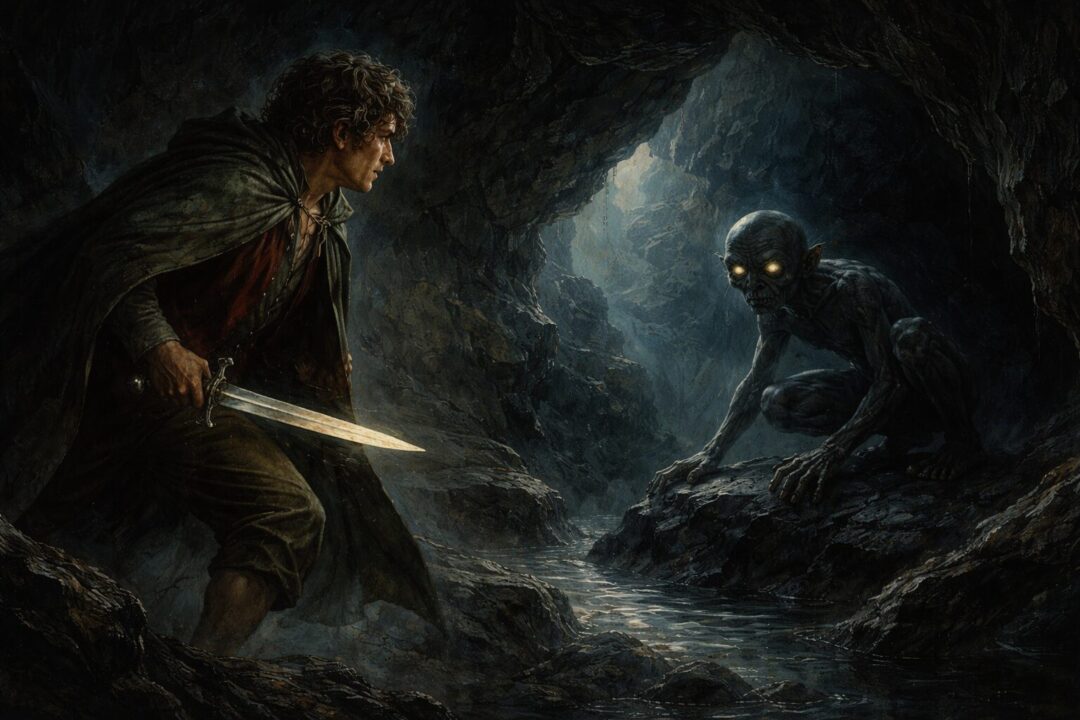
Bilbo Baggins encounters Gollum in the dark, wins a riddle-game, and discovers the Ring. When Gollum realizes what has happened, Bilbo suddenly holds absolute power over him.
Bilbo has the Ring.
He is invisible.
He could strike first and escape cleanly.
Nothing in the rules of the game forbids it. Nothing in logic demands restraint.
And yet, Bilbo hesitates.
What stays his hand is not wisdom or foresight. Bilbo does not know what Gollum is. He does not know what the Ring is. He has no idea that the fate of the world is balanced on his decision.
He feels pity.
Bilbo sees a creature who is ruined, isolated, and consumed by obsession. And instead of finishing him, Bilbo leaps over Gollum and spares his life.
This moment is easy to overlook. It feels small, even sentimental. But it quietly becomes the most important moral act in the entire history of the Ring.
Gandalf’s Warning
Years later, Frodo learns the truth about Gollum—and recoils.
His reaction mirrors that of many readers. Gollum is dangerous. He has murdered before. He has been corrupted beyond recognition. Surely, sparing him was a mistake.
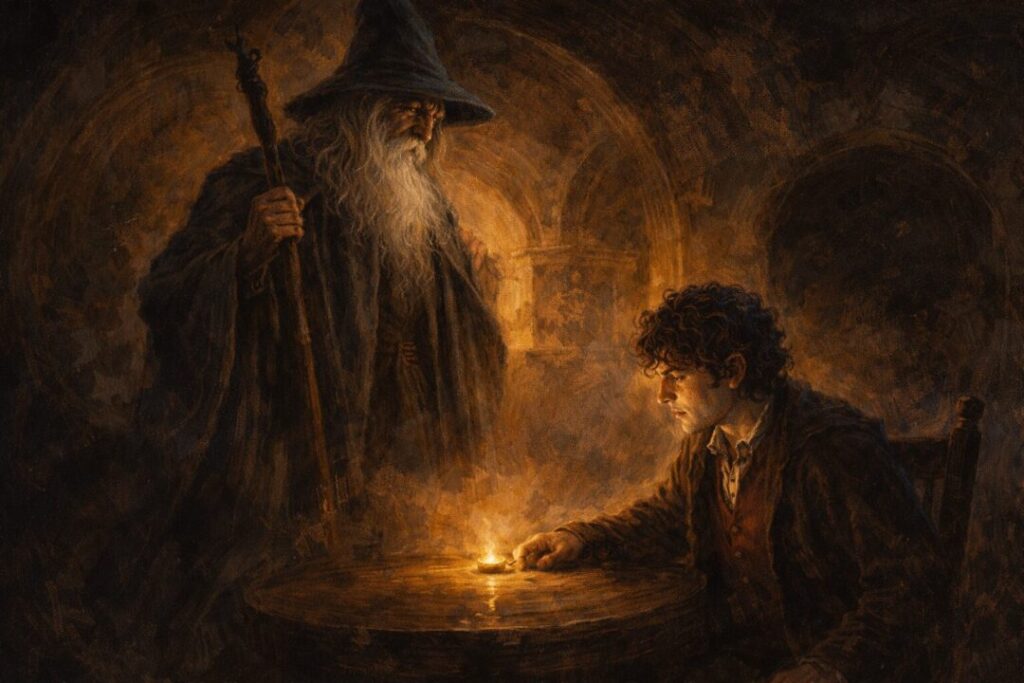
Gandalf’s response is one of the most revealing moral statements in the legendarium.
He tells Frodo that many who live deserve death, and many who die deserve life—but that Frodo cannot give it to them. Judgment, Gandalf insists, does not belong to him.
But Gandalf goes further.
He suggests that Gollum still has a role to play, for good or ill. Not because Gollum is secretly virtuous, and not because redemption is guaranteed—but because mercy sets events in motion that no one can fully predict or control.
This is a crucial distinction.
Mercy is not portrayed as a reward for goodness. It is an act of restraint in the face of fear and disgust. Gandalf does not argue that Gollum will improve. He argues that ending his life would foreclose possibilities that even the wise cannot see.
Frodo’s Burden of Mercy
Frodo inherits more than the Ring. He inherits Bilbo’s moral debt.
Once Gollum re-enters the story, Frodo repeatedly chooses mercy, even when it appears reckless:
- On the Emyn Muil, when Gollum is captured but spared
- In Ithilien, when Frodo prevents his execution
- Even after deception, lies, and near betrayal
Each act of mercy costs Frodo something.
Mercy isolates him from Sam, whose instincts are sharper and more practical. Sam understands Gollum’s danger clearly—and he is not wrong. Gollum does betray them. He leads them to Shelob. He nearly succeeds in reclaiming the Ring.
Mercy does not prevent suffering.
It permits it.
This is one of the hardest truths in the story. Mercy does not shield Frodo from consequences. Instead, it exposes him to deeper harm. Frodo becomes weaker, more vulnerable, and more burdened with each compassionate choice.
And yet, those choices remain necessary.
Mercy Is Not Naivety
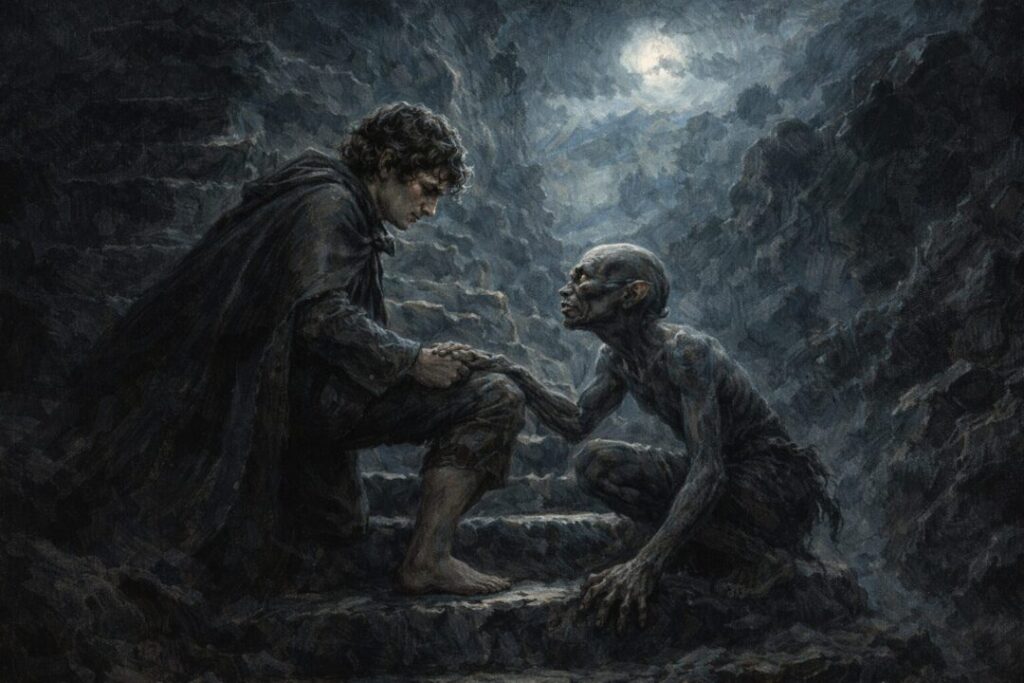
It is important to note that Frodo is not blind to Gollum’s corruption. He does not trust Gollum fully, nor does he excuse his actions. Frodo understands that Gollum is enslaved to the Ring—and that this enslavement mirrors his own future.
In sparing Gollum, Frodo is not forgiving crimes. He is acknowledging kinship.
Gollum is not an “other.” He is a possible end-state.
This recognition changes Frodo’s relationship to mercy. Sparing Gollum becomes, in part, an act of humility. Frodo does not place himself above judgment because he knows he may one day require the same restraint from others.
The Failure at Mount Doom
At the climax of the story, Frodo reaches Mount Doom—an achievement no one else could have managed.
He resists the Ring longer than anyone in history. He carries it farther, deeper, and closer to destruction than any being before him.
And then, he fails.
This failure is not framed as weakness or cowardice. It is presented as inevitability. The Ring proves stronger than any individual will.
If the story ended here, the quest would fail completely.
But Gollum is there.
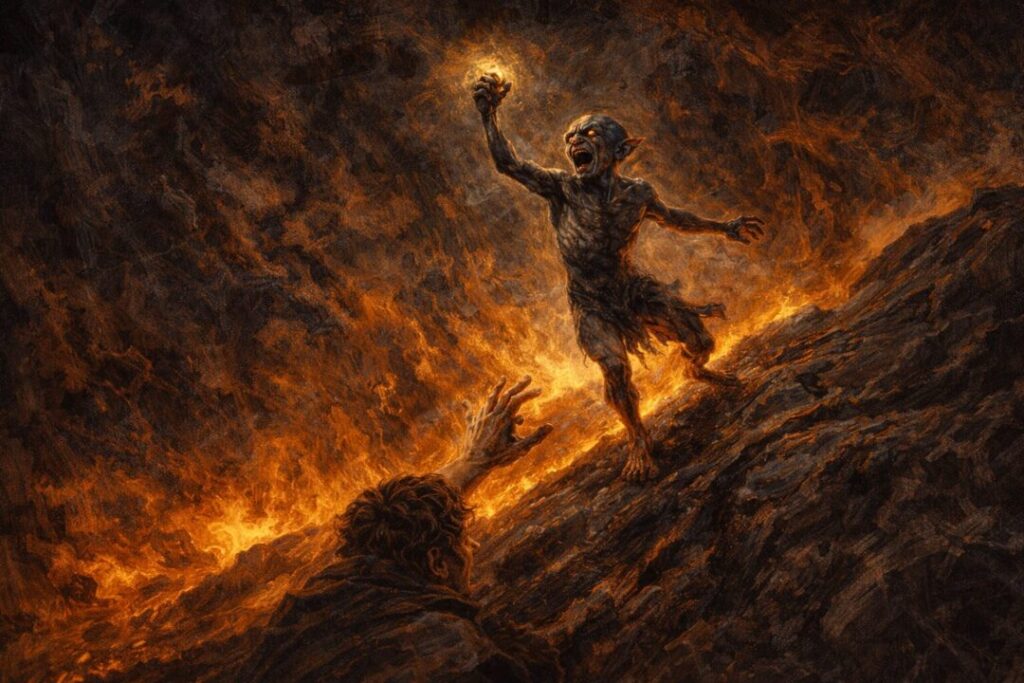
Driven by obsession, stripped of restraint, Gollum attacks Frodo, bites off his finger, and claims the Ring in triumph. And in that moment of victory, he falls into the fire.
The Ring is destroyed not by moral triumph, but by consequence.
No Redemption—Only Completion
This is the point many readers misunderstand.
Gollum does not redeem himself.
He does not make a conscious sacrifice. He does not choose good over evil. He dies exactly as he lived: consumed by the Ring.
But his presence—made possible only by mercy—completes the quest.
If Bilbo had killed him, the Ring would endure.
If Frodo had struck him down, the Ring would endure.
If Sam had been allowed to decide, the Ring would endure.
Middle-earth survives not because mercy transforms Gollum—but because mercy allows the story to reach an ending that force never could.
Why This Still Matters
Middle-earth is not saved by purity.
It is saved by restraint.
This is a deeply unsettling message. It denies the fantasy of moral certainty. It suggests that doing the “right” thing may feel dangerous, costly, and even irresponsible in the moment.
Mercy invites risk.
It invites suffering.
It invites outcomes that cannot be controlled.
And yet, without it, the world ends.
This is why the story endures. Not because it comforts, but because it challenges. It insists that the smallest acts—those done without hope of reward—can shape history more profoundly than any display of power.
Gollum is not the hero of the story.
But without mercy toward him, there is no ending at all.
Sources & Notes
- J.R.R. Tolkien, The Hobbit, Chapter 5, “Riddles in the Dark” — Bilbo’s pity stays his hand when he has the chance to kill Gollum.
- J.R.R. Tolkien, The Lord of the Rings, Book I, Chapter 2, “The Shadow of the Past” — Gandalf explains Bilbo’s pity, warns Frodo against dealing out death in judgment, and says Gollum may yet have a part to play.
- J.R.R. Tolkien, The Lord of the Rings, Book IV, Chapters 1–2, “The Taming of Sméagol” and “The Passage of the Marshes” — Frodo spares Gollum and begins the perilous mercy that carries into Mordor.
- J.R.R. Tolkien, The Lord of the Rings, Book VI, Chapter 3, “Mount Doom” — Frodo claims the Ring, Gollum takes it from him, and Gollum’s fall destroys it.
- J.R.R. Tolkien, The Letters of J.R.R. Tolkien, Letter 246 — Tolkien discusses Frodo’s failure at the last moment and the providential importance of mercy toward Gollum.