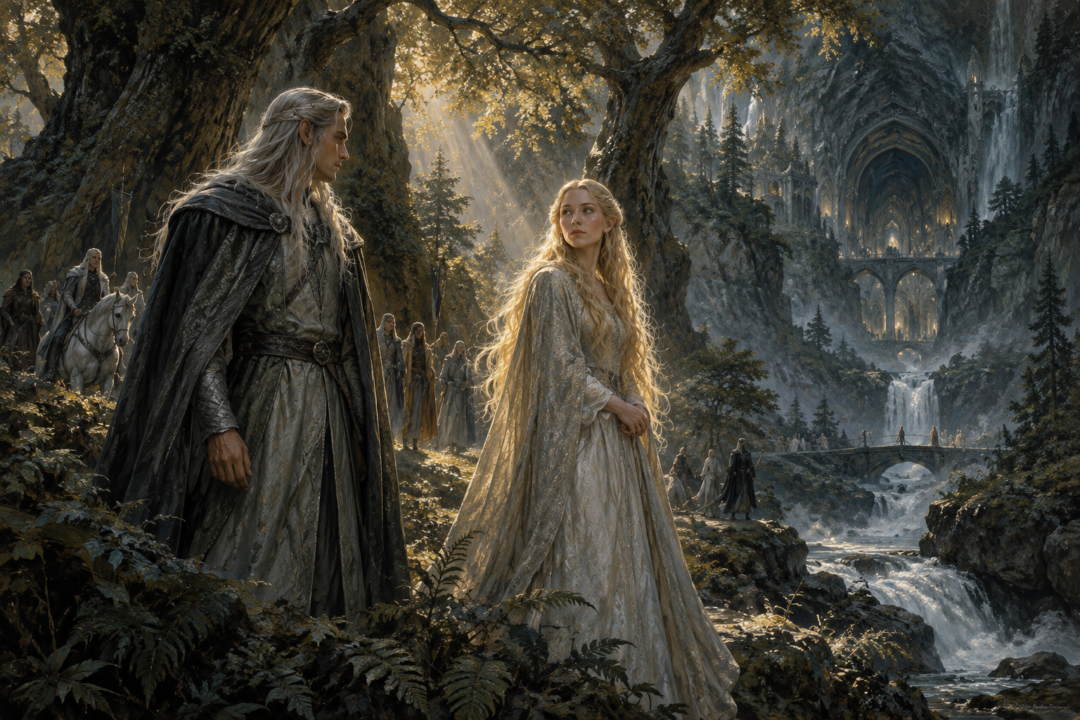
Celeborn is one of the most familiar Elves in The Lord of the Rings and one of the most difficult to place securely in the deeper history of Middle-earth. When the Fellowship enters Lothlórien, there is little ambiguity about who he is in the Third Age: he is the Lord of the Galadhrim, the husband of Galadriel, a figure of immense age who remembers Beleriand before it was destroyed.
Yet one deceptively simple question—where did Celeborn originally come from?—opens into one of the legendarium’s most complicated unresolved histories.
In different conceptions, Celeborn belongs to the Sindarin world of Doriath, is connected more broadly with the Teleri, or becomes a Telerin Elf of Aman who knew Galadriel before either of them entered Middle-earth. These are not merely different labels for the same biography. Moving Celeborn across the Sea changes where he met Galadriel, what languages lay behind their names, how he was related to Thingol, and even how Galadriel herself came to Middle-earth.
The result is not a single hidden biography waiting to be uncovered. It is a set of overlapping versions that reveal how profoundly Celeborn’s identity was tied to the evolving history of Galadriel.
The Celeborn Readers Actually Meet
The safest starting point is The Lord of the Rings.
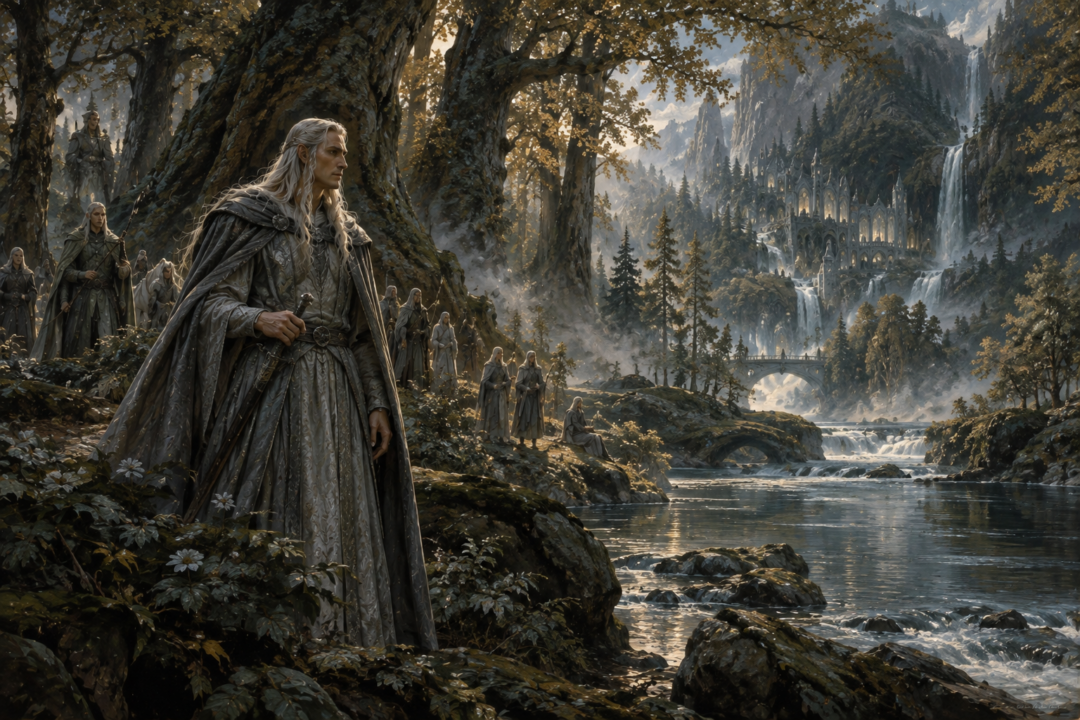
Celeborn rules in Lórien beside Galadriel, and his memories reach back into the Elder Days. During the Fellowship’s stay, he speaks of the fall of Gandalf and of the danger represented by Moria. Later material in The Lord of the Rings establishes an especially important genealogical clue: Celeborn is described as a kinsman of Thingol.
Thingol was the Sindarin King of Doriath and one of the three original ambassadors of the Elves who had seen the light of the Two Trees before returning to Middle-earth. Calling Celeborn his kinsman therefore places Celeborn close to one of the greatest royal houses of the First Age.
But that statement does not, by itself, provide a complete genealogy.
This distinction matters because later attempts to construct Celeborn’s history went in different directions while preserving connections with the Telerin family to which Thingol belonged. Thingol and his brother Olwë were both leaders among the Teleri during the Great Journey. Thingol remained in Middle-earth, while Olwë eventually became king of the Teleri in Aman.
That divided family created two possible worlds for Celeborn.
He could belong to Thingol’s people east of the Sea.
Or he could belong to the branch that reached Aman.
Both possibilities were explored.
Celeborn of Doriath
The best-known First Age conception makes Celeborn a Sinda associated with Doriath.
This is the version reflected in the published Silmarillion. Galadriel comes to Doriath, where Melian the Maia and King Thingol rule from Menegroth. Celeborn is already there, described as a prince of Doriath and a kinsman of Thingol. Galadriel remains in Doriath with him rather than following her brother Finrod to Nargothrond.
In this conception, their relationship is fundamentally a meeting between two branches of the Eldar separated by the ancient Sundering of the Elves.
Galadriel is one of the Noldor who lived in Aman.
Celeborn belongs to the Sindar who remained in Beleriand.
Their marriage therefore joins the returning Exiles to the royal house of Doriath. It also helps explain the striking cultural character of their later history. Galadriel carries the memory of Aman and the Noldorin tradition, while Celeborn belongs to the Grey-elven world of Beleriand.
Notes concerning Thingol’s family went further and attempted to make the relationship precise. In one genealogy Celeborn was the son of Galadhon, son of Elmo, who was a younger brother of Thingol. That would place Celeborn within Thingol’s extended royal family.
But the surviving material is not perfectly stable, so the safest conclusion is simply that one developed conception made Celeborn a close Sindarin relative of Thingol and a prince associated with Doriath.
Why the Telerin Label Complicates Everything
Calling Celeborn “Telerin” does not necessarily mean that he came from Aman.
This is one of the easiest sources of confusion.
The Sindar themselves descended from the Teleri who remained behind in Middle-earth. In the broad historical division of the Eldar, Thingol’s people belonged to the Telerin branch even though they never completed the journey to Valinor.
So descriptions connecting Celeborn with Telerin ancestry can coexist with a Middle-earth origin.
Earlier linguistic conceptions also complicate the terminology because the names used for Elvish languages and peoples changed considerably during the development of the mythology. A statement that appears to make Celeborn “Telerin” cannot always simply be translated into the later idea that he was one of Olwë’s Sea-elves of Aman.
The decisive shift comes when Celeborn is explicitly moved across the Sea.
Then his entire story changes.
Teleporno: Celeborn in Aman
In late writings, Celeborn appears as a Teler of Aman under the Telerin name Teleporno.
This was far more than a linguistic adjustment.
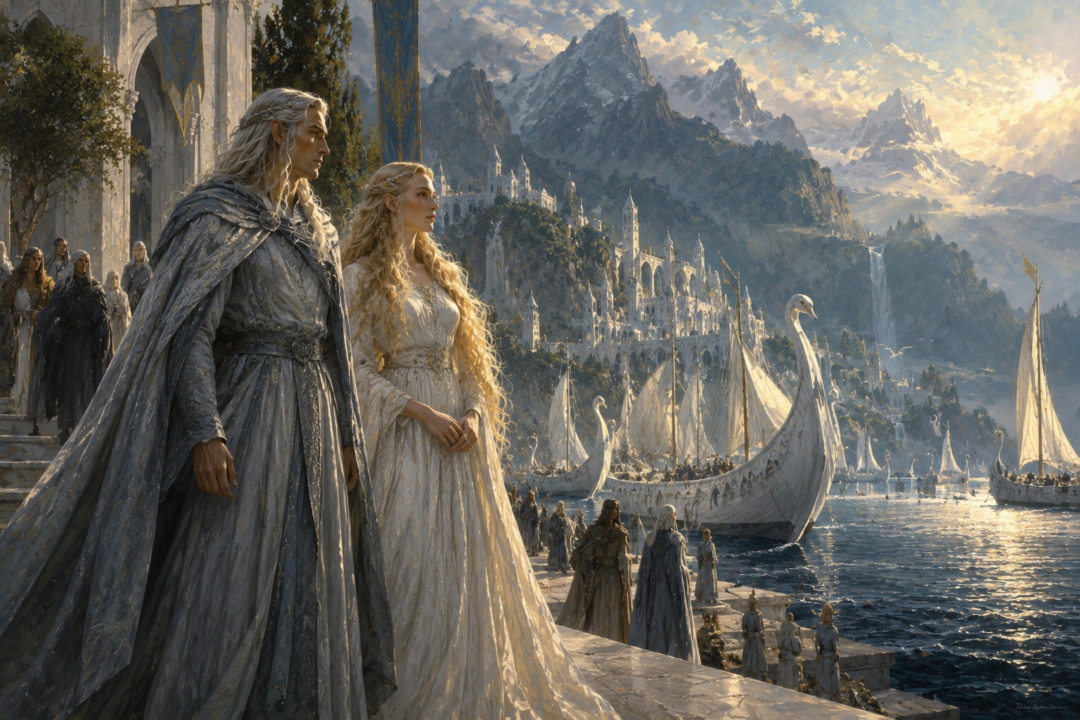
Instead of Galadriel travelling to Doriath and meeting Celeborn there, the two could already know one another in Aman. Celeborn becomes connected with the Teleri of Alqualondë, the people of Galadriel’s mother Eärwen, who was herself a daughter of Olwë.
The famous name “Galadriel” also fits this conception differently. Late material associates the name given by Celeborn with a Telerin form that was subsequently represented in Sindarin as Galadriel.
Now their relationship begins before the exile of the Noldor.
That transforms Celeborn from a prince whom Galadriel encounters after reaching Beleriand into a participant in her life before she ever leaves the Blessed Realm.
And once Celeborn moves to Aman, the question of how Galadriel reaches Middle-earth must also be reconsidered.
The Alqualondë Version Changes Galadriel Too
One especially late conception presents an extraordinary alternative history.
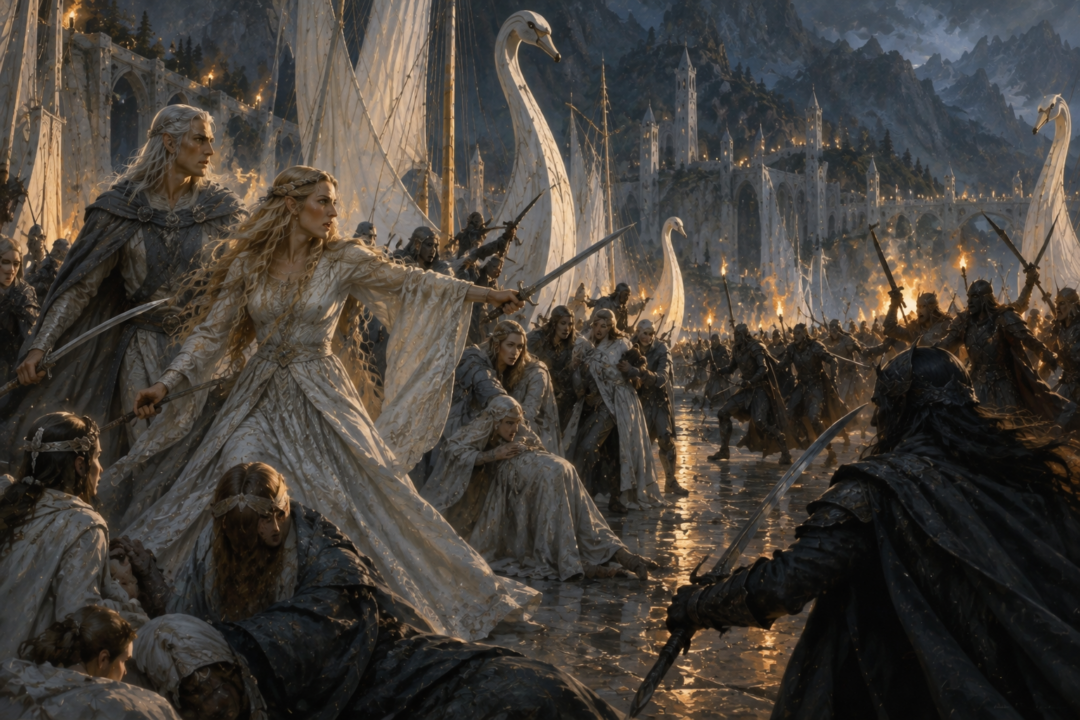
Galadriel desires to leave Aman independently of Fëanor’s rebellion. At Alqualondë she meets Celeborn, here a Telerin prince, and they intend to sail eastward. When Fëanor and his followers attack the Teleri and seize their ships, Galadriel fights against them in defence of her mother’s people.
Galadriel and Celeborn then depart for Middle-earth in their own vessel.
This is incompatible in important respects with the familiar narrative in which Galadriel crosses into Middle-earth with the rebellious Noldor and later meets Celeborn in Doriath. It belongs to a very late rethinking of her history and should not simply be inserted into the published Silmarillion as though both accounts describe the same sequence of events.
Its importance lies elsewhere.
Celeborn has become central to Galadriel’s departure itself.
In the Doriath conception, Middle-earth brings them together.
In the Aman-centered conception, they face the departure from Aman together.
That is an enormous narrative shift.
His Relationship to Thingol Did Not Simply Vanish
Moving Celeborn to Aman might appear to destroy the older statement that he was Thingol’s kinsman. It does not necessarily do so.
Thingol and Olwë were brothers. A Telerin Celeborn belonging to Olwë’s people could therefore still be related to Thingol without being a Sinda of Doriath.
Some late formulations place Celeborn within the Telerin royal house of Aman, though the exact genealogical details vary across the surviving writings. The important point is that “kinsman of Thingol” does not logically require Celeborn to have been born in Doriath.
This helps explain why the statement preserved in The Lord of the Rings is unusually resilient.
Celeborn’s precise ancestry could move.
His connection to the wider family of the Telerin kings could remain.
Why There Is No Clean Final Answer
It is tempting to solve the problem by declaring the latest surviving version automatically definitive.
That is risky.
The late Aman-centered material represents a profound revision, but the revision was never fully worked into a complete, harmonized account of the First Age and Second Age. Other published narratives preserve the Doriath conception, while The Lord of the Rings itself gives only limited information about Celeborn’s earliest life.
Unfinished Tales is particularly valuable precisely because it preserves this instability rather than disguising it. Its material on Galadriel and Celeborn contains variant narratives and explanatory notes instead of presenting one seamless history.
Therefore the lore-grounded answer depends on what question is being asked.
In the familiar published First Age narrative, Celeborn is the Sindarin prince of Doriath who meets Galadriel in Middle-earth.
In significant late conceptions, he is instead Teleporno, a Teler of Aman who knows Galadriel before her departure and crosses the Sea with her.
The texts do not provide a final synthesis resolving every contradiction.
The Strange Importance of Celeborn’s Changing Past
Celeborn’s shifting origin matters because each version changes what his marriage represents.
As the Sinda of Doriath, he connects Galadriel to the Elves who never reached Aman and to the vanished woodland kingdom of Thingol and Melian. Their union becomes another bridge between the Noldorin Exiles and the Sindarin world they entered.
As the Teler Teleporno of Aman, he belongs to Galadriel’s story before exile. Their bond becomes rooted in her Telerin connections, Alqualondë, and a radically different account of her departure from the Blessed Realm.
Yet the Celeborn encountered by the Fellowship remains recognizable through all this uncertainty.
He is ancient. He is bound to Galadriel. He remembers the lost West of Middle-earth. He belongs, in some fashion, to the extended Telerin world of Thingol. And after Galadriel finally sails over the Sea at the end of the Third Age, Celeborn remains behind for a time, becoming one of the last great Eldar still lingering in Middle-earth.
His beginning was repeatedly reconsidered.
His ending was left open too.
That uncertainty is unusually appropriate for a character standing at the meeting point of so many disappearing Elven worlds: Aman and Middle-earth, Noldor and Teleri, Doriath and Lórien, the Elder Days and the fading years after Sauron’s fall.
There is no single version that makes every surviving statement fall neatly into place.
Instead, Celeborn exists in several layers of Middle-earth’s history—and understanding those layers reveals something more interesting than a tidy genealogy ever could.
Sources & Notes
- Tolkien Gateway, “Celeborn” — https://tolkiengateway.net/wiki/Celeborn
- Tolkien Gateway, “The History of Galadriel and Celeborn” — https://tolkiengateway.net/wiki/The_History_of_Galadriel_and_Celeborn
- Tolkien Gateway, “Galadriel” — https://tolkiengateway.net/wiki/Galadriel
These secondary reference entries identify the relevant Tolkien texts and document the characters, events, and objects discussed. Explanations of motives and practical consequences remain interpretation unless explicitly stated in the cited texts.