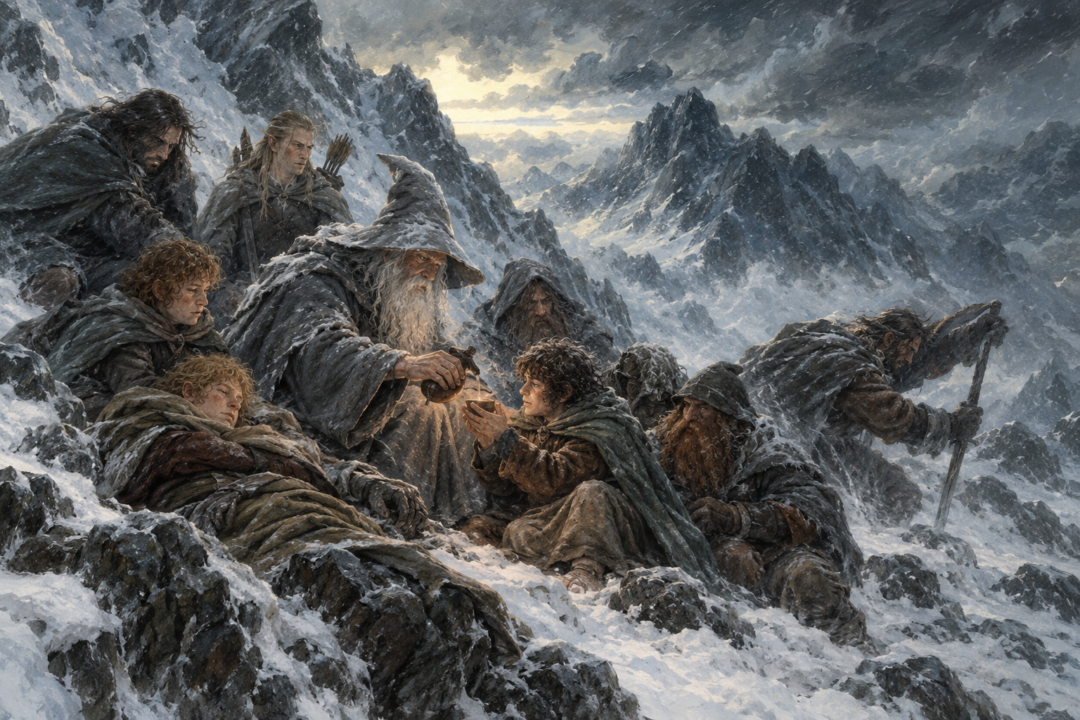
On the slopes of Caradhras, the Fellowship is not merely uncomfortable. Snow is piling around them, the hobbits are succumbing to cold and exhaustion, and Boromir warns that unless something is done they may die where they sit.
Gandalf reaches into his pack and produces a leather flask.
Inside is miruvor, the precious Cordial of Imladris that Elrond gave him when the Company left Rivendell. Each member receives only a mouthful. Frodo feels his crushing drowsiness lift; the others recover hope and vigour.
It is easy to turn that moment into a familiar fantasy idea: an Elvish potion that magically replenishes the body.
But the text points toward something more precise.
Miruvor does not replace food. It does not make exhaustion irrelevant. Gandalf does not distribute it as the Fellowship’s normal travelling ration. Instead, he guards a limited supply and uses it at moments when cold, fatigue, and failing spirits threaten the Company’s ability to continue.
Miruvor is better understood as an emergency restorative: something that helps exhausted people recover enough strength and heart to act again.
That distinction matters because Middle-earth already contains something much closer to supernatural travelling nutrition.
It is called lembas.

What Miruvor Actually Does on Caradhras
Miruvor’s clearest description comes in The Fellowship of the Ring, Book II, Chapter 3, “The Ring Goes South.”
The Company has attempted the Redhorn Pass and become trapped in a worsening snowstorm. Frodo and the other hobbits are particularly vulnerable. Gandalf gives everyone a small amount of the cordial, emphasizing both its scarcity and its value.
Its effects are described immediately.
Frodo gains “a new strength of heart,” while the dangerous drowsiness leaves his limbs. The rest of the Company likewise revives, recovering hope and vigour.
Notice what is emphasized.
The effect is partly physical, but it is also psychological or spiritual in the ordinary sense of courage and morale. Miruvor drives away the lethargy that is overtaking Frodo and restores the Company’s capacity to keep struggling.
Yet it does not solve their underlying problem.
The storm continues.
They still need fire. They still need to escape the snow. Boromir and Aragorn must force a path through the drifts and carry the hobbits. Miruvor has not made the Fellowship immune to exposure or exhaustion.
It has given them a precious second wind.
Gandalf Treats It Like Emergency Medicine
Gandalf’s behaviour may tell us more about miruvor than any attempt to define its ingredients.
He does not casually pass the flask around the camp.
On Caradhras, he specifically orders only a mouthful for each person and calls the cordial “very precious.” Later, after the Company retreats from the mountain and halts exhausted, Gandalf spares them another mouthful.
The wording matters: he is rationing something scarce.
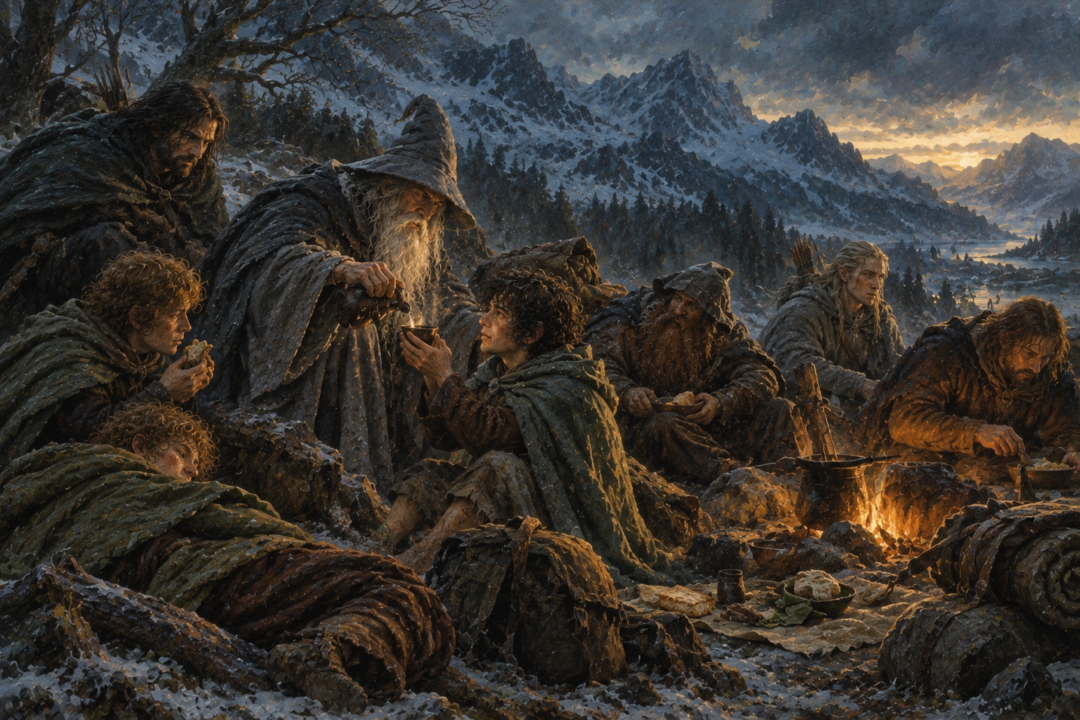
And immediately afterward, they eat food.
That sequence is perhaps the strongest evidence against treating miruvor as magical nutrition.
If a swallow of miruvor were functioning as a complete substitute for nourishment, there would be little narrative reason to distinguish the cordial from the meal that follows. Instead, the two serve different purposes. Miruvor revives the exhausted travellers; food sustains them.
The Fellowship then continues toward Moria, and miruvor is used again during this desperate stage of the journey.
This pattern makes its intended role remarkably consistent. It appears when the Company is physically depleted and needs immediate restoration, not whenever ordinary hunger needs satisfying.
Miruvor belongs in Gandalf’s emergency supplies, not in the Fellowship’s pantry.
Lembas Shows What Magical Sustenance Looks Like
The comparison becomes clearer after the Fellowship reaches Lothlórien.
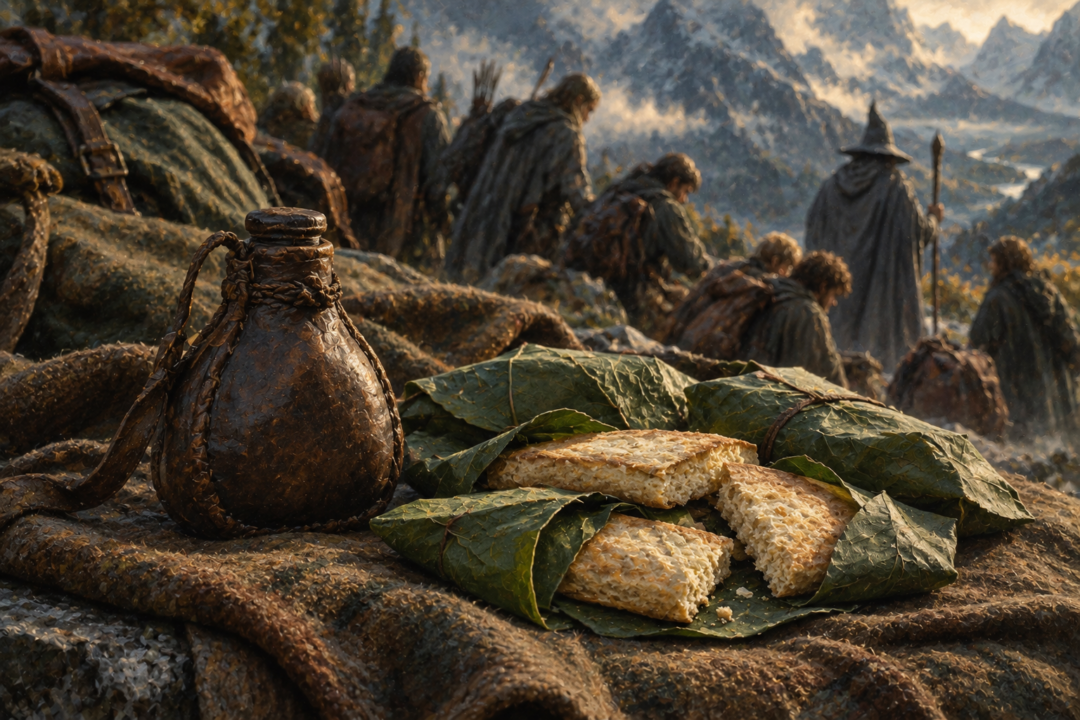
Before their departure, the Galadhrim give them lembas, or waybread. Unlike miruvor, lembas is explicitly described as food for journeys.
The Elves tell the Company that it is more strengthening than food made by Men and warn them to eat only a little at a time. Properly wrapped, the cakes remain good for long periods. Most importantly, a single cake can keep a traveller on his feet through a day of prolonged labour, even a large Man.
That is sustained nourishment.
Later, Frodo and Sam depend increasingly upon lembas as they approach Mordor. By the final stages of their journey, it becomes crucial to their survival.
Miruvor never receives that function.
No one calculates how many days a flask can feed the Company. Gandalf does not use it to replace meals. Its effectiveness is described through revived limbs, renewed vigour, warmth, hope, and the ability to continue.
Lembas answers the question, “How can we keep going when ordinary provisions fail?”
Miruvor answers a different question:
“How can we get back on our feet right now?”
Is Miruvor Actually Magical?
The safest answer is that the text never provides a technical explanation.
Trying to classify miruvor as either mundane alcohol or a conventional fantasy potion imposes categories that the story itself does not require.
Its effects are certainly extraordinary. A small mouthful produces rapid revival in people suffering severe fatigue and cold. But there is no spell attached to it, no defined duration, and no mechanical list of powers.
This is typical of many Elvish works in Middle-earth.
The boundary between exceptional craft, natural virtue, and what other peoples might call magic is often deliberately indistinct. The same ambiguity surrounds Elven cloaks, healing practices, rope, lembas, and other works whose makers do not necessarily understand them through the vocabulary of “magic items.”
So it is reasonable to call miruvor extraordinary or restorative.
It is less secure to claim that it magically supplies calories, cures injuries, prevents starvation, or grants unlimited stamina. None of those powers is stated.
Its demonstrated ability is narrower: it revives.
What Was Miruvor Made From?
Here the lore becomes more complicated, because miruvor of Rivendell is connected linguistically and conceptually with miruvórë.
Later linguistic material associates miruvórë with a special wine or cordial and ultimately with a Valarin word connected with honey-wine. Traditions concerning the drink of the Valar also associate it with the nectar or honey of flowers in Aman.
But this does not give us a canonical recipe for Elrond’s flask.
The exact ingredients and method used to make the Cordial of Imladris are never specified in The Lord of the Rings. Modern recipes involving particular flowers, herbs, spices, spirits, or proportions are therefore reconstructions or inventions, not recovered Elvish recipes.
Even its relationship to the miruvórë associated with the Blessed Realm should be handled carefully. The names and traditions are connected, but the texts do not justify confidently describing Gandalf’s Rivendell cordial as literally the identical substance served in Valinor.
What can safely be said is much simpler.
The miruvor carried by Gandalf was a precious Elvish cordial from Imladris, warm and fragrant when Frodo drank it, and capable of remarkable restoration.
The Deeper Purpose of the Cordial
Miruvor becomes more interesting when we stop asking how many calories it contained.
Its great effect on Caradhras is not that the Fellowship suddenly becomes powerful.
They become capable of trying again.
That is a recurring pattern throughout the story. Many of the most important forms of aid do not remove hardship. They give people enough strength, courage, memory, or hope to endure hardship themselves.
The phial of Galadriel does not destroy every enemy between Frodo and Mount Doom. Lembas does not make the road painless. Aragorn’s healing does not erase the wars that wounded his people. Even Gandalf repeatedly strengthens others rather than simply accomplishing their tasks for them.
Miruvor fits naturally into that pattern.
On Caradhras, the mountain remains lethal after they drink.
The snow does not vanish.
The wind does not stop.
The Fellowship still has to save itself.
What changes is the people caught inside the storm.
Why Elrond Gave It to Gandalf
The text does not record Elrond explaining why he chose miruvor specifically, so any motive beyond practical foresight would be speculation.
But its usefulness is obvious.
The Fellowship is leaving one of the last great refuges of the Elves and travelling into winter with no certainty about its road. Exposure, exhaustion, fear, and physical collapse are predictable dangers.
A small flask of an exceptionally potent restorative is therefore exactly the sort of provision that might matter when ordinary supplies are not enough.
And Elrond’s judgment proves valuable almost immediately.
The Company does not need miruvor because someone forgot to pack dinner.
They need it because there are moments on a dangerous journey when possessing food is not the same thing as possessing the strength to stand up, make a fire, break a path, or survive until that food can help you.
Miruvor bridges that gap.

Miruvor Was Precious Because It Could Not Replace Everything
Modern fantasy logic often encourages us to turn mysterious objects into systems. A potion restores health. A ration restores energy. A magical drink provides a measurable quantity of stamina.
Miruvor resists that simplification.
The Fellowship drinks it and still needs food.
They drink it and still need rest.
They drink it and still suffer from cold.
They drink it and still have to retreat from Caradhras.
Yet without renewed strength and hope, all those other resources might have become useless.
That is why the best description of miruvor is not “magical nutrition.”
It is emergency cordial.
Lembas can sustain a traveller through the long road. Miruvor can help an exhausted traveller rise when the road has nearly defeated him.
And on Caradhras, with snow climbing around the hobbits and darkness closing in, that smaller power is exactly the one the Fellowship needs.
Sources & Notes
- Tolkien Gateway, “Miruvor” — https://tolkiengateway.net/wiki/Miruvor
- Tolkien Gateway, “Lembas” — https://tolkiengateway.net/wiki/Lembas
- Tolkien Gateway, “Caradhras” — https://tolkiengateway.net/wiki/Caradhras
Reference entries document the characters, places, events, and textual details discussed in this article.