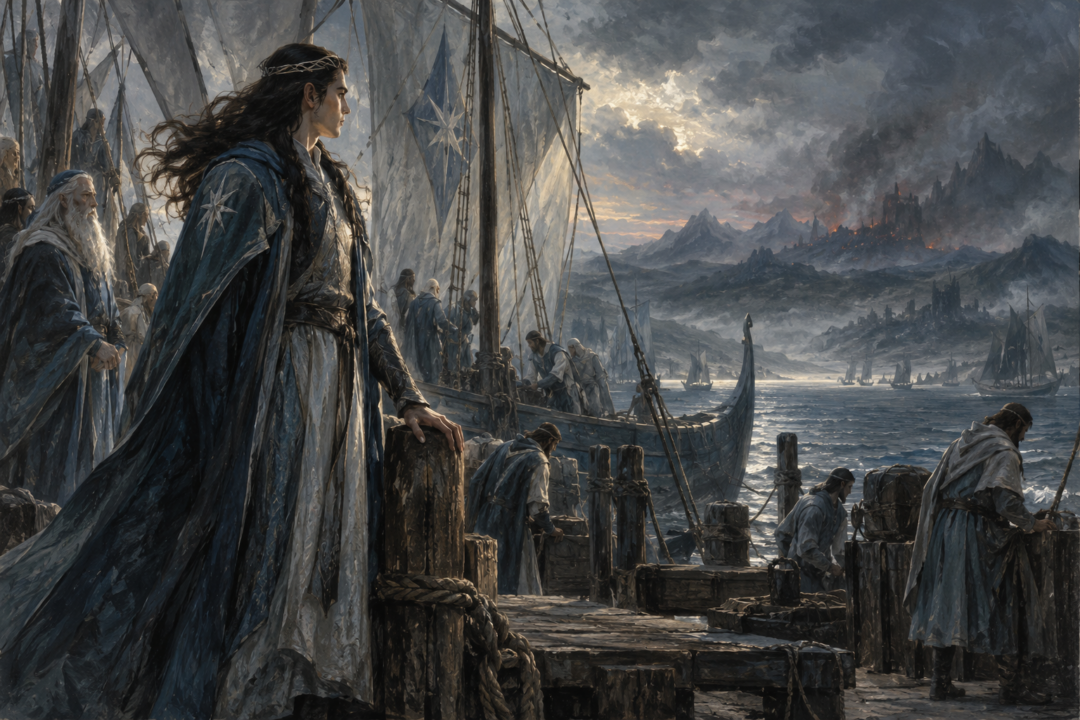
Gil-galad stands at the end of an extraordinary line of Elven kings. He is the last High King of the Noldor in Middle-earth, the ruler who joins Elendil in the Last Alliance, and one of the great figures remembered by the Elves thousands of years after Beleriand disappeared beneath the sea.
Yet one surprisingly basic question about him has two very different answers:
Who was Gil-galad’s father?
Readers of the published Silmarillion receive a clear answer. Gil-galad is Ereinion, son of Fingon, placing him in the House of Fingolfin.
Later genealogical material points elsewhere. In a late conception preserved in The Peoples of Middle-earth, Gil-galad is instead the son of Orodreth, whose own ancestry had also been revised. That would place Gil-galad in the House of Finarfin and make Finduilas of Nargothrond his sister.
This is more than a stray contradiction. It reveals how dramatically the genealogy of one of Middle-earth’s most important kings continued to change—and why the published Silmarillion cannot always be treated as a simple record of the final version of every idea.
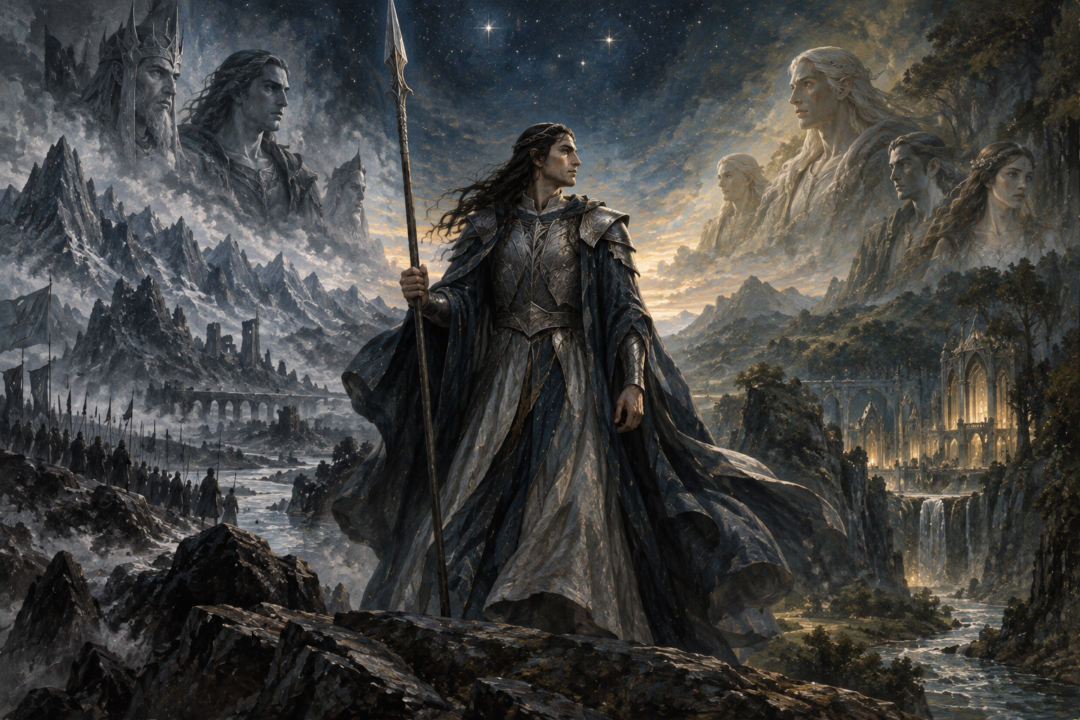
The Published Silmarillion Makes Gil-galad Fingon’s Son
Within the published Silmarillion, the matter appears straightforward.
After Fingolfin dies fighting Morgoth, Fingon becomes High King of the Noldor. The narrative then identifies the young Ereinion—later called Gil-galad—as Fingon’s son and says that he was sent to the Havens for safety.
The connection appears again when the story describes those who survived the catastrophe of the Nirnaeth Arnoediad. Gil-galad is again identified as Fingon’s son, who had previously been sent to the Havens.
Taken entirely on its own terms, therefore, the published Silmarillion gives Gil-galad a clear place in the royal house:
Finwë → Fingolfin → Fingon → Gil-galad.
That is an enormously prestigious ancestry. Fingolfin had become High King after the reconciliation of the divided Noldor in Middle-earth, and Fingon succeeded him. Gil-galad would consequently be a direct descendant of that same branch.
There is nothing within the published narrative that asks an ordinary reader to doubt this.
The difficulty appears only when later textual material is considered.
The Fingon Version Was Not the Final Conception
The history behind the published text is considerably more complicated.
Gil-galad’s ancestry changed more than once during the development of the legendarium. At different stages he was connected with different branches of the House of Finwë. Among these evolving ideas was the identification of him as Fingon’s son.
But that conception did not remain the final one.
Material published much later in The Peoples of Middle-earth, particularly the discussion accompanying “The Shibboleth of Fëanor,” shows a different genealogy. Christopher Tolkien explained that the idea of Gil-galad as Fingon’s son had been comparatively brief and that later work moved Gil-galad back toward the descendants of Finarfin.
The decisive late note dates to August 1965.
There Gil-galad was made the son of Orodreth.
But understanding what that means requires another surprise, because this Orodreth is not genealogically identical to the Orodreth familiar from the published Silmarillion.
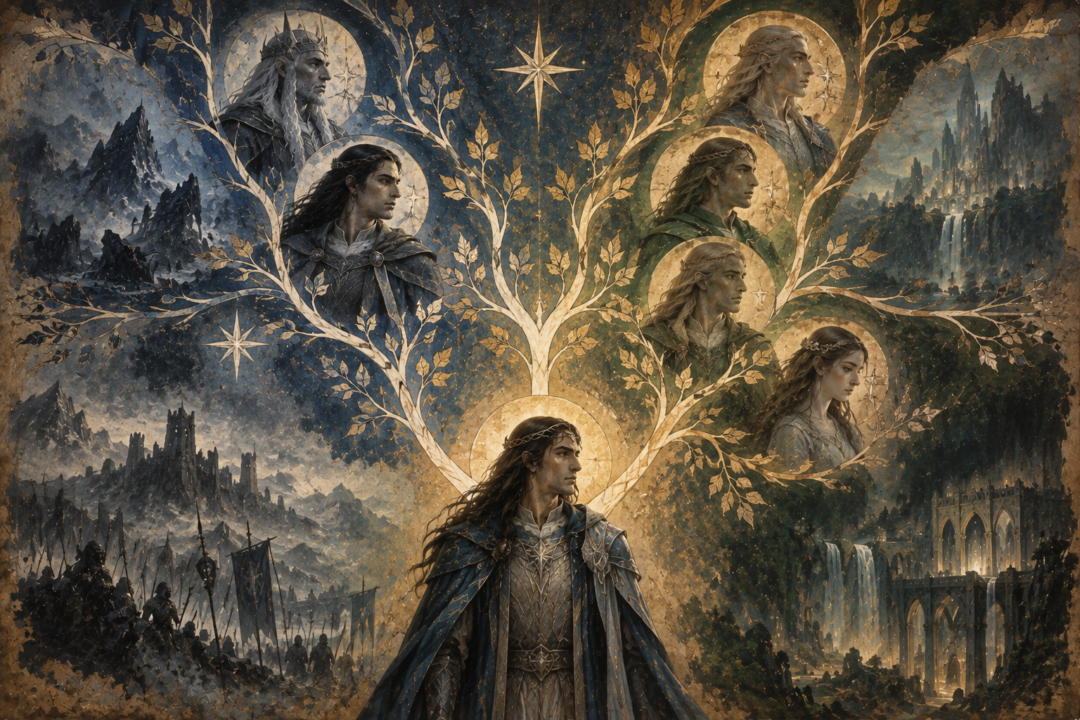
Orodreth Himself Had Been Moved Down a Generation
In the published Silmarillion, Orodreth is a son of Finarfin and therefore the brother of Finrod, Angrod, Aegnor, and Galadriel.
That arrangement makes Orodreth one of the great princes of the original generation of Noldorin exiles.
The later genealogy altered this.
Orodreth became the son of Angrod rather than the son of Finarfin. He was therefore Finrod’s nephew rather than his brother.
The late conception can be represented as:
Finwë → Finarfin → Angrod → Orodreth → Gil-galad.
That changes Gil-galad’s ancestry completely.
Instead of descending from Fingolfin through Fingon, he descends from Finarfin through Angrod and Orodreth.
And the revision creates another striking relationship.
Finduilas Becomes Gil-galad’s Sister
Finduilas is one of the most tragic figures in the story of Túrin.
She is the daughter of Orodreth, loved by Gwindor and later drawn toward Túrin. When Nargothrond falls, she is captured by Orcs and ultimately slain after the attempt to rescue her fails.
Under the late genealogy, Gil-galad and Finduilas are children of the same father.
They are brother and sister.
This produces a very different emotional and dynastic background for Gil-galad from the one presented in the published Silmarillion. His family would be rooted not primarily in Hithlum and the house of Fingolfin, but in the Finarfinian branch and the royal history of Nargothrond.
It is important, however, not to retrofit that relationship too aggressively into the existing narrative.
The surviving Nargothrond stories were not comprehensively rewritten to accommodate the revised genealogy. We therefore cannot safely invent interactions between Gil-galad and Finduilas, or assume how their sibling relationship would have altered events.
The genealogy tells us that the late conception made them siblings. It does not give us a completed rewritten narrative showing what that relationship would have looked like.
That distinction matters.
Why Gil-galad Could Not Remain Finrod’s Son
Gil-galad’s changing ancestry was connected to another evolving question: whether Finrod Felagund had children.
At one stage of the textual development, Gil-galad had been conceived as Finrod’s son.
That arrangement eventually became difficult to maintain alongside the conception in which Finrod had no children in Middle-earth. In the tradition associated with Amarië, Finrod loved her in Valinor, but she did not accompany him into exile.
As the genealogy evolved, Gil-galad consequently had to be placed elsewhere.
The eventual late solution preserved his connection with the House of Finarfin without making him Finrod’s son.
Orodreth became the crucial link.
In the 1965 note, Orodreth is the son of Angrod, is associated closely with Finrod, and succeeds him in Nargothrond. Gil-galad in turn becomes Orodreth’s son.
It is an elegant genealogical solution on paper.
The problem was that the surrounding narratives had not been rewritten to match it.
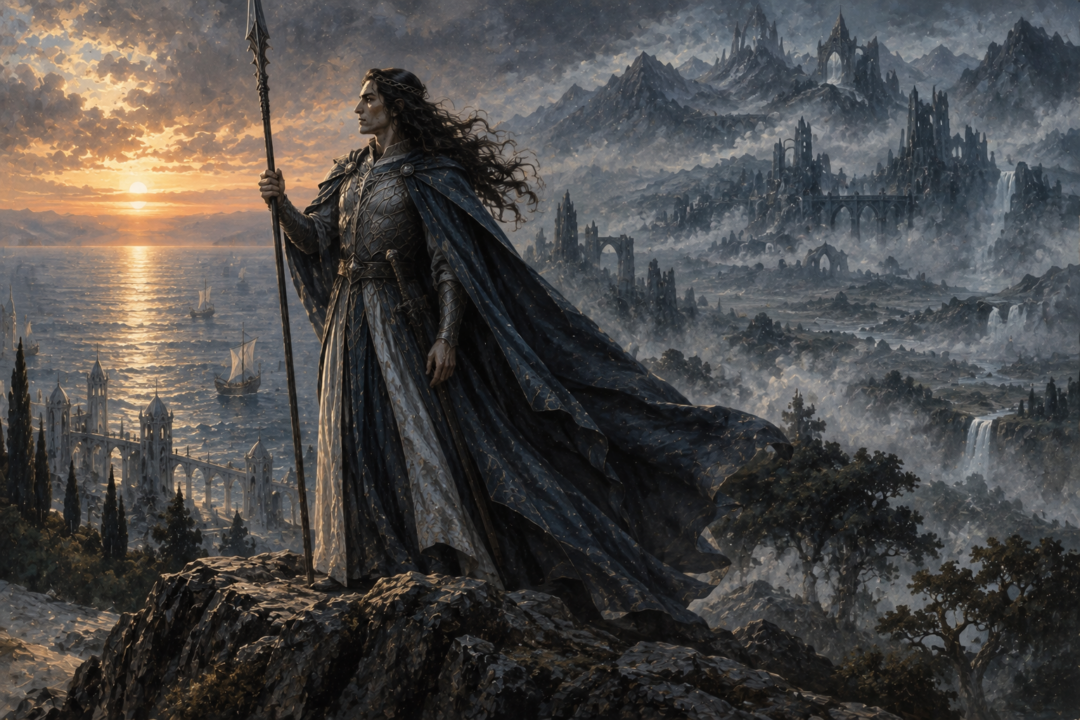
Why the Published Silmarillion Still Says Fingon
This is where the distinction between the published book and the underlying manuscripts becomes essential.
When preparing The Silmarillion for publication, Christopher Tolkien faced numerous texts written and revised across decades. Some late alterations existed only as notes or genealogical changes and had never been propagated through the larger narratives.
Gil-galad’s late parentage was one such case.
Making him Orodreth’s son would not simply have required changing one name. Orodreth himself would have needed to move from being Finarfin’s son to Angrod’s son. His relationship to Finrod would change. Finduilas would acquire a brother of enormous later importance. Passages concerning Gil-galad’s early life would require reconsideration.
The late genealogy and the older narrative tradition did not yet form a single fully harmonized text.
The published Silmarillion therefore retained the Fingon genealogy.
Christopher Tolkien later concluded that this had not been the best solution. In his commentary in The Peoples of Middle-earth, he regarded the Fingon parentage as an idea that should not have been elevated into the definitive published account and stated that it would have been better to leave Gil-galad’s parentage unspecified.
That editorial history explains the apparent contradiction better than trying to force both genealogies into the same fictional chronology.
They are not two simultaneously true family traditions within Middle-earth. They belong to different stages in the development of the legendarium.
A Further Problem: Later Fingon Is Childless
There is another reason the distinction matters.
Late genealogical material associated with “The Shibboleth of Fëanor” explicitly presents Fingon—Findekáno—as having no wife or child.
That cannot be reconciled literally with the published Silmarillion calling Gil-galad his son.
Again, the safest approach is not to invent an explanation inside the story. There is no need to propose adoption, secret marriages, uncertain records, or competing Elven traditions. The textual history already explains the discrepancy.
The two statements derive from different conceptions.
Under the published Silmarillion genealogy, Fingon is Gil-galad’s father.
Under the later conception, Fingon is childless and Gil-galad belongs to the line of Finarfin through Orodreth.
So Which Parentage Should Readers Use?
There is no single answer that works for every purpose.
If discussing the internal narrative of the published Silmarillion, Gil-galad is the son of Fingon. That is what the book actually says, repeatedly and unambiguously.
If discussing the later development of the legendarium, the picture changes. The August 1965 note makes Gil-galad the son of Orodreth, with Orodreth himself the son of Angrod. Christopher Tolkien regarded this as the final conception of Gil-galad’s parentage found in his father’s work.
But even that deserves careful qualification.
The late genealogy was never fully incorporated into a completed rewriting of the First Age narratives. Calling it simply “the canon version” can therefore conceal the very textual problem that makes the question interesting.
The most accurate formulation is narrower:
The published Silmarillion makes Gil-galad the son of Fingon. A later genealogical conception makes him the son of Orodreth and therefore a descendant of Finarfin through Angrod.
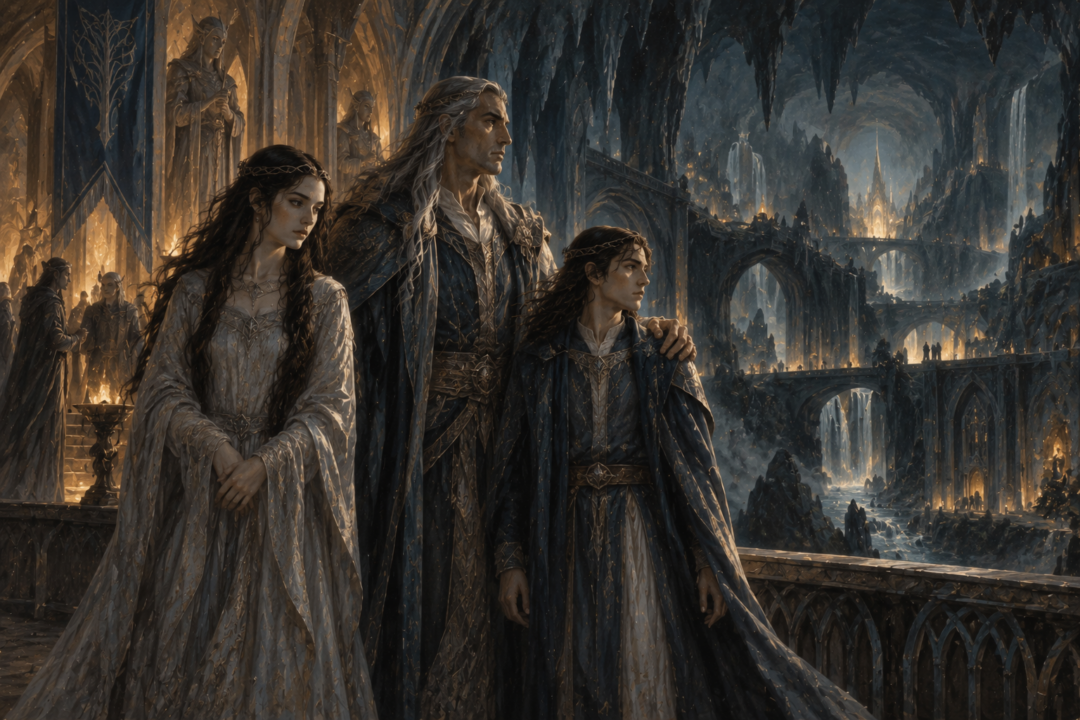
The Last High King With Two Family Trees
Gil-galad’s uncertain ancestry is strangely appropriate to the world he inherits.
By the time he becomes one of the greatest rulers of the Second Age, nearly all the kingdoms that defined the Noldor in Beleriand are gone. Fingolfin, Fingon, Finrod, Turgon, Orodreth, and Finduilas all belong to a vanished age. Hithlum is lost. Nargothrond is ruined. Gondolin has fallen. Beleriand itself is broken.
Gil-galad rules among the survivors.
Whether one reads him as Fingon’s son in the published Silmarillion or as Orodreth’s son in the late genealogy, he remains an heir to that destroyed world.
But the difference between those versions is significant. One makes him the direct continuation of the line of Fingolfin and Fingon. The other binds him to the House of Finarfin, to Angrod, Orodreth, and the tragedy of Nargothrond.
The contradiction should not be disguised.
It is one of those places where Middle-earth preserves the marks of its long development—and where a seemingly simple question about an Elven king opens onto an entire hidden history of the legendarium.
Sources & Notes
- Tolkien Gateway, “Gil-galad” — surveys the changing parentage traditions and Christopher Tolkien’s editorial choice in the published Silmarillion. https://tolkiengateway.net/wiki/Gil-galad
- Tolkien Gateway, “Orodreth” — documents Orodreth’s revised place as Angrod’s son and his children Finduilas and Gil-galad. https://tolkiengateway.net/wiki/Orodreth
- Tolkien Gateway, “Fingon” — records the published identification of Gil-galad as Fingon’s son and the contrary later manuscripts. https://tolkiengateway.net/wiki/Fingon
- The Encyclopedia of Arda, “Ereinion Gil-galad” — summarizes both the published Fingon lineage and Tolkien’s alternative genealogical revisions. https://www.encyclopedia-of-arda.com/g/gilgalad.html
Sources document the competing accounts of Gil-galad’s parentage, the published Silmarillion’s Fingon genealogy, Tolkien’s later Orodreth genealogy, Orodreth’s revised descent from Angrod, and the resulting relationship to Finduilas.