What Happens to the Roads Sauron Built Once His Empire Is Gone?
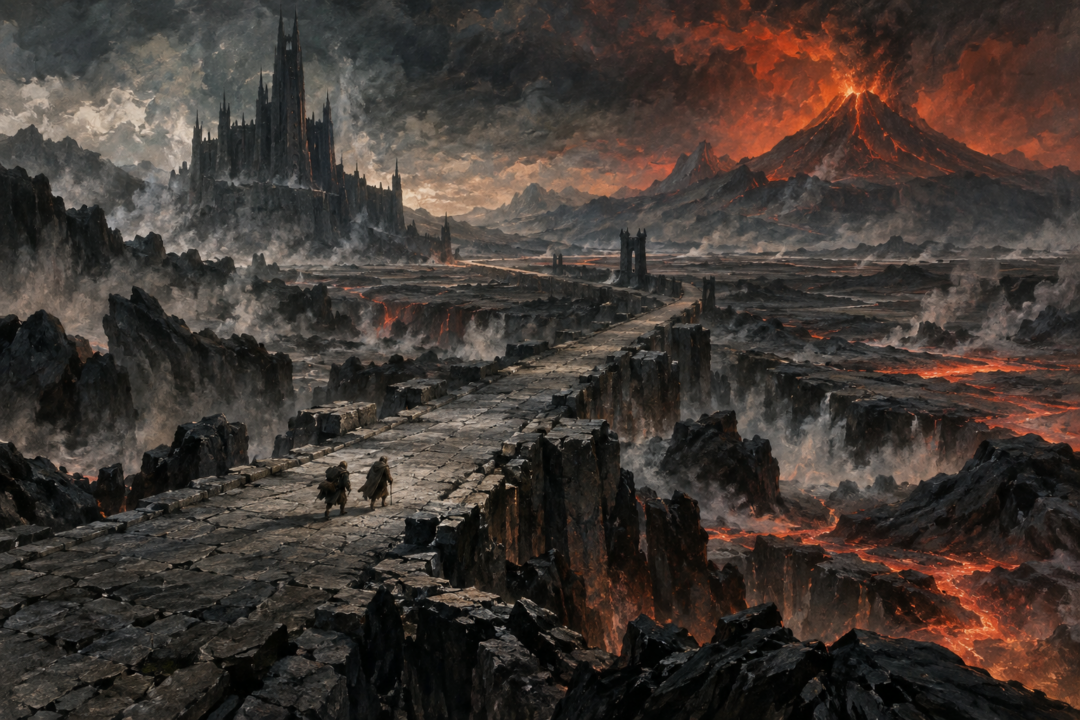
When Frodo and Sam finally reach the last stage of their journey across Mordor, something unexpectedly mundane helps them approach Mount Doom: a road.
Not a forgotten path made by travellers, nor an ancient Gondorian highway captured by the Enemy, but a great engineered route serving Sauron’s own realm. It runs from Barad-dûr toward Orodruin, raised above the broken country where necessary and built for the purposes of the Dark Tower.
The irony is perfect. A road constructed to serve Sauron becomes part of the route by which the Ring reaches the place where his power can be destroyed.
But that raises a question the story never directly answers. After Barad-dûr falls and Sauron disappears, what happens to all that infrastructure?
Mordor was not simply a fortress surrounded by wasteland. It possessed roads connecting its military heart with territories to the east and south, supply networks feeding armies, and agricultural lands around Lake Núrnen. Once Sauron was gone, those physical structures did not necessarily vanish with him.
And that means the Fourth Age inherited something uncomfortable: pieces of Sauron’s empire that could potentially outlive Sauron himself.
Mordor Was an Empire That Needed Logistics
Sauron’s armies can look almost supernatural when seen from outside Mordor: enormous hosts appearing from the Black Gate, seemingly generated by the Dark Land itself.
The text gives us a more practical picture.
When Frodo and Sam are struggling through Mordor, they do not know about the extensive slave-worked agricultural country farther south around Lake Núrnen. Nor do they initially understand the wider logistical system supporting the armies of the Tower.
The narrative describes great roads running east and south toward tributary lands. Along these routes came wagon-trains carrying goods, booty, and new slaves.
That detail matters.
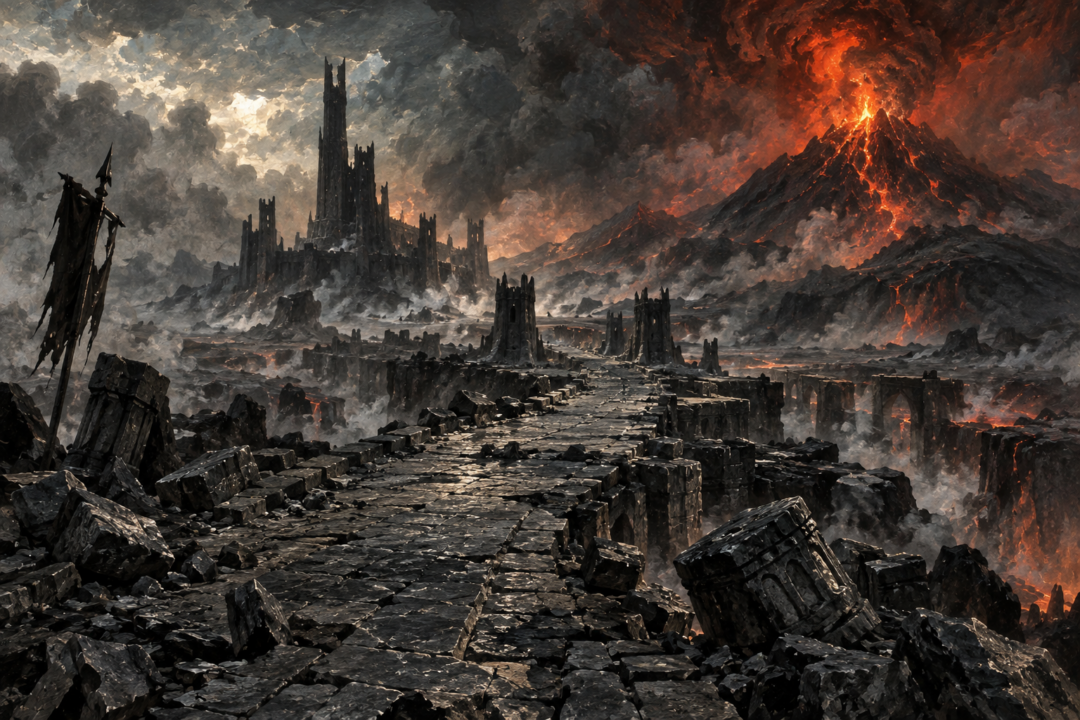
Sauron’s military power depended partly upon ordinary material systems: food had to be grown or imported, goods transported, armies moved, captives relocated, and distant territories connected to the political and military centre.
Mordor therefore contained more than fortifications. It contained infrastructure.
And infrastructure is morally indifferent after its builders are gone.
A road made for conquest can later carry refugees home.
The Road to Mount Doom Survives Long Enough to Betray Its Maker
The clearest example is the road linking Barad-dûr and Orodruin.
Frodo and Sam encounter it during their final approach to Mount Doom. The road is engineered through exceptionally hostile terrain, emerging from the direction of the Dark Tower and running toward the Mountain.
Its purpose is never explained in exhaustive administrative detail, and we should not invent one. What the text establishes is that Sauron had constructed and maintained a substantial route between Barad-dûr and Orodruin.
For Sam, its existence becomes an unexpected gift.
Without that road, the last approach might have been impossible.
This creates one of the quietest reversals in the entire War of the Ring. Sauron spent immense effort shaping Mordor around his own needs. Yet the very order he imposed upon the landscape created a navigable line through country that otherwise threatened to defeat the Ring-bearer.
There is no suggestion that Sauron imagined this possibility.
His road was not secretly destined to destroy him. It was simply infrastructure designed for his own purposes.
But once Frodo and Sam reached it, purpose changed.
The builder no longer controlled what his creation meant.
Then Barad-dûr Falls
When the Ring is destroyed, the political geography of Mordor changes almost instantly.
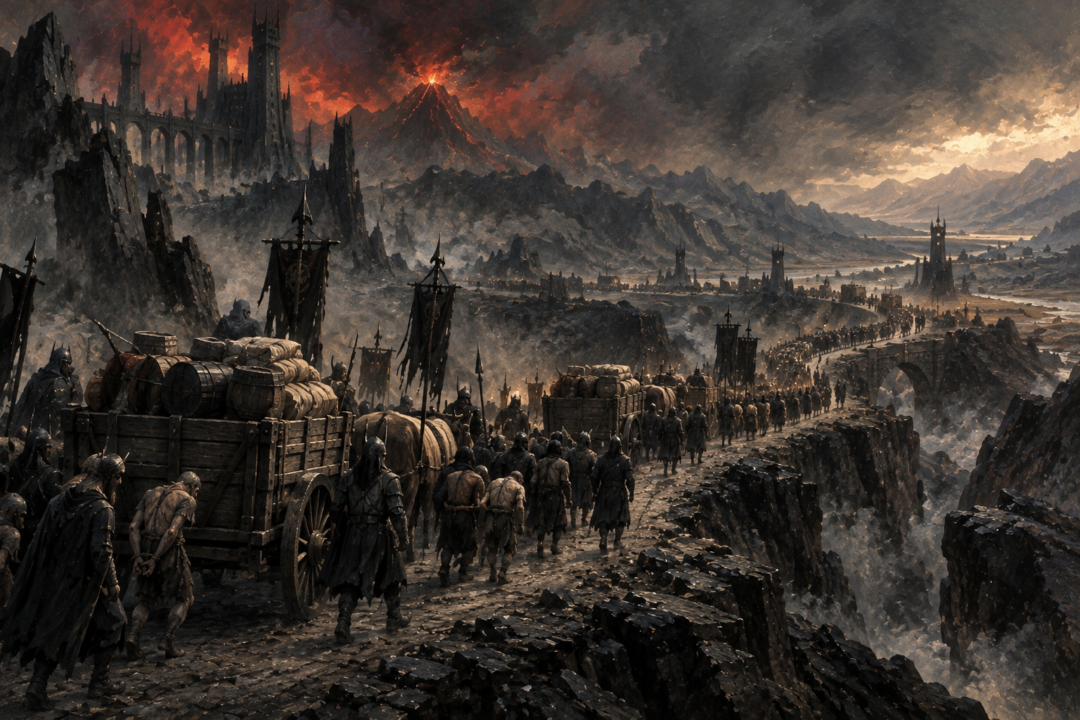
Barad-dûr collapses. The Black Gate and the Towers of the Teeth are ruined amid the catastrophe accompanying Sauron’s downfall. His armies break. Mount Doom erupts violently, and the land around the Mountain is convulsed.
This is important when imagining the fate of Sauron’s roads.
Some portions almost certainly suffered catastrophic physical damage, particularly near Orodruin and the collapsing strongholds. The text does not provide a Fourth Age survey of Mordor’s road system, so it would be wrong to claim that particular highways definitely survived intact.
But neither does it say that every road in Mordor was destroyed.
That distinction matters.
Sauron’s supernatural power could disappear in a moment. Stone causeways, tracks, bridges, embankments, and roads elsewhere in his enormous realm would obey more ordinary rules. Unless damaged by the destruction, deliberately dismantled, or abandoned to decay, they could remain.
The empire died faster than its infrastructure necessarily did.
The Roads East and South Suddenly Lead Somewhere Different
The most intriguing roads may not be the famous route to Mount Doom at all.
They are the roads running toward the east and south.
Before Sauron’s fall, these were arteries of domination. Through them came tribute, supplies, soldiers, booty, and enslaved people. They physically connected Mordor to the broader system of power Sauron had established beyond its mountains.
After his defeat, the meaning of those roads would inevitably change.
The text tells us that King Elessar made peace with peoples who had served Sauron, while those who persisted in hostility were dealt with differently. The precise political future of every eastern and southern land is not described, and we should not imagine a neat Fourth Age settlement where none is given.
Yet the old routes remained geographically significant whether or not they remained usable in their previous form.
A road connecting Mordor to the East does not cease leading east because Sauron is dead.
That makes these routes potential channels for an entirely different world: diplomacy rather than tribute, ordinary travel rather than military mobilization, or simply abandonment as the political networks that maintained them disappear.
The texts never tell us which outcome occurred.
Their silence is revealing because another part of Mordor definitely receives a new future.
Núrnen Changes the Whole Question
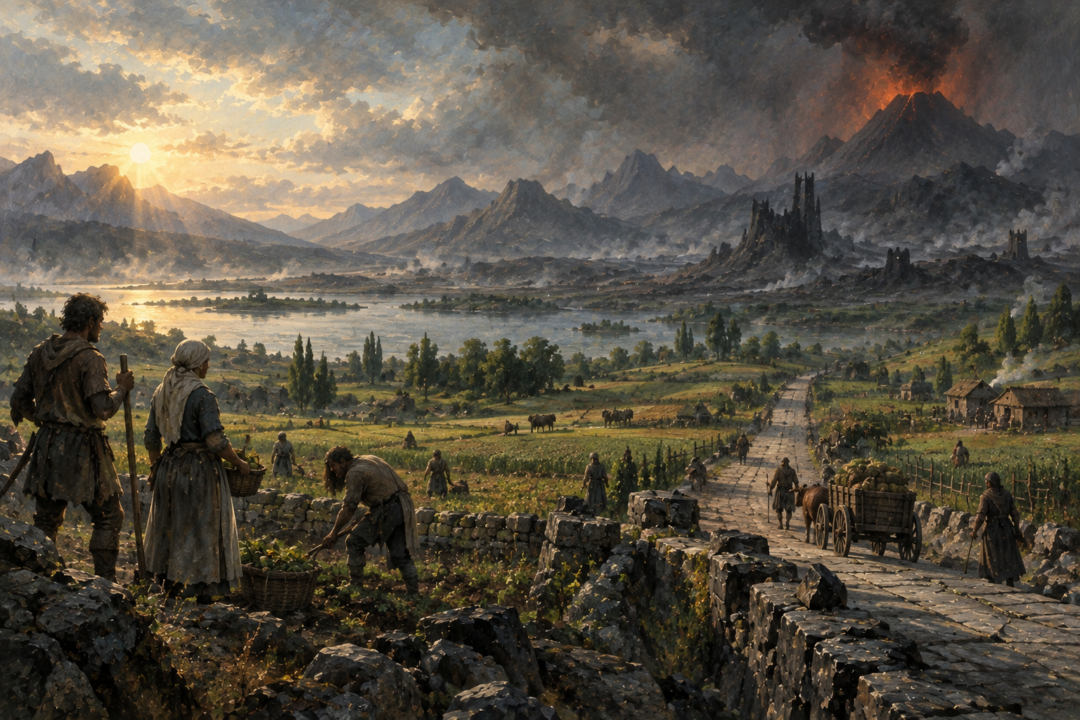
South of the devastated plateau lay the lands around Lake Núrnen.
During Sauron’s rule, these lands were cultivated by slaves and helped provision his armies. The contrast with Gorgoroth is striking: while Frodo and Sam cross a poisoned military wasteland, productive land exists elsewhere within the same realm.
After the victory, Elessar frees the slaves of Mordor and gives them the lands around Lake Núrnen to be their own.
That single detail transforms how we should imagine post-Sauron Mordor.
Mordor does not simply become an empty cursed zone that everyone abandons.
At least one substantial part of it becomes the homeland of freed people.
And people living around Núrnen would still require movement, agriculture, exchange, and communication.
The texts never explicitly state that Sauron’s old roads were adopted by the inhabitants of Núrnen. We therefore cannot say that they definitely converted imperial highways into peaceful trade routes.
But it is a reasonable possibility where surviving roads connected useful places.
The physical landscape inherited by the freed people was not untouched wilderness. It was land that had been organized for exploitation.
Their challenge was not merely to live after Sauron.
It was to live among things Sauron had built.
Do You Destroy an Evil Empire’s Useful Works?
Here the question becomes larger than Mordor.
Should everything created under tyranny be destroyed simply because tyranny created it?
Middle-earth repeatedly distinguishes between power itself and the purposes to which power is directed. Roads make that distinction unusually visible.
A fortress designed for oppression may remain threatening because its architecture embodies military control. A road is different. Its function depends largely on who travels it and why.
Under Sauron, a southern road could carry chained captives toward Mordor.
After Sauron, the same surviving route could theoretically carry former captives away from it.
Nothing in the texts says that such a journey occurred. But the possibility follows from the extraordinary political reversal established around Núrnen.
The road has not become morally good.
It has simply lost its master.
Some Roads Would Probably Fade
There is also a less dramatic possibility.
Many of Sauron’s roads may simply have ceased to matter.
Imperial infrastructure exists because an imperial system continually gives it purpose. Garrisons maintain strategic routes because troops must travel them. Supply roads matter because armies require provisions. Roads toward fortresses matter because those fortresses remain occupied.
Remove the army, administration, slaves, tribute, and central authority, and some routes become roads to nowhere.
The great road toward Barad-dûr offers the clearest conceptual example.
After the Dark Tower fell, what reason remained for maintaining a highway whose destination was a gigantic ruin?
Likewise, a road built specifically for the movement of Sauron’s military forces might gradually deteriorate once those forces disappeared.
This is inference rather than recorded history. We are never given a detailed account of Mordor’s infrastructure during the Fourth Age.
But ordinary decay requires no magical explanation.
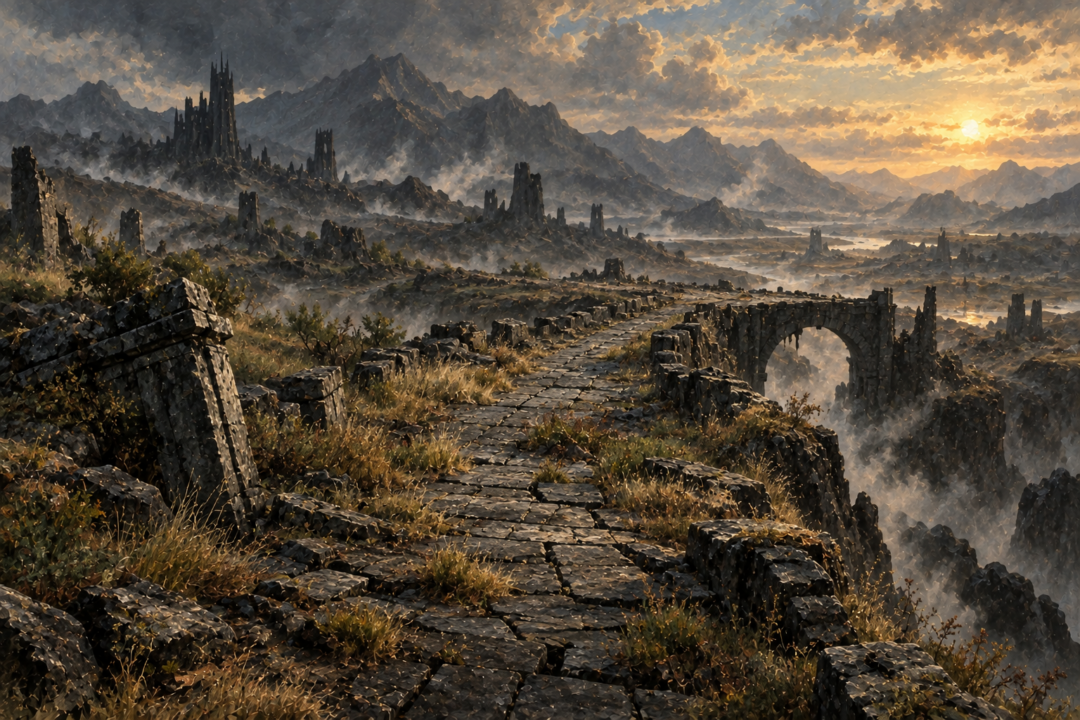
Without labour and necessity, roads crack. Bridges fail. Ash covers paving. Water cuts through embankments. Vegetation may return where the land permits it.
Sauron’s roads could therefore disappear slowly rather than dramatically.
The Most Tolkien-Like Fate Is Not Destruction but Change
There is something fitting about the possibility that parts of Sauron’s infrastructure survived him.
The Ring is destroyed because the object containing Sauron’s power cannot safely be repurposed. No one can simply inherit it and use it benevolently without confronting its corrupting nature.
A road is not the Ring.
Its evil lies in what an evil regime does with it.
That difference makes the roads of Mordor an overlooked symbol of the transition into the Fourth Age.
The great machines of domination stop. The armies scatter. The Dark Tower falls. The slaves around Núrnen become owners of the land they had been forced to cultivate.
Yet the landscape still bears scars and structures left by the vanished regime.
Some are ruins.
Some presumably decay.
And some may have remained useful.
Tolkien never tells us whether travellers of the Fourth Age walked Sauron’s highways or whether the people of Núrnen repaired any of them. The safest answer to the original question is therefore deliberately incomplete: we do not know the specific fate of the road network.
But we do know enough to see the deeper irony.
Before Sauron fell, his roads carried the machinery of empire.
One of them helped Frodo and Sam reach Mount Doom.
And after the Shadow passed, whatever stretches survived no longer belonged to the purpose for which they had been built.
Sauron could shape stone.
He could build roads across Mordor.
What he could not guarantee was that those roads would always lead where he intended.
Sources & Notes
- Tolkien Gateway, “Sauron’s Road” — documents the road from Barad-dûr to Mount Doom, Frodo and Sam’s use of it, and its damage in the eruption. https://tolkiengateway.net/wiki/Sauron%27s_Road
- Tolkien Gateway, “Nurn” — summarizes Mordor’s fertile southern region, its slave-worked fields, and Elessar’s postwar grant of the land to the freed slaves. https://tolkiengateway.net/wiki/Nurn
- The Encyclopedia of Arda, “Mordor” — outlines Mordor’s geography, including Gorgoroth and the more fertile plain of Nurn. https://www.encyclopedia-of-arda.com/m/mordor.php
- Tolkien Gateway, “Mount Doom” — documents Orodruin’s connection to Barad-dûr by Sauron’s Road and the eruption at the Ring’s destruction. https://tolkiengateway.net/wiki/Mount_Doom
Sources document Sauron’s engineered road between Barad-dûr and Mount Doom, Mordor’s military and agricultural geography, the slave-worked lands of Nurn, their grant to the freed slaves after the war, and the eruption accompanying Sauron’s fall. The article’s conclusions about later infrastructure are explicitly interpretive.