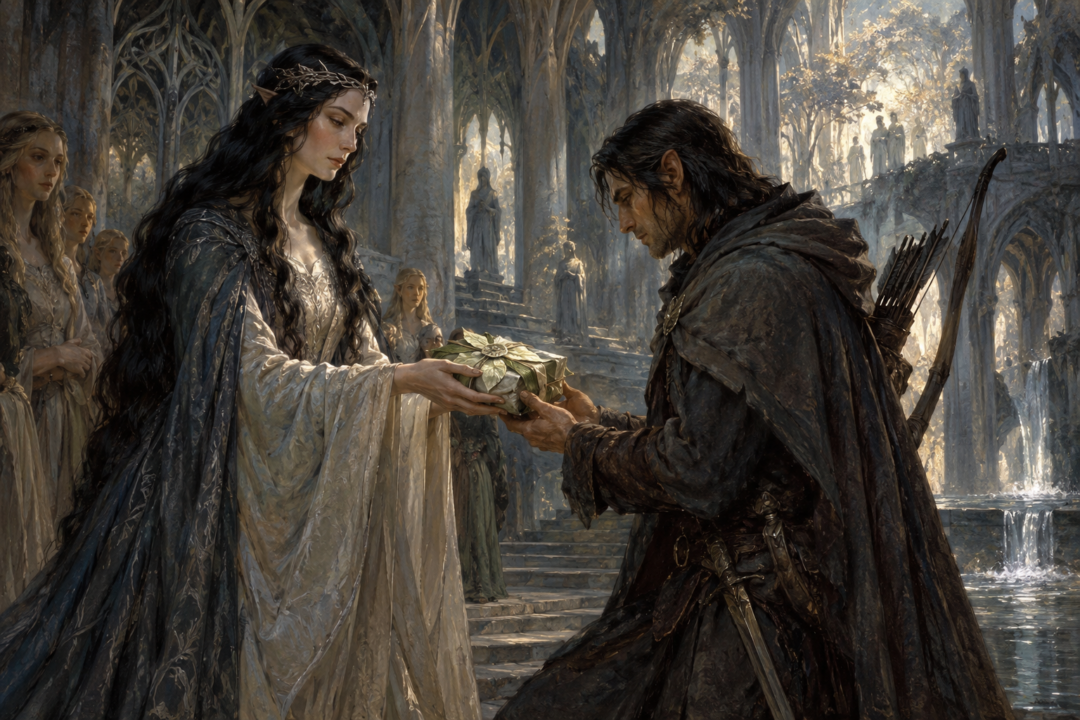
When the Fellowship leaves Lothlórien, one of Galadriel’s most important gifts looks almost ordinary: thin cakes of Elvish waybread, wrapped for travel.
Yet lembas was never merely the Elves’ superior version of trail food.
Behind those small cakes stood an ancient custom reaching back toward Aman. The grain was guarded. Its preparation belonged to specially appointed Elven-women. Its keeping and distribution belonged to a queen—or, more precisely in the surviving tradition, the highest-ranking woman of an Elven people.
And when Men received it, the gift was remarkable.
That changes the meaning of Galadriel’s farewell. Frodo, Sam, Aragorn, Boromir, Gimli, and the other non-Elves in the Fellowship were not simply being handed provisions. They were being admitted, temporarily and deliberately, into something normally reserved within Elven life.
To understand why, we have to look back far beyond Lothlórien.
Lembas Was Restricted Even Among the Elves
The later lore concerning lembas describes an unusually controlled tradition.
The grain from which it was made was associated with Yavanna and with Aman. According to the account preserved in “Of Lembas,” the Eldar said that they first received this food from the Valar for their aid during the Great Journey.
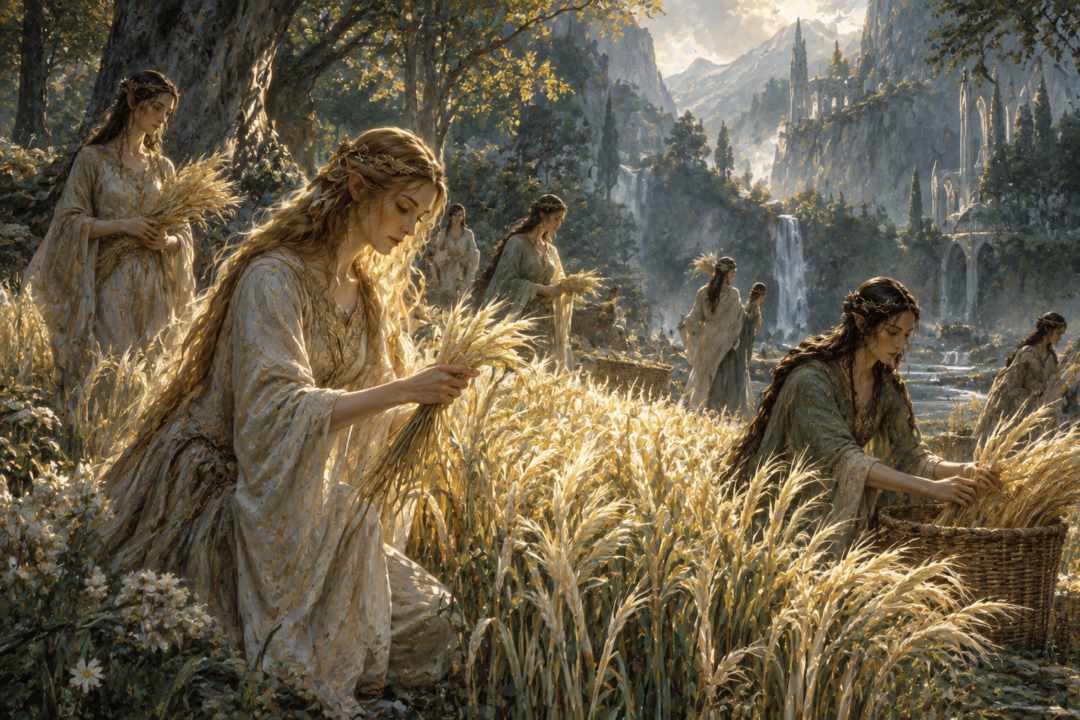
In Middle-earth, the special corn was cultivated in guarded places and sunny glades. Its ears were gathered individually by hand rather than cut with metal. From harvesting through the finished wafer, the grain could be handled only by particular Elven-women known as the Yavannildi, the Maidens of Yavanna.
Even its consumption was not simply casual.
Lembas was intended especially for those undertaking long journeys in the wild and for those wounded or endangered who needed its sustaining power.
The entire process therefore surrounded the bread with restriction: who cultivated and handled it, who made it, who kept it, who distributed it, and under what circumstances it was properly used.
That makes one detail especially important.
The final authority over the store did not belong to a cook, quartermaster, warrior, or king.
It belonged to the chief woman of the people.
The Queen Was the Keeper and Giver
The tradition states that the keeping and giving of lembas belonged to the queen, or to the highest-ranking Elven-woman where there was no queen.
This office was important enough to have its own titles: the Quenya massánië and Sindarin besain, meaning essentially “bread-giver” or “lady bread-giver.”
This was not simply ceremonial language.
It meant that distributing lembas was an act of authority.
An ordinary Elf could not simply decide that an outsider seemed trustworthy and hand over the community’s sacred waybread. The power to release it rested at the highest level of its traditional guardianship.
That explains one of the most striking scenes involving lembas in the First Age.
It begins with Melian, Queen of Doriath.
Melian’s Gift to Beleg Crossed an Ancient Boundary
When Beleg Cúthalion prepared to seek Túrin in the wilderness, Melian gave him a store of lembas.
The immediate recipient was an Elf, but Melian explicitly allowed the bread to aid not only Beleg but also those whom he chose. Since Beleg was going in search of Túrin, the significance was unmistakable.
The narrative emphasizes how extraordinary this was.
The Eldar had not previously permitted Men to eat their waybread, and they would seldom do so afterward.
Túrin therefore stood at the edge of a privilege no Man before him had received.
The gift was visibly marked with Melian’s authority. The lembas was wrapped in leaves, and its binding was sealed with the Queen’s seal. The detail matters because the story immediately explains that the keeping and giving of lembas belonged to the Queen.
This was not Beleg stealing supplies from Menegroth.
It was authorized.
And Melian went further: she gave Beleg discretion over whom the bread might help.
The chain of authority remained intact even as the normal boundary was crossed.
Why Men Were Normally Excluded
The later account of lembas gives a remarkable explanation for Elven reluctance to share it with mortals.
The concern was not that Men were physically incapable of eating it.
Rather, the Elves feared the effect that prolonged use might have upon mortal desire. Because lembas carried a quality associated with Aman, mortals who became accustomed to it might increasingly desire the life and lands of the Elves and become dissatisfied with their own mortal nature.
That concern fits a much larger tension running through the history of Middle-earth: the danger of mortals envying the deathlessness of the Eldar.
It is therefore misleading to imagine the restriction as mere Elvish possessiveness.
The texts present mortality and immortality as fundamentally different conditions. Attempts to escape the appointed limits of mortality repeatedly lead toward tragedy. Lembas could not make a mortal immortal, but the Elves were wary of encouraging a mortal hunger for what did not belong to mortal life.
The restriction was therefore partly protective.
And that makes the exceptions more meaningful.
Túrin Shows That Permission Was Not the Same as Acceptance
There is a bitter irony in Túrin becoming the first Man offered this privilege.
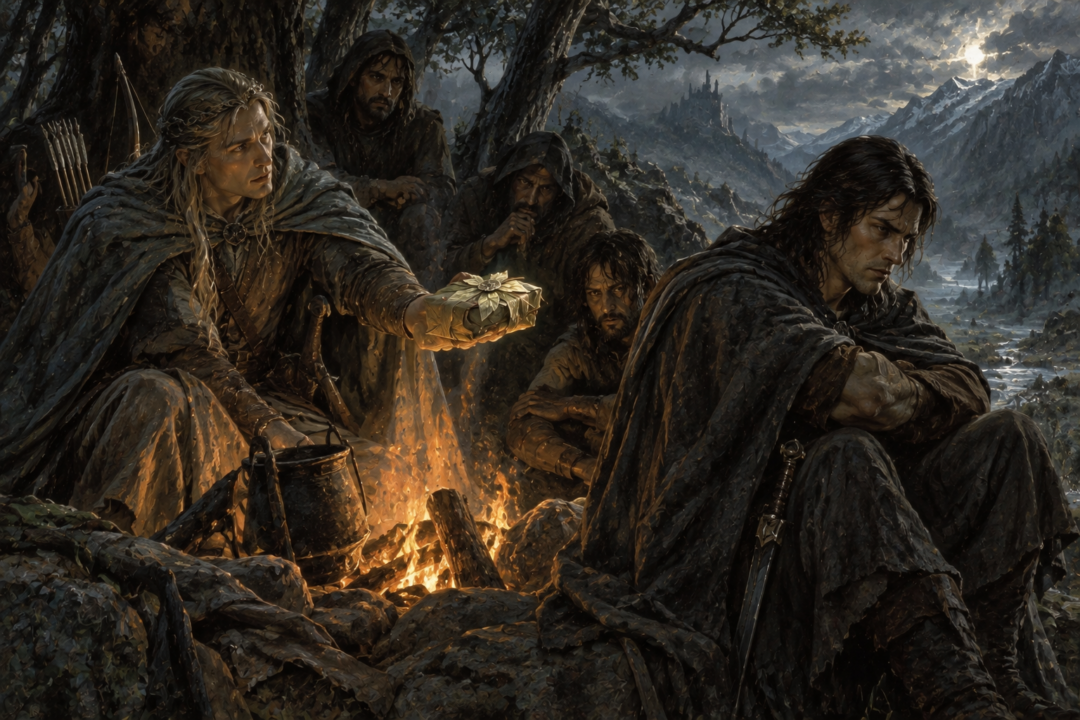
In the fuller tradition preserved around his story, Beleg eventually showed him Melian’s lembas and identified it as a gift from someone who still loved him.
Túrin refused.
His reason was not fear of the bread. He would not accept gifts from Doriath.
The moment captures much of Túrin’s tragedy in miniature. Something precious has crossed an ancient boundary specifically to help him, yet his estrangement and pride make him resist the gift.
Beleg, however, points out that Melian had given the lembas to him, and he could use it for others who needed it.
That distinction is important.
Melian had not merely issued Túrin a personal ration. She had entrusted Beleg with extraordinary authority to use the bread mercifully among people beyond its normal circle.
Lembas therefore becomes part of a recurring pattern in these stories: rules and boundaries remain real, but mercy can authorize an exception.
Tuor Provides Another Important Case
Túrin was not the only mortal connected with Elven waybread in the First Age.
In the tradition surrounding Tuor’s journey to Gondolin, Voronwë had survived the disastrous voyage of a ship sent westward from Gondolin. He possessed a small remaining supply of waybread that had been provided for the mariners, and he shared his provisions with Tuor during their dangerous journey.
The circumstances differ significantly from Melian’s deliberate gift for Beleg’s mission.
We should therefore be cautious about treating every appearance of lembas as evidence of an identical ceremony or authorization.
What the examples do show is that the normal restriction could yield under exceptional circumstances: perilous journeys, desperate necessity, and missions of extraordinary importance.
By the end of the Third Age, that pattern reaches its most famous expression.
Galadriel Did Not Simply Pack the Fellowship Lunch
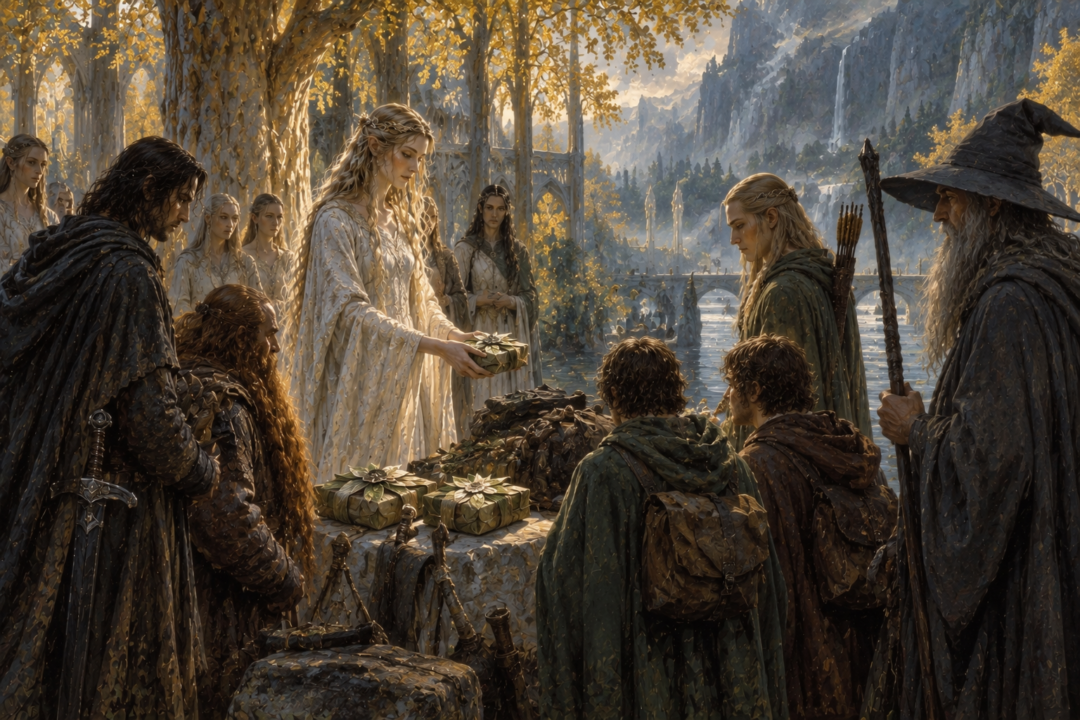
When the Fellowship prepares to depart Lothlórien, the Elves bring them lembas.
Gimli initially compares it with cram, the hard travelling food known among the Men of Dale, only to discover that the resemblance is superficial. The Elves explain that their waybread is far more strengthening than ordinary human travelling food.
But the deeper significance appears when this moment is read alongside the older lembas tradition.
Galadriel occupies precisely the kind of authority associated with its keeping and distribution.
And the recipients are extraordinary.
The Fellowship includes Hobbits, Men, a Dwarf, an Elf, and Gandalf. Their mission concerns the fate of the Free Peoples themselves. Galadriel has already recognized the immense burden carried by Frodo and the danger lying ahead.
Giving them lembas is therefore entirely consistent with the ancient pattern.
An exceptional authority grants an exceptional provision for an exceptional journey.
The old boundary is not abolished.
Galadriel chooses to cross it.
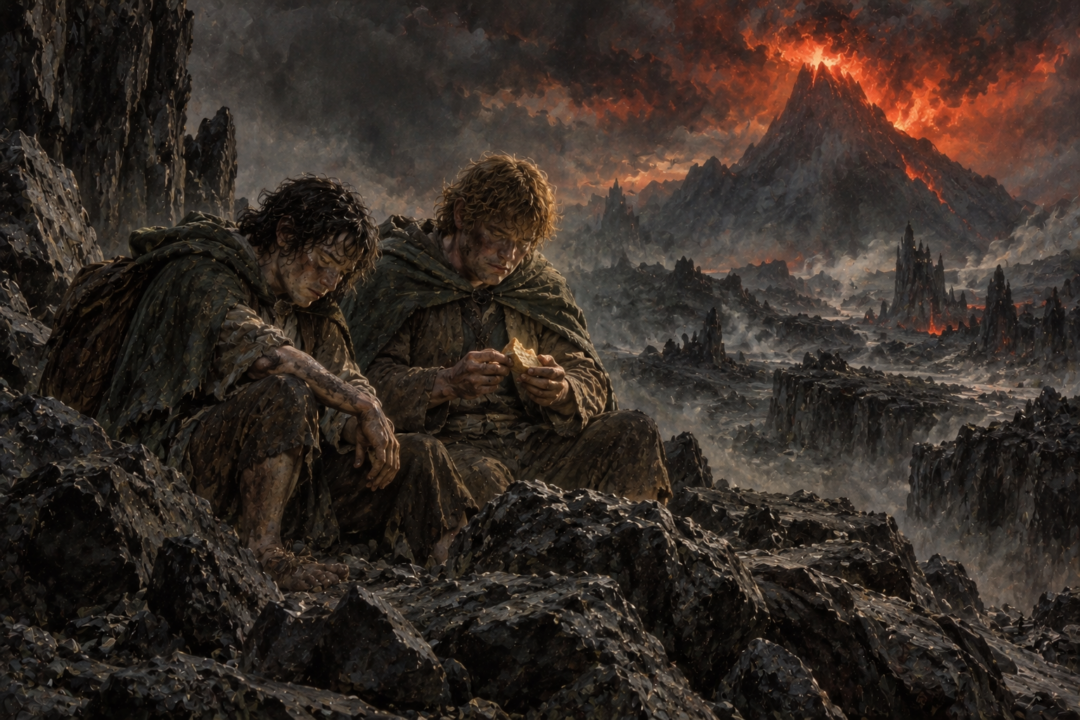
In Mordor, the Meaning of the Gift Becomes Clear
Only much later do Frodo and Sam discover how essential Galadriel’s gift truly was.
As ordinary provisions disappear, lembas increasingly sustains them. The narrative stresses that its effectiveness becomes greater when they depend upon it without mixing it with other foods.
More importantly, its virtue is described as strengthening not merely the body but the will to endure.
That does not mean lembas removes exhaustion, hunger, despair, or physical limitation. Frodo and Sam continue to weaken terribly as they approach Mount Doom.
It means the bread helps them continue beyond what ordinary nourishment might have allowed.
The ancient restriction therefore leads to a striking conclusion.
The Elves guarded lembas because it was not ordinary food. Its making was tied to inherited lore; its distribution belonged to designated authority; and its use was intended for genuine need.
Yet the greatest recorded examples of its giving show that the rule was capable of mercy.
Melian allowed her bread to pass toward Túrin.
Voronwë shared his dwindling provision with Tuor.
Galadriel supplied a company containing representatives of several peoples, knowing that some of them were travelling toward the very heart of the Shadow.
The rarity of the gift is precisely what gives those moments their weight.
The Rule Makes Galadriel’s Gift Greater, Not Smaller
It is easy to remember lembas simply because Frodo and Sam eat it on the road to Mordor.
But its older history transforms that familiar detail.
Every cake they carried represented a tradition carefully guarded across ages. Mortals did not possess an automatic right to it. Neither friendship nor ordinary hospitality was enough to make its distribution commonplace.
Someone with the authority to give it had chosen to do so.
That is why the small bundles leaving Lothlórien belong beside Galadriel’s more visibly wondrous gifts.
The Phial shines.
The Elven cloaks conceal.
Sam’s earth eventually helps heal the Shire.
But lembas does something quieter. It accompanies Frodo and Sam into a country where nearly everything green and wholesome has been stripped away, and it helps them keep moving when strength and hope are failing.
The ancient rule was not meaningless.
The exception was meaningful because the rule existed.
And when the need became great enough, the guarded bread of the Elves passed into mortal hands—not because the boundary had vanished, but because those entrusted with guarding it judged that mercy, necessity, and the fate of others justified opening it.
Sources & Notes
- The Encyclopedia of Arda, “Lembas” — describes Elvish waybread, its exceptional sustaining power, and its use by the Fellowship. https://www.encyclopedia-of-arda.com/l/lembas.html
- Wikipedia, “Lembas” — summarizes the bread’s appearances in Tolkien’s works and the later ‘Of Lembas’ tradition concerning Yavannildi and Queens’ authority. https://en.wikipedia.org/wiki/Lembas
- The Encyclopedia of Arda, “Melian” — records the Queen of Doriath’s role in Túrin’s story and her gift of lembas to Beleg. https://www.encyclopedia-of-arda.com/m/melian.html
- The Encyclopedia of Arda, “Galadriel” — documents Galadriel’s rule in Lórien and her gifts to the departing Fellowship. https://www.encyclopedia-of-arda.com/g/galadriel.html
Sources document lembas, its restricted Elven use, Melian’s authorized gift for Beleg’s journey to Túrin, and Galadriel’s provision of the Fellowship.