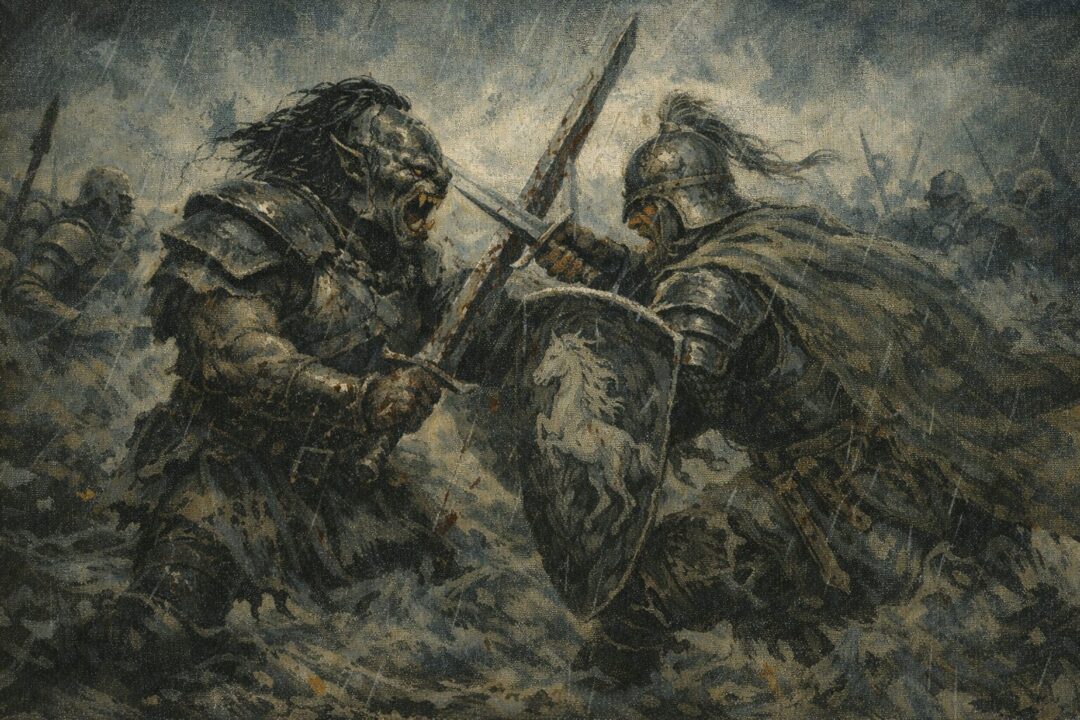
Uruk-hai are often treated as interchangeable villains—another enemy to be cut down on the battlefield, another dark shape among many in the long wars of Middle-earth. But within the story, they represent something far more specific and unsettling: a deliberate attempt to surpass the natural limits of Orc-kind and rival the strength, endurance, and battlefield effectiveness of Men.
And for a time, they succeed.
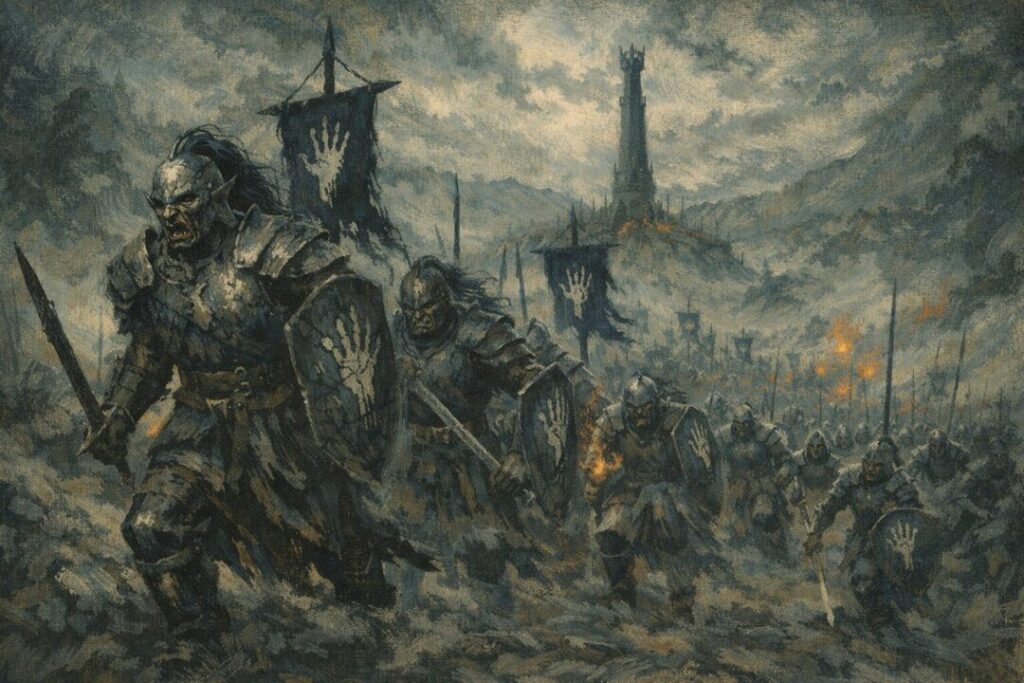
When Saruman begins breeding the Uruk-hai beneath Isengard, his aim is not subtlety, nor is it conquest through sheer numbers alone. He wants soldiers who can march by day, fight without hesitation, and obey without question. He wants warriors who can meet Men head-on—and not flinch.
The result is an enemy that repeatedly proves capable of standing toe-to-toe with human warriors, and in many cases, overpowering them.
But strength in Middle-earth is never just about muscle and steel. To understand how Uruk-hai truly compare to Men, we need to look beyond raw physicality and examine endurance, morale, leadership, and—most importantly—choice.
Physical Strength and Endurance
Uruk-hai are larger and more powerfully built than most Orcs. They are often described as tall, broad-shouldered, thick-limbed—frequently approaching the size of Men, and sometimes exceeding it. This alone makes them dangerous in close combat.
But size is not their greatest advantage.
Endurance is.
Unlike ordinary Orcs, Uruk-hai can march long distances without rest, fight under the sun without weakening, and continue advancing even after heavy losses. They do not require the same cycles of rest or recovery as human soldiers, nor do they slow when supplies grow thin. Pain, exhaustion, and fear do not affect them in the same way.
Against average Men—militia, conscripts, or lightly trained defenders—this is decisive. A single Uruk-hai can overpower an unprepared human opponent through brute force alone, especially in chaotic, close-quarters fighting.
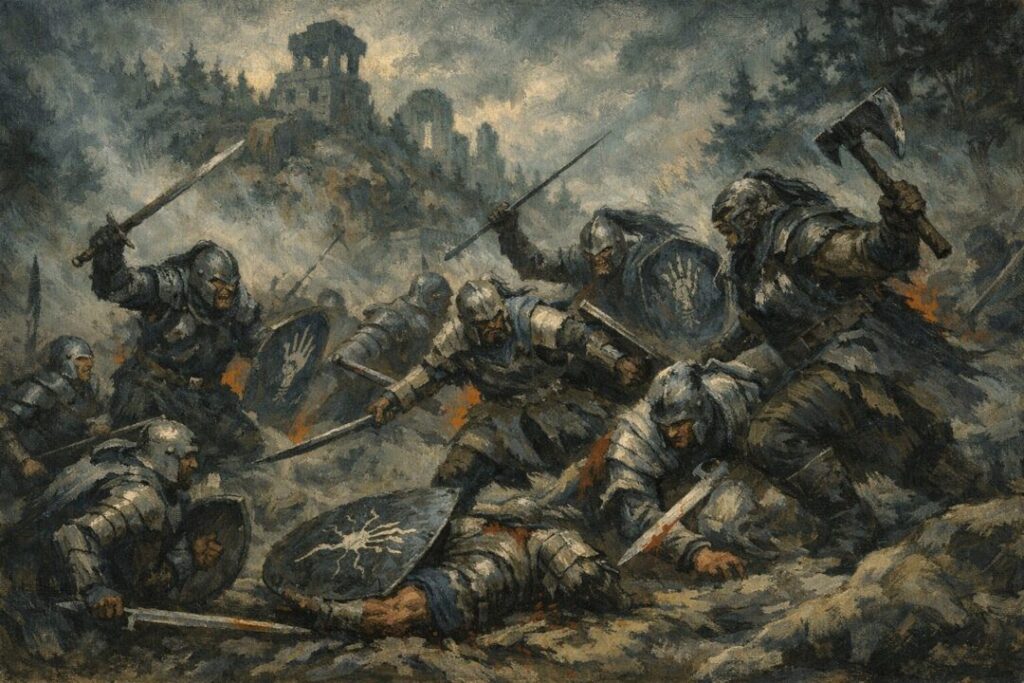
This advantage is on full display during the ambush at Amon Hen, where the Uruk-hai assault overwhelms a small but determined force. Even well-armed defenders struggle to slow their advance. Shields break. Lines collapse. The Uruk-hai do not pause or hesitate; they press forward relentlessly.
Men can fight bravely—but they tire. Uruk-hai do not, at least not in the same way.
Training Versus Breeding
The difference between Men and Uruk-hai is not only physical—it is structural.
Men become warriors through training, culture, and experience. A soldier of Gondor or Rohan is shaped over years: taught discipline, drilled in formation, instructed in tactics, and bound by oaths of loyalty. Their strength grows gradually, unevenly, shaped by individual skill and circumstance.
Uruk-hai bypass this entirely.
They are bred for war.
From the moment of their creation, violence is their purpose. They do not need to be convinced to fight, nor inspired by ideals. Their instincts align perfectly with the battlefield. This gives them immediate readiness: they require no time to “become” soldiers. They simply are.
But this advantage carries a cost.
Uruk-hai do not innovate. They do not adapt well without orders. They follow commands with brutal efficiency—but when those commands are unclear, delayed, or lost, cohesion begins to fracture. Their discipline is imposed, not internalized.
Men, by contrast, can improvise. They retreat, regroup, and adapt. They argue, disobey, and sometimes fail—but they can also learn.
In prolonged conflict, this difference matters.
Morale, Fear, and Motivation
Uruk-hai fight because they are compelled to. Fear of punishment, conditioning, and domination outweigh fear of death. This makes them terrifying in the moment: they charge where others would hesitate, advance where others would break.
But it also makes them brittle.
They do not fight for home, family, or future. They fight because they are driven forward. When control weakens—when leadership falls, when commands stop—their motivation collapses with it.
Men fight for reasons.
They fight to defend their land, their people, their way of life. These motivations do not always make them stronger in the instant—but they give resilience over time. A human army can suffer defeat and still endure. A broken Uruk-hai force rarely recovers.
This is why Uruk-hai excel in shock assaults and rapid offensives, but struggle in drawn-out wars where morale and adaptation matter more than raw aggression.
The Battle of Helm’s Deep
The Uruk-hai reach the height of their effectiveness at Helm’s Deep.
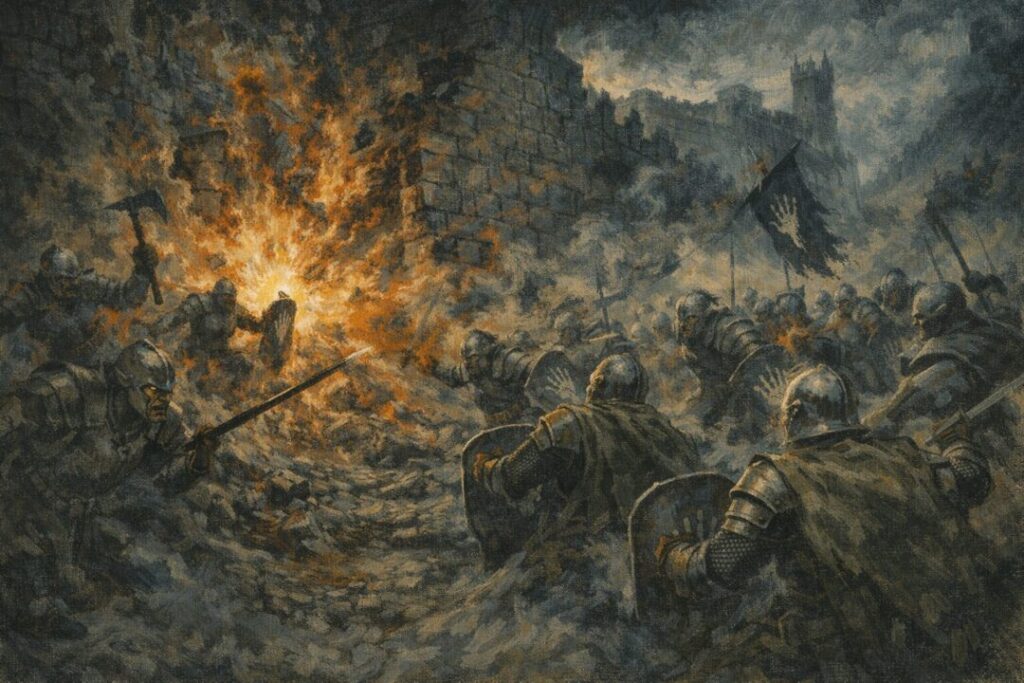
Here, everything favors them: numbers, preparation, siege engines, and even a new and terrible weapon—explosives designed to breach stone itself. They advance in disciplined ranks, absorb arrow-fire, and press the assault without hesitation. Against them stand the Rohirrim—experienced warriors, yet outmatched in numbers and technology.
For a time, it nearly works.
The walls are breached. The defenders are driven back. The fortress teeters on the edge of collapse.
And yet—the Uruk-hai do not win.
Why?
Because once coordination breaks, once surprise fades, and once unexpected resistance appears, their advantage erodes. Leadership among Men rises to meet the moment. Individuals act beyond orders. Courage spreads in ways no command structure can manufacture.
The Uruk-hai fight well.
But they cannot adapt fast enough.
And when the tide turns, it turns decisively.
Strength Without Choice
Uruk-hai are physically formidable. In single combat, they are often stronger than individual Men. In disciplined formations, they are terrifying.
But strength in Middle-earth is never only physical.
Men possess choice.
They can refuse.
They can retreat.
They can sacrifice.
They can change.
Uruk-hai cannot.
Their strength is borrowed, enforced, and ultimately hollow. They represent a shortcut to power—strength without conscience, obedience without loyalty, endurance without hope.
Against Men in isolated battles, they often prevail.
Against humanity as a whole, they cannot.
Because Men fight not only with bodies, but with will.
Why This Comparison Matters
The question of whether Uruk-hai are “stronger” than Men misses something essential.
They are stronger in the ways that can be engineered.
They are weaker in the ways that cannot.
Middle-earth is not saved by the greatest warriors, the strongest arms, or the most disciplined armies. It is saved by endurance, mercy, and the ability to choose something better than domination.
Uruk-hai embody a vision of strength stripped of restraint and meaning.
Men embody strength that can falter—but also grow.
And in the end, that difference decides everything.
Strength alone can conquersor.
Choice can endure.
And that is why, despite all their power, the Uruk-hai are never the future of Middle-earth—only a warning.
Sources & Notes
- J.R.R. Tolkien, The Lord of the Rings, Book III, Ch. 3 ‘The Uruk-hai’ — Uglúk’s Isengarders are shown as disciplined, daylight-marching soldiers who despise ordinary Mordor Orcs and drive the captives hard across Rohan.
- J.R.R. Tolkien, The Lord of the Rings, Book II, Ch. 10 ‘The Breaking of the Fellowship’ and Book III, Ch. 1 ‘The Departure of Boromir’ — the Uruk-hai assault at Amon Hen shows their physical danger even against armed heroes and Boromir’s costly last stand.
- J.R.R. Tolkien, The Lord of the Rings, Book III, Ch. 7 ‘Helm’s Deep’ — Saruman’s host advances in ordered ranks, uses siege-craft and blasting fire, and nearly overwhelms the Men of Rohan before morale and leadership turn the battle.
- J.R.R. Tolkien, The Lord of the Rings, Book III, Ch. 8 ‘The Road to Isengard’ — Merry and Pippin describe Saruman’s Orcs and Men, including the Isengard war-machine behind the attack on Rohan.
- J.R.R. Tolkien, The Lord of the Rings, Appendix F, ‘The Languages and Peoples of the Third Age’ — distinguishes the Black Speech name Uruk-hai and supports treating them as a particular soldierly breed of Orc rather than generic goblins.