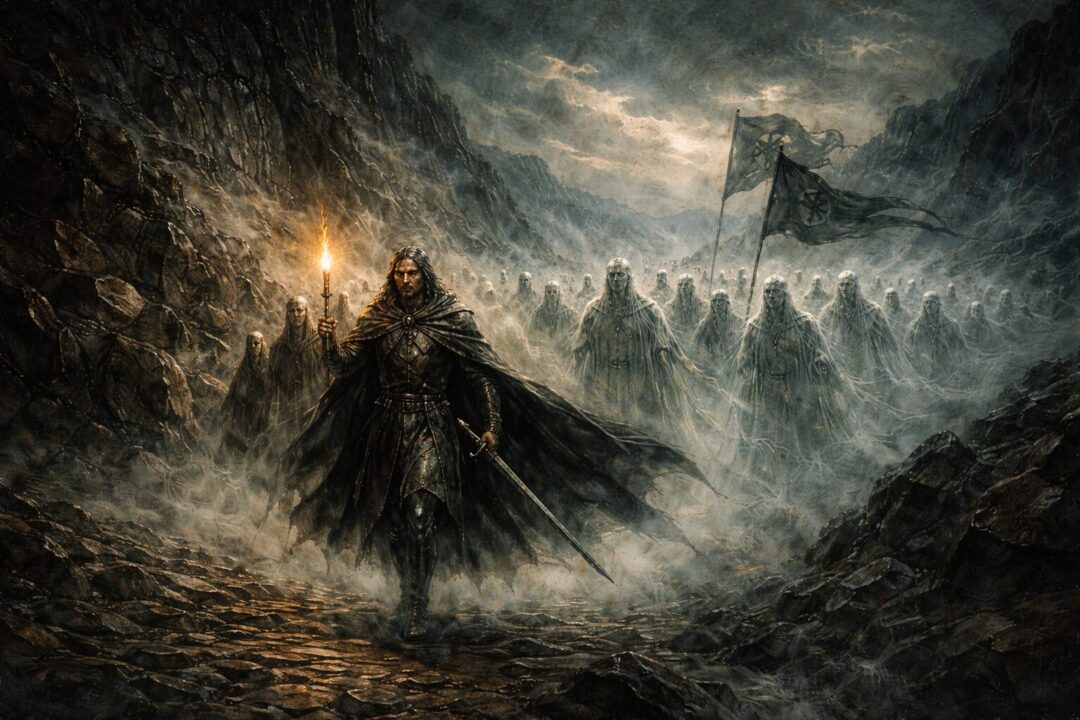
Few moments in The Return of the King are as unsettling as the first appearance of the Dead beneath the mountains. Pale shapes drift through vast stone halls. Their voices echo without breath. They do not attack, yet their presence alone inspires dread. They are not creatures of rage or hunger, but of memory—bound to something unfinished.
Yet their story does not begin with Aragorn, nor even with the War of the Ring.
It begins at the end of the Second Age, when victory itself carried the seeds of long failure, and when fear proved more enduring than open allegiance to evil.
The Men of the Mountains Before the Oath
Before they were known as the Dead of Dunharrow, these people were simply the Men of the Mountains. They lived in the White Mountains long before Gondor reached its height. They were not subjects of Númenor in the same way as the people of the coasts, nor were they entirely free of older shadows.
In ancient years, they had fallen under the influence of Sauron during his first dominion in Middle-earth. Though they did not openly serve him in war, they had worshiped him in secret. When Sauron was overthrown at the end of the Second Age, they found themselves in a dangerous position—caught between a defeated dark power and a new king claiming authority.
When Isildur came north and claimed the kingship of Gondor, the Men of the Mountains swore an oath to him. They promised that if Sauron ever rose again, they would fight against him.
This oath was not coerced.
It was not sworn under threat of destruction.
It was freely given.
And in Tolkien’s world, that distinction matters more than almost anything else.
When the Call Came—and Was Ignored
When Sauron returned in strength, the Men of the Mountains did not march. They did not send warriors. They did not even send warning.
They hid.
The reason is important. They did not join Sauron. They did not betray Gondor to its enemies. They simply chose fear over faithfulness. The power of the Dark Lord terrified them, and they decided that silence was safer than resistance.
In many stories, this kind of failure would be treated lightly. No blood was spilled. No swords were drawn. Nothing actively evil was done.
But Tolkien does not treat inaction as neutral.
In Middle-earth, moral responsibility does not vanish simply because a choice feels safer. An oath, once sworn, creates a claim upon the future. When that claim is ignored, the cost does not disappear—it accumulates.
And so the Men of the Mountains became oathbreakers.
Isildur’s Judgment: Justice Without Vengeance
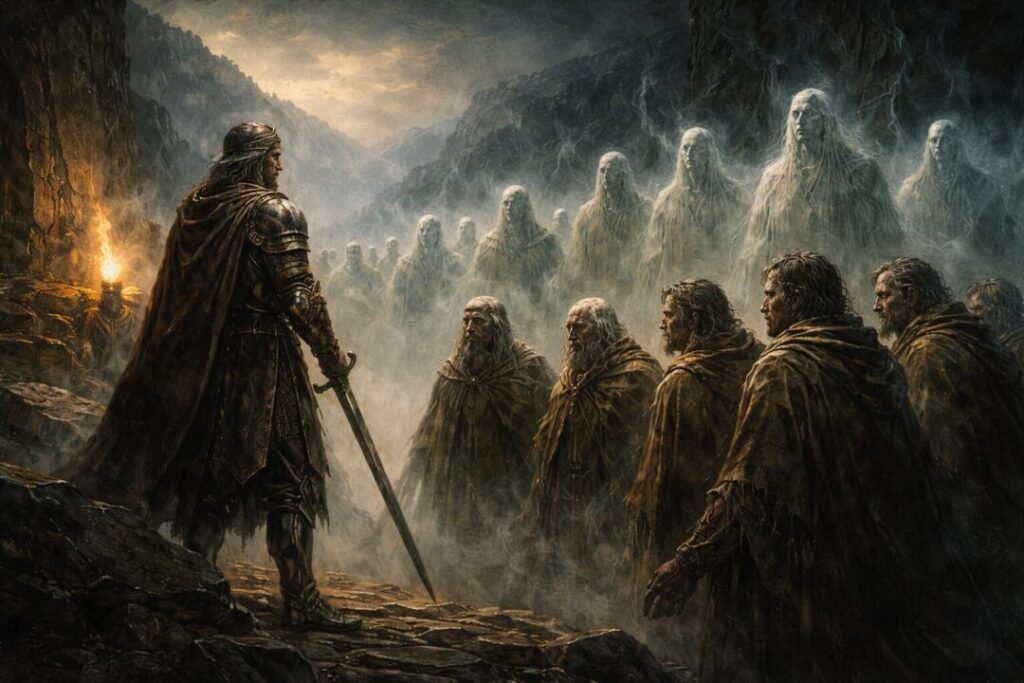
Isildur’s response is often misunderstood, especially in modern retellings.
He did not slaughter the Men of the Mountains.
He did not seize their lands or enslave their people.
He did not curse them with fire or torment.
Instead, he pronounced judgment.
They would not find rest until their oath was fulfilled.
This was not sorcery in the usual sense. Isildur was not a wizard, nor did he bind them through spells of domination. What he invoked was something far older and deeper: the moral weight of a freely sworn word.
In Tolkien’s legendarium, oaths have real power because they bind the will. To break one is not merely to disappoint another—it is to fracture the moral order that sustains trust, authority, and meaning itself.
The judgment did not kill the Men of the Mountains.
But it prevented them from fully living—or fully dying.
A Curse of Delay, Not Torment
For nearly three thousand years, the Dead lingered beneath the mountains.
They could not fight.
They could not flee.
They could not repair their failure through action.
They existed in a suspended state, aware of the passage of time but unable to participate in it. This is one of Tolkien’s most restrained and devastating punishments. There is no screaming agony, no endless violence.
Only waiting.
Their fate reflects a recurring truth in Middle-earth: evil often grows not from cruelty, but from fear that paralyzes responsibility. The Men of the Mountains were not punished because they hated the good—but because they chose safety over duty when duty mattered most.
Their punishment was proportionate to their failure. They had refused to act when action was required. Now they were denied action altogether.
Why No One Could Release Them—Until Aragorn
For centuries, the Dead did not rise for any lord of Gondor. Kings passed. Stewards ruled. Wars came and went.
Nothing changed.
The reason is simple but profound: the oath was sworn to Isildur alone, and only his true heir could release them. Not merely an heir by blood, but by authority freely acknowledged.
When Aragorn enters the Paths of the Dead, he does not threaten them. He does not dominate them. He speaks as one who has the right to command—but chooses instead to offer fulfillment.
This distinction matters.
Aragorn does not bind the Dead further.
He gives them a way out.
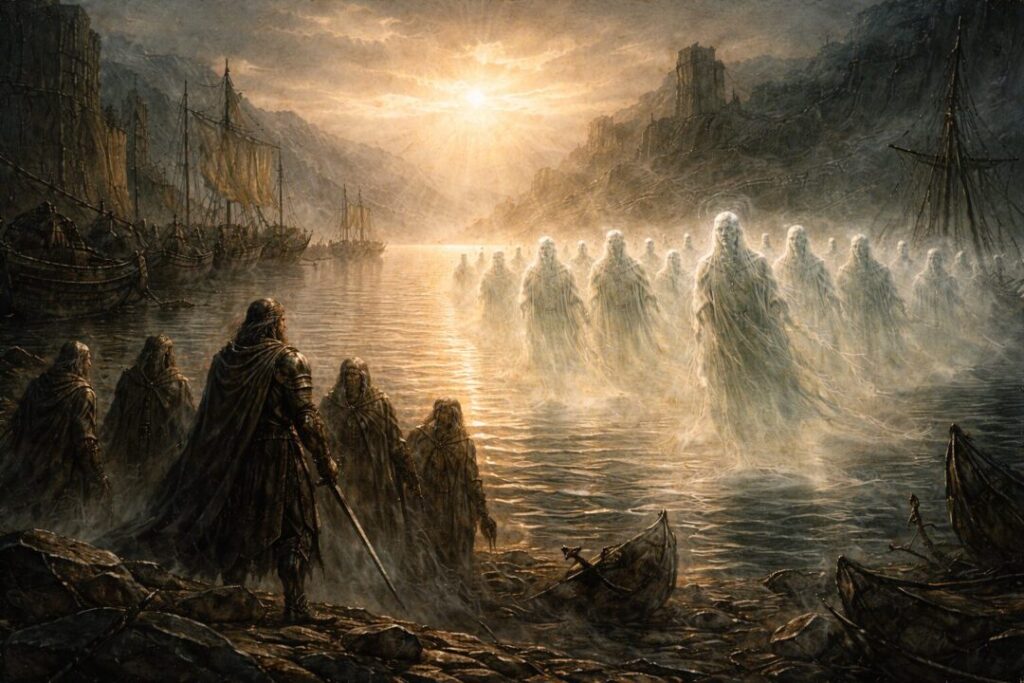
Their service is precise and limited. They do not conquer lands or slaughter armies. They break the power of the Corsairs of Umbar—enemies whose defeat directly supports Gondor, fulfilling the military promise their ancestors failed to keep.
Once the task is done, Aragorn releases them immediately.
There is no attempt to keep them as a weapon.
No temptation to use them again.
Power, once fulfilled, is relinquished.
Fulfillment Without Glory
This is where the story of the Dead of Dunharrow becomes quietly heartbreaking.
They receive no songs.
No monuments.
No place in the annals of Gondor.
They simply vanish.
Their reward is not honor, but rest.
In Tolkien’s moral vision, this is deeply intentional. Redemption does not always come with celebration. Sometimes it comes with silence—because what was broken has been repaired, and nothing more is required.
The Dead do not become heroes.
They are not remembered as saviors.
They are simply released.
And that is enough.
Fear, Mercy, and the Weight of Words
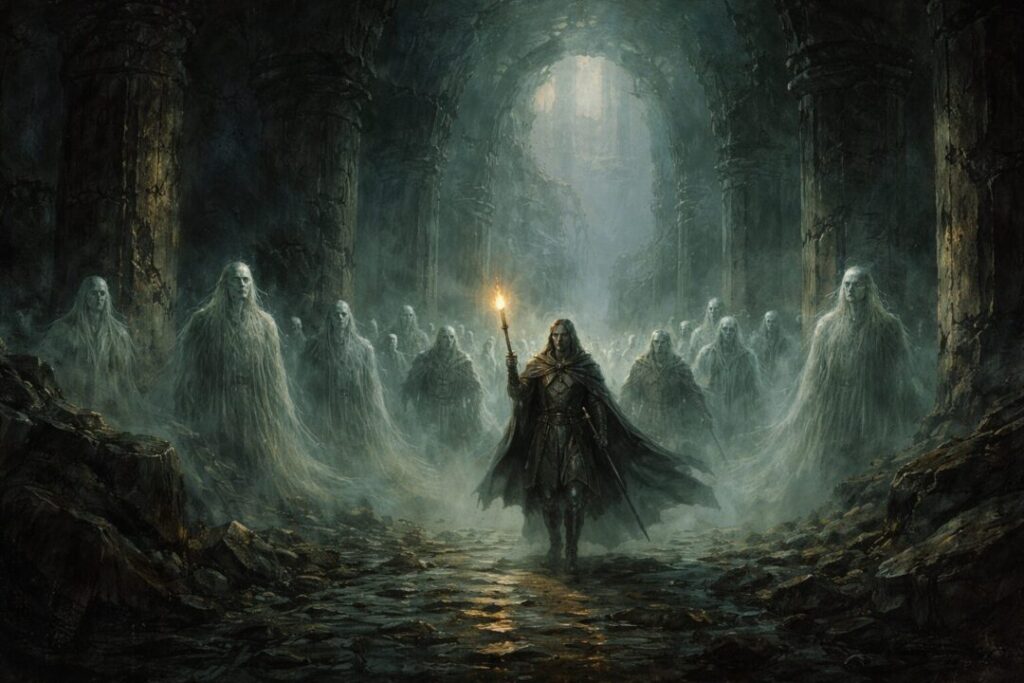
The Dead of Dunharrow are often treated as a horror story—a ghostly army unleashed at the last moment. But their deeper meaning lies elsewhere.
They are not a warning about monsters.
They are a warning about fear.
Fear that convinces people that silence is harmless.
Fear that disguises inaction as neutrality.
Fear that postpones responsibility until responsibility becomes impossible.
And yet, their story is not without mercy.
They are given a second chance—after centuries of failure. When they finally act, they are not judged by their past delay, but by their willingness to fulfill what was once promised.
Middle-earth does not demand perfection.
It demands faithfulness.
And when that faithfulness is finally given—even at the end of a very long road—even the Dead are allowed to rest.
That, perhaps, is why their story still lingers so powerfully: not because they are frightening, but because they are recognizably human.
Sources & Notes
- J.R.R. Tolkien, The Lord of the Rings, The Return of the King, Book V, Chapter 2, “The Passing of the Grey Company” — gives the history of the Men of the Mountains, their oath to Isildur, their refusal, and the prophecy that Isildur’s heir would summon them.
- J.R.R. Tolkien, The Lord of the Rings, The Return of the King, Book V, Chapter 9, “The Last Debate” — reports how Aragorn used the Dead to break the Corsairs at Pelargir and then released them from their oath.
- J.R.R. Tolkien, The Lord of the Rings, Appendix A, “Gondor and the Heirs of Anárion” — places Isildur, the heirs of Elendil, and Aragorn’s inherited authority within Gondor’s royal history.
- J.R.R. Tolkien, The Silmarillion, “Akallabêth” — supplies the Second Age background of Sauron’s shadow over Men and the Númenórean/Exilic setting behind Isildur’s oath-bound world.