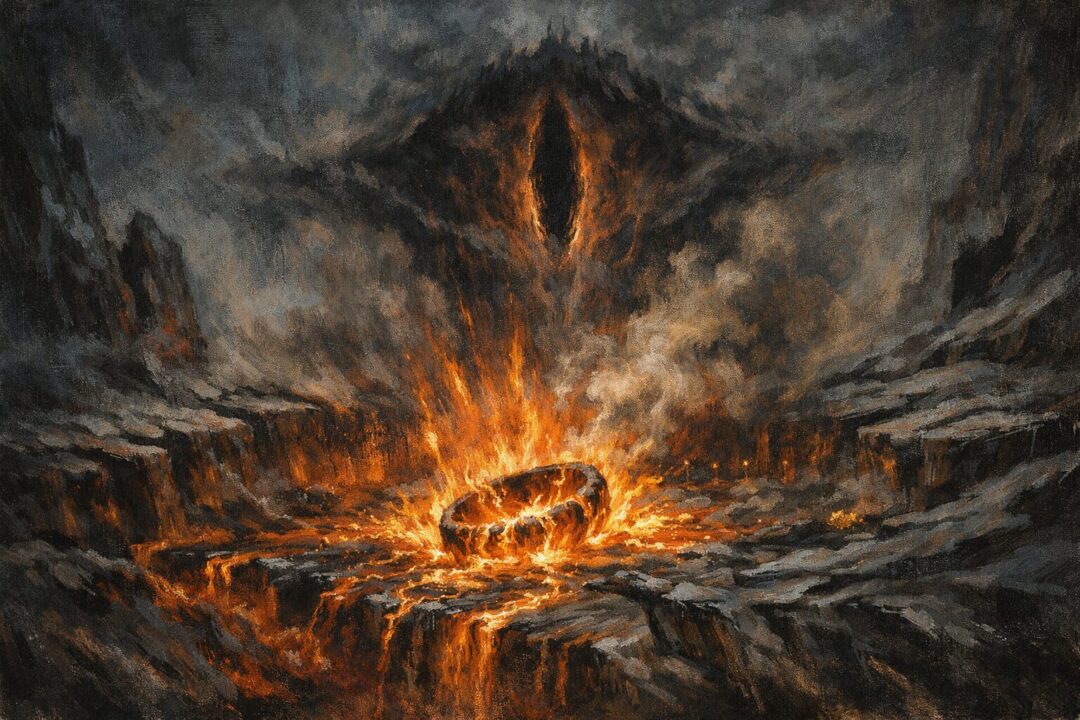
When the One Ring falls into the fire of Mount Doom, the collapse of Sauron’s power is immediate and total.
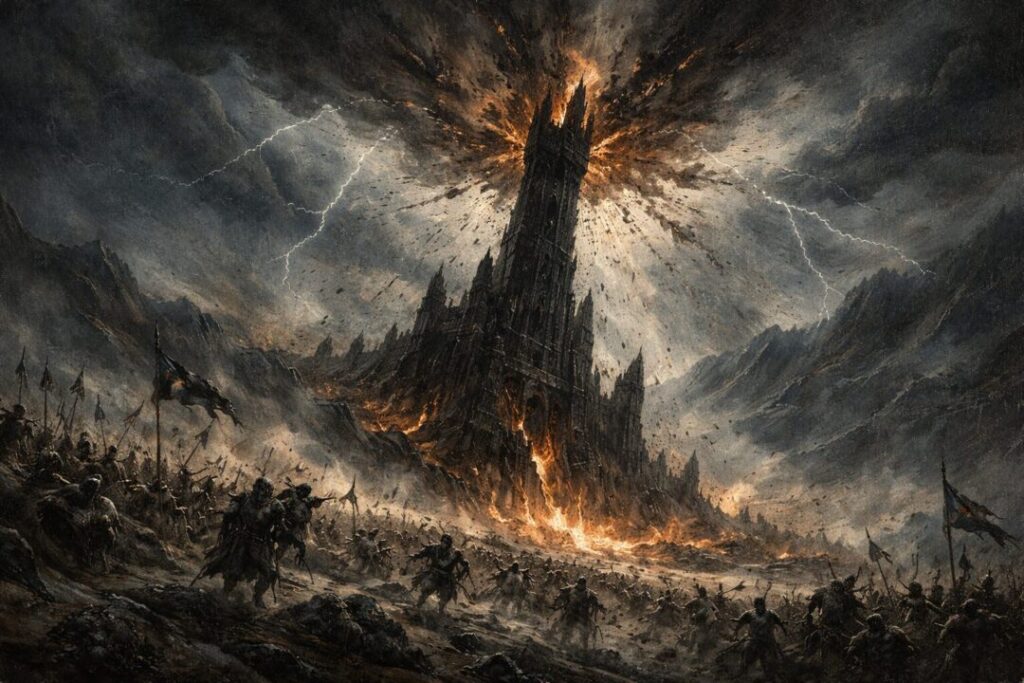
The Dark Tower falls.
The Nazgûl perish in flame and wind.
And the will that bent much of Middle-earth to terror simply vanishes.
There is no final duel.
No dark king struck down by a blade.
No confrontation between equals.
Instead, Sauron ceases to matter.
For many readers, this ending feels abrupt—almost anticlimactic. How can a being who shaped centuries of war, corruption, and fear be undone without ever appearing on the battlefield?
But this is not a narrative shortcut, nor an unresolved thread.
It is the inevitable result of what Sauron chose to become long before the War of the Ring ever began.
Sauron Was Never Bound to a Body
To understand why destroying the Ring ends Sauron, we must first abandon the idea that he functions like a mortal villain.
Sauron is not a Man, an Elf, or even a fallen king in the usual sense. He is a Maia—a being of spirit whose natural state is not physical at all. A body, for him, is something worn, shaped, and eventually discarded.
Yet over time, Sauron bound himself more and more tightly to physical form. He sought permanence, control, and dominion not only over others, but over the world itself.
That desire reached a turning point with the downfall of Númenor.
When Númenor was destroyed, Sauron’s physical body was annihilated. Though his spirit survived, he lost the ability to take a fair or pleasing form ever again. From that point forward, any shape he assumed was laboriously rebuilt, unstable, and bound to external sources of strength.
Sauron did not truly recover from this loss.
He endured.
And that endurance depended on one thing.
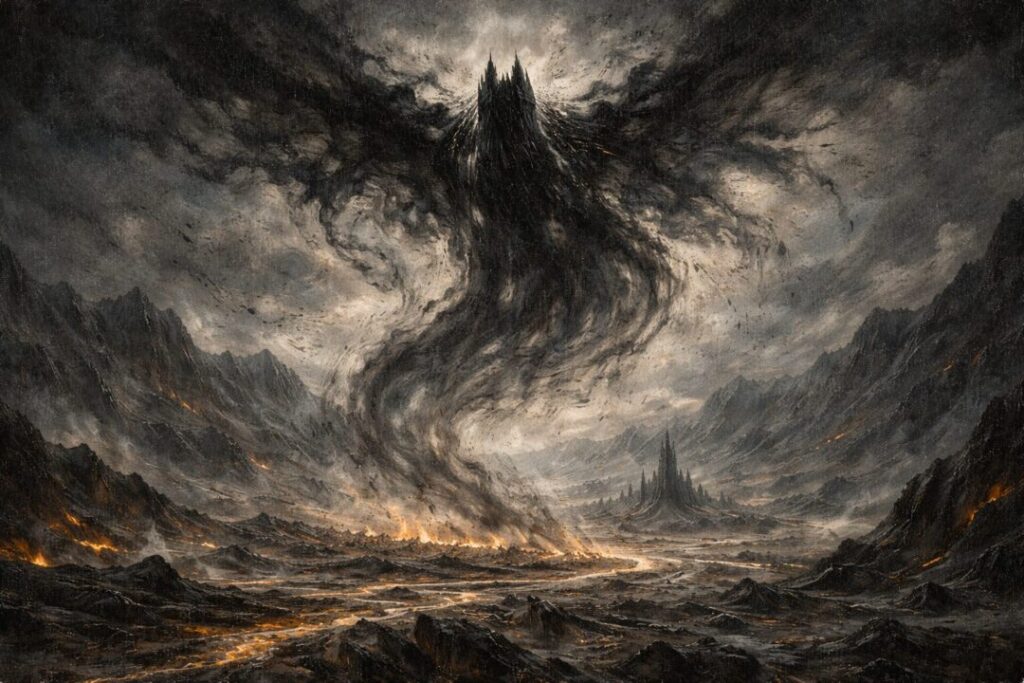
The One Ring Was a Fragment of Sauron Himself
When Sauron forged the One Ring in the fires of Orodruin, he did something no other power in Middle-earth dared to attempt.
He did not simply create a weapon.
He invested the Ring with a vast portion of his own native power—his will to dominate, his authority over the other Rings, and the strength that allowed him to impose himself upon the world.
This was not skill or knowledge transferred.
It was being.
The Ring became an extension of Sauron’s identity. As long as it endured, so did the coherence of his power. Even after losing his body, even after catastrophic military defeat, the Ring anchored him to the world.
This choice gave Sauron terrifying resilience.
But it came at a fatal cost.
By tying so much of himself to an external object, Sauron made his continued relevance conditional. If the Ring was destroyed, the power it contained would not return to him.
It would be unmade.
Why Sauron Could Not Imagine the Ring’s Destruction
This is the heart of Sauron’s final failure—and it has nothing to do with strategy or intelligence.
Sauron cannot imagine the destruction of the Ring because he cannot imagine voluntary weakness.
To him, power exists to be used. Authority exists to be enforced. Strength exists to dominate others “for their own good.” The idea that someone would willingly destroy absolute power rather than wield it is entirely outside his moral universe.
That is why he assumes Aragorn will claim the Ring and challenge him openly.
That is why he focuses on armies, gates, and thrones.
That is why Mount Doom itself is left largely unguarded—not out of arrogance alone, but because the danger never truly occurs to him.
Sauron prepares for conquest, rebellion, and betrayal.
He does not prepare for humility.
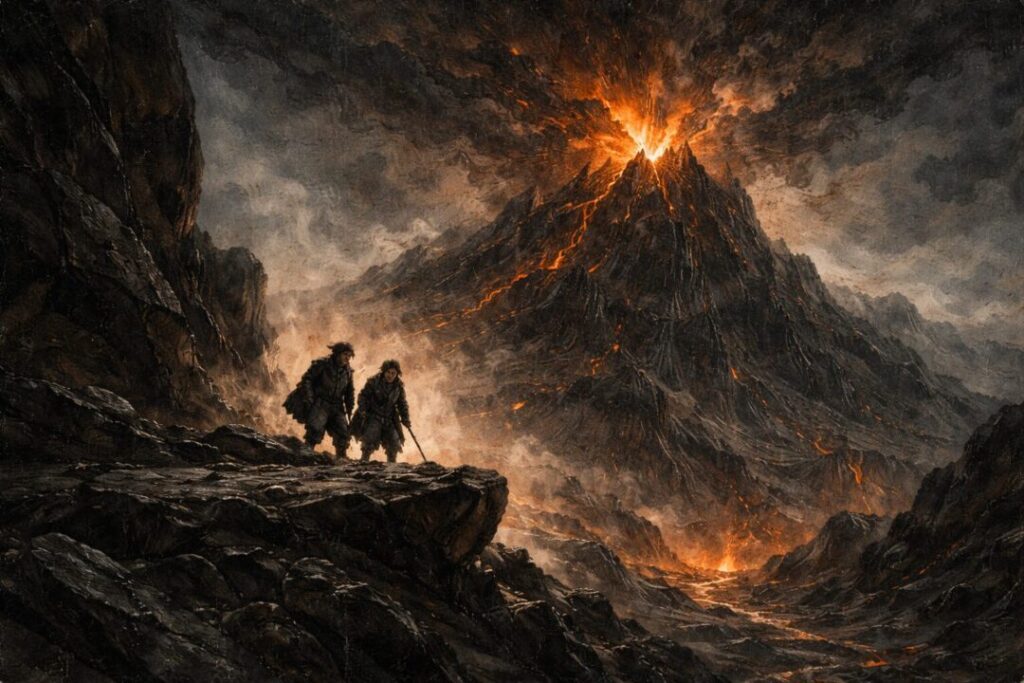
The Moment the Ring Fell
When the Ring is finally destroyed, the effect is instantaneous.
The power stored within it does not return to Sauron. There is no recoil, no second chance, no lingering reservoir to draw upon.
That part of him is gone forever.
What remains of Sauron is a spirit so diminished that it can no longer act meaningfully within the world. He is not imprisoned. He is not slain in the manner of Men or Elves.
He is rendered irrelevant.
Too weak to rebuild a body.
Too scattered to command others.
Too diminished to impose his will upon events.
He becomes a shadow without shape, memory without influence.
For a being defined entirely by control, this fate is worse than death.
Why Sauron Does Not “Come Back”
One of the quiet but crucial details in Middle-earth’s ending is that Sauron is not merely defeated for an age.
He is finished.
Unlike earlier defeats—when he lost armies, strongholds, or physical form—this loss is irreversible. The Ring was the final concentration of his strength. Without it, he lacks the capacity to rebuild, corrupt, or dominate on any meaningful scale.
Evil itself persists in Middle-earth. Fear, cruelty, and pride do not vanish.
But Sauron does.
His age ends not with a battle, but with a relinquishment of power he never believed possible.
Why This Ending Is Thematically Perfect
Sauron’s fall is deliberately unheroic.
Middle-earth is not saved by a greater force overthrowing a lesser one. It is saved by refusal.
Refusal to dominate.
Refusal to seize power.
Refusal to answer tyranny with tyranny.
The Ring is not destroyed by a king or a warrior, but by small hands bearing unbearable weight—and by mercy shown long before anyone understood its consequences.
Sauron falls because his worldview cannot survive contact with humility.
He believes power is the only currency that matters.
Middle-earth proves him wrong.
The End of a Tyrant, Not the End of Darkness
It is important to understand what the Ring’s destruction does—and does not—accomplish.
It does not erase evil from the world.
It does not usher in perfection.
It does not end sorrow, loss, or conflict.
What it ends is this kind of evil.
The kind that seeks absolute control.
The kind that cannot imagine letting go.
The kind that binds itself so tightly to domination that it cannot survive without it.
The world moves forward not because power triumphed…
…but because power was finally set aside.
And that is why destroying the One Ring didn’t just defeat Sauron.
It ended him.
Sources & Notes
- J.R.R. Tolkien, The Lord of the Rings, Book I, Ch. 2 ‘The Shadow of the Past’ — Gandalf explains that Sauron poured much of his former power into the One Ring and that, if it is destroyed, Sauron will fall.
- J.R.R. Tolkien, The Silmarillion, ‘Of the Rings of Power and the Third Age’ — describes the forging of the One Ring, Sauron’s rule through it, his loss of fair form after Númenor, and his survival while the Ring endured.
- J.R.R. Tolkien, The Lord of the Rings, Book II, Ch. 2 ‘The Council of Elrond’ — Elrond and Gandalf reject using the Ring and frame its destruction as the only way to end Sauron’s power, not merely win a battle.
- J.R.R. Tolkien, The Lord of the Rings, Book V, Ch. 9 ‘The Last Debate’ — Gandalf’s strategy depends on Sauron being unable to imagine that anyone would try to destroy, rather than wield, the Ring.
- J.R.R. Tolkien, The Lord of the Rings, Book VI, Ch. 3 ‘Mount Doom’ and Ch. 4 ‘The Field of Cormallen’ — the Ring’s unmaking brings Barad-dûr down, destroys the Nazgûl, and leaves Sauron as a powerless shadow blown away by the wind.
- J.R.R. Tolkien, Letter 131 — Tolkien’s own summary of Sauron’s motive as domination and ordered control supports the article’s reading of why relinquishment defeats him thematically.