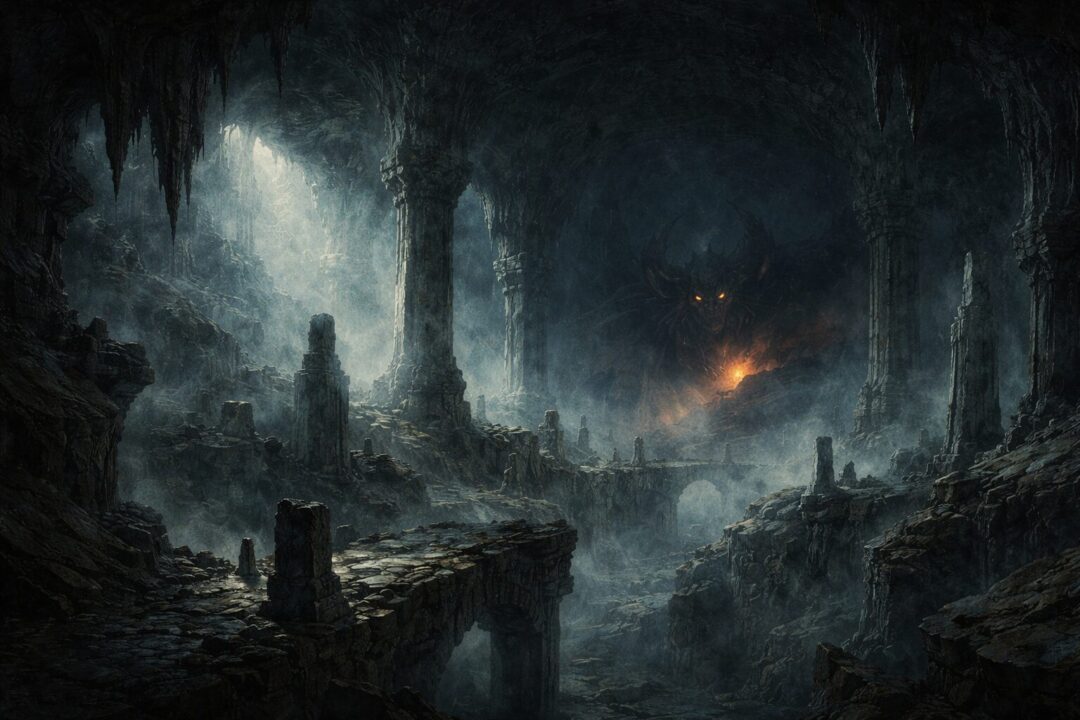
When Gandalf names the creature in Moria “a Balrog of Morgoth,” he is not simply identifying a dangerous enemy. He is invoking a memory from a vanished world.
Balrogs do not belong to the Third Age. They are relics of the First—beings shaped in an era when the world itself was unfinished, when mountains were broken in battle and entire lands were drowned beneath the sea. By the time of the War of the Ring, such creatures should exist only in history and song.
And yet, one does.
Deep beneath Khazad-dûm, Durin’s Bane endures for nearly two thousand years, unseen and undisturbed, until its awakening brings ruin to the greatest Dwarven realm in Middle-earth. Its presence forces an uncomfortable realization: the defeat of Morgoth did not cleanse the world as completely as legend often suggests.
If one Balrog survived the end of the First Age, could others have survived as well?
The question lingers not because Tolkien answers it—but because he does not.
What We Know for Certain
In The Silmarillion, we are told that the Balrogs were largely destroyed during the War of Wrath. This final conflict of the First Age was not merely a battle but a cataclysm. Morgoth was overthrown, his armies shattered, and the shape of the world permanently altered. Beleriand itself was broken and swallowed by the sea.
Most of Morgoth’s greatest servants perished in that ruin.
But Tolkien is careful with his language.
He does not say all Balrogs were destroyed. He says most were slain or driven into hiding. That distinction matters, because Tolkien rarely leaves such wording ambiguous by accident.
Durin’s Bane proves that survival—however rare—was possible.
After Morgoth’s defeat, this Balrog fled east and hid beneath the roots of the Misty Mountains. There it remained, dormant and unseen, through the rise of Númenor, the founding of Gondor, the Last Alliance, and the long centuries that followed. For over a thousand years, it left no mark on recorded history.
That silence is itself significant.
Durin’s Bane did not rebuild an army. It did not seek dominion. It did not announce itself to the world. It endured by remaining hidden.
This establishes a crucial precedent: Balrogs could survive by withdrawing from history.
The Nature of Balrogs
Balrogs were not beasts or monsters in the ordinary sense. They were Maiar—spirits of the same order as Gandalf, Saruman, and Sauron—corrupted by Morgoth in the earliest days of Arda. Their fiery forms were not their true essence, but manifestations shaped for war.
This distinction matters when considering their survival.
Unlike Orcs or Trolls, Balrogs were not dependent on breeding, numbers, or supply lines. They did not age as mortals do. Their power was spiritual as much as physical, and their endurance far exceeded that of later creatures.
At the same time, Balrogs were deeply bound to Morgoth.
Their purpose was domination through terror, serving as captains of his hosts and instruments of his will. When Morgoth fell, that purpose vanished. Unlike Sauron—who sought to replace his master—Balrogs did not attempt to inherit dominion over Middle-earth.
Without Morgoth, they were creatures without a role.
This may explain their withdrawal. In the absence of a Dark Lord to command them, Balrogs did not become conquerors. They became remnants—isolated, purposeless, and dangerous only when disturbed.
If any survived beyond Durin’s Bane, they would not have marched openly across the world.
They would have waited.
Durin’s Bane as a Pattern, Not an Exception
It is tempting to treat Durin’s Bane as a unique anomaly—a final ember that somehow refused to die. But Tolkien does not frame it that way.
Durin’s Bane is not described as extraordinary among Balrogs. It is not given a personal name. It is not singled out as greater or stronger than its kind. What makes it remarkable is not what it is, but when it appears.
Its survival demonstrates that at least one Balrog escaped the destruction of the First Age and remained hidden long enough to emerge in a world that had nearly forgotten such beings existed at all.
Once that door is opened, the possibility cannot be closed again.
If one Balrog fled into the deep places of the earth and endured unseen, others could theoretically have done the same—especially in regions never explored, never settled, or never recorded by the peoples of Middle-earth.
Why Tolkien Leaves the Question Open
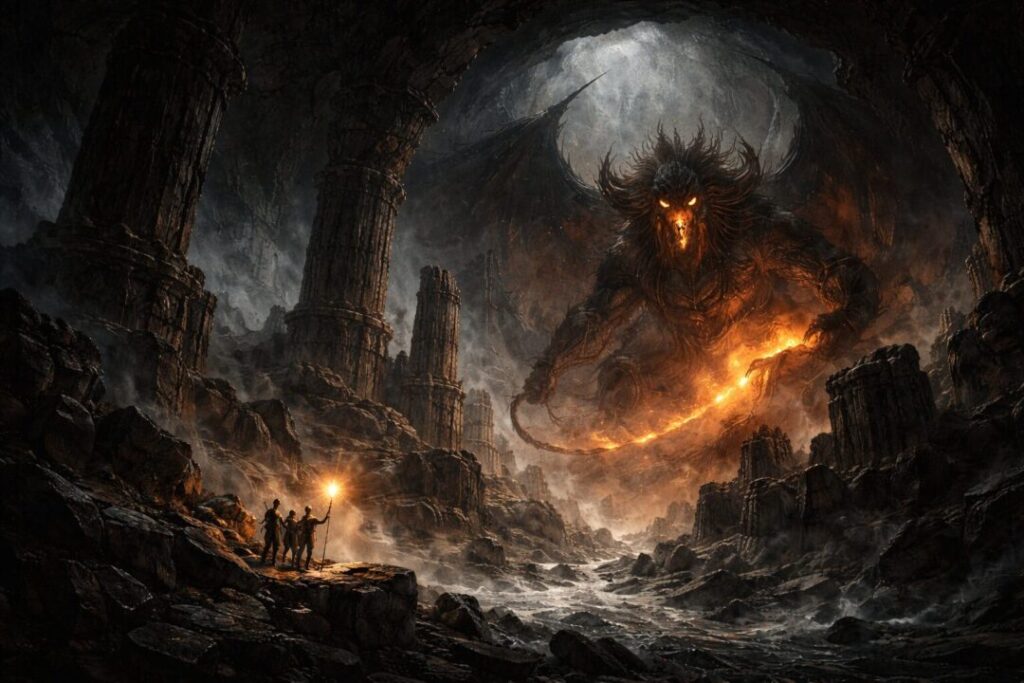
In The Lord of the Rings, Tolkien does not speculate about other Balrogs. After Gandalf’s fall in Moria, no further mention is made of them. There is no suggestion of another awakening, no rumor of fire-demons stirring elsewhere in the world.
This absence is deliberate.
By the Third Age, Middle-earth is no longer shaped by primordial powers. The story narrows its focus to Hobbits, Men, and moral choice rather than cosmic warfare. The age of world-breaking battles has passed. What remains is the long struggle of fading light against persistent darkness.
Introducing additional Balrogs into the narrative would pull the story backward—toward the Elder Days that are meant to be ending.
Tolkien often preserves mystery by refusing to define the full boundaries of his world. The Watcher in the Water is never explained. The Nameless Things beneath the earth are mentioned only in passing. These elements exist to remind the reader that Middle-earth is deeper and older than any single story can encompass.
Balrogs fit naturally into this pattern.
Their absence from the narrative does not mean they are definitively gone. It means they are no longer central.
Could Others Still Be Hidden?
Canonically, Tolkien never confirms the existence of surviving Balrogs after the fall of Durin’s Bane. But neither does he deny it. There is no statement declaring the race extinct, no passage closing the door on their possibility.
If any endured, they would not have revealed themselves during the War of the Ring. That conflict was not their war. Sauron did not command them, and the shape of the age no longer favored their kind.
They would be buried in the deep places of the world—beneath mountains, beneath the roots of stone, in regions uncharted and unnamed. They would sleep, or wait, or fade into something lesser and forgotten.
And if they never emerged again, history would never record them.
Durin’s Bane is remembered not necessarily because it was the last Balrog—but because it was the last to awaken.
Why This Matters
The lingering possibility of surviving Balrogs reinforces one of Tolkien’s central themes: evil is not always defeated in a single, final victory.
Some evils are broken.
Some are diminished.
Some endure quietly, stripped of purpose, waiting for a world that will never return.
Middle-earth is not made safe by eliminating every shadow. It is made livable by the choices of those who walk within it—by humility, restraint, and endurance rather than overwhelming force.
The uncertainty surrounding the fate of the Balrogs is not a flaw in Tolkien’s mythology. It is a reflection of its depth.
The world is older than memory.
Its wounds are not always visible.
And some fires, once lit, may smolder far longer than history dares to admit.
That lingering sense of ancient danger—half-forgotten, half-imagined—is not a gap in the story.
It is one of its greatest strengths.
Sources & Notes
- J.R.R. Tolkien, The Silmarillion, ‘Valaquenta: Of the Enemies’ — identifies the Balrogs as Maiar corrupted by Melkor, supporting the article’s point that they were ancient spirits rather than ordinary monsters.
- J.R.R. Tolkien, The Silmarillion, ‘Of the Voyage of Eärendil and the War of Wrath’ — says most of Morgoth’s hosts were destroyed, while some Balrogs fled and hid in deep places after the First Age.
- J.R.R. Tolkien, The Lord of the Rings, Book II, Ch. 5 ‘The Bridge of Khazad-dûm’ — Gandalf names Durin’s Bane as a Balrog of Morgoth, proving that at least one survived into the Third Age.
- J.R.R. Tolkien, The Lord of the Rings, Appendix A, ‘Durin’s Folk’ — records how the Dwarves awakened Durin’s Bane in Moria after it had lain hidden beneath the Misty Mountains.
- J.R.R. Tolkien, Unfinished Tales, ‘The Istari’ — frames Gandalf’s confrontation with the Balrog as a meeting of ancient powers, useful context for why such a survivor matters in the late Third Age.