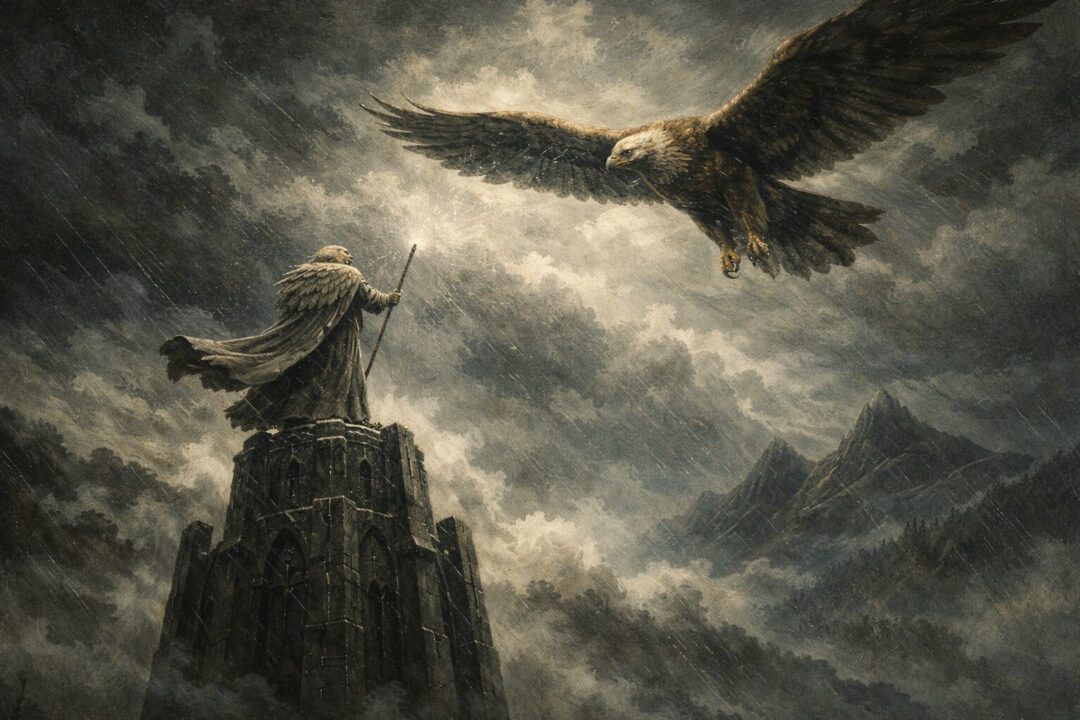
Few beings in Middle-earth inspire as much debate as the Great Eagles.
They appear rarely, yet memorably. When they arrive, the situation is already desperate. When they depart, the world continues on its fragile, uncertain path. They rescue heroes from impossible heights, turn the tide at moments of utter despair, and then vanish again into the high airs, leaving the peoples of Middle-earth to finish the work themselves.
This has led many readers to ask a familiar question:
If the Eagles were so powerful, why didn’t they do more?
Why didn’t they strike directly at Mordor?
Why didn’t they patrol the skies above the Black Land?
Why didn’t they become a decisive military force in the War of the Ring?
At first glance, their limited involvement can feel strange — even frustrating. In a story filled with sieges, armies, and world-altering threats, beings capable of flight, speech, and terrible force seem perfectly suited to change everything.
But the Eagles’ restraint is not a narrative oversight. It is one of the clearest expressions of how power truly works in Middle-earth.
To understand why the Eagles remain on the margins of politics and war, we first need to understand what they actually are.
The Eagles Are Not Just Powerful Creatures
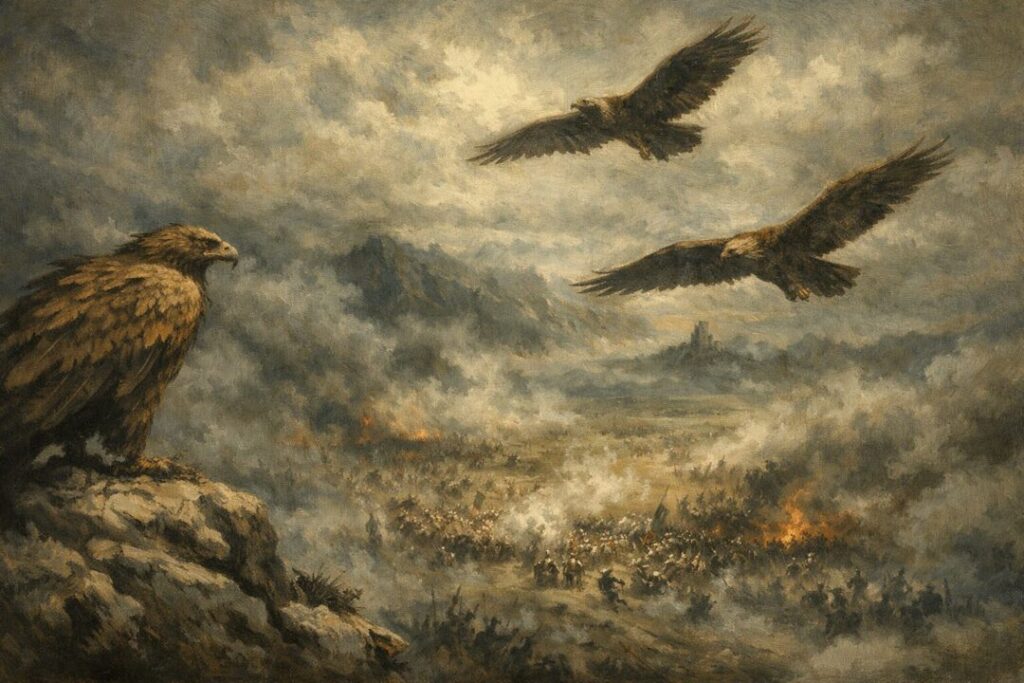
The Great Eagles are not animals in the ordinary sense, nor are they simply allies who happen to assist the Free Peoples. In the deeper history of the world, they are known as the Eagles of Manwë — the Elder King, lord of the winds and the skies, who dwells far above the world.
This origin matters.
The Eagles are watchers before they are warriors.
Messengers before they are combatants.
Guardians of the airs, not rulers of the lands below.
They see far, remember long, and act only when events threaten the balance set in motion at the world’s beginning. Their perspective is not bound to kingdoms, borders, or generations. Where Men think in years and Elves think in ages, the Eagles think in terms of harmony and disruption.
This immediately places them outside the political structures of Middle-earth.
They do not swear fealty to kings of Men.
They do not serve Elven realms as vassals.
They do not claim territory or rule peoples.
Their allegiance lies higher — ultimately to the will of Ilúvatar as expressed through the ordering of the world — and that allegiance imposes limits.
The Eagles are powerful, but they are not free in the way the Children of Ilúvatar are free.
Why the Eagles Do Not Govern or Command
One of the most important distinctions in Middle-earth is the difference between guardianship and dominion.
Dominion — the desire to rule, command, and impose order through strength — is consistently portrayed as dangerous. It is the path taken by Morgoth, by Sauron, and by any who seek to “make the world better” through control rather than harmony.
The Eagles do not walk this path.
They are not meant to rule from above. They do not set laws or crown kings. Their role is observational and preservative, not administrative. To take part in politics would be to abandon their purpose and assume authority that was never meant to be theirs.
Middle-earth is meant to be shaped by its peoples — Elves, Men, Dwarves, and Hobbits — through their choices, failures, endurance, and courage.
The Eagles stand apart from that struggle, not because they are indifferent, but because intervention at the wrong level would unravel the moral structure of the world itself.
Why the Eagles Do Not Wage War
War in Middle-earth belongs to the Children of Ilúvatar.
Elves fight to preserve what is fading.
Men fight to determine what kind of world will follow.
Dwarves fight for memory, craft, and home.
Hobbits, unwillingly, fight simply to endure.
These struggles matter precisely because they are costly, uncertain, and limited.
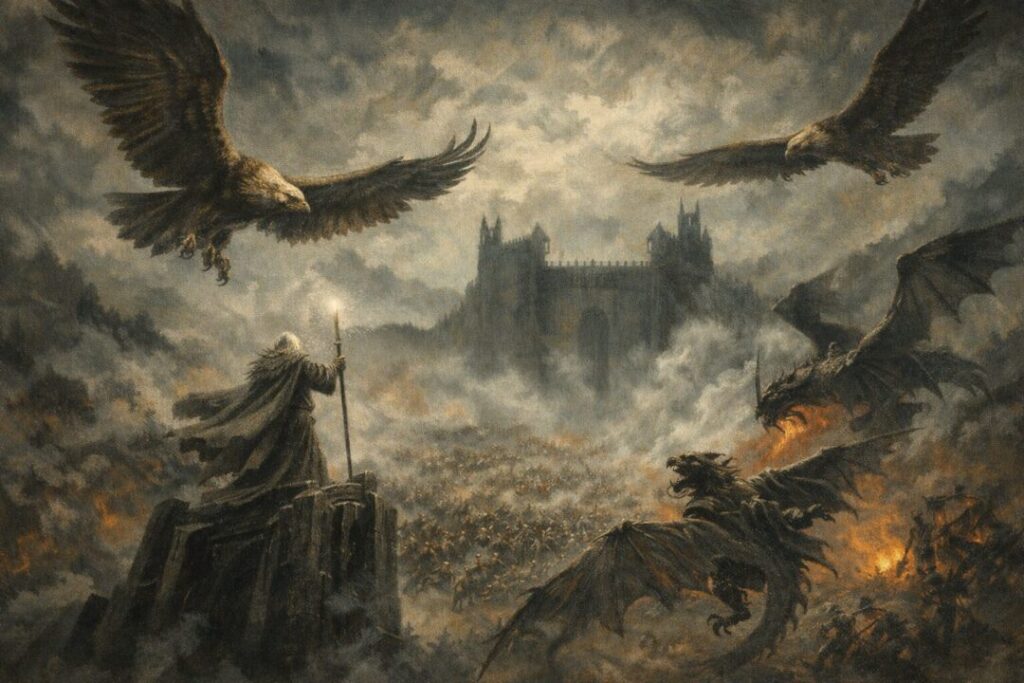
If the Eagles became a dominant military force, the central conflict of the age would change entirely. Victory would come not through perseverance or moral resistance, but through overwhelming external intervention.
And that is never how evil is defeated in Middle-earth.
The Ring is not destroyed by armies.
Sauron is not overthrown by strength of arms.
The Dark Lord is undone by a chain of mercy, chance, endurance, and unintended consequence.
The Eagles could destroy enemies in open battle — and sometimes do — but they cannot resolve the deeper conflict. That conflict is not about winning territory. It is about resisting domination itself.
To allow the Eagles to “solve” the war would hollow out the very meaning of victory.
The Problem of Visibility and Power
There is another, subtler reason the Eagles cannot play a dominant role.
Great power in Middle-earth is visible.
Just as powerful beings blaze in the unseen world, so too would constant intervention by the Eagles draw attention, escalation, and counterforce. Sauron is not ignorant. He watches the skies as closely as the lands. The Nazgûl themselves are airborne hunters.
The War of the Ring is won not by spectacle, but by obscurity.
By the small moving unnoticed.
By hope surviving where power would fail.
The Eagles are at their most effective when they act after the decisive moment — when the moral trial has already been faced.
Why They Help Sometimes
This explains the pattern that confuses so many readers.
The Eagles rescue Gandalf from Orthanc because his task is unfinished.
They come to the Field of Cormallen because the war has already been decided.
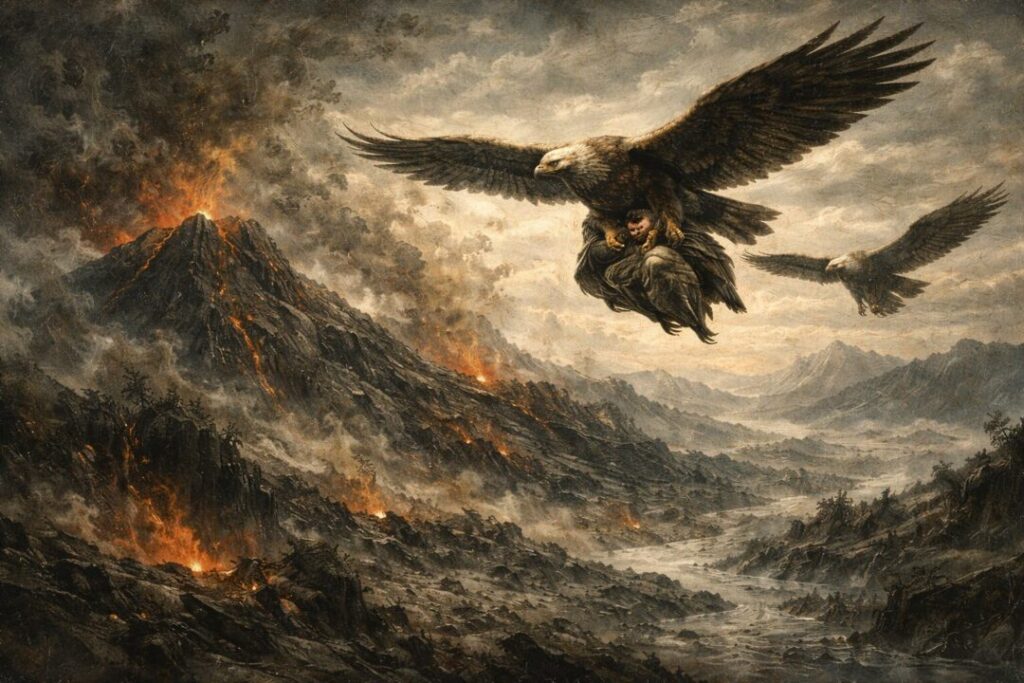
They retrieve Frodo and Sam because the Ring is destroyed, and endurance has reached its limit.
Each intervention comes after the central test has been endured.
They do not prevent the trial.
They do not make the choice easier.
They do not spare the cost.
They preserve life once the meaning of the struggle has been secured.
The Eagles do not solve the problem.
They safeguard the outcome.
Boundaries, Not Cowardice
It is easy to mistake restraint for reluctance.
But the Eagles are not hesitant. They are obedient.
They are ancient beings bound to a role deliberately narrow in scope. They may watch, warn, carry, and rescue — but they may not rule, conquer, or decide the fate of the world in place of those who must live in it.
This is why they often speak with a tone of caution, even severity. They are aware of lines that must not be crossed, even for a good cause.
Middle-earth is not meant to be governed from above.
Its history must be written on the ground — in fear and hope, failure and mercy.
Why This Matters
The Eagles embody one of the central truths of Middle-earth: that power is not measured by capability, but by responsibility.
Just because one can act does not mean one should.
In a world where domination is the ultimate evil, restraint becomes one of the highest virtues. The Eagles do not seek glory, remembrance, or authority. They act only when the balance of the world itself is at risk — and then they withdraw.
Their absence from politics is not neglect.
It is wisdom.
The Eagles Were Never Missing
The Eagles were never forgotten.
They were never sidelined.
They were never a convenient solution withheld for drama.
They were exactly where they were meant to be.
Watching.
Waiting.
And intervening only when the world itself stood on the edge of ruin.
Not to win the war.
But to ensure that, once won, the world could still belong to those who must live in it.
Sources & Notes
- J.R.R. Tolkien, The Silmarillion, ‘Of Aulë and Yavanna’ — Manwë’s Eagles are established as watchers and messengers tied to the Elder King’s concern for Middle-earth.
- J.R.R. Tolkien, The Hobbit, ‘Out of the Frying-Pan into the Fire’ and ‘The Clouds Burst’ — the Eagles intervene powerfully but briefly, rescuing or turning a desperate battle rather than governing events afterward.
- J.R.R. Tolkien, The Lord of the Rings, Book II, Ch. 2 ‘The Council of Elrond’ — Gandalf’s rescue from Orthanc by Gwaihir shows Eagle-aid arriving to preserve an unfinished mission, not to replace it.
- J.R.R. Tolkien, The Lord of the Rings, Book V, Ch. 10 ‘The Black Gate Opens’ and Book VI, Ch. 4 ‘The Field of Cormallen’ — the Eagles enter at the war’s crisis and rescue Frodo and Sam only after the Ring is destroyed.
- J.R.R. Tolkien, Letter 210 — Tolkien’s storycraft comment that the Eagles are a dangerous ‘machine’ used sparingly supports the article’s point that they cannot simply solve every military problem.