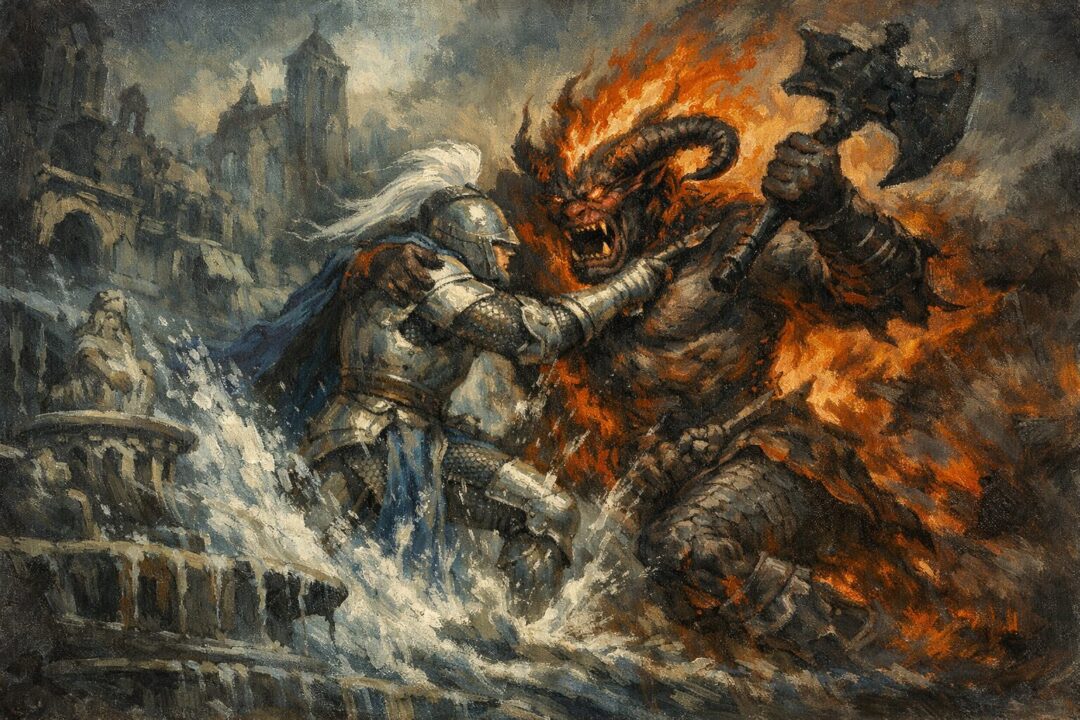
Among the heroes of the Elder Days, few embody quiet finality as completely as Ecthelion of the Fountain.
He is not a wanderer.
Not a returning legend.
Not a figure whose influence stretches visibly across multiple ages of the world.
Instead, he appears once — at the precise moment when Middle-earth needed someone to end something forever.
Ecthelion does not linger in the margins of later stories. He leaves no descendants who shape future kingdoms, no songs that echo in the halls of Rivendell or Lothlórien. His role is narrower, sharper, and more decisive than that.
He exists to close a chapter.
The House of the Fountain and What It Represented
Ecthelion was an Elf-lord of Gondolin, the greatest of the secret cities founded by Turgon in the First Age. Gondolin was not merely a fortress; it was a vision of what Elven civilization could be when untouched by Morgoth’s corruption — white stone, ordered streets, living water, and a harmony between beauty and defense.
Within Gondolin, each noble house embodied a particular virtue or mode of guardianship. Ecthelion led the House of the Fountain, whose warriors bore silver and diamond emblems and stood watch over the King’s Fountain, the symbolic and literal heart of the city.
This is important.
The House of the Fountain was not associated with reckless valor or fiery assault. It represented clarity, discipline, and steadfast protection. Where other houses might charge outward to meet an enemy, Ecthelion’s role was to hold, to endure, and to guard what must not fall.
His arms and armor reflected this philosophy. Silver and diamond are not the colors of bloodlust or conquest. They are cold, reflective, unwavering — light held steady rather than flung outward in fury.
That distinction matters more than it first appears.
Gondolin and the Illusion of Invulnerability
For centuries, Gondolin survived not because it could defeat Morgoth in open war, but because it was unknown. Its location was hidden by mountain rings and secret ways. Even the Valar’s enemies did not know where it lay.
This secrecy bred a dangerous illusion.
Gondolin began to feel eternal.
But secrecy is not strength. It is a condition — one that can be broken.
When Gondolin was finally betrayed, Morgoth did not test its walls with probes or skirmishes. He did not send Orcs to see how strong the defenses were.
He sent annihilation.
The Coming of the Balrogs
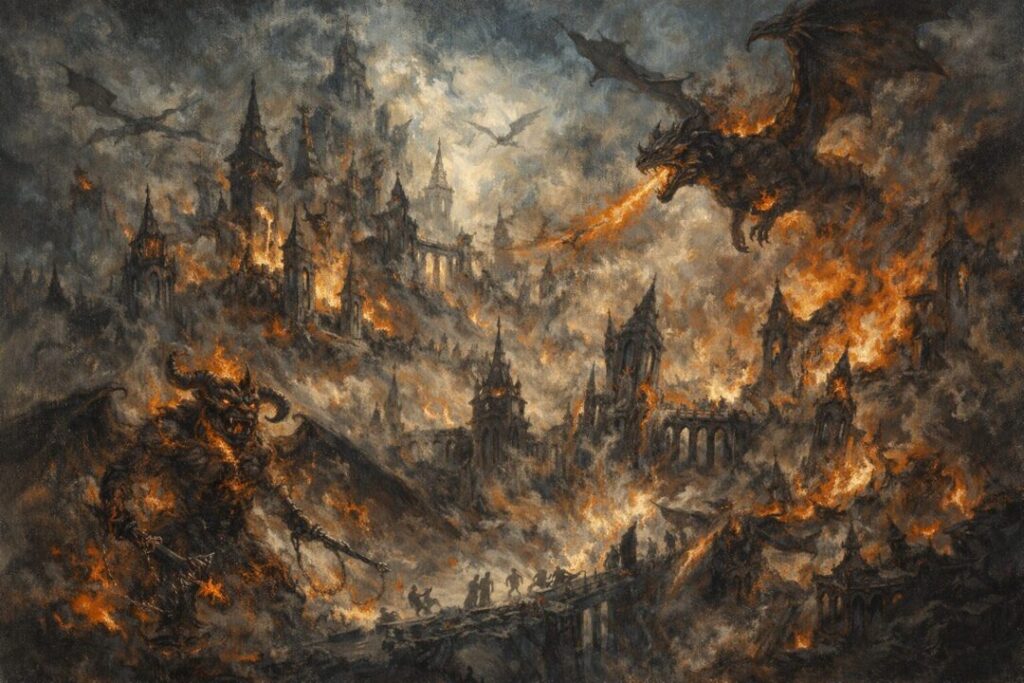
The Fall of Gondolin was not a siege in the traditional sense. It was an overwhelming rupture. Dragons breached the gates. Orc-hosts flooded the streets. And with them came the Balrogs — spirits of fire and shadow whose presence alone had shattered armies in earlier wars.
These were not lesser demons or battlefield monsters.
They were the same beings who had driven the Noldor into exile, broken great hosts, and stood as Morgoth’s most feared captains during the Wars of Beleriand. Even the greatest Elven lords did not face Balrogs lightly — if at all.
At their head came Gothmog, High Captain of Angband.
Gothmog was no ordinary servant. He had slain Fëanor, first of the High Kings of the Noldor. He had killed Fingon, greatest warrior of his age, in single combat. Where Gothmog walked, kings fell.
When he reached the King’s Fountain — the very space Ecthelion was sworn to defend — Gondolin was already dying.
This was not a battlefield where victory was possible.
It was a place where something had to be ended.
The Nature of the Duel
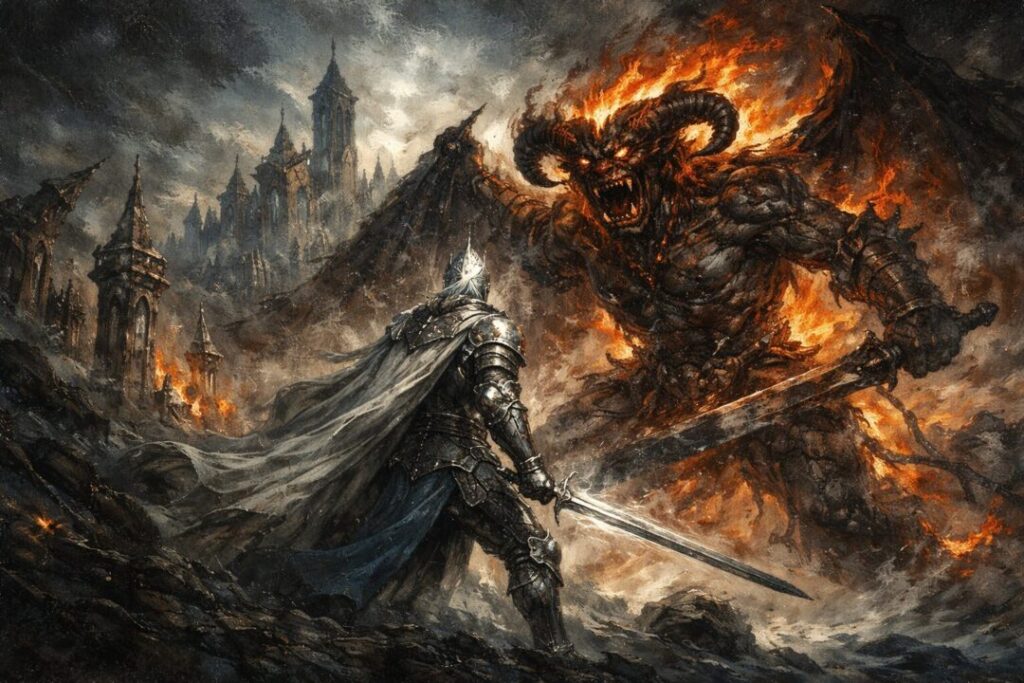
Unlike many legendary combats in Middle-earth, the encounter between Ecthelion and Gothmog is described with remarkable restraint.
There are no spells shouted across the flames.
No divine signs in the sky.
No sudden reinforcements.
There is only proximity.
Ecthelion does not overpower Gothmog through superior strength. He does not banish him with hidden lore. Instead, he wounds him, closes with him, and locks himself into a struggle where survival is no longer the goal.
This is not a duel meant to be won and walked away from.
It is a sacrifice shaped like a fight.
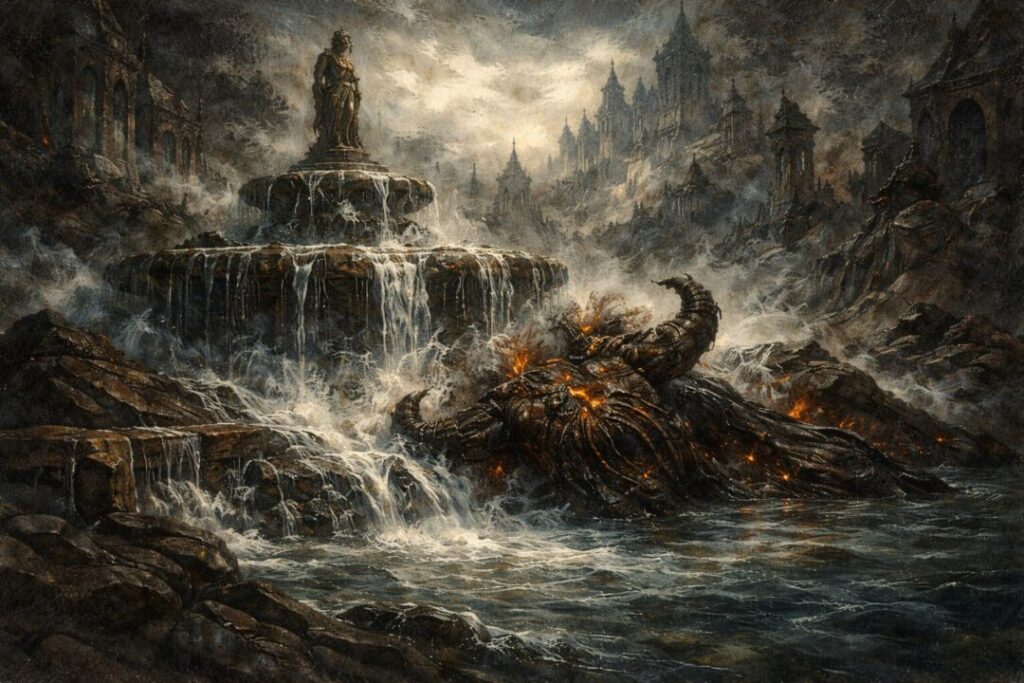
Ecthelion drives Gothmog into the depths of the King’s Fountain — water swallowing fire, stone collapsing, light extinguished. And he goes with him.
The greatest Balrog ever named dies.
So does Ecthelion.
And with them, something else ends.
Why This Moment Changes the World
At first glance, Ecthelion’s death can feel like a tragic footnote — one hero among many lost in the ruin of a city. But the consequences of Gothmog’s fall ripple outward in a way that reshapes the future of Middle-earth.
After Gondolin, Balrogs do not lead armies.
They do not command hosts.
They do not stride openly onto battlefields.
They do not challenge kings and High Elves.
Instead, they vanish.
We know that some survive the First Age — at least one certainly does. But they are no longer captains of conquest. They are hidden things, lurking beneath the world, avoiding notice rather than commanding fear.
This change is not accidental.
Gothmog was not just another Balrog. He was their lord — the organizing will behind their presence in war. With his destruction, Morgoth’s most terrifying servants lose cohesion and purpose.
What remains are remnants.
Durin’s Bane as the Final Echo
Millennia later, the world encounters one last Balrog: Durin’s Bane.
And notice how it behaves.
It does not rule Moria as a king.
It does not marshal armies.
It does not announce itself.
It hides.
It sleeps.
It reacts only when disturbed.
Durin’s Bane is not a conqueror. It is a survivor — exactly what Balrogs became after Gothmog’s fall.
In this sense, Ecthelion’s sacrifice reaches across ages. He does not merely kill a powerful enemy. He ends an era of dominance. The Balrogs never recover their former role in the history of Middle-earth.
Why Ecthelion Does Not Return
Some figures of the First Age are restored or return in later forms. Others echo through descendants or reincarnations.
Ecthelion does not.
Unlike Glorfindel, he is not sent back. Unlike many great Elves, he does not linger unseen in the background of later history.
Why?
Because his role is complete.
Ecthelion belongs to an age of open, cataclysmic confrontation between powers that reshaped continents. When that age ends, Middle-earth moves toward a quieter, more diminished mode of heroism — one defined by endurance, humility, and moral resistance rather than raw force.
The world no longer has room for heroes whose purpose is to end things absolutely.
Ecthelion closes the door behind him.
A Legacy Without Presence
Though his name fades, the world Ecthelion leaves behind is fundamentally altered.
Balrogs no longer dominate wars.
Morgoth’s greatest battlefield weapon is broken.
The First Age ends not with victory — but with resolution.
This is the quiet truth of Ecthelion of the Fountain.
He does not walk into legend.
He does not shape the next age with counsel or command.
He becomes the reason legends change.
And in a world where power slowly diminishes, where great lights fade rather than explode, that may be the most fitting — and most profoundly Tolkienian — fate of all.
Sources & Notes
- J.R.R. Tolkien, The Silmarillion, “Of Tuor and the Fall of Gondolin” — names Ecthelion of the Fountain among Gondolin’s defenders and records his mutual slaying with Gothmog, Lord of Balrogs.
- J.R.R. Tolkien, The Book of Lost Tales Part Two, “The Fall of Gondolin” — gives the fuller scene of Ecthelion, lord of the House of the Fountain, fighting Gothmog at the King’s Fountain.
- J.R.R. Tolkien, The Silmarillion, “Of the Return of the Noldor” and “Of the Fifth Battle: Nirnaeth Arnoediad” — establishes Gothmog’s stature through the deaths of Fëanor and Fingon.
- J.R.R. Tolkien, Unfinished Tales, “Of Tuor and His Coming to Gondolin” — supplies deeper background for Turgon’s hidden city, its secrecy, and the road by which Tuor came there.
- J.R.R. Tolkien, The Lord of the Rings, Book II, Chapter 5, “The Bridge of Khazad-dûm” — provides the later Third Age comparison point in Durin’s Bane, the hidden Balrog of Moria.