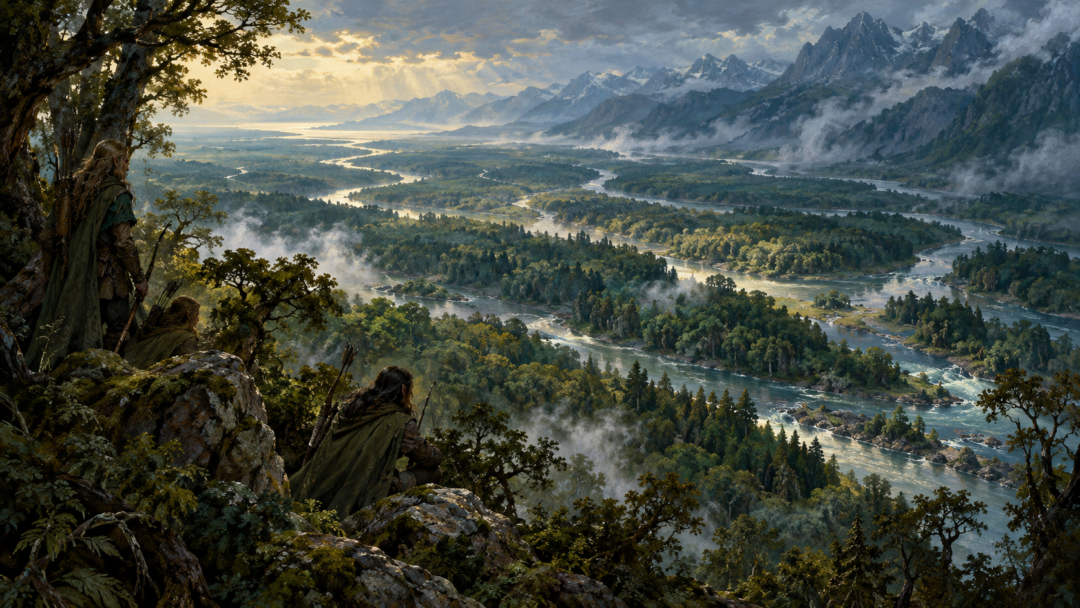
Ossiriand was not protected by a wall like Gondolin, nor by the Girdle of Melian like Doriath. It possessed no great fortress, no famous standing army, and after the death of Denethor its Green-elves chose no new king. Yet through much of the First Age, the Land of Seven Rivers remained an unusually elusive corner of Beleriand.
Its geography helps explain why.
Ossiriand lay between the Blue Mountains and the River Gelion. From those mountains six rivers—the Ascar, Thalos, Legolin, Brilthor, Duilwen, and Adurant—flowed westward into Gelion. Together with Gelion itself, they gave the country its name: the Land of Seven Rivers. The region was wooded, watered, and inhabited by the Laiquendi, or Green-elves, whose woodcraft became extraordinary. A stranger, the texts tell us, could cross their country without seeing them at all.
It is tempting to turn this into a simple military formula: seven rivers made Ossiriand unconquerable. The texts never say that. But they do present a remarkable combination of terrain, secrecy, political decentralization, and a deliberate rejection of open warfare. Ossiriand survived not by becoming stronger in the conventional sense, but by becoming harder to find, concentrate, and destroy.
A Country Divided by Water
Gelion formed the great western boundary of Ossiriand, while the Blue Mountains rose along its eastern side. Between them ran the six tributaries, roughly east to west.
From north to south came Ascar, Thalos, Legolin, Brilthor, Duilwen, and Adurant. The Ascar was especially important because the Dwarf-road from the Blue Mountains followed its vicinity toward the ford of Sarn Athrad. Farther south, the Adurant divided around Tol Galen, the green island later associated with Beren and Lúthien.
This was therefore not an isolated wilderness without routes or outside contact. Dwarves crossed the region’s northern approaches, and other travelers entered it. Finrod encountered the people of Bëor after crossing Gelion into Ossiriand.
What made the country unusual was that movement through it did not necessarily mean control over it.
The repeated rivers naturally broke the landscape into smaller bands of woodland and valley. Tolkien does not explicitly describe these waterways as defensive barriers or say that the Laiquendi organized their society around separate river districts. Any such detailed military or political system would be invention.
But the physical pattern matters. An army advancing north or south through the country would repeatedly encounter watercourses descending from the mountains. An invader moving east or west would face either Gelion or the rising terrain of Ered Luin. Combined with dense woodland and inhabitants skilled at remaining unseen, this produced a landscape far better suited to concealment and local movement than to the concentration of large hostile forces.
The rivers did not need to be impassable to matter.
They only needed to complicate the landscape.
Denethor’s Death Changed Everything
The decisive transformation of the Green-elves was not geographical but historical.
Denethor, son of Lenwë, had led part of the Nandor westward over the Blue Mountains into Beleriand. Thingol welcomed them as long-separated kin, and they settled in Ossiriand.
When Morgoth’s Orcs invaded Beleriand before the rising of the Moon, Thingol called upon Denethor. The Elves of Ossiriand joined him in what became the First Battle of Beleriand.
They helped win—but the victory exposed their weakness.
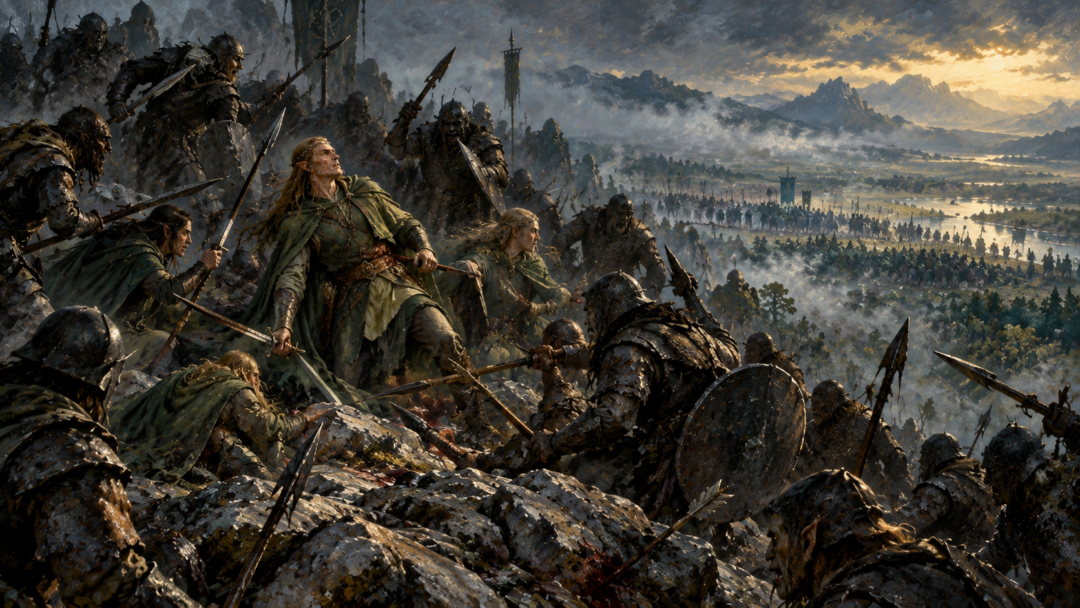
Denethor’s people were lightly armed. Against Orcs protected by iron and carrying heavy weapons, they were badly disadvantaged. Denethor was surrounded on Amon Ereb and slain with his nearest kin before Thingol’s forces could reach him.
The consequence was profound.
The surviving Green-elves did not simply appoint another king and rebuild their army. They chose no more kings and did not again go to open war in the manner of that disastrous battle. Some entered Doriath. Those remaining in Ossiriand became a secretive woodland people.
This is the essential political fact behind Ossiriand’s later character.
Its decentralization cannot simply be attributed to its rivers. The text gives us a much clearer immediate cause: the traumatic destruction of Denethor and his following. Geography and political development should therefore not be confused.
Yet after that decision, the geography of Ossiriand suited the society that emerged remarkably well.
The Laiquendi Turned Concealment Into Defense
The Green-elves did not disappear. They changed the terms on which outsiders encountered them.
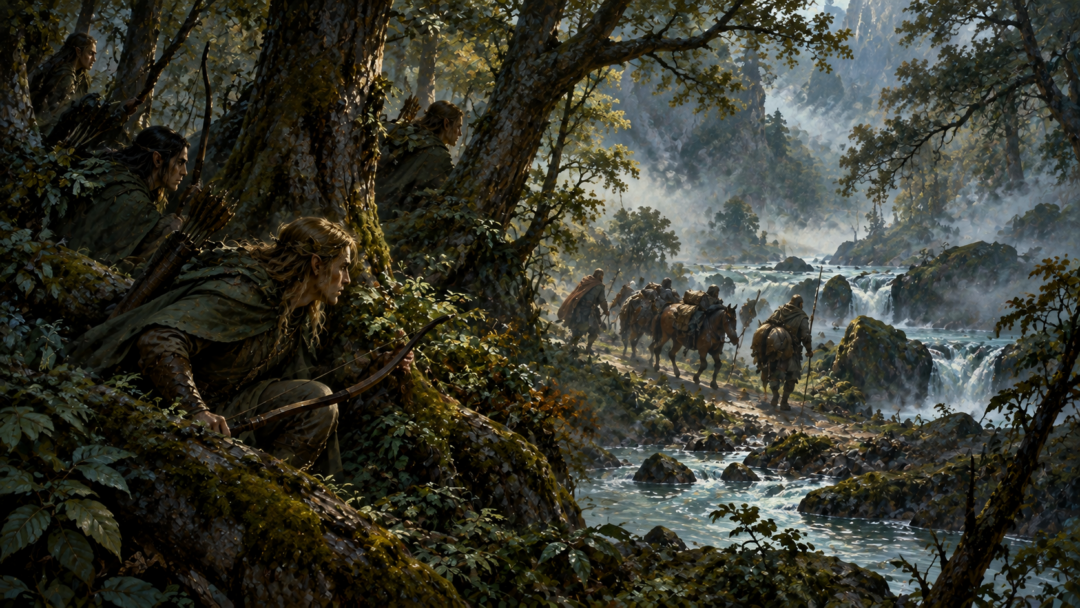
Their woodcraft became so effective that travelers could pass through Ossiriand without seeing its inhabitants. Their green clothing gave them the name Laiquendi, the Green-elves, and their association with the living landscape was practical as well as cultural.
That produced a radically different defensive model from the great realms of the First Age.
Nargothrond concentrated strength underground. Gondolin depended upon secrecy surrounding a hidden city. Doriath possessed a central royal power protected by Melian’s enchantment. The Noldorin realms maintained fortified positions and organized armies along the northern frontiers.
Ossiriand offers something else: concealment spread across an entire inhabited landscape.
There is no canonical statement that the Laiquendi established a coordinated system of river defenses, watch-posts, or territorial commands. We should not imagine infrastructure that the texts never describe.
What we can say is more interesting.
An enemy could enter the country without necessarily bringing its inhabitants to battle.
That distinction is crucial.
Why Conquest Becomes Difficult Without a Center
Traditional conquest depends upon targets.
Destroy the capital. Kill or capture the ruler. Break the main army. Occupy the fortress. Control the road junctions. Force the surviving population to recognize the conqueror’s authority.
After Denethor, Ossiriand offered fewer obvious targets of this kind.
The Laiquendi had already experienced what happened when their people gathered under one king and fought a heavily armed enemy in open battle. Their response was not to construct a stronger center but to abandon that model.
Here the seven-river landscape may have reinforced the consequences of that choice.
A population living throughout wooded country crossed by numerous streams did not necessarily need one defensible urban center to make the land habitable. This is an inference from the geography and the descriptions of the Laiquendi, not an explicitly stated constitutional principle. The surviving texts give us little detail about their settlements or internal government.
But that absence itself cautions against imagining Ossiriand as a conventional kingdom.
After Denethor, there is no succession of named kings ruling from a capital. There is no equivalent of Menegroth, Nargothrond, or Gondolin. The Green-elves remain a people and Ossiriand remains recognizably their land, yet political identity survives without the centralized monarchy that had once led them.
This made them weaker in one sense and potentially harder to destroy in another.
There was no new Denethor whose death could decapitate the entire society.
The Rivers Were Boundaries, But Also Connections
It would be misleading to picture every river merely as a defensive moat.
Rivers connect landscapes as readily as they divide them. Ossiriand’s waterways descended from the Blue Mountains into Gelion, and the northern part of the country stood close to an important Dwarven route.
The Ascar and Sarn Athrad make the point particularly clearly.
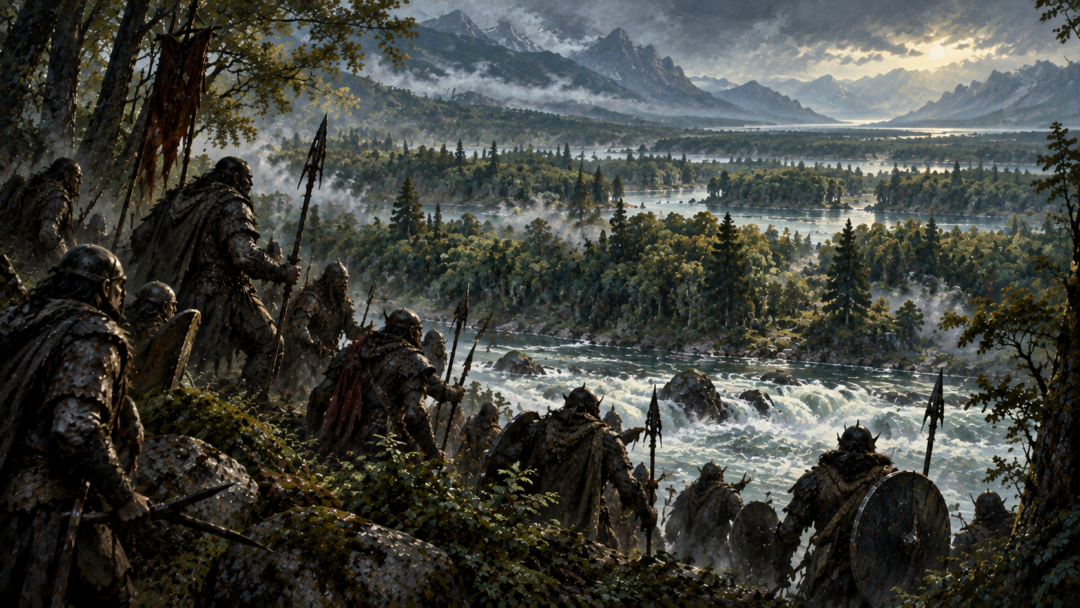
After the destruction of Doriath, the Dwarves of Nogrod who had sacked Menegroth attempted to return eastward. Their journey brought them toward the crossings associated with Gelion and the road into the mountains. Beren and his allies intercepted them, and the returning Dwarven host was destroyed.
The episode does not prove that the rivers formed a planned Laiquendian defense system. It does demonstrate something more modest: the geography of eastern Beleriand contained predictable corridors and crossings. Armies carrying treasure, traders moving between regions, and travelers heading toward the mountains could not simply ignore the waterways.
A ford can therefore be both an opening and a vulnerability.
That is one of Ossiriand’s central geographical paradoxes.
A Land That Refused the Logic of the Great Kingdoms
The history of Beleriand is filled with magnificent centers that eventually become magnificent ruins.
Gondolin is hidden, discovered, and destroyed. Nargothrond is fortified, exposed, and sacked. Menegroth becomes one of the wonders of the Sindar and later falls violently.
Ossiriand follows a less dramatic path.
That does not mean it was invulnerable. Nor does it mean the Green-elves possessed some superior political philosophy. Their withdrawal from open warfare followed terrible losses and fear. Their decentralized condition after Denethor was born at least partly from catastrophe.
Yet it produced an unusual form of endurance.
The Laiquendi ceased trying to compete with the military powers around them on those powers’ terms. They did not become another heavily armed kingdom. Instead, they became difficult to see.
Their homeland matched that strategy almost perfectly: mountain foothills, woods, Gelion on the west, and six descending tributaries repeatedly breaking the country into smaller natural spaces.
The rivers alone did not save Ossiriand. The texts never grant them that magical or strategic power.
The stronger conclusion is that geography and historical choice reinforced one another.
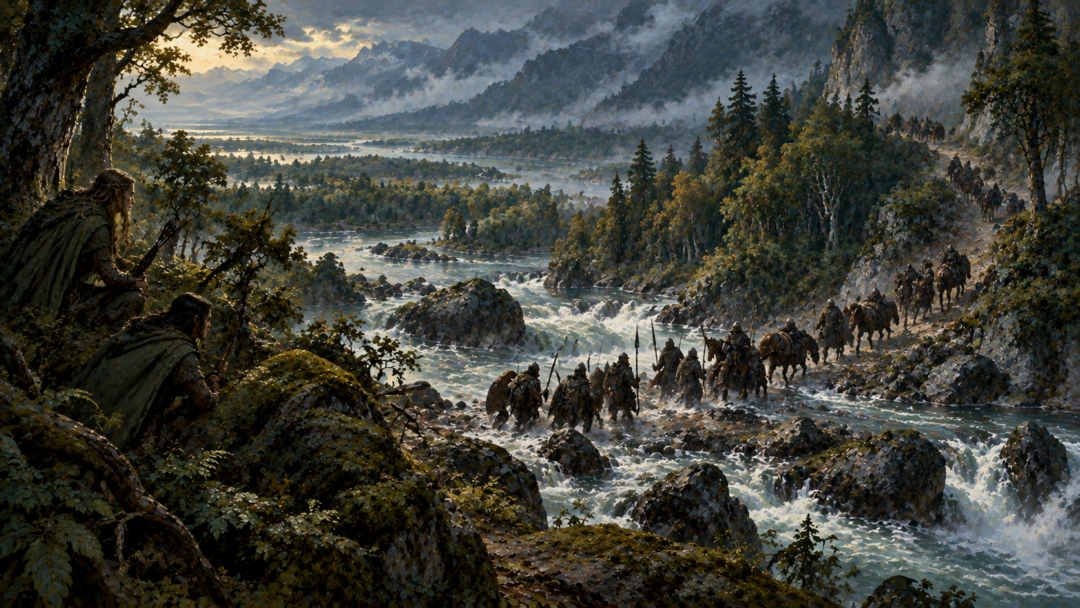
The Hidden Strength of the Land of Seven Rivers
Ossiriand reveals a quieter pattern of power in Middle-earth.
Its people suffered when they concentrated for conventional war. Their king died surrounded by enemies, and their light weapons could not match the iron equipment of the Orcs. Afterward they rejected both kingship and open battle.
Then the landscape became part of a different way of surviving.
Forests concealed them. Rivers complicated movement and created repeated local divisions in the terrain. The Blue Mountains enclosed the country from the east, while Gelion marked its western side. The inhabitants knew this environment so intimately that strangers might cross the whole region without finding them.
That is not the same as being unconquerable.
It is something subtler: making conquest difficult to define.
An invader could cross a river. He could follow a road. He could perhaps occupy a patch of ground. But where was the capital whose capture meant victory? Where was the king whose submission delivered the people? Where was the assembled army waiting to be destroyed?
After Denethor, those answers became increasingly elusive.
The Seven Rivers did not create the political decentralization of the Laiquendi; the surviving texts point instead to the aftermath of the First Battle. But Ossiriand’s divided, wooded geography gave that decentralized and secretive society an unusually suitable home.
The Land of Seven Rivers endured because its people learned a lesson many greater realms of Beleriand learned too late: sometimes survival depends less upon making a fortress impossible to enter than upon giving the enemy no single heart to strike.
Sources & Notes
- Tolkien Gateway — Ossiriand: the seven rivers, woodland secrecy, and abandonment of kingship https://tolkiengateway.net/wiki/Ossiriand
- Tolkien Gateway — Green-elves: Denethor's people and their withdrawal from open warfare https://tolkiengateway.net/wiki/Green-elves
- Silmarillion Writers' Guild — Denethor of the Nandor: sourced biography of the king and the aftermath of his death https://www.silmarillionwritersguild.org/reference/characterofthemonth/denethor.php
Primary reading: The Silmarillion, 'Of the Sindar', 'Of Beleriand and its Realms', 'Of the Coming of Men into the West', and 'Of the Ruin of Doriath'. These are secondary geography and character guides. Denethor's death precedes the rejection of kingship; the rivers' contribution to concealment and decentralized survival is interpretation, not a documented Laiquendian military constitution or proof of invulnerability.