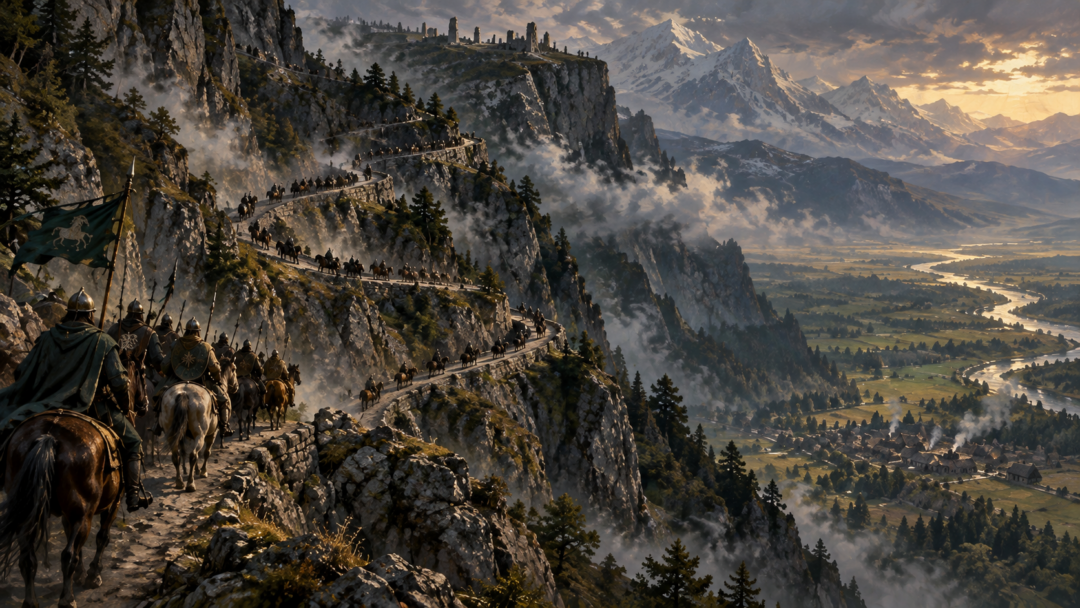
Rohan is a kingdom built around horses. Its Riders cross open country with extraordinary speed, gather into mounted companies, and depend upon mobility in war. Yet one of Rohan’s most important refuges is reached by a road that works against almost every advantage a mounted host possesses.
The road to Dunharrow does not run straight up the mountain.
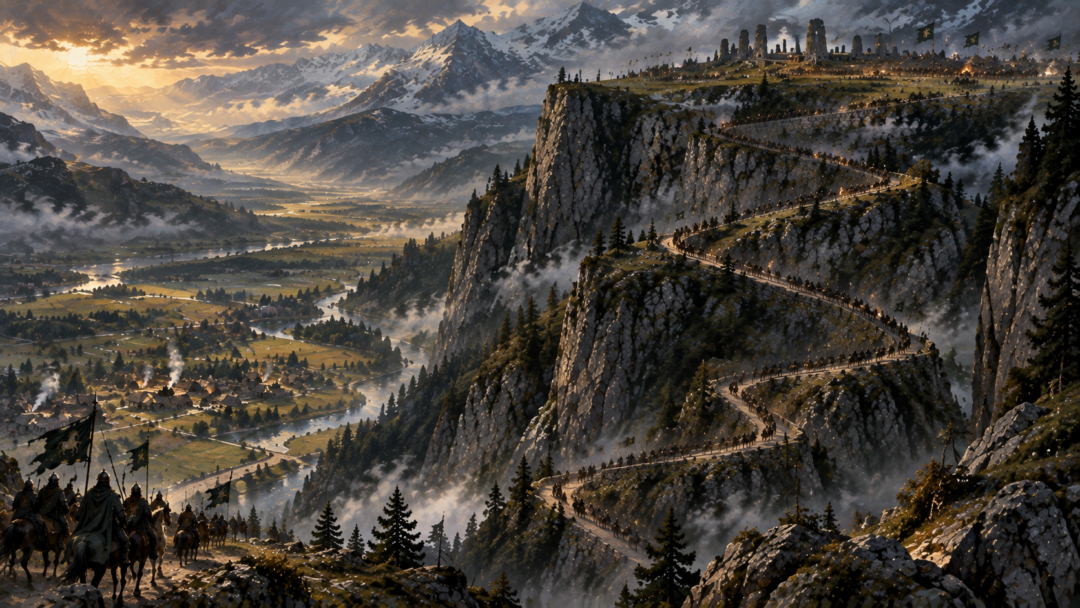
It climbs from Harrowdale in steep turns, doubling repeatedly back upon itself until it reaches the high refuge beneath the White Mountains. At those bends stand the ancient Púkel-men, weathered stone figures left by people whose history the Rohirrim themselves no longer understand.
For a traveler, the road is memorable. For an army, it creates a much more serious problem.
The text never gives us a military engineering analysis of the Stair of the Hold, nor does it calculate marching speeds or prescribe formations. But its physical description allows a cautious conclusion: the road forces a large mounted force to surrender much of its freedom of movement. Riders who thrive on open ground must become a long, constrained column.
And that helps explain both the strength and the inconvenience of Dunharrow.
The Stair of the Hold Is a Deliberate Geographic Constraint
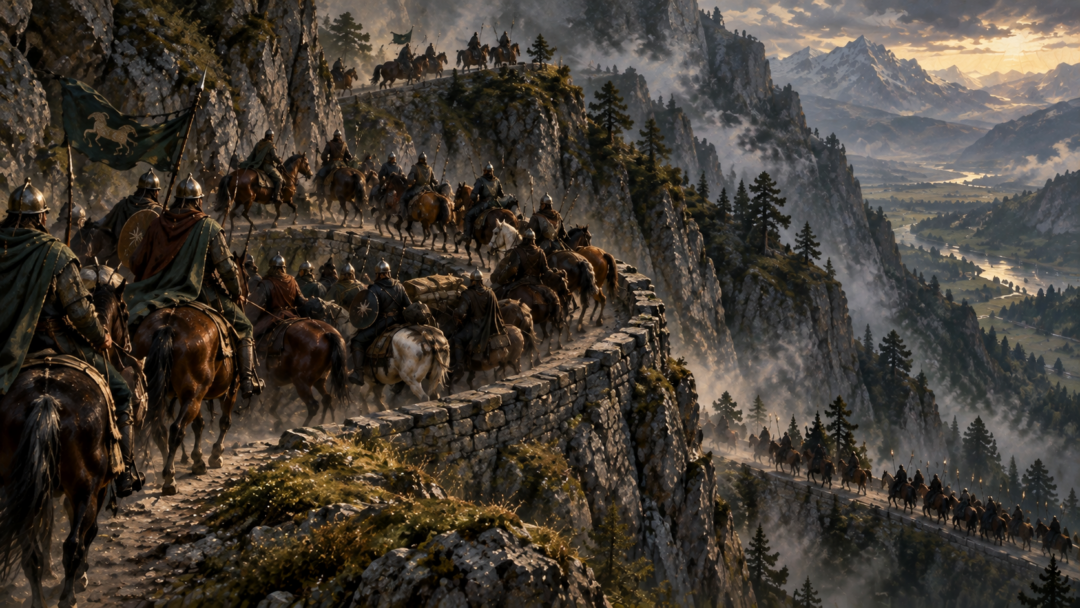
Dunharrow lies high above Harrowdale, reached by the steep road commonly called the Stair of the Hold. In The Return of the King, the ascent is described as winding repeatedly upward, with the Púkel-men positioned at the turns.
The road climbs hundreds of feet before reaching the high ground of Dunharrow.
That immediately distinguishes it from the roads across the plains of Rohan.
On open country, mounted troops have room. Companies can spread out, change their frontage, ride alongside one another, overtake slower groups, and reorganize without every movement being dictated by a cliff or road edge.
A steep switchback road removes those options.
A force ascending it must largely follow the route already provided. At every reversal, the head of the column changes direction while those behind are still approaching the bend. Different parts of the same force can therefore be traveling in opposite directions while separated vertically by only a short distance.
This does not mean Tolkien explicitly describes Rohirric traffic jams on the Stair. He does not.
But the geometry of the road has unavoidable consequences. A broad body of horsemen cannot remain broad when the usable ground narrows to a mountain road.
The terrain converts width into length.
Thousands of Riders Become One Long Column
This matters particularly because Dunharrow is associated with the great muster before Théoden's ride to Gondor.
Rohan's military strength lies in mounted men, and the gathering at Dunharrow involves forces arriving from across the Mark. Yet however many Riders can eventually assemble on the high ground, they cannot all occupy the ascending road abreast.
Imagine an éored approaching the first steep turns.
The riders must fit themselves to the road. A company that could deploy across a much wider space on grassland instead stretches along the ascent. Add another company behind it, then another, along with whatever attendants and baggage accompany the movement, and the physical length of the procession increases rapidly.
The front may already be approaching the upper turns while the rear remains far below.
That produces an important distinction between assembly space and access space.
Dunharrow provides room for a substantial gathering once the Riders reach the upland. The road by which they reach it is far more restrictive.
In modern language, one might call the road a bottleneck, though that term is not used in the text. It is simply the natural consequence of funneling many mounted men through a narrow, steep approach.
Rohan can gather an army at Dunharrow.
It cannot make the mountain road behave like the plains.
The Switchbacks Work Against Cavalry’s Greatest Advantage
The Rohirrim are dangerous partly because horses give them operational and battlefield mobility.
The Stair of the Hold temporarily neutralizes much of that advantage.
A horse can certainly climb a mountain road, and the Rohirrim repeatedly use the route. The issue is not whether mounted men can pass. They plainly can.
The issue is what they cannot do while passing.
They cannot exploit open-ground speed in the same way. They cannot freely widen their formation. Riders behind slower traffic cannot simply fan out across the landscape. A problem near one turn potentially affects everyone following because the route offers limited alternatives.
The sharp reversals also matter.
A switchback exists because a direct ascent would be too steep. It trades distance for manageable gradient. Consequently, even when two points are relatively close vertically, the road between them may cover considerably more ground.
For an individual rider this is an inconvenience.
For an army it multiplies.
Every horse and rider must travel the bends. Every company must negotiate the same constrained route. The greater the force, the more significant the difference becomes between the movement of the first riders and the movement of the entire host.
An army has not truly completed a movement merely because its vanguard has arrived.
The last men must arrive too.
Dunharrow Is Strong for the Same Reason It Is Awkward
Here lies the deeper contradiction.
Everything that makes Dunharrow inconvenient for mass movement also contributes to its usefulness as a refuge.
The Rohirrim use Dunharrow as a place of safety in dangerous times. Théoden speaks of the people defending themselves there if events go badly. The high position above Harrowdale and the difficult approach make it fundamentally different from an exposed settlement on the plains.
An attacker approaching by the same road would face the same geographic restrictions.
He too would be forced onto the ascent.
He too would lose freedom of maneuver.
He too would have to negotiate the steep turns beneath defenders already occupying higher ground.
The text does not give us a detailed hypothetical siege of Dunharrow, so claims about precise defensive tactics should remain speculative. Yet the general strategic logic is clear: difficult access is valuable to a refuge precisely because it prevents an enemy from approaching as freely as he could across open terrain.
The road therefore has two faces.
When Rohan wants protection, the restricted approach is an advantage.
When Rohan wants rapid movement, it becomes a cost.
That tradeoff is built directly into the landscape.
The Púkel-Men Mark Every Turn
The strange stone figures along the ascent make the road even more memorable.
At the turnings sit the Púkel-men: squat, ancient figures whose origins have passed beyond Rohirric memory. Some are so weathered that much of their original appearance has been lost.
Their placement gives the ascent an almost ritual quality.
The army climbs, turns, passes another ancient watcher, climbs again, and turns once more.
The Rohirrim themselves pay the figures little attention. They belong to a past older than Rohan. Yet their presence emphasizes something important about Dunharrow: this is not a fortress newly constructed by the Horse-lords according to their own military preferences.
The place is ancient.
The people who shaped Dunharrow belonged to the remote past, and even the Rohirrim cannot say with certainty what the site's original purpose was. The surviving works predate their kingdom by a vast span of time.
Rohan inherited the refuge.
And in doing so, it inherited its geography.
A people famous for mounted warfare must therefore adapt itself to a defensive landscape designed—or at least shaped—by people whose world is largely forgotten.
The Muster Reveals the Two Different Dunharrows
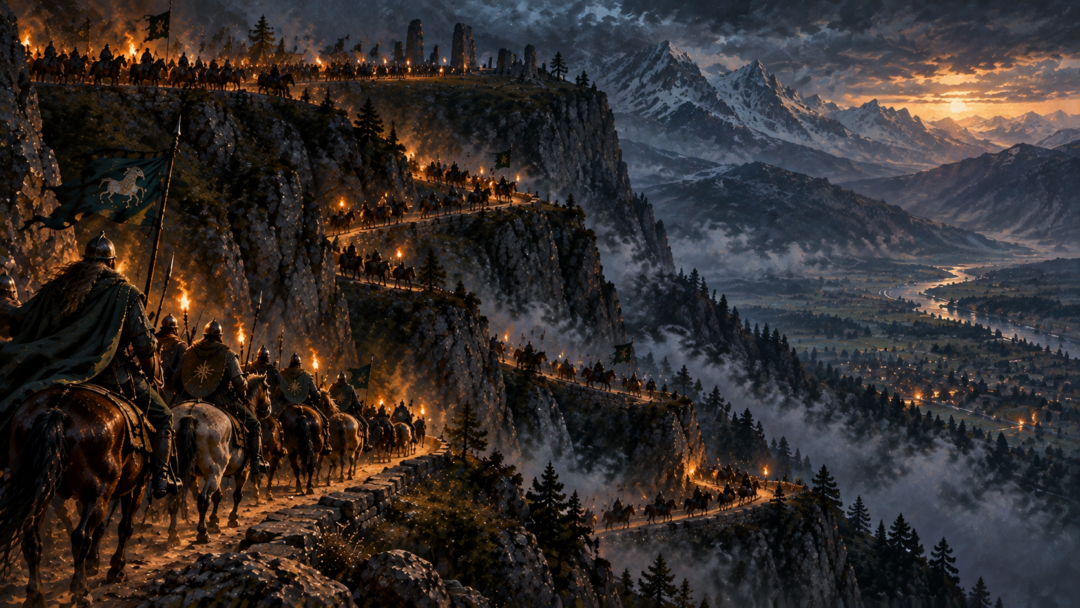
During the War of the Ring, Dunharrow becomes a gathering place for Rohan's strength.
This can initially seem strange.
Why gather cavalry on a mountain refuge reached by such an awkward road?
Because the restrictive approach is only one part of the site.
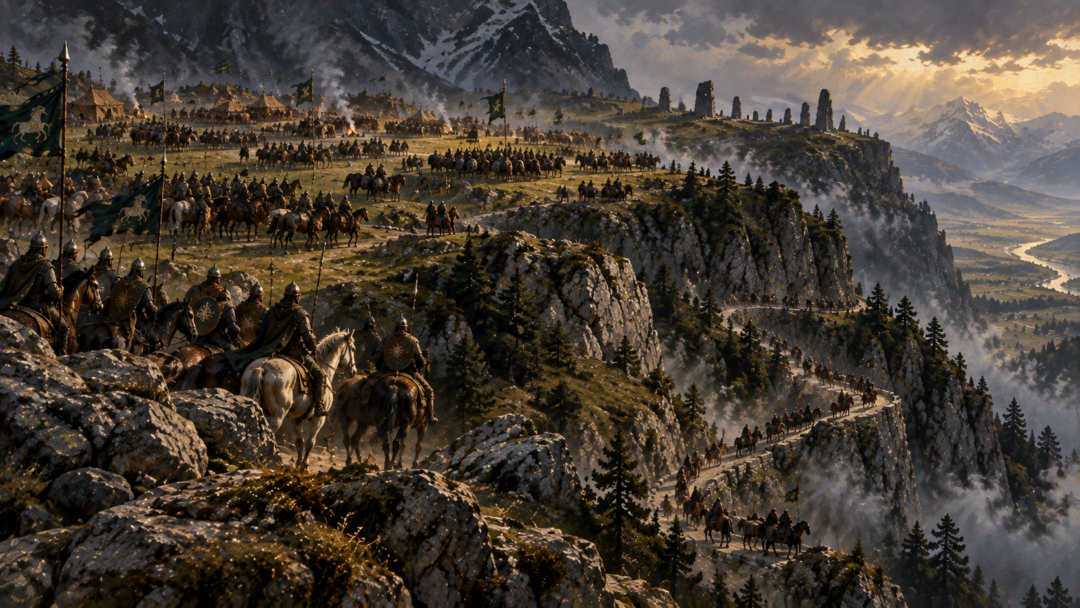
Above lies the Firienfeld, the high field where the Riders can assemble. Dunharrow therefore combines a protected approach with usable ground above it. The army does not remain permanently compressed into the switchbacks. The compression occurs during passage between valley and upland.
Once riders reach the higher ground, formations can gather again.
This creates a striking rhythm in the movement of the host.
Open country allows the Rohirrim to move as horsemen.
The mountain approach narrows them into a column.
The high field allows them to become an assembled host again.
Then, when the time comes to leave, they must pass back through constrained terrain before regaining the freedom of the broader roads and plains.
That distinction is easy to miss because narratives naturally follow important characters. A king or messenger can move through a location comparatively quickly. Thousands of men and horses cannot be treated as though they were one traveler.
The road has to absorb them all.
Why Leaving Dunharrow Is as Important as Reaching It
The same geometry applies in reverse when an army descends.
A mounted host gathered on the Firienfeld cannot instantly transform into a force moving at full speed toward Gondor.
First it must leave the refuge.
The leading riders can enter the descending road while the rest remain above. As successive companies follow, the host becomes extended along the switchbacks. Only after reaching less restrictive ground can the larger force recover greater freedom of movement.
Again, the narrative does not provide a minute-by-minute logistical schedule, so it would be wrong to invent one.
But the broader principle is unavoidable.
Departure has a throughput limit.
A host of thousands may be ready at roughly the same time without being physically capable of occupying the same narrow stretch of road at once.
This is one of the subtle realities behind the great movements of armies in Middle-earth. Decisions can be made in a hall or delivered by a messenger in moments. Turning those decisions into the movement of thousands of living bodies takes space and time.
At Dunharrow, the mountain decides how that movement must begin.
The Road Shows the Hidden Cost of Safety
Dunharrow is therefore more than a dramatic setting beneath the Dwimorberg and beside the Paths of the Dead.
Its road embodies a basic military exchange.
Accessibility and defensibility often pull in opposite directions.
A place that an army can enter instantly from every direction is also a place an enemy may find easier to approach. A refuge protected by height, steep terrain, and limited routes of access gains security by sacrificing convenience.
Dunharrow lies strongly on the side of protection.
The switchbacks allow horses and men to overcome an otherwise punishing rise, but they do so by controlling exactly where movement occurs. The road makes the mountain passable without making it open.
That difference matters.
The Riders of Rohan remain formidable horsemen when they climb the Stair of the Hold. Yet for those moments, their greatest military advantage is subordinated to terrain.
They cannot command the mountain as they command the grasslands.
They must follow its road.
And that may be the most revealing thing about Dunharrow's switchbacks: the same road that slows Rohan's army helps make the place worth retreating to in the first place. The mountain refuge protects its occupants because it refuses to let large forces move freely.
Even the Riders of the Mark must pass its ancient stone watchers one turn at a time.
Sources & Notes
- Tolkien Gateway — Stair of the Hold: the steep switchback road and its ancient stone figures https://tolkiengateway.net/wiki/Stair_of_the_Hold
- Tolkien Gateway — Dunharrow: the refuge above Harrowdale and the Firienfeld assembly ground https://tolkiengateway.net/wiki/Dunharrow
- Tolkien Gateway — The Muster of Rohan: Théoden's arrival at Dunharrow and the gathering of the Riders https://tolkiengateway.net/wiki/The_Muster_of_Rohan
Primary reading: The Return of the King, 'The Passing of the Grey Company' and 'The Muster of Rohan'; Appendix B, 'The Great Years'. These secondary guides establish the landscape and muster. Bottlenecks, column length, and movement constraints are geographical inferences; Tolkien gives no quantified marching schedule or engineered traffic model.