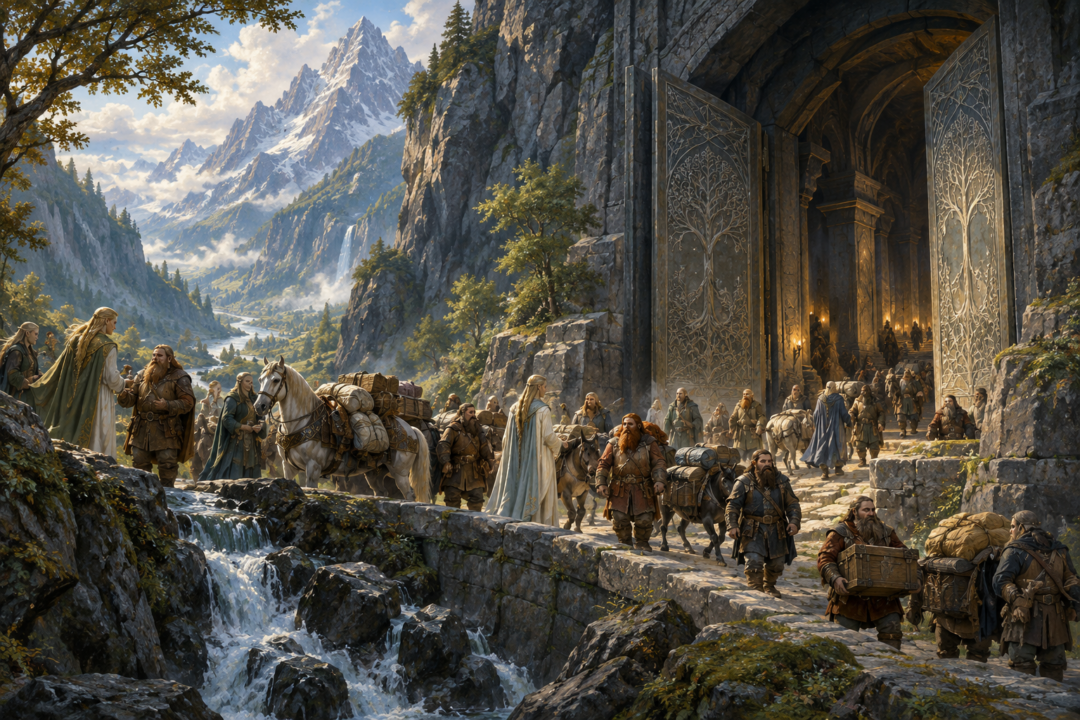
When the Fellowship reached the West-gate of Moria, they found more than a locked door. They found the surviving signature of an extraordinary Second Age relationship.
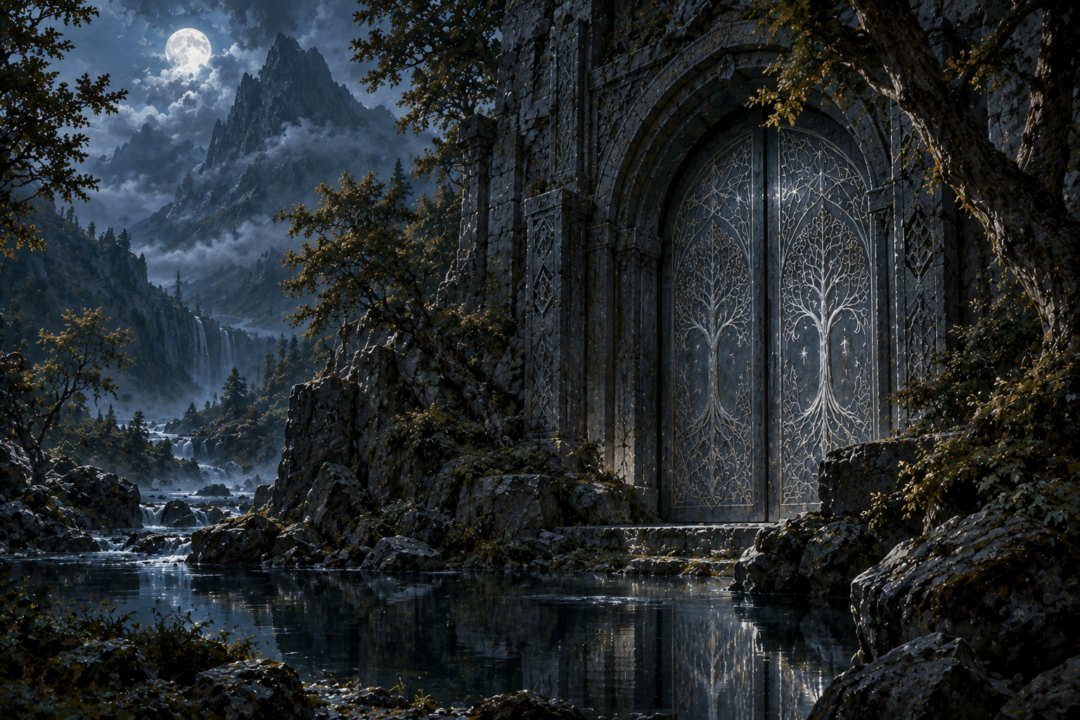
Narvi, a Dwarf of Khazad-dûm, had made the doors. Celebrimbor of Eregion had drawn the signs upon them. Those signs were traced in ithildin, a substance associated with mithril, the precious metal for which Moria was famous. The entrance itself faced west toward Eregion, and its inscription addressed an arriving “friend.”
Centuries after both communities had fallen from their former greatness, their gate still preserved the essential pattern of their prosperity: different peoples, different traditions of craft, and a shared work neither side is said to have made alone.
The surviving texts do not provide an economic history in the modern sense. There are no prices, production totals, contracts, wage records, or inventories of goods passing between Ost-in-Edhil and Khazad-dûm. But they give enough evidence to reconstruct a narrower and more interesting truth.
Eregion and Khazad-dûm prospered together because proximity joined two unusually accomplished craft cultures whose strengths were complementary rather than identical.
Eregion Was Founded Beside Something Its Smiths Wanted
Eregion occupied a remarkably significant position on the western side of the Misty Mountains, close to the West-gate of Khazad-dûm.
That geography was not incidental.
In the account preserved in Unfinished Tales, the Noldor were interested in the region because mithril had been discovered in Khazad-dûm. Their attraction therefore had a material as well as a geographical dimension. Here was a Dwarven realm possessing access to a substance coveted by some of the greatest craftsmen remaining in Middle-earth.
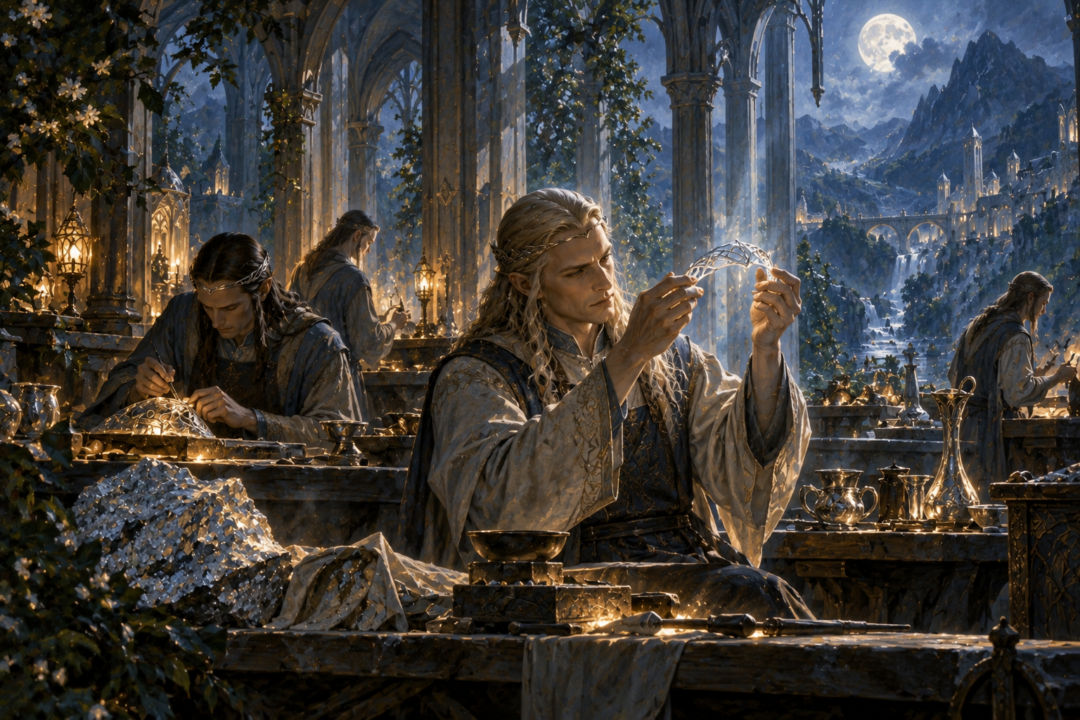
The Elves of Eregion were themselves exceptionally skilled. Their great brotherhood of craftsmen, the Gwaith-i-Mírdain, the People of the Jewel-smiths, was led by Celebrimbor. The tradition represented by these smiths ultimately produced the Rings of Power, although that later achievement belongs to the darker part of Eregion’s history.
Before that catastrophe, the fundamental arrangement was simpler.
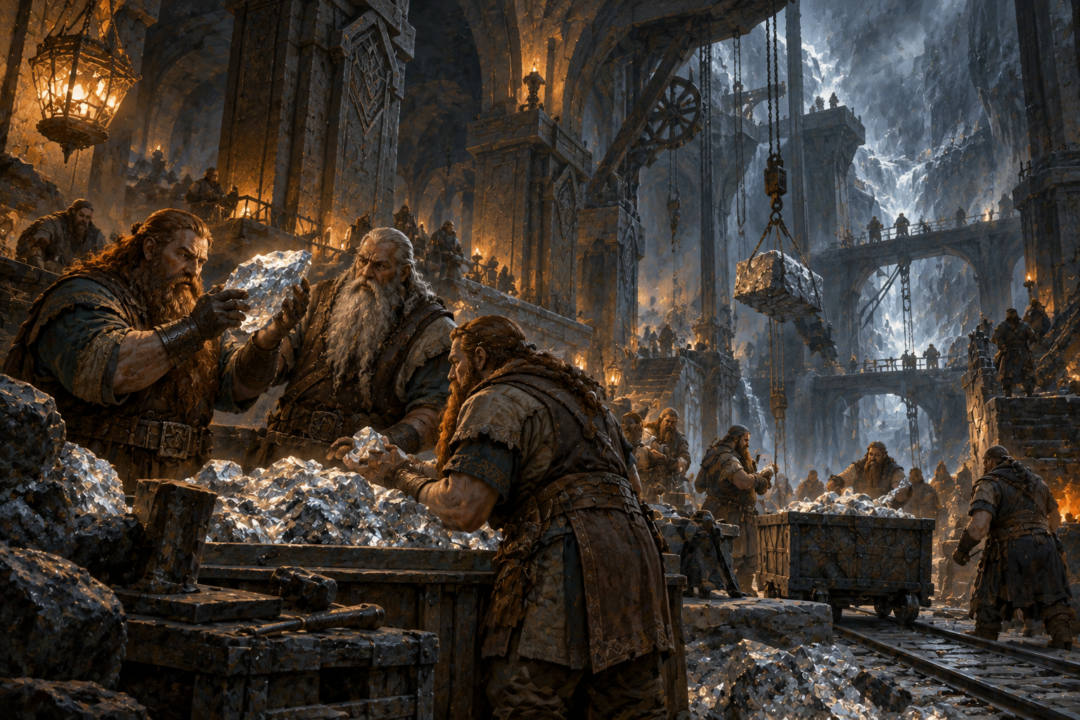
The Dwarves possessed mines, subterranean works, accumulated craft traditions, and access to mithril. The Noldorin smiths brought their own formidable knowledge of making and shaping beautiful objects. The texts explicitly describe friendship and profitable intercourse between the communities.
That is stronger evidence than merely observing that two skilled peoples happened to live near each other.
They deliberately became neighbors whose craft interests overlapped.
Mithril Made Khazad-dûm More Than a Convenient Neighbor
Mithril explains much of Eregion’s attraction to Khazad-dûm, but it should not be reduced to a fantasy equivalent of ordinary silver.
In The Fellowship of the Ring, Gandalf describes its unusual combination of qualities: it could be worked readily, polished brilliantly, and made into metal both light and extraordinarily strong. Its beauty did not tarnish like common silver.
The Dwarves extracted it from beneath the mountains. The Noldor of Eregion also learned to work with it, and Gandalf specifically associates them with ithildin, made using mithril and visible under particular light. The West-gate preserves the most famous surviving example.
This gives us an unusually concrete chain of evidence.
Khazad-dûm had access to the raw material. Eregion contained craftsmen intensely interested in that material. The neighboring communities maintained friendly relations. And an important shared monument combined Dwarven construction with Celebrimbor’s ithildin work.
We should not go farther than the evidence permits. Tolkien does not tell us how mithril was priced, in what quantities it crossed the border, who controlled individual transactions, or whether formal agreements regulated its exchange.
But we do not need imaginary ledgers to see the underlying complementarity.
A rare material lay beneath the mountain. Master craftsmen lived immediately outside it.
The Relationship Was About Skill as Well as Material
It would nevertheless be misleading to imagine Khazad-dûm merely supplying ore while Eregion supplied the “real” artistry.
Dwarven craftsmanship was itself among the great technical traditions of Middle-earth. The Doors of Durin make this especially clear because Narvi is not described as a supplier to Celebrimbor. His authorship is placed directly upon the monument.
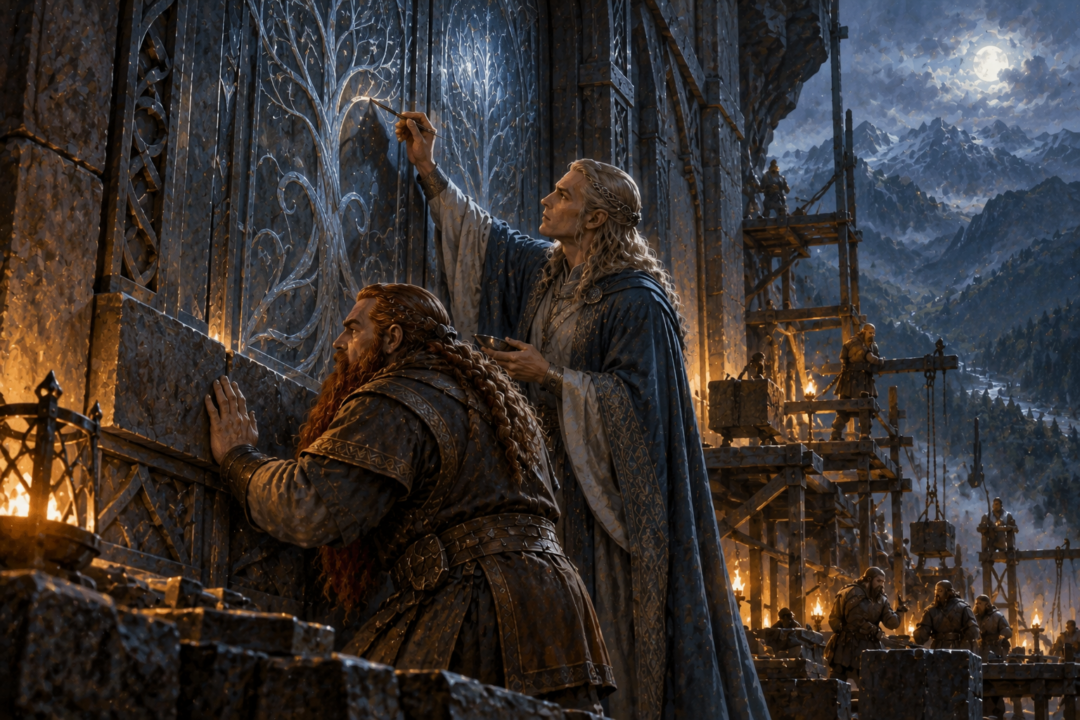
Narvi made the doors. Celebrimbor drew the signs.
The distinction matters.
The surviving inscription records two makers associated with different parts of one finished work. Whatever additional labor must historically have been involved is not described, so it would be speculation to reconstruct a workforce behind them. What the text chooses to preserve is the partnership of two named craftsmen.
That makes the West-gate almost a physical statement of complementarity.
Its stonework and construction belong to Narvi’s achievement. Its luminous signs belong to Celebrimbor’s. The imagery itself brings Dwarven and Elvish identities together: emblems associated with Durin appear alongside Elvish symbols and the star connected with the House of Fëanor.
Neither tradition disappears into the other.
Cooperation produces something shared without requiring cultural sameness.
The West-gate Shows What Prosperity Looked Like
There is another overlooked feature of the Doors of Durin: in the period for which they were designed, this western entrance belonged to a living relationship.
By the time Frodo and his companions reached it, the gate had become mysterious and forbidding. Moria was dark, Eregion was deserted, the stream had been dammed, and the Fellowship struggled even to understand how the doors opened.
That ruined setting can distort our perception of what the gate originally represented.
Its surviving inscription is astonishingly friendly in spirit. The password is the Sindarin word for “friend.” Gandalf eventually realizes that the inscription is not presenting the kind of hostile riddle expected from a sealed fortress. It comes from a more trusting age.
That makes sense in the context of Eregion and Khazad-dûm.
The western entrance connected the Dwarven realm directly with the Elvish land beyond it. Unfinished Tales describes close intercourse between the peoples, and the broader tradition emphasizes the exceptional friendship that developed between them.
A monumental doorway facing your neighbor is infrastructure as well as art.
The texts do not tell us how many travelers or loads of goods passed through it, so numerical claims would be invention. Yet its existence demonstrates that the relationship was substantial enough to be embodied in one of Khazad-dûm’s principal approaches.
The gate did not merely commemorate friendship.
It facilitated contact.
Celebrimbor and Narvi Turn the Larger Relationship Personal
Large historical relationships can become abstract. Celebrimbor and Narvi prevent this one from doing so.
Celebrimbor was the greatest craftsman of Eregion. Narvi was a Dwarven craftsman whose surviving fame rests chiefly upon the West-gate. Their names appear together upon their work.
Other writings go further in emphasizing the friendship between Celebrimbor and the Dwarves, with Narvi singled out as his close companion in craft.
That personal relationship matters because it shows that exchange was not necessarily confined to anonymous movement of materials.
Knowledge, admiration, and creative work could cross the cultural boundary too.
This is particularly striking because relations between Elves and Dwarves elsewhere in the legendarium were often burdened by suspicion and old grievances. Eregion and Khazad-dûm demonstrate that hostility was never an unavoidable law of their natures.
Under different historical conditions, proximity and shared love of craft could generate friendship.
Their prosperity was therefore not simply based on possessing useful things. It also depended on a social condition: people on either side were willing to work with those unlike themselves.
What We Can Reconstruct — and What We Cannot
It is tempting to turn Eregion and Khazad-dûm into a fully modeled trade economy.
The evidence does not allow it.
We cannot responsibly assign mithril prices, estimate mining output, identify regular trade caravans, calculate labor specialization, or invent treaties between the realms. Nor are we given a catalogue dividing everything produced in the region into “Elven” and “Dwarven” industries.
What we can say is more limited but firmly grounded.
Khazad-dûm possessed extraordinary mineral wealth and a renowned craft tradition. Eregion contained Noldorin smiths whose desire for mithril helped draw them near the Dwarven realm. The two peoples established an unusually friendly relationship from which both benefited. Celebrimbor and Narvi collaborated. And the West-gate physically joined their worlds while displaying their crafts together.
From those facts, a careful economic interpretation follows.
Their prosperity was complementary because neither community is presented as merely duplicating the other. Khazad-dûm controlled access to coveted resources beneath the mountains and possessed its own mastery of making. Eregion brought another sophisticated craft tradition capable of using those resources in distinctive ways.
Exchange enlarged what each community could do.
Anything more precise disappears beyond the edge of the surviving record.
The Tragedy Is Written Into the Ruins
The final irony is that readers encounter the greatest monument to this relationship only after the relationship itself has vanished.
Eregion was destroyed during Sauron’s war against the Elves in the Second Age. Khazad-dûm survived that catastrophe, closing itself against the war outside, but much later it too was abandoned after the awakening of Durin’s Bane.
By the end of the Third Age, Ost-in-Edhil was gone and Moria was a place of dread.
Yet the West-gate remained.
Its makers had not signed a treaty preserved by historians. They signed their work.
That may be the clearest way to understand why Eregion and Khazad-dûm prospered together. Their relationship was built upon resources, location, access, technical excellence, and exchange, but the surviving evidence gives it a profoundly personal symbol.
Narvi made the doors.
Celebrimbor drew the signs.
Two neighboring traditions met at the threshold, and for a remarkable period of the Second Age, the boundary between their worlds became not a wall but a doorway.
Sources & Notes
- The Encyclopedia of Arda — Eregion — The Elven smiths’ realm and its friendship with nearby Khazad-dûm. https://www.encyclopedia-of-arda.com/e/eregion.html
- The Encyclopedia of Arda — Narvi — The Dwarven craftsman’s friendship and collaboration with Celebrimbor. https://www.encyclopedia-of-arda.com/n/narvi.html
- The Encyclopedia of Arda — Doors of Durin — Narvi’s gateway and Celebrimbor’s ithildin signs, normally open in the years of friendship. https://www.encyclopedia-of-arda.com/d/doorsofdurin.html
Primary passages: The Fellowship of the Ring, “A Journey in the Dark”; Appendix B; Unfinished Tales, “The History of Galadriel and Celeborn.” Complementary crafts is interpretation of their collaboration and exchange. The texts do not supply a full trade ledger or establish that all variant accounts of Eregion’s founding describe one settled history.