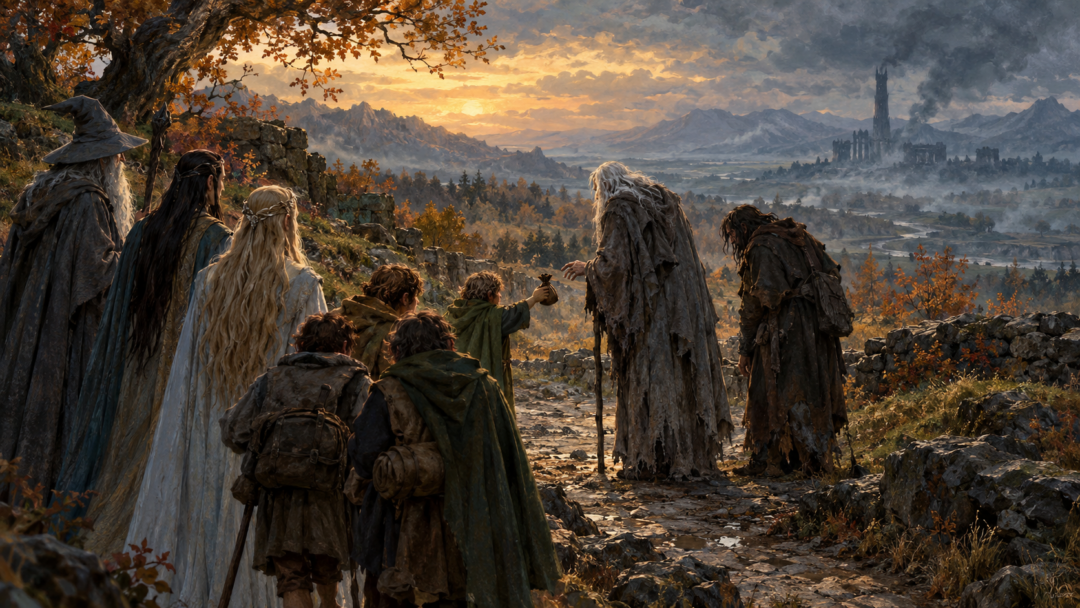
When Merry offers Saruman a little pipe-weed on the road north, the gesture looks almost absurdly generous. The once-powerful head of the White Council is now a ragged wanderer. Orthanc is behind him. His staff is broken. His armies are gone. Sauron has fallen. Beside him trudges the miserable Gríma.
Yet Saruman’s response turns an ordinary pouch of Shire leaf into something ominous. He calls attention to the fact that the weed had been his, speaks bitterly of the Southfarthing, and suggests that the hobbits may find matters less pleasant when they reach home.
Sam notices the warning.
What neither Sam nor the others yet understand is how much history lies behind it.
Saruman is not physically ruling the Shire when they meet him on the road. His personal arrival there comes later. But his connection with the Shire is already old, secretive, and materially real. The returning victors are looking at a defeated enemy while unknowingly travelling toward a country into which that enemy’s influence has already reached.
That distinction is what makes the meeting so unsettling in hindsight.
Saruman Looks Like a Threat That Has Already Ended
Everything visible about Saruman encourages the company to think of him in the past tense.
His great political and military project has collapsed. Isengard has been wrecked by the Ents. Gandalf has expelled him from the order and broken his staff. Treebeard has eventually allowed him to leave Orthanc, and now Saruman possesses neither fortress nor army.
When the travellers encounter him in “Many Partings,” he is therefore dangerous in a very different sense from the Saruman whom Gandalf confronted at Isengard.
He can still wound with words. He can still refuse pity. He can still hate.
But he no longer appears capable of shaping kingdoms.
That appearance is misleading because it measures Saruman only by the power immediately surrounding his person. His power has collapsed, but not every consequence of his earlier actions has fallen with it.
The Shire is the proof.
The Clue Had Already Been Found at Isengard
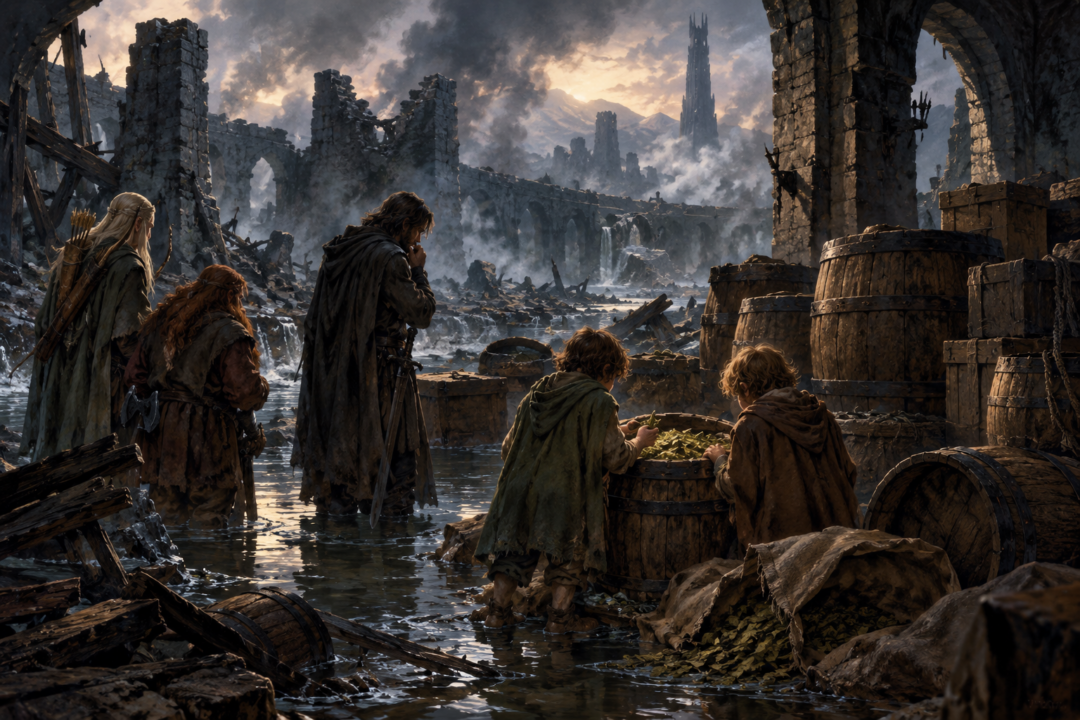
Long before this road meeting, Merry and Pippin discover something strange among the stores at Isengard: genuine pipe-weed from the Shire, including Longbottom Leaf.
The discovery is more significant than it first appears.
Merry naturally recognizes what it is, but Aragorn recognizes the geographical problem. Goods from the Southfarthing should not casually have travelled across the long, sparsely inhabited country between the Shire and Isengard. He therefore concludes that Saruman must have had secret dealings with someone in the Shire.
That is a remarkably important deduction.
It establishes within The Lord of the Rings itself that Saruman’s relationship with the Shire predates his final journey north. The later occupation is not created from nothing when Saruman arrives. There was already a hidden connection.
Unfinished Tales adds further background, though its material concerning Saruman and the Shire contains variant accounts and should be treated accordingly. It describes his growing interest in Gandalf’s concern for hobbits, his secret acquisition of pipe-weed, and the use of agents connected with the Shire and Bree.
The essential point does not depend upon resolving every variant: Saruman had been watching and dealing with the Shire before his military power collapsed.
Merry’s Gift Accidentally Touches the Secret
This is why the pipe-weed exchange on the road matters so much.
Merry offers Saruman some of the leaf recovered from Isengard. Saruman immediately insists that it was his and says it was dearly bought. Then he turns his bitterness toward the Southfarthing and the possibility that the hobbits will find shortages when they return.
Sam catches the implication more quickly than anyone else.
He wonders how Saruman had “bought” the leaf and dislikes the reference to the Southfarthing. His instinct is simple: they should get home.
Sam does not yet possess enough information to reconstruct the whole mechanism. But his suspicion is rational. Saruman has just connected himself, money, Shire produce, and trouble at home in the same conversation.
The warning is not a complete confession.
It is almost worse than that.
Saruman knows something about their home that they do not.
What the Hobbits Still Cannot Know
The crucial limit is that the travellers have clues, not a complete picture.
They know Saruman obtained Shire pipe-weed.
They have reason to infer secret dealings.
They now hear him speak maliciously about conditions in the Southfarthing.
What they do not yet know is how far the internal corruption of the Shire has advanced.
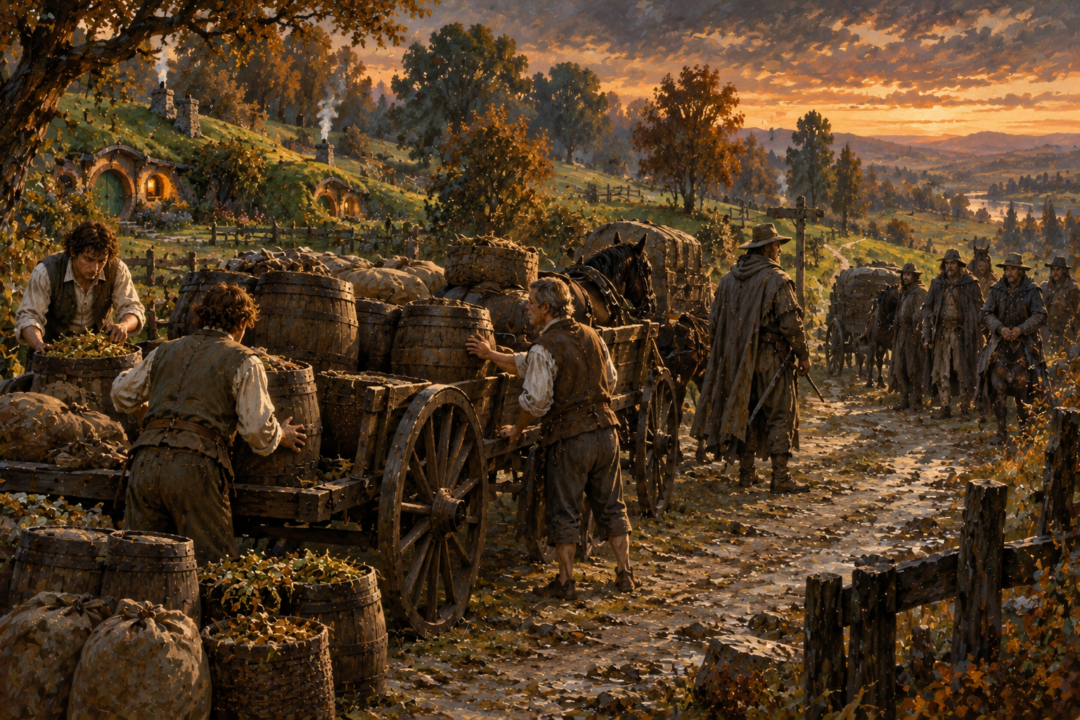
When they finally return, they learn how Lotho Sackville-Baggins had used wealth and property to increase his position. Farmer Cotton explains that Lotho had been buying property and sending goods away, while Men associated with this new order increasingly appeared in the Shire. Lotho’s authority then became entangled with the outsiders he had brought in until he was no longer truly master of what he had helped create.
Saruman ultimately takes control personally, but that is a later stage.
This chronology matters.
At the road encounter, it would be wrong to imagine Saruman secretly doubling back from an already established personal headquarters at Bag End. The meeting occurs before his own arrival in the Shire. What already exists is the network and the damage made possible through earlier dealings, agents, commerce, and the growing presence of Men.
The distinction makes Saruman’s fall more interesting, not less.
He has lost his central fortress while effects set in motion elsewhere continue without him.
The Victors Have Won the Great War, Not Every Consequence
The returning company has every reason to believe that the decisive struggle is over.
The Ring is destroyed. Sauron is defeated. Aragorn has been crowned. Rohan has survived. Isengard has been broken.
The great centres of hostile power have fallen.
But the Shire reveals a harder truth: defeating the architect of a system does not instantly erase everything that system has already touched.
Saruman’s influence had travelled by less spectacular means than an army marching beneath banners. Goods moved. Money changed hands. Agents watched. Local ambition became useful to an outside power. Men arrived. Authority hardened.
None of this resembles the siege of Minas Tirith.
That is precisely why the returning hobbits are unprepared for it.
They have learned to recognize orcs, Nazgûl, fortresses, armies, and Rings of Power. The danger waiting at home has grown through transactions, intimidation, opportunism, and the corruption of ordinary local life.
Saruman has become smaller, but his methods have become painfully intimate.
Saruman’s Warning Is Cruel Because It Is Incomplete
Saruman could tell the hobbits more.
He does not.
Instead, he gives them enough information to cause unease without enough to understand what awaits them. His remarks about the Southfarthing work as malice precisely because Sam senses that they refer to something real.
There is also a bitter reversal here.
Earlier, Saruman accumulated information about the Shire partly because it mattered to Gandalf. Now the hobbits who helped overthrow him are travelling home while Saruman knows more than they do about what has happened there.
For a brief moment, the defeated wanderer possesses the advantage of knowledge.
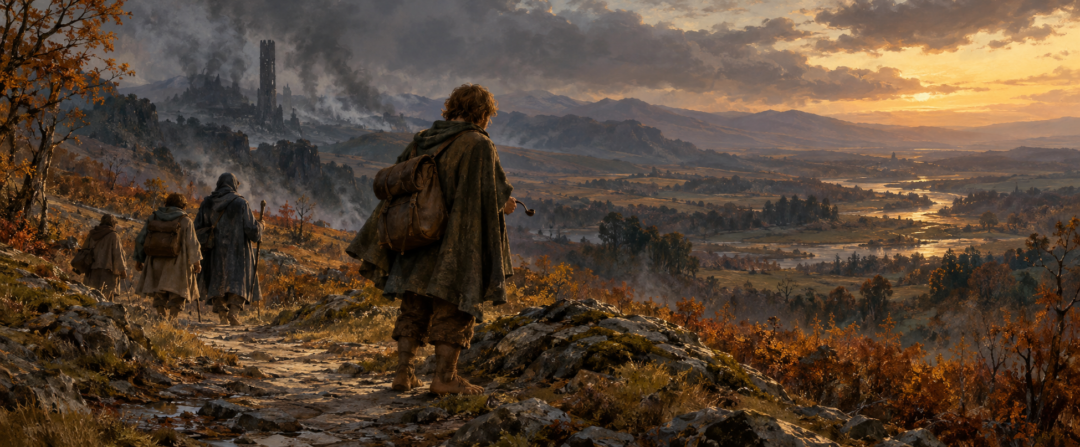
The heroes have crossed Mordor and participated in the overthrow of powers vastly greater than themselves, yet they cannot see beyond the next stretch of road.
Saruman can.
Bree Provides the Next Warning, but Not the Answer
The road continues to strip away the assumption that peace in the South means peace everywhere.
At Bree, Barliman Butterbur tells the hobbits and Gandalf about violence and disorder in the surrounding country. The old security of the North has been shaken during their absence.
That news broadens the warning.
Still, it does not reveal the specific truth of the Shire.
Even when Gandalf eventually parts from the four hobbits before they reach home, he does not accompany them to solve the problem for them. By then he understands that they have grown through their journeys and can meet what lies ahead.
The result is one of the great reversals of the homeward journey: returning home is not an epilogue to the adventure. It is the final test of what the hobbits have become.
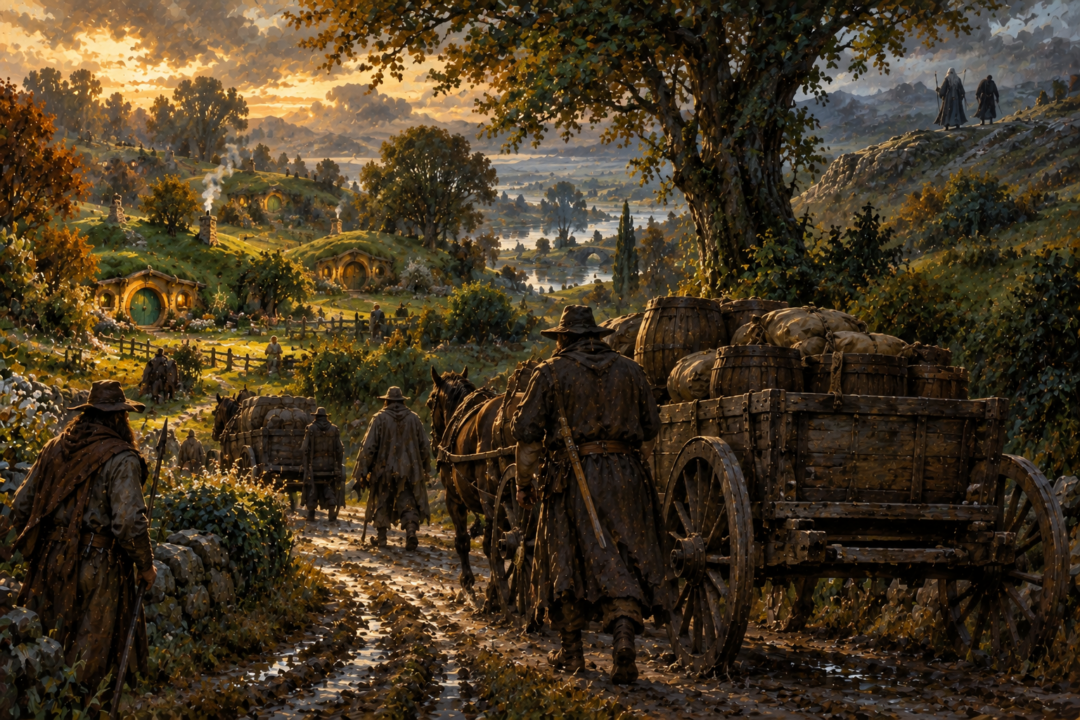
The Road Meeting Changes Meaning in Hindsight
On a first reading, Saruman on the road can look pathetic.
On a second, he looks informed.
The pipe-weed at Isengard, Aragorn’s suspicion of secret dealings, Saruman’s claim that the leaf was bought, his pointed reference to the Southfarthing, and Sam’s uneasiness form a chain of clues. None individually reveals the whole situation. Together they show that the Shire has already entered Saruman’s orbit before the returning hobbits understand the danger.
Yet the text carefully preserves the chronology.
Saruman has not already installed himself at Bag End when the company passes him on the road. He is a dispossessed wanderer moving north. His later personal arrival marks another stage in the disaster.
What precedes him is influence.
That is the hidden menace of the encounter.
The hobbits see a ruined wizard and naturally measure the threat by what he has left: almost nothing. What they cannot see is what he has already sent ahead of himself—relationships, agents, resentment, commercial connections, and consequences.
By the time Saruman reaches the Shire in person, he is not entering an untouched country.
The road has been prepared.
And that is what his ragged appearance fails to reveal: Saruman’s power is broken, but some of his work is still waiting for the victors at home.
Sources & Notes
- LitCharts — The Return of the King, Book VI, chapter 6 — The encounter with Saruman on the northward journey after his release from Orthanc. https://www.litcharts.com/lit/the-return-of-the-king/book-6-chapter-6
- The Thain’s Book — Saruman — His prior dealings with the Shire and his later arrival there after the road encounter. https://thainsbook.minastirith.cz/saruman.html
- LitCharts — The Return of the King, Book VI, chapter 8 — The hobbits discover the damage in the Shire and Saruman’s role. https://www.litcharts.com/lit/the-return-of-the-king/book-6-chapter-8
Primary passages: The Return of the King, “Many Partings” and “The Scouring of the Shire”; compare Unfinished Tales, “The Hunt for the Ring” and “The Istari,” keeping variant accounts distinct. Saruman’s personal arrival in the Shire follows the road meeting; his agents and commercial influence were already present.