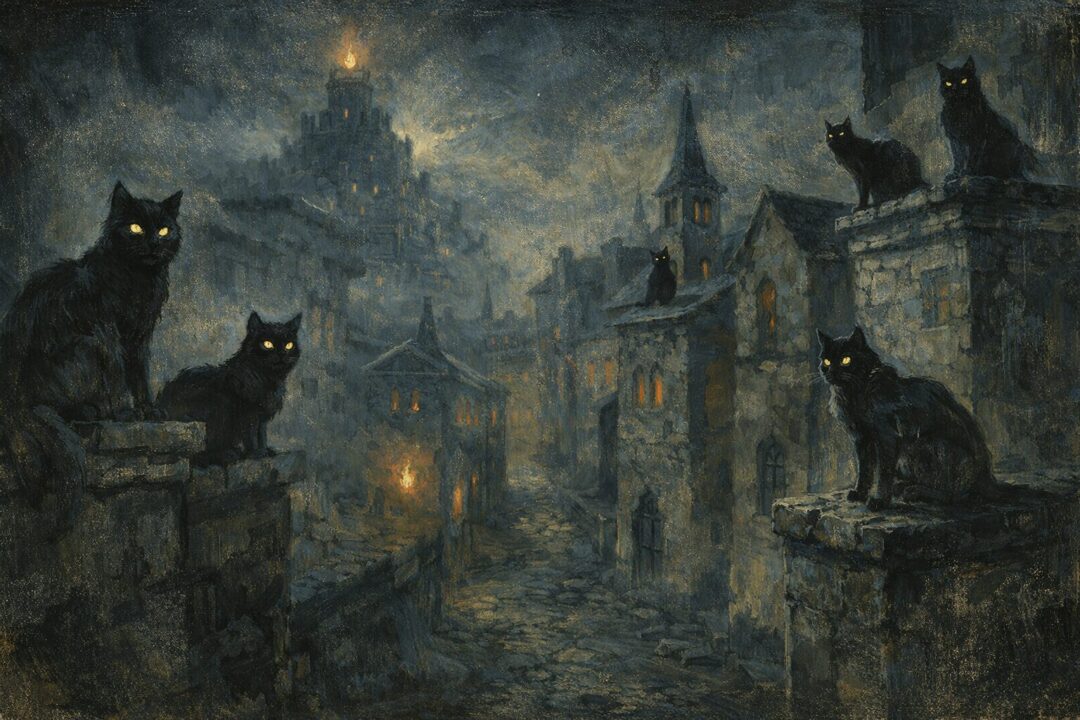
Among the many kings, stewards, captains, and warriors who shape the long history of Gondor, Queen Berúthiel stands apart—not because of great deeds, heroic sacrifices, or infamous betrayals, but because of how little we are told about her.
And how unsettling that little truly is.
Berúthiel appears only briefly in The Lord of the Rings, mentioned in passing rather than shown directly. There are no scenes from her life, no recorded speeches, no moments of triumph or downfall played out on the page. Yet the few details that survive paint a portrait unlike almost any other figure in Gondorian history.
She was feared rather than loved.
Watched rather than understood.
And remembered long after her banishment.
That lingering unease is no accident.
A Queen Defined by Absence
Berúthiel was the wife of Tarannon Falastur, the first of Gondor’s Ship-kings. His reign marked a turning point for the realm: a shift toward the sea, expansion of naval power, and renewed contact with distant coasts and harbors.
Tarannon looked outward.
Berúthiel did not.
Where his legacy is one of movement, exploration, and ambition, hers is defined by silence. She leaves behind no monuments, no reforms, no public acts. Instead, her presence is felt only indirectly—through rumor, fear, and the damage left behind after her removal.
This contrast is essential to understanding her story.
A Queen Who Never Belonged
Berúthiel did not come from Gondor. She was said to have come from lands to the south—regions viewed by the Gondorians as culturally alien and morally suspect. Even at the height of its power, Gondor remained deeply wary of southern influences, associating them with decay, secrecy, and hidden loyalties.
From the beginning, Berúthiel was an outsider.
Not merely foreign in origin, but foreign in spirit.
More telling still: Berúthiel despised the sea.
This detail may seem small, but in the context of Tarannon’s reign, it is profoundly symbolic. The sea was not just a strategic focus—it was the heart of Gondor’s renewed identity. Tarannon’s ships carried trade, influence, and prestige. To reject the sea was to reject the direction of the realm itself.
While the King invested in fleets and harbors, Berúthiel withdrew.
She did not walk among the people.
She did not host gatherings or cultivate alliances.
She did not participate in the symbolic life of the kingdom.
Instead, she isolated herself within the city.
And isolation, in Middle-earth, is rarely neutral.
The Cats of the Queen
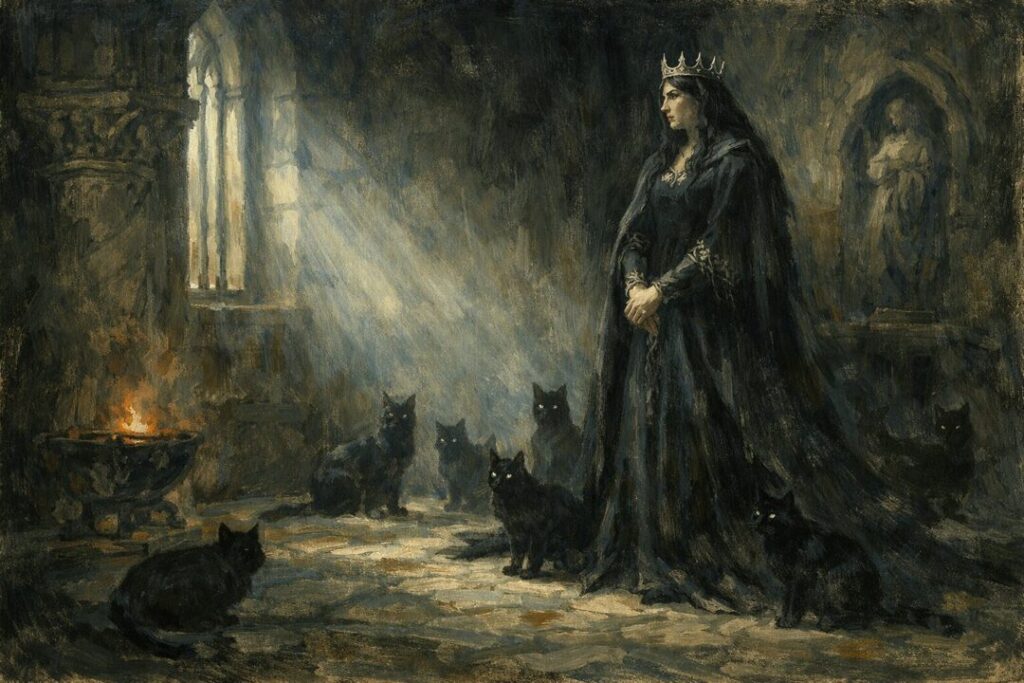
Berúthiel kept ten cats: nine black and one white.
This is not metaphor. It is stated plainly.
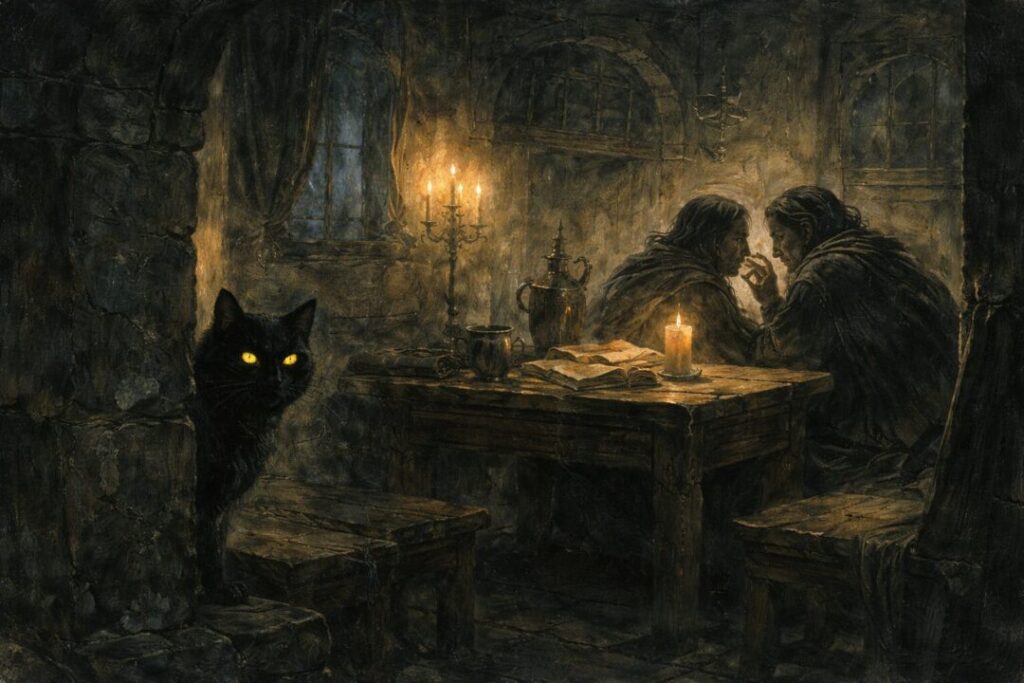
These cats moved freely through Minas Tirith and its surrounding settlements. They entered houses unchallenged. They lingered in corners. They watched.
And the people of Gondor believed—rightly or wrongly—that through these cats, the Queen could see and hear what others could not.
Tolkien never explicitly confirms that Berúthiel possessed supernatural powers. But in Middle-earth, belief itself often shapes reality. Fear alters behavior. Rumor becomes truth through repetition.
What matters is not whether the cats truly spied.
What matters is that people believed they did.
As a result, trust eroded.
Conversations softened.
Whispers replaced honest speech.
Private grievances went unspoken.
Berúthiel did not rule through decrees or punishment. She did not command armies or enforce laws. Her influence worked quietly, invisibly—through the fear of being observed.
This kind of power is rare in Tolkien’s world.
And deeply unsettling.
Surveillance Without Violence
Most threats in Middle-earth announce themselves openly. Orcs march. Dark Lords declare war. Even corrupted rulers tend toward spectacle and force.
Berúthiel represents something different.
She embodies control without conquest. Fear without open cruelty. Authority exercised not through action, but through presence.
Her cats function less as servants and more as symbols. They blur the line between the public and the private, making every home feel exposed. In a society built on honor, lineage, and trust, this is corrosive.
People begin to police themselves.
And once that happens, power no longer needs to be enforced.
This is why her cats terrified Gondor.
A Marriage That Could Not Endure
The estrangement between Tarannon and Berúthiel eventually hardened into open hatred. The Queen’s withdrawal, her reputation, and the growing fear surrounding her made coexistence impossible.
Tarannon acted.
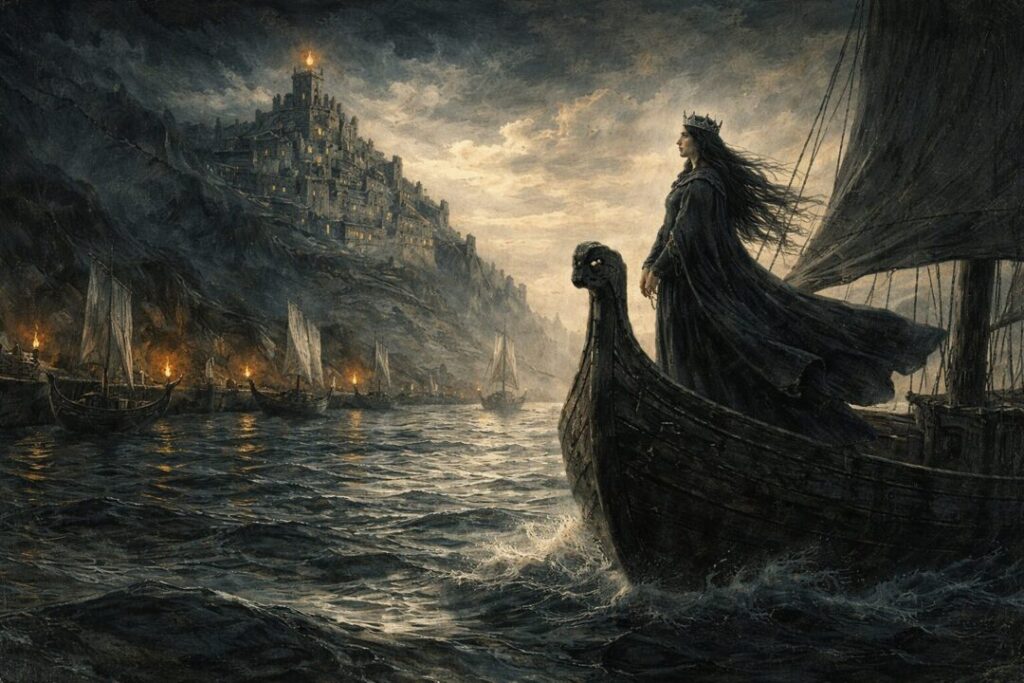
Berúthiel was banished from Gondor and set adrift alone on a ship, sent back toward the southern lands from which she had come. There was no public trial. No attempt at reconciliation. No recorded justification.
Her cats were destroyed—cast into the sea she so despised.
The punishment is chilling in its simplicity.
Berúthiel is not imprisoned.
She is not executed.
She is erased.
Removed from the narrative of Gondor as cleanly as possible.
Why Her Story Feels Unfinished
Berúthiel never appears directly on the page. Her voice is never heard. Her fate after banishment is never recorded.
This absence is deliberate.
Her story is not meant to resolve. It is meant to unsettle.
Unlike villains who are confronted and defeated, Berúthiel is simply removed—and the damage is left implied rather than repaired. We are never told whether Gondor healed fully from the mistrust she fostered.
Because some wounds do not close cleanly.
A Shadow That Lingers
Berúthiel represents a threat Middle-earth rarely places at its center: the slow decay of trust within a society. Surveillance. Isolation. Fear without open violence.
She reminds us that not all evils arrive with fire and shadow.
Some sit quietly in high places.
Some listen.
Some watch.
And when they are gone, the silence they leave behind can be just as troubling as their presence.
That is why Queen Berúthiel lingers in the imagination.
Not because she conquered Gondor—but because, for a time, she changed how its people spoke, thought, and trusted one another.
And that may be the most unsettling legacy of all.
Sources & Notes
- J.R.R. Tolkien, The Lord of the Rings, Book II, Chapter 4, “A Journey in the Dark” — Aragorn’s comparison to “the cats of Queen Berúthiel” shows how firmly her sinister legend survived in Gondor’s memory.
- J.R.R. Tolkien, Unfinished Tales, “The Istari” — the note on Berúthiel gives the main account: her southern origin, hatred of the sea, loveless marriage to Tarannon, spying cats, and banishment.
- J.R.R. Tolkien, The Lord of the Rings, Appendix A, “Gondor and the Heirs of Anárion” — places Tarannon Falastur among Gondor’s Ship-kings and notes that he died childless, framing Berúthiel’s place in the royal line.
- J.R.R. Tolkien, The Peoples of Middle-earth, “The Heirs of Elendil” — preserves development material for Gondor’s kings and the Tarannon/Berúthiel tradition, useful background for the historical setting.