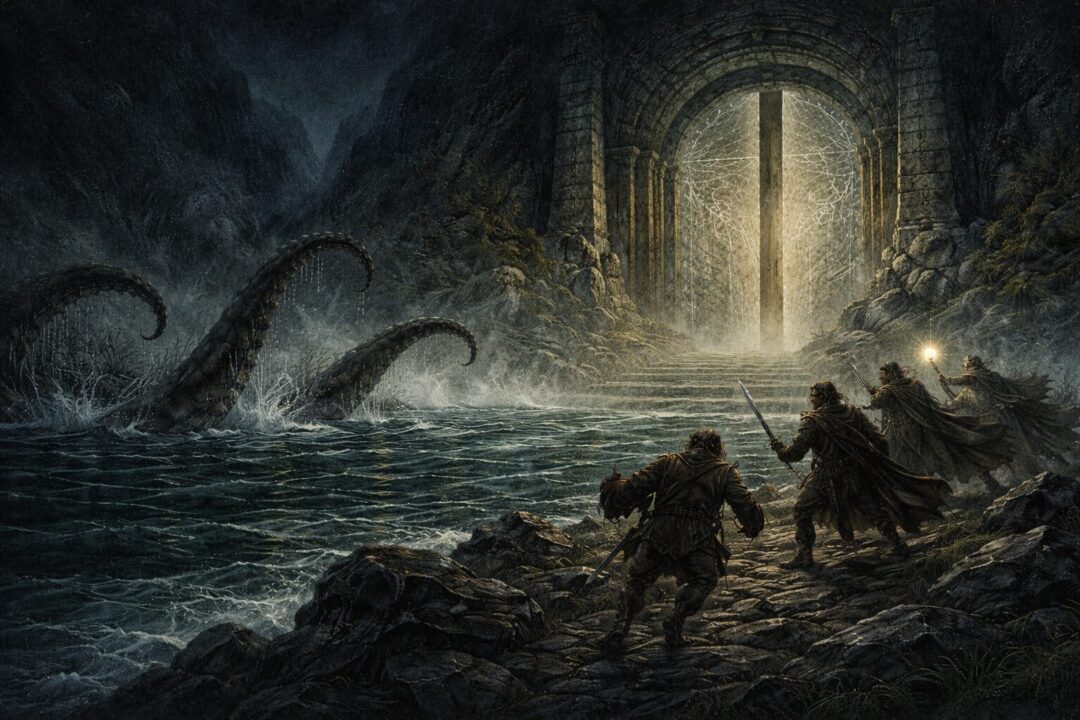
The Watcher in the Water appears suddenly and violently, but Tolkien gives us just enough detail to understand that this moment is not coincidence.
The Fellowship does not stumble into danger by accident. They arrive at the West-gate of Moria expecting difficulty—perhaps a locked door, perhaps pursuit from behind—but not recognition. And yet the Watcher acts with eerie precision, striking immediately, forcefully, and with unsettling purpose.
Most importantly, it does not attack at random.
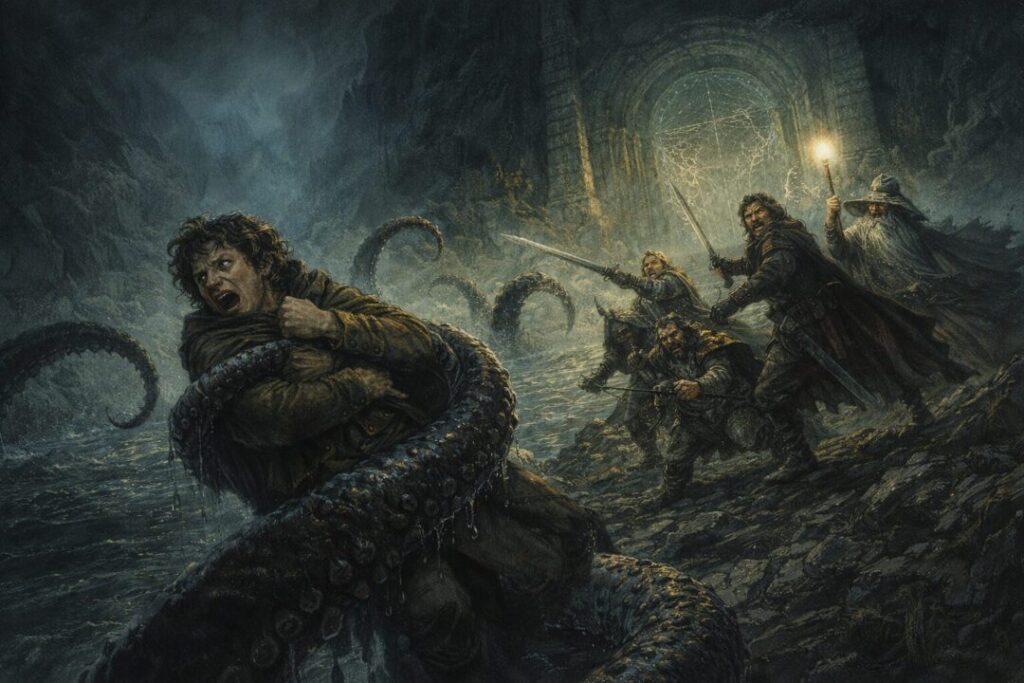
It reaches for Frodo first.
That detail is easy to miss in the chaos of the scene, but it matters. Tolkien is careful with causality, especially when it comes to encounters involving the Ring. Events do not simply “happen.” They are reactions, consequences, responses to deeper forces already in motion.
Nothing in Middle-earth acts without reason.
Once that principle is applied, the question changes. The mystery is no longer what the Watcher did, but why it did it at that exact moment—and why Frodo, above all others, drew its attention.
The Watcher Is Not a Random Monster
Tolkien never explains exactly what the Watcher in the Water is—but he is very deliberate about what it is not.
It is not an Orc.
It is not a Balrog.
It is not a creature that marches in armies or answers openly to a master.
When Gandalf speaks of it, his uncertainty is telling. He does not name it. He does not classify it. He only says that “something has crept, or has been driven, out of dark waters under the mountains.”
That phrasing matters.
The Watcher is not described as a hunter roaming the land. It does not pursue travelers across distance. It does not range far from its pool. Everything about it suggests stillness, patience, and deep-rooted presence.
This is a creature adapted to waiting.
Which means it did not find the Fellowship by chance. The Fellowship came to it—or rather, something they carried entered a range where it could be perceived.
The Watcher does not wake without cause. It responds to disturbance.
Frodo’s Presence in the Unseen World
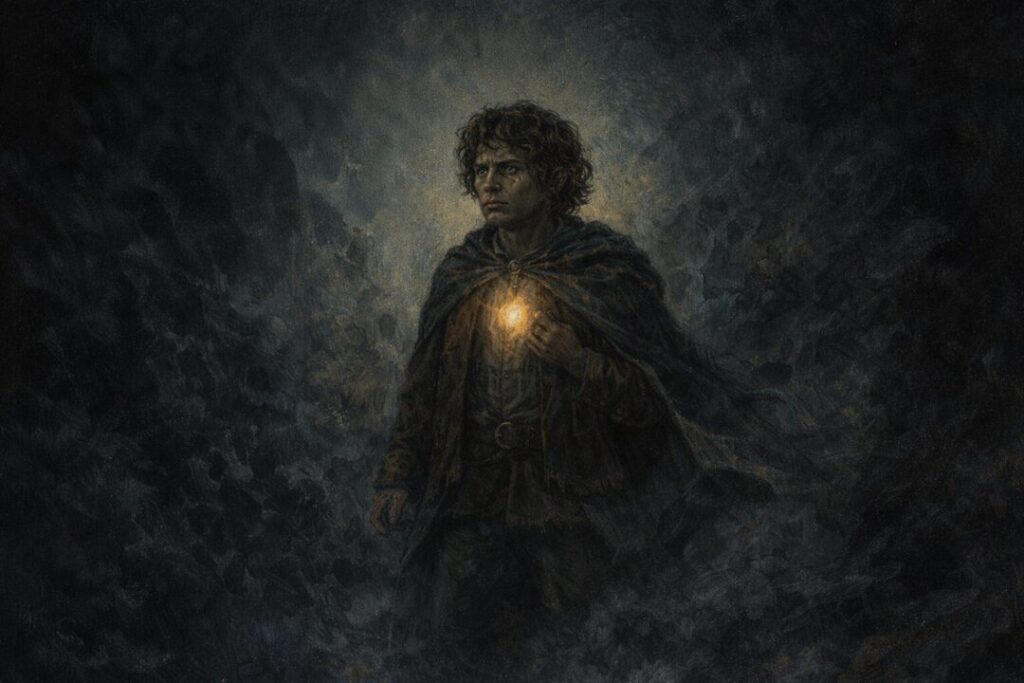
By the time the Fellowship reaches Hollin, Frodo is no longer merely carrying the Ring as a burden on a chain.
He is bearing it.
This distinction matters deeply in Tolkien’s world. The Ring does not only weigh on Frodo physically or emotionally. It changes how he exists. His awareness shifts. His sensitivity increases. And, most importantly, his presence begins to register more strongly in the unseen world—the realm where power, will, and spiritual weight truly operate.
Frodo feels this before he understands it.
He senses the Eye more often.
He feels watched even when no eyes are visible.
He becomes aware of pressure, attention, and threat in places that seem empty to others.
This is why the Nazgûl are drawn to him.
This is why he perceives Glorfindel differently than the rest of the Fellowship.
This is why certain places feel heavier to him than they do to Aragorn or Boromir.
Creatures bound to shadowed, ancient places do not need sight as Men understand it. They sense imbalance. They feel intrusion. They recognize power moving where it does not belong.
The Watcher does not need eyes.
It senses disturbance.
The Pool Before the West-gate
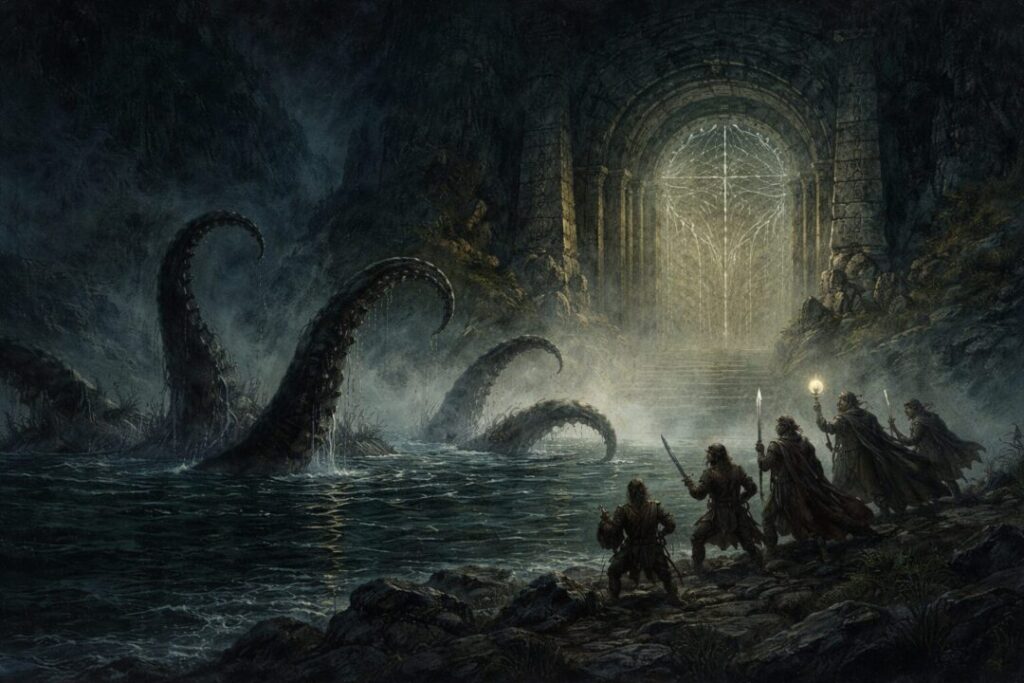
The pool outside the West-gate of Moria is not a natural feature casually placed in the landscape.
It is described as deep, dark, and unnaturally still—lying at the threshold of one of the most ancient and perilous places in Middle-earth. In a region shaped by running water, wind, and open stone, this pool is stagnant, silent, and heavy with age.
Its source matters.
The waters are fed from beneath the mountains, from the same deep roots where ancient things have slept for ages. This is not merely geography. It is proximity. The pool exists at a boundary between the surface world and the buried past.
Durin’s Bane slept not far below.
Old tunnels, forgotten delvings, and lightless depths stretch beneath the stone.
The Watcher’s pool is part of that system—connected, hidden, and isolated.
The Ring has passed near dormant evils before, but rarely in such close confinement. At the West-gate, there is no distance, no buffer, no open road. Frodo steps forward, bringing the Ring into immediate proximity with something ancient, waiting, and sensitive to power.
And something responds.
Why the Watcher Strikes First—and Fails
When the attack comes, the Watcher does not lash out blindly.
It grabs Frodo.
Not Boromir, whose strength is obvious.
Not Aragorn, whose presence is commanding.
Not Gandalf, whose power would be unmistakable to any being capable of perceiving the unseen.
This is not strength-based logic.
It is spiritual logic.
The Watcher reacts to the strongest disturbance—not the strongest warrior. Frodo’s physical smallness is irrelevant. What matters is the signal he carries into the pool’s awareness.
And yet, the Watcher fails.
It cannot hold him.
This is where the scene becomes especially revealing. The Watcher senses something terrible—but it does not understand it. The Ring draws attention, but it does not grant mastery or clarity to those who perceive it. The Watcher is not a servant of Sauron. It is not aligned with his will. It has no purpose beyond its own existence.
It knows only that Frodo does not belong.
That ignorance is why the attack feels desperate rather than controlled. The Watcher lashes out, then retreats when resistance and disruption overwhelm it. Once the doors of Moria close, it withdraws—not defeated, but thwarted.
It has sensed power.
But not power it can claim.
The Watcher’s Withdrawal and What It Means
Once the Fellowship enters Moria and the doors are sealed, the Watcher does not continue the assault. It does not follow. It does not attempt to break through stone or pursue through tunnels.
This is crucial.
If the Watcher were a guardian, it would persist.
If it were a servant, it would pursue.
If it were a hunter, it would adapt.
Instead, it withdraws.
This tells us that the Watcher’s reaction was limited by proximity and perception. It was not responding to a mission. It was responding to contact. Once that contact is severed, its purpose ends.
The danger was not planned.
It was triggered.
A Pattern Tolkien Repeats
This moment fits a broader pattern repeated throughout the story.
Old evils wake when the Ring moves.
Ancient things stir when its bearer draws near.
Not because they are commanded—but because the world itself reacts.
The Ring is not just an object. It is a remnant of a previous age, saturated with will, domination, and unresolved power. When it passes through places shaped by earlier histories, it creates friction.
Caradhras resists the Fellowship.
The Watcher attacks.
Durin’s Bane awakens deeper within Moria.
These are not coordinated responses. They are symptoms.
The world remembers.
Frodo as the Signal
The Watcher is not guarding Moria.
It is reacting to history waking up again.
Frodo does not intend to draw attention. He does not understand what he is signaling. But his role as Ring-bearer makes him a moving fault line between past and present.
Where he goes, dormant things stir.
Not because they know his name.
Not because they understand the quest.
But because the Ring reintroduces power into places that have slept for too long.
And so, at the West-gate of Moria, something ancient reaches out from the dark.
Not in obedience.
Not in strategy.
But in instinct.
And Frodo—whether he knows it or not—is the signal that wakes it.
Sources & Notes
- J.R.R. Tolkien, The Lord of the Rings, Book II, Chapter 4, “A Journey in the Dark” — gives the direct Watcher scene: the dark pool before Moria, Gandalf’s uncertainty about the creature, and Frodo being seized first.
- J.R.R. Tolkien, The Lord of the Rings, Book I, Chapter 12, “Flight to the Ford” — shows Frodo’s growing exposure to the unseen world and his altered perception of figures such as Glorfindel.
- J.R.R. Tolkien, The Lord of the Rings, Book I, Chapter 2, “The Shadow of the Past” — explains the One Ring as Sauron’s own power and will, supporting the article’s reading of the Ring as a signal of spiritual disturbance.
- J.R.R. Tolkien, The Lord of the Rings, Book II, Chapter 5, “The Bridge of Khazad-dûm” — supplies nearby Moria context for ancient powers and nameless terrors in the deep places under the mountains.