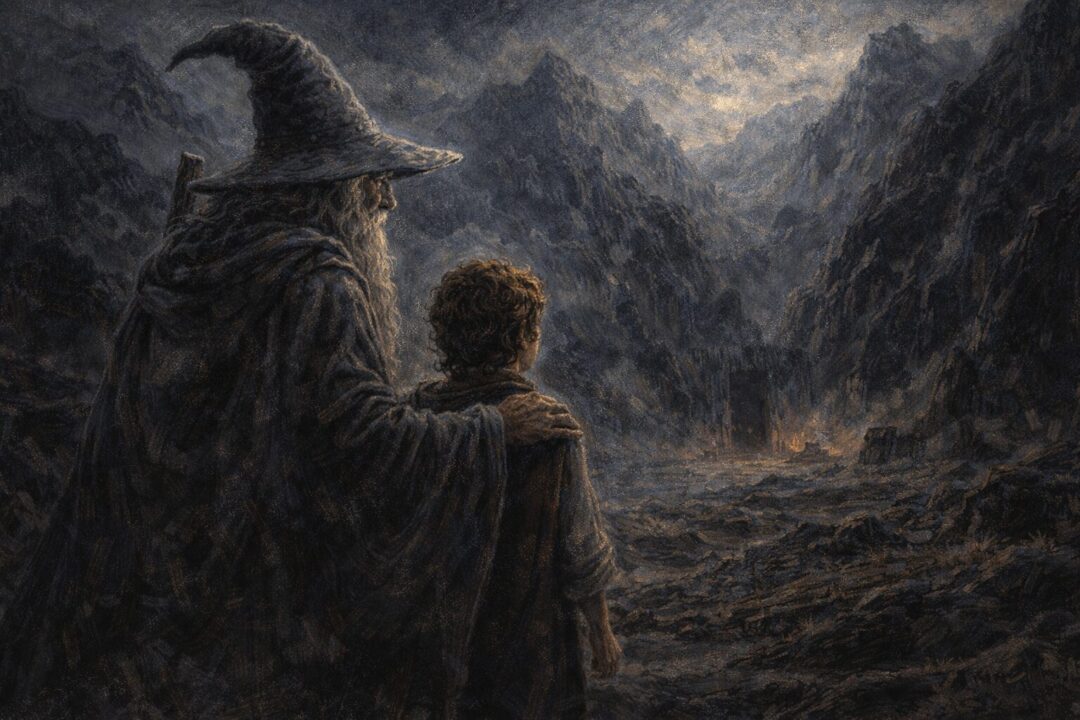
Among the Istari, Gandalf is often described as the least imposing.
He arrives without titles, walks without guards, and speaks with a warmth that can easily be mistaken for softness. Where Saruman surrounds himself with towers, lore, and mechanisms of control, and Radagast retreats into forests and beasts, Gandalf chooses roads, inns, kitchens, and quiet conversations.
This difference is not cosmetic.
It reveals something fundamental about how Gandalf understands the world—and why he alone truly understands Hobbits.
His insight is not sentimental. It is strategic, moral, and deeply tied to how he understands power itself.
Hobbits and the Blindness of the Wise
Most of the powerful beings in Middle-earth overlook Hobbits for the same reason they overlook danger in the Shire: Hobbits do not seek dominion.
They build no empires.
They raise no monuments.
They leave little mark on history as the Wise usually record it.
To the Elves, this makes them charming but irrelevant—pleasant relics of a simpler way of life.
To Men, they are scarcely noticed at all.
To Saruman, they are useful only once they become exploitable.
This blindness is not accidental. It is structural.
The Wise are trained to watch for ambition. They look for rising kings, gathering armies, forbidden knowledge, and growing shadows. Hobbits generate none of these signals. Their lives are oriented inward—toward family, land, food, memory, and routine. From the outside, this appears small.
But Gandalf understands that smallness is not the same as weakness.
The One Ring does not corrupt by force. It corrupts by amplification. It feeds on the desire to rule, to improve the world according to one’s own vision, to impose order where others have failed. Hobbits, by nature, resist this impulse. Their ambitions are local, limited, and deeply embodied. They want good meals, familiar paths, and a tomorrow that looks much like yesterday.
This makes them unusually resistant to the Ring’s most seductive promises.
Gandalf does not idealize this trait. He knows Hobbits can be narrow-minded, fearful, and resistant to change. But he also sees what others miss: that their lack of hunger for domination is a form of moral armor.
Gandalf’s Long Study of the Shire
Gandalf’s understanding of Hobbits is not theoretical.
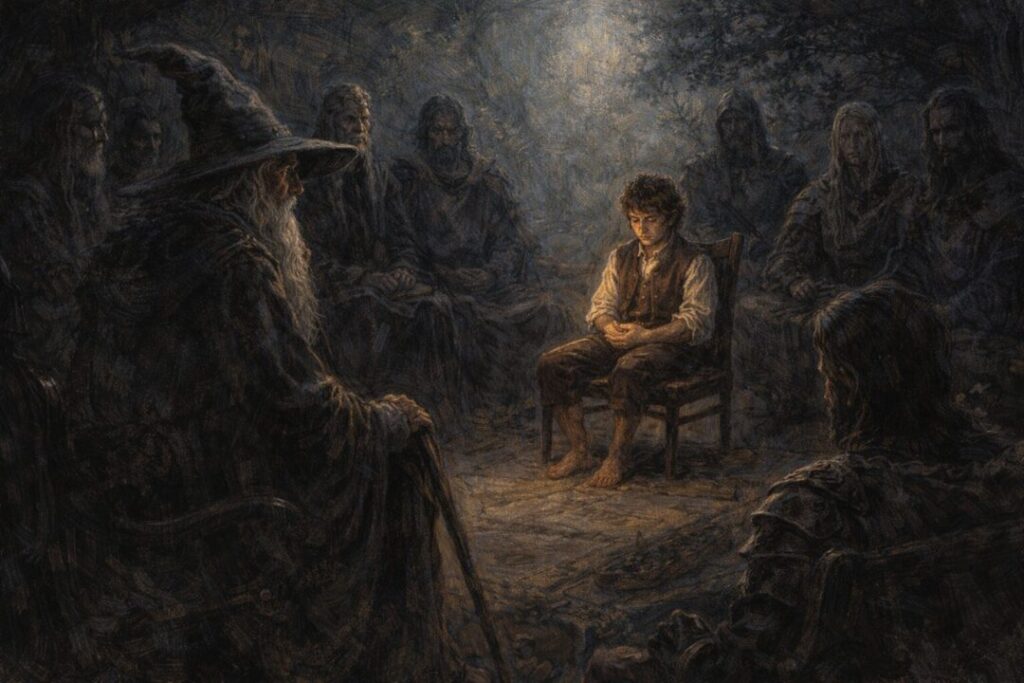
Unlike Saruman, who studies from above, Gandalf studies from within. He walks the lanes of the Shire for decades. He watches children grow into adults and adults into elders. He notices which families value generosity over respectability, which Hobbits remain curious about the wider world, and which possess a stubborn endurance that does not announce itself loudly.
He listens.
This matters more than it seems.
The Shire is often dismissed as static, but Gandalf knows it is quietly resilient. It absorbs change without being defined by it. Wars pass beyond its borders. Empires rise and fall elsewhere. The Shire endures not because it is hidden, but because it does not tempt conquest. There is little to gain and much that would be spoiled by interference.
Gandalf sees this as wisdom embedded in culture rather than doctrine.
This is why Bilbo Baggins captures his attention long before the Ring is revealed. Bilbo is not heroic in the conventional sense. He is uncomfortable with danger, reluctant to leave home, and painfully aware of his own limits. And yet, he is curious without being grasping, generous without being naïve, and—most importantly—capable of pity even when it costs him.
When Bilbo spares Gollum, Gandalf recognizes something essential. This is not cleverness or courage. It is moral perception: the ability to see another being as more than a problem to be solved.
These qualities cannot be taught quickly. They must be lived into.
The Ring and the Psychology of Power
Saruman understands the Ring’s mechanics. He knows its history, its forging, and its place within the larger structures of power in Middle-earth. What he does not understand is its psychology.
He assumes that power must be countered with greater power. That domination can only be opposed through mastery of the same tools. From this assumption flows his entire strategy: industrialization, surveillance, coercion, and eventually imitation of the very enemy he claims to oppose.
Hobbits do not fit into this framework.
Saruman studies them only after they become inconvenient. And even then, he reduces them to resources—land to be seized, pipe-weed to be exploited, labor to be broken. He never truly sees them as agents capable of moral resistance.
This is his fatal miscalculation.
Gandalf understands that domination begins with contempt. The moment you believe someone is beneath notice, you stop guarding against them. You stop imagining that they might choose sacrifice over survival, destruction over mastery.
The Ring is not destroyed because Sauron is overpowered. It is destroyed because he cannot conceive of a being who would willingly unmake the greatest source of power ever offered to them.
Gandalf can conceive of this—because he has seen it, in small ways, again and again.
Why Gandalf Refuses the Ring
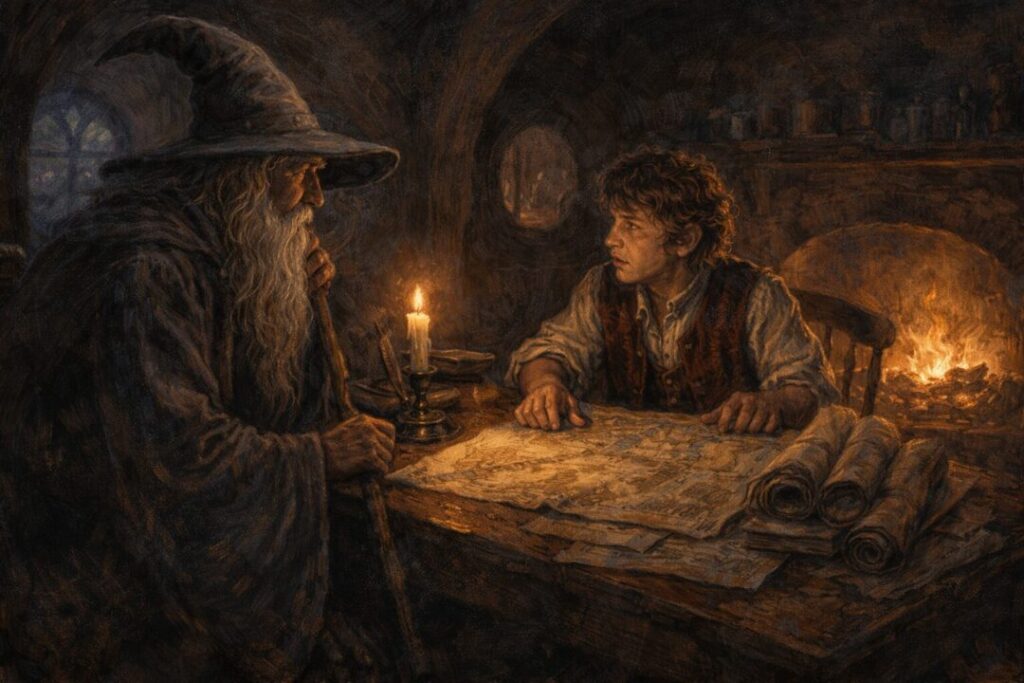
One of the most revealing moments in the story occurs when Gandalf refuses to take the Ring from Frodo.
His explanation is brief, but devastatingly honest. He knows himself too well. He knows that his desire to do good would make him dangerous. Through him, the Ring would wield righteousness as a weapon.
This self-knowledge is inseparable from his understanding of Hobbits.
Hobbits do not desire to reshape the world. They want the world to leave them alone. Their instinct is preservation, not transformation. This makes them uniquely capable of bearing a burden that would corrupt anyone whose identity is tied to leadership, reform, or salvation.
It is not that Hobbits are purer. It is that their sense of self is less bound up with control.
Gandalf understands that resisting the Ring is not about strength of will alone. It is about the shape of one’s desires. Hobbits desire stability, continuity, and belonging. These desires blunt the Ring’s sharpest hooks.
The Wizard Who Walked Beside, Not Above
Gandalf never rules Hobbits.
He advises, warns, provokes, and occasionally manipulates—but he does not command. He does not build institutions in the Shire or appoint himself its guardian. Even when he knows danger is coming, he allows Hobbits to make their own choices, including the choice to misunderstand him.
This is not negligence. It is restraint.
By treating Hobbits as moral agents rather than pawns, Gandalf ensures that their actions remain freely chosen. And it is precisely this freedom that weakens the Ring’s hold. The Ring thrives on domination—both given and received. Where obedience replaces agency, its influence deepens.
Gandalf understands that coercion, even in the name of good, would only replicate the Ring’s logic.
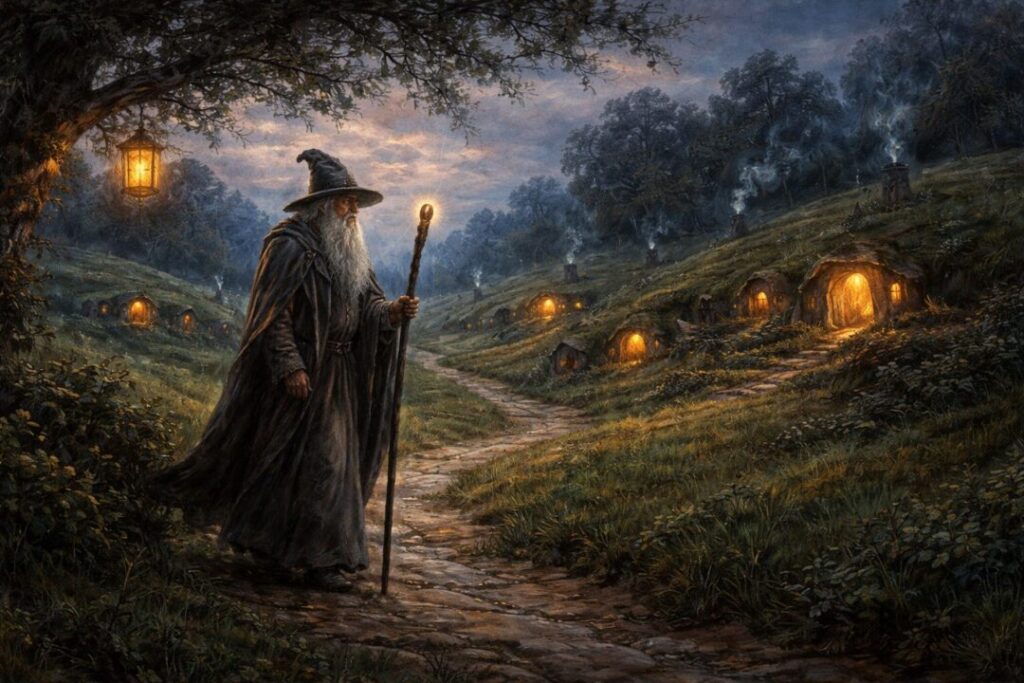
This is why he walks beside Hobbits rather than above them. Why he eats their food, sleeps under their roofs, and speaks to them as equals. In doing so, he affirms something radical: that the fate of the world does not belong exclusively to the powerful.
Small Hands, World-Shaping Choices
The War of the Ring is often framed as a clash of armies and ancient powers. But its outcome hinges on decisions made far from thrones and battlefields.
It hinges on Frodo Baggins choosing to carry a burden he does not fully understand.
On Samwise Gamgee choosing loyalty over despair.
On mercy extended where vengeance would be easier.
Gandalf does not orchestrate these choices. He creates the conditions in which they can occur.
He understands that history is not only shaped by those who seek to shape it. Sometimes it is shaped by those who simply refuse to become what the world demands of them.
Why This Understanding Matters
Gandalf’s insight into Hobbits reveals something deeper about Middle-earth itself.
Evil does not always advance through overwhelming force. Often it advances through the quiet erosion of humility, the belief that some lives matter less, and the assumption that power must always be met on its own terms.
Gandalf resists this logic.
He places his hope not in the strongest, the wisest, or the most prepared—but in those least likely to seek domination for themselves. This choice appears foolish to many. It nearly fails. And yet, it succeeds in a way no other strategy could.
The fate of Middle-earth is not decided by the Wise acting alone.
It is decided because one of them understood when not to act—when to trust small hands with great consequences.
And among all the Istari, only Gandalf truly understood why that mattered.
Sources & Notes
- J.R.R. Tolkien, The Lord of the Rings, Prologue, “Concerning Hobbits” — frames Hobbits as quiet, unambitious folk often overlooked by the great powers of Middle-earth.
- J.R.R. Tolkien, The Hobbit, Chapter 1, “An Unexpected Party” — Gandalf’s choice of Bilbo shows his long, personal knowledge of Shire-folk and his sense for hidden courage beneath ordinary habits.
- J.R.R. Tolkien, The Lord of the Rings, Book I, Chapter 2, “The Shadow of the Past” — Gandalf explains the Ring’s danger, refuses to take it, and stresses Bilbo’s pity for Gollum as morally decisive.
- J.R.R. Tolkien, The Lord of the Rings, Book II, Chapter 2, “The Council of Elrond” — Frodo’s free acceptance of the Ring-burden supports the article’s contrast between humble agency and power-seeking strategies.
- J.R.R. Tolkien, Unfinished Tales, “The Istari” — distinguishes Gandalf’s mission and temperament from Saruman and Radagast, especially his pity, patience, and refusal to dominate by force.