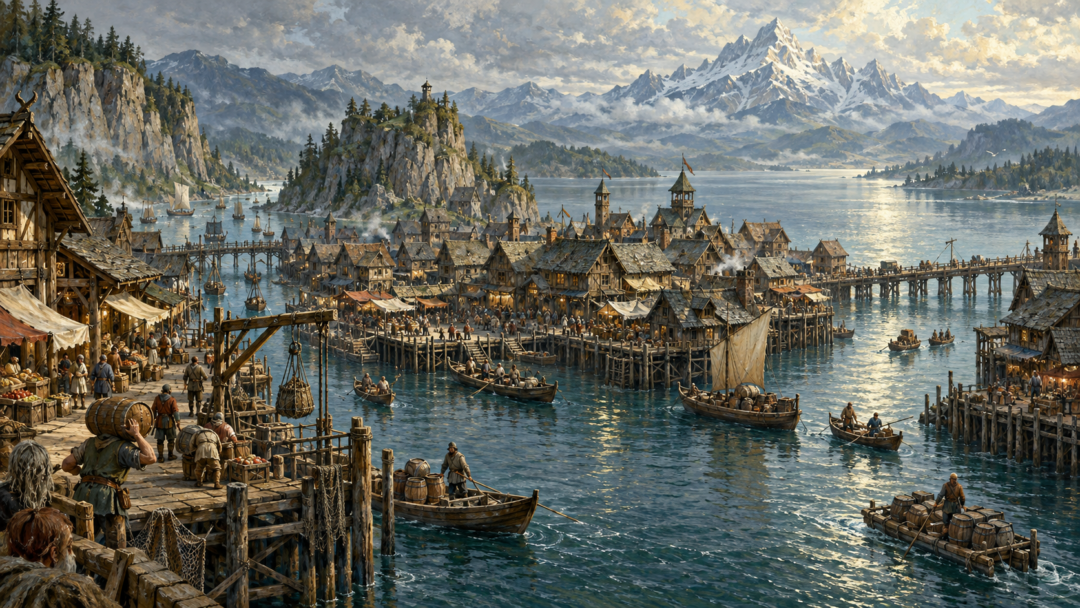
When Bilbo Baggins first reached Lake-town, he found something remarkable: a settlement standing out upon the waters of the Long Lake, supported by wooden piles driven into its bed. Boats moved between the town and the shore, merchants carried goods, and the people lived above the very water that connected them to the wider world.
It was an extraordinary place to build a trading town. It was also an extraordinarily vulnerable place to face a dragon.
The same wooden structures that helped Lake-town prosper would become a terrible weakness when Smaug descended from the Lonely Mountain. Its piles raised the settlement above the lake, its platforms supported everyday life, and its water approaches made commerce possible. Yet the town itself remained largely a construction of timber, exposed to an enemy whose most devastating weapon was fire.
The tragedy of Lake-town was not simply that Smaug could burn buildings. It was that the town's practical relationship with water offered no reliable protection against an attack from the sky.
A Town That Stood Upon the Lake
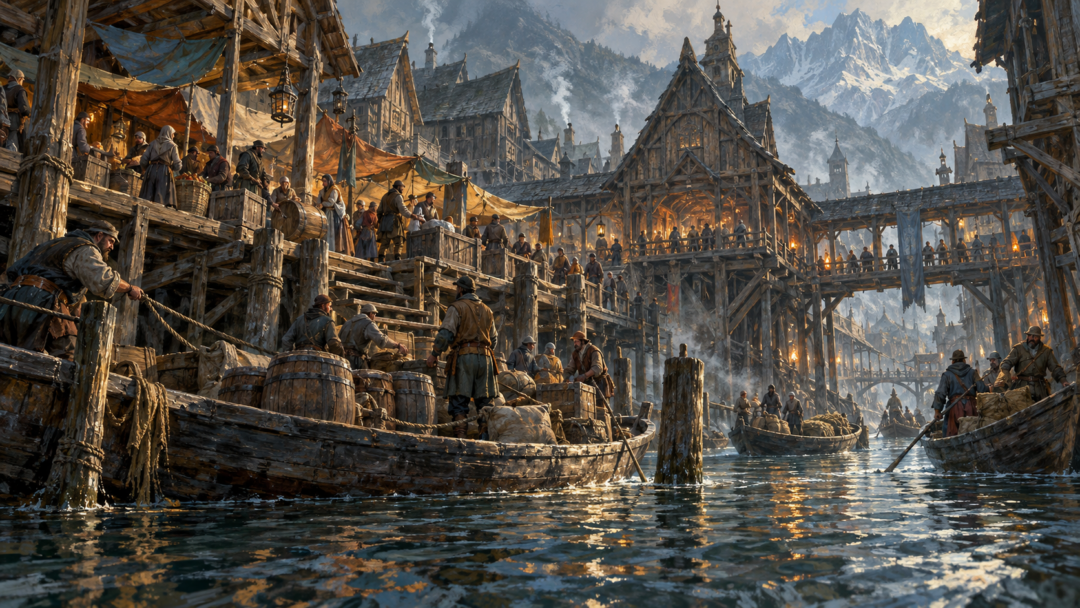
In The Hobbit, particularly the chapter "A Warm Welcome," Lake-town is introduced as a community whose physical arrangement is inseparable from its livelihood.
The settlement stood on wooden piles driven into the lakebed, with a great wooden bridge connecting it to the shore. Its houses, public spaces, and streets belonged to a built environment supported above the water rather than spread across ordinary dry ground.
At the center of the town was a broad space associated with the Master's great house. Lake-town was therefore more than a scattering of fishermen's huts. It possessed the organization and communal spaces of a substantial settlement.
Its location also mattered.
The Long Lake received the River Running, which flowed south from the region of the Lonely Mountain, while the Forest River entered from the west. These waterways connected the town with important regions of the North, including the lands around Erebor and the Woodland Realm.
The wooden piles made occupation of this watery position possible. They provided a stable foundation for buildings and public movement while leaving the settlement directly connected to its surrounding waters.
That was the essential advantage.
Lake-town did not need to stand beside the lake and merely look out upon it. Its inhabitants could live in close contact with the routes by which people and goods arrived.
The text does not provide an engineering plan showing every pile, landing, or platform, or record the original builders’ precise reasons for choosing this arrangement. But its description makes the fundamental arrangement clear: this was a town whose wooden foundations supported a community built around access to water.
And access to water was access to trade.
Why Boats Were the Lifeblood of Lake-town
By the time of Thorin Oakenshield's return, it remained a place where merchants, boatmen, and traders could conduct business. Its relationship with the Elves of the Woodland Realm was especially important.
In "A Warm Welcome," Bilbo and the Dwarves reach Lake-town by traveling down the Forest River after escaping the Elvenking's halls in barrels. Their unusual journey follows a genuine commercial route.
Barrels were transported along the river, and the movement of goods between the Elvenking's people and Lake-town was an established part of regional life.
Goods could travel by water through the forest and arrive at the lake settlement. From there, connections extended toward other communities and trading routes.
Water transport could carry substantial cargo without requiring every load to cross the difficult surrounding landscape by road.
The narrative does not specify exactly how all cargo was unloaded or distributed through Lake-town. Nevertheless, the relationship between its boats, bridge, wooden platforms, and buildings suggests a settlement designed to accommodate frequent movement between water and inhabited space.
When Smaug Turned the Town's Strength Against It
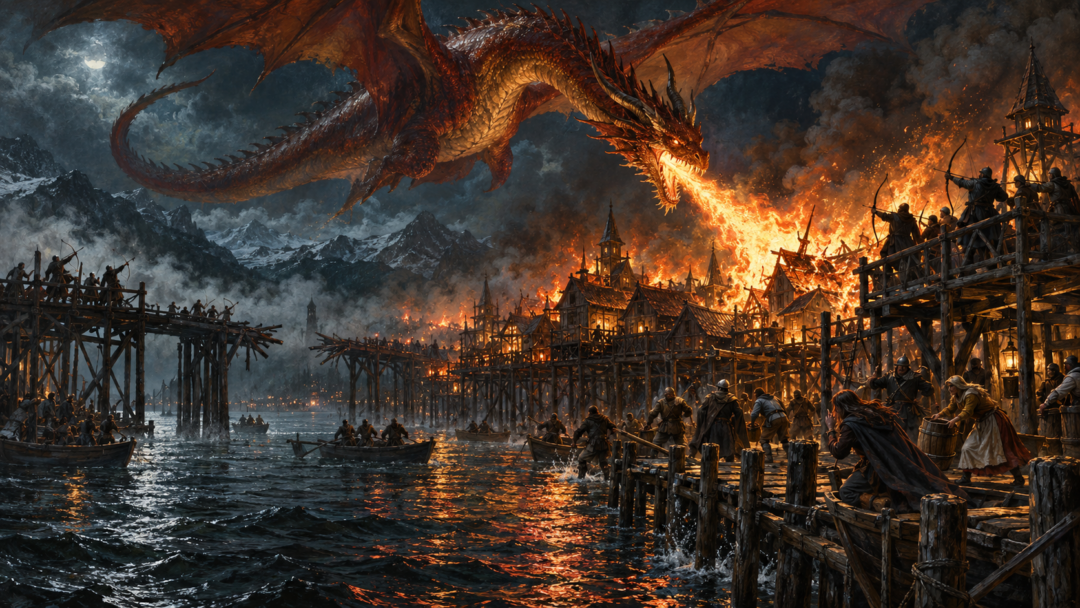
The attack described in "Fire and Water" transforms Lake-town's familiar surroundings into the setting of a disaster.
Smaug approaches from the north, furious after discovering that the intruders at the Mountain have escaped his immediate reach. His anger turns toward the lake settlement.
Lake-town’s inhabitants do not respond with helpless panic. The people prepare to defend their town, and the narrative describes efforts to meet the dragon with arrows and to resist the danger of fire.
Smaug, however, is an enemy for whom ordinary defenses are painfully inadequate.
He can fly over the water. He can attack from above. He can direct fire against wooden structures without needing to cross the bridge or approach the town like a conventional army.
Against an enemy advancing on foot, the water surrounding a settlement might complicate an assault. An attacker would need some means of reaching the occupied structures.
Against Smaug, that obstacle barely matters.
And once his fire reaches the wooden town, the very material that makes its elevated construction possible becomes fuel.
The narrative depicts the spread of burning and the destruction of the settlement. Its inhabitants face not just an attacking creature but the rapid loss of the built environment beneath and around them.
Why the Lake Could Not Save the Town
There is a bitter irony in a wooden town burning while surrounded by water.
At first glance, the lake seems to offer a natural defense against fire. Water is close at hand, and boats provide a way to escape.
Yet proximity to water is not the same as effective protection.
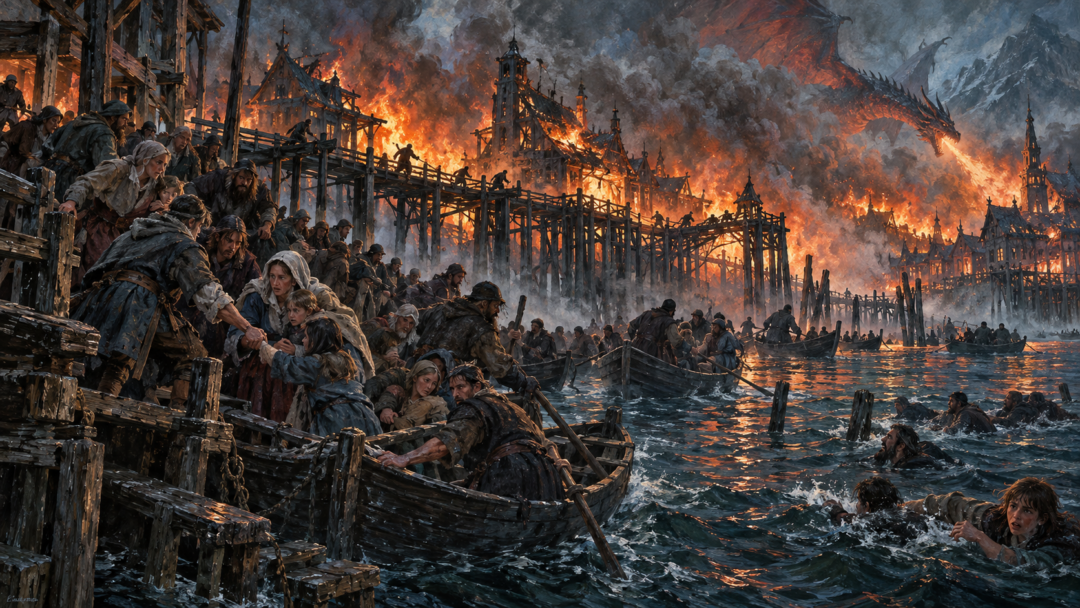
The inhabitants of Lake-town had to contend with flames striking buildings and structures above the lake's surface. Water beneath a floor could not automatically extinguish a burning roof, wall, or wooden walkway.
Nor could the inhabitants safely treat the lake as an unlimited firefighting resource while a dragon continued attacking from overhead.
The story does not describe a formal fire brigade, a standardized emergency plan, or a detailed system of water pumps. It would be misleading to invent any of these.
What it does show is that the townspeople attempted to defend their homes, while Smaug's fire overwhelmed the settlement.
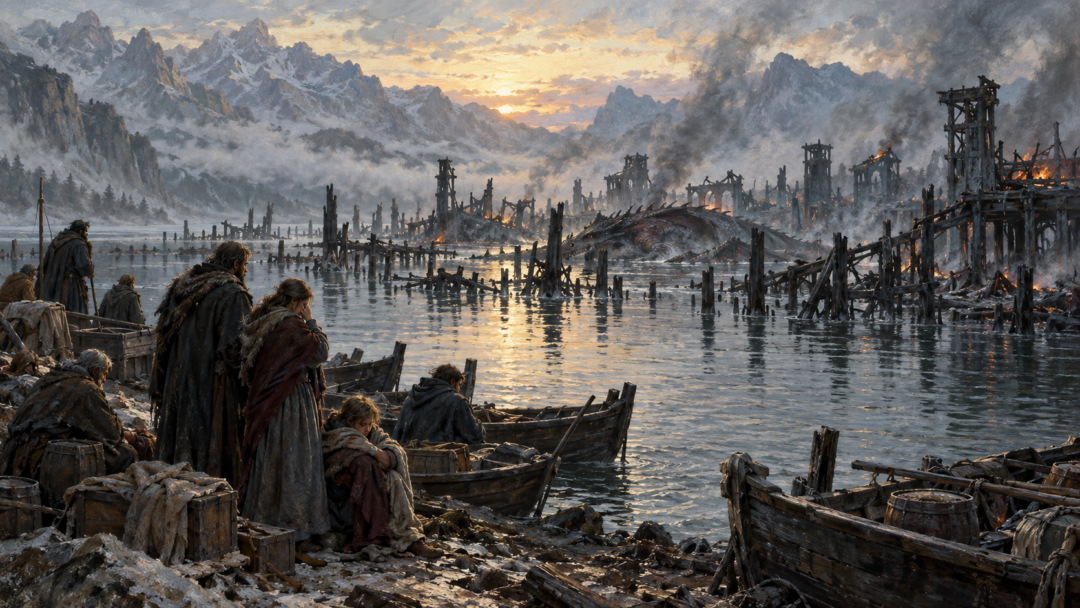
As the wooden town burned, the spaces that ordinarily enabled movement became dangerous.
A bridge, platform, or street is useful only while it remains passable. Once fire reaches a connected wooden environment, routes that normally join a community together can become hazardous or unusable.
This does not mean every structure burned in an identical sequence. The narrative supplies no precise reconstruction of the fire's progress.
The inhabitants lived upon combustible structures above deep water. When those structures failed, remaining in place became increasingly dangerous.
The lake offered escape, but not everyone could reach safety without loss.
Boats, which had carried trade and passengers in ordinary times, became crucial to survival. People also entered the water as the town was destroyed.
The same waters that had sustained Lake-town's prosperity now received its fleeing inhabitants.
That is the central contradiction of the disaster: the lake was a source of livelihood and a possible refuge, but it could not preserve the town built above it.
Bard's Victory Did Not Prevent the Destruction
As the dragon attacks, Bard remains in the fight. With the knowledge of Smaug's vulnerable spot brought by the thrush, he uses his last arrow to strike the dragon.
Smaug’s falling body crashes into Lake-town, completing the catastrophe already unleashed by his fire.
Bard defeats the enemy, but the victory comes too late to preserve the town.
The inhabitants survive in part because they can escape into or across the surrounding water. Yet they lose homes, possessions, and the familiar physical setting of their community.
The lake remains. The commercial routes remain geographically possible. The dragon is dead.
But the wooden town that had joined those elements into a functioning settlement is gone.
The Hidden Cost of Living Above the Water
The settlement was not an accidental collection of buildings waiting to be destroyed. It was a working community adapted to a particular place.
Its wooden piles made life above the lake possible. Its bridge and boats connected that life to the shore, the rivers, the forest, and the wider northern trading world.
Yet the town's architecture also concentrated its homes and public spaces in a combustible environment that Smaug could reach directly from the air.
The water that made commerce convenient could not stop dragon fire from above. The boats that brought goods became means of escape. The wooden platforms that supported daily life became part of the disaster.
Lake-town was not foolish simply because it was built of wood. Its inhabitants had made a life in a location that offered real opportunities, and the story gives no reason to assume they had designed it with a dragon's aerial assault in mind.
What made the town useful in ordinary life could not protect it from an extraordinary enemy.
And when Smaug fell, he destroyed not only a settlement but the material foundation of a way of life.
That is why Lake-town's piles matter. They explain both how a community could prosper upon the Long Lake and why, when fire descended from the sky, the water beneath its feet was not enough to save it.
Sources & Notes
- Tolkien Gateway — Lake-town (Esgaroth). https://tolkiengateway.net/wiki/Esgaroth
- Tolkien Gateway — A Warm Welcome. https://tolkiengateway.net/wiki/A_Warm_Welcome
- Tolkien Gateway — Fire and Water. https://tolkiengateway.net/wiki/Fire_and_Water
- Tolkien Gateway — Long Lake. https://tolkiengateway.net/wiki/Long_Lake
- Tolkien Gateway — River Running (Celduin). https://tolkiengateway.net/wiki/Celduin
- Tolkien Gateway — Forest River. https://tolkiengateway.net/wiki/Forest_River
- Tolkien Gateway — Smaug. https://tolkiengateway.net/wiki/Smaug
- Tolkien Gateway — Bard the Bowman. https://tolkiengateway.net/wiki/Bard
- Tolkien Gateway — The Hobbit. https://tolkiengateway.net/wiki/The_Hobbit
Primary text: The Hobbit, and specifically its tenth chapter, 'A Warm Welcome', the episode in which Bilbo and the Dwarves arrive at Lake-town, and its fourteenth chapter, 'Fire and Water', which describes the dragon's attack on the town and Bard's shot. Tolkien Gateway's chapter entry for 'A Warm Welcome' fixes the scene the article's first half rests on: following 'Barrels Out of Bond' and preceding 'On the Doorstep', Thorin and Company come down the Forest River to the Long Lake and reach Lake-town, 'a small collection of huts and buildings built on stilts over the water', where the ruins of a bigger town are seen rotting along the shores, and they stay about two weeks (dated 22 September - c. 6 October T.A. 2941) before leaving for the Lonely Mountain. Its 'Fire and Water' entry fixes the attack sequence the article's second half rests on: the town's people prepared for the fire 'with vessels of water or readying their boats to escape', Smaug first destroyed the bridge to land so that the people were stranded on the island, the archers under Bard could not bring him down until a thrush revealed the bare patch on the dragon's breast, and Bard then shot him with the Black Arrow, Smaug falling directly on Lake-town. Tolkien Gateway's Lake-town (Esgaroth) entry supplies the architecture the article explains: the town 'was constructed entirely of wood and stood upon wooden pillars sunk into the bed of the Long Lake, as a protection against enemies, especially the dragon Smaug who dwelt nearby in the Lonely Mountain'; a long wooden bridge connected the town to the land, with guards at its landward head, gates at its lakeward end, and a bridge that 'could be thrown down to protect the town'; the market-place held a round pool linked to the lake by a waterway for boats and was surrounded by wooden quays with steps and ladders down to the water, with the greatest houses, including the Great House of the Master, around it. The same entry records that in T.A. 2941 the town was attacked by Smaug and set on fire by his breath, that Bard slew the dragon with the Black Arrow while the wrecked town burned and Smaug fell dead on it and sank in the lake, and that at least three quarters of the inhabitants escaped to the lakeshore. Tolkien Gateway's Long Lake entry grounds the geographic setting: the lake lay south of the Lonely Mountain and Dale, was fed by the Forest River and the River Running, had Lake-town on its western shore near the mouth of the Forest River, and in T.A. 2941 became the grave site of Smaug. Its River Running (Celduin) entry grounds the trade geography the article describes: a 600-mile river pouring out of the Front Gate of the Lonely Mountain, swirling around Dale, turning to the Long Lake, and continuing south-east to the Sea of Rhûn, with the Forest River named as one of its three tributaries flowing into the Long Lake from the west. Its Forest River entry grounds the route by which the Dwarves actually reached the town, and the commercial character of that route: the river met the River Running at Esgaroth, and 'the river was used by the Raft-elves to carry their goods', the same waterway the Dwarves used to escape in barrels. Tolkien Gateway's Smaug entry establishes the nature of the threat: Smaug was the greatest fire-breathing dragon of the Third Age, winged, who had attacked the Lonely Mountain and Dale in T.A. 2770 and was slain by Bard in T.A. 2941 - an enemy able to reach a lake-borne town from the air rather than across the water. Its Bard entry covers the defender: Bard was a descendant of Girion, the last Lord of Dale, living in Lake-town when Smaug attacked; when he recognised that the dragon was coming he ran to the Master and 'shouted to cut the bridges and to get arms', he cheered on the archers and 'held out with a great yew bow in the burning town' as captain of a company of archers, and he inherited the black arrow from his ancestors which had never failed him. The Hobbit entry supplies the work itself - Tolkien's 1937 novel, following Bilbo's quest and containing both chapters on which this article depends. Together these sources cover the article's whole argument: why the wooden piles were built over the Long Lake, how boats, bridge and river traffic made the town a trading place, and why the same timber, reachable from above by a fire-breathing dragon, turned a commercial advantage into the mechanism of the town's destruction.