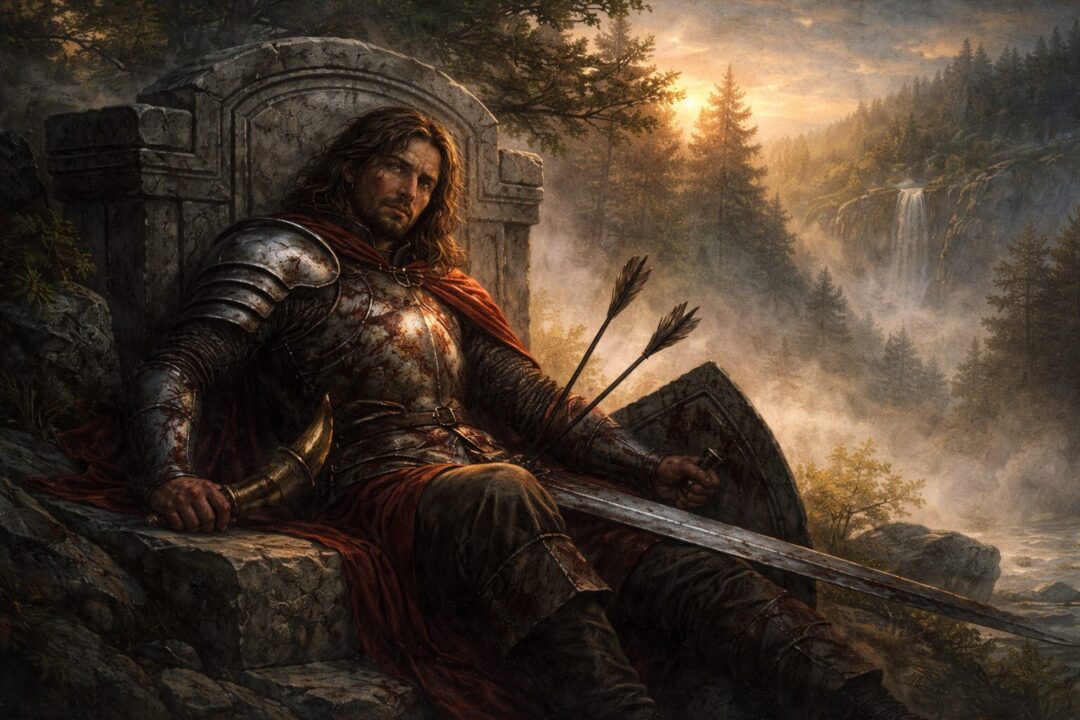
Boromir’s death is often remembered as a necessary redemption—a tragic but clean resolution to his struggle with the Ring. He fails, repents, and dies defending the innocent. The moral ledger feels balanced. His last moments are brave. His intentions are purified by sacrifice. The story seems to close the book on his inner conflict.
But Middle-earth is rarely that simple.
In The Lord of the Rings, death does not merely end a character’s arc; it redirects the fate of nations. To ask what would have happened if Boromir had survived is not to imagine a triumphant alternative timeline where everything goes better. It is to confront how fragile Gondor truly was—and how narrowly it avoided collapse from within as much as from without.
Boromir’s death removes a pressure point from the story. His survival would have intensified it.
Boromir Was Gondor’s Strength… and Its Risk
Boromir was not merely a warrior or a companion in the Fellowship. He was the living embodiment of Gondor in the late Third Age: proud, embattled, weary, and increasingly desperate.
Unlike his brother Faramir, Boromir was shaped by constant war. He had grown up watching Gondor lose ground year by year, retreating inch by inch before the pressure of Mordor. He had fought in the ruins of Osgiliath. He had heard the horn calls from the Anduin grow fewer. To Boromir, restraint did not look like wisdom—it looked like surrender delayed.
This is why the Ring spoke to him so powerfully.
It did not promise domination for its own sake.
It did not whisper visions of tyranny or cruelty.
It promised defense.
It promised walls that would not fall.
Armies that would not break.
A future where Gondor would not have to fade quietly into memory.
Boromir’s desire was not to rule the world. It was to save his own.
Had Boromir lived, he would not have shed that desire. He would have carried it back with him—sharpened by guilt, justified by survival, and reinforced by the knowledge that such power truly existed.
The Ring Would Not Have Let Him Rest
Even without possessing the Ring, Boromir knew too much.
He knew of its origin.
He knew of its potential.
He knew that somewhere beyond his reach, a weapon existed that might decide the fate of the war.
In Tolkien’s world, knowledge itself can be a burden—and sometimes a corruption.
Gondor at this point was already stretched beyond endurance. Denethor ruled not through hope, but through force of will. Supplies were dwindling. Allies were distant or unreliable. Every delay felt like betrayal by fate itself.
In such an atmosphere, Boromir’s arguments would have sounded not reckless, but reasonable.
Why should Gondor bleed while others gamble on secrecy?
Why should its soldiers die while a power capable of changing everything was deliberately withheld?
Why should Gondor trust in patience when time was its greatest enemy?
The Ring does not corrupt only through desire. It corrupts through logic.
Boromir’s survival would not have brought immediate disaster. There would have been no sudden betrayal, no dramatic seizing of power. Instead, there would have been pressure—constant, persuasive, incremental—pushing Gondor closer to a catastrophic choice.
Aragorn’s Claim Would Have Grown More Difficult
Boromir’s death clears the path for Aragorn in ways that are easy to overlook.
Alive, Boromir would not have openly opposed Aragorn. He was honorable, loyal, and capable of recognizing true authority. But neither would he have stepped aside easily. He was, in practice, the Steward’s heir in all but name. Gondor’s soldiers followed him instinctively. His leadership was proven not by lineage, but by years of command under fire.
Aragorn’s legitimacy depends not only on blood, but on timing.
Gondor had to reach a moment of absolute crisis before it could accept a king who represented renewal rather than endurance. Boromir’s continued presence would have delayed that reckoning. As long as Gondor still had a champion who embodied its old identity—defiant, martial, proud—it could postpone the deeper transformation Aragorn represented.
Boromir’s survival might have strengthened Gondor’s resistance. But it might also have prevented Gondor from becoming something new.
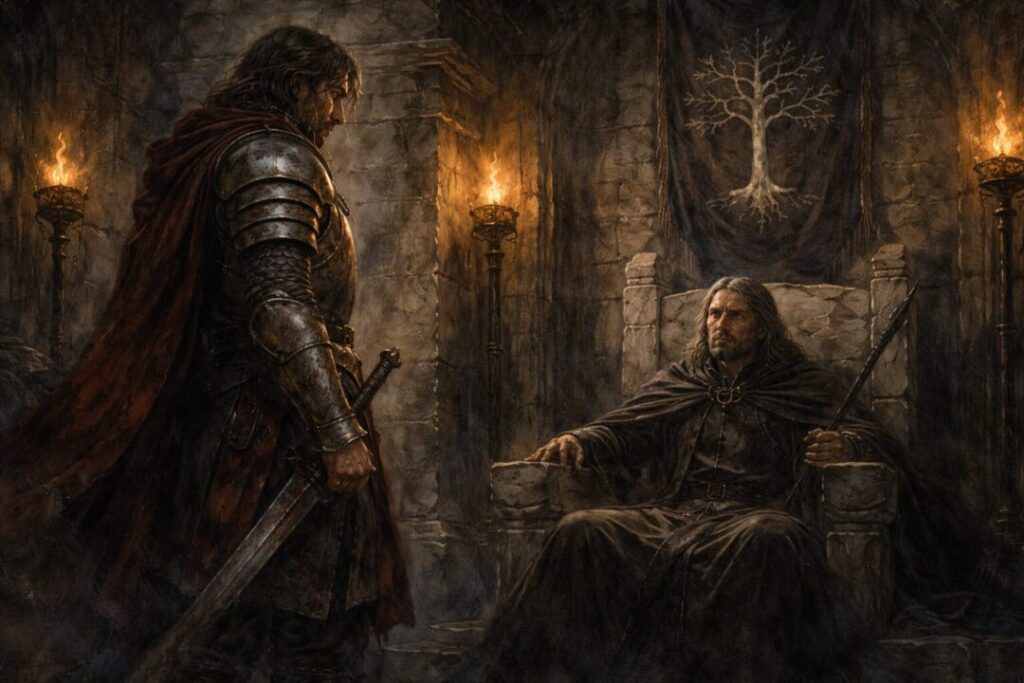
The Subtle Divide Between Boromir and Faramir
The contrast between Boromir and Faramir is often reduced to temptation versus resistance. But the difference is deeper than that.
Faramir understands that some victories are worse than defeat. Boromir believes that survival itself justifies risk.
Had Boromir lived, the brothers would have stood on opposite sides of Gondor’s greatest moral question—not as enemies, but as competing visions of duty. One rooted in preservation at all costs. The other in obedience to a higher moral order, even when that order appears impractical.
That division would not have torn Gondor apart overnight. But it would have weakened it precisely when unity mattered most.
Gondor Might Have Fallen… Later
This is the hardest truth to accept.
Boromir’s survival could have improved Gondor’s fortunes in the short term. Better battlefield leadership. Stronger morale. Perhaps even decisive victories against Mordor’s forces.
But victories purchased through the Ring—or even through the hope of the Ring—would have hollowed Gondor from within.
Sauron does not need cities to burn if wills can be bent. He does not need conquest if corruption can accomplish the same end more quietly.
Boromir’s death removes the last credible advocate for using the Ring among Men. Without him, the moral line holds. With him alive, that line blurs—not through malice, but through love of country.
Gondor survives the War of the Ring not because it grows stronger, but because it chooses humility at the final hour. It accepts help. It accepts renewal. It accepts that salvation will not come through force of arms alone.
Boromir, tragically, was not made for that choice.
Why Boromir Had to Die
Boromir’s death is not a punishment. It is a release.
It frees Gondor from the temptation to save itself by any means necessary. It frees Aragorn to step forward not as a rival, but as a healer and restorer. And it frees Boromir himself from a conflict that would otherwise have consumed him slowly and painfully.
His survival might have preserved his life—but it might have cost Gondor its soul.
And that is why his death, heartbreaking as it is, may have saved far more than one man.
It may have saved an entire kingdom from winning the war the wrong way.
Sources & Notes
- J.R.R. Tolkien, The Lord of the Rings, Book II, Chapter 2, “The Council of Elrond” — Boromir argues for using the Ring as a weapon for Gondor, while Elrond and Gandalf reject that hope as perilous.
- J.R.R. Tolkien, The Lord of the Rings, Book II, Chapter 10, “The Breaking of the Fellowship” — shows Boromir’s temptation, attempted seizure of the Ring, repentance, and death defending Merry and Pippin.
- J.R.R. Tolkien, The Lord of the Rings, Book IV, Chapter 5, “The Window on the West” — Faramir’s refusal to take the Ring contrasts Gondor’s martial desperation with a stricter moral wisdom.
- J.R.R. Tolkien, The Lord of the Rings, Book V, Chapter 4, “The Siege of Gondor” — presents Denethor’s increasingly hopeless rule and Gondor under the crushing pressure of Mordor.
- J.R.R. Tolkien, The Lord of the Rings, Book VI, Chapter 5, “The Steward and the King” — supports the article’s point that Gondor’s renewal comes through healing, humility, and acceptance of Aragorn’s kingship.