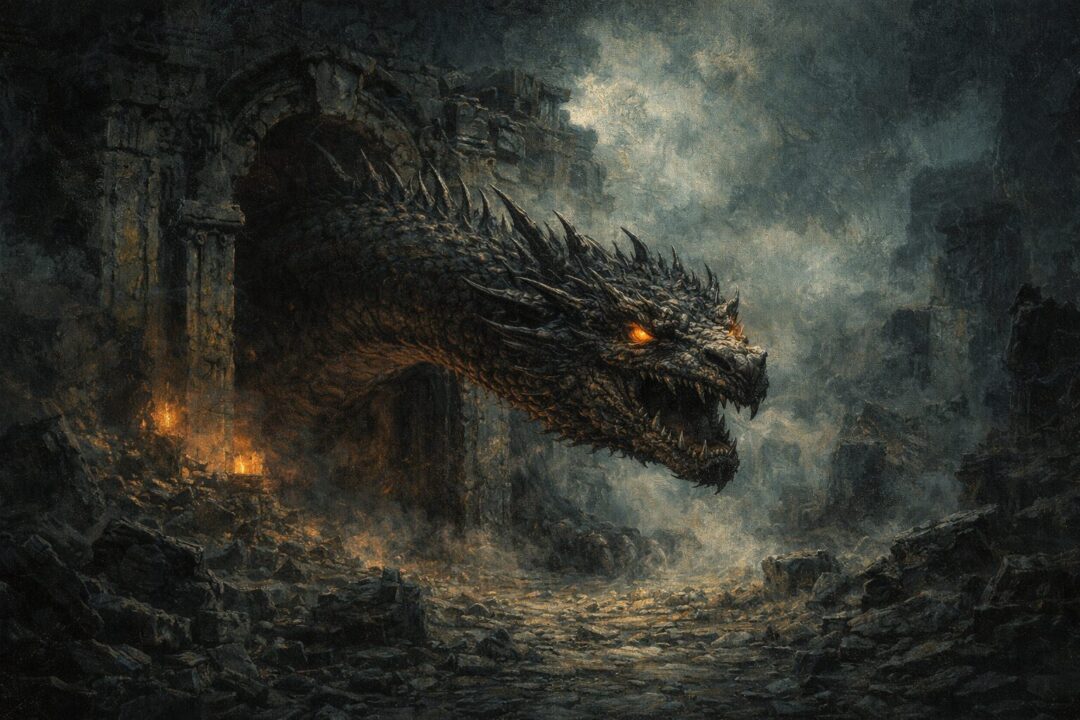
Few creatures in Middle-earth inspire such immediate, visceral fear as dragons. Across the long history of the world—from the dark wars of the First Age to the fading twilight of the Third—they appear as agents of catastrophe. Cities burn. Kingdoms fall. Bloodlines end. The land itself remembers where dragons once lay.
And yet, for all their destruction, dragons occupy a strange and unsettling moral space in the legendarium.
They are not servants in the way Orcs are.
They are not enslaved like the Nazgûl.
They do not answer when Sauron calls.
Dragons act alone.
That single fact sets them apart from nearly every other major evil force in Middle-earth—and suggests that something far more complex is at work than simple allegiance to darkness.
Dragons Do Not Serve—They Possess
Consider Smaug, the last great dragon of the Third Age.
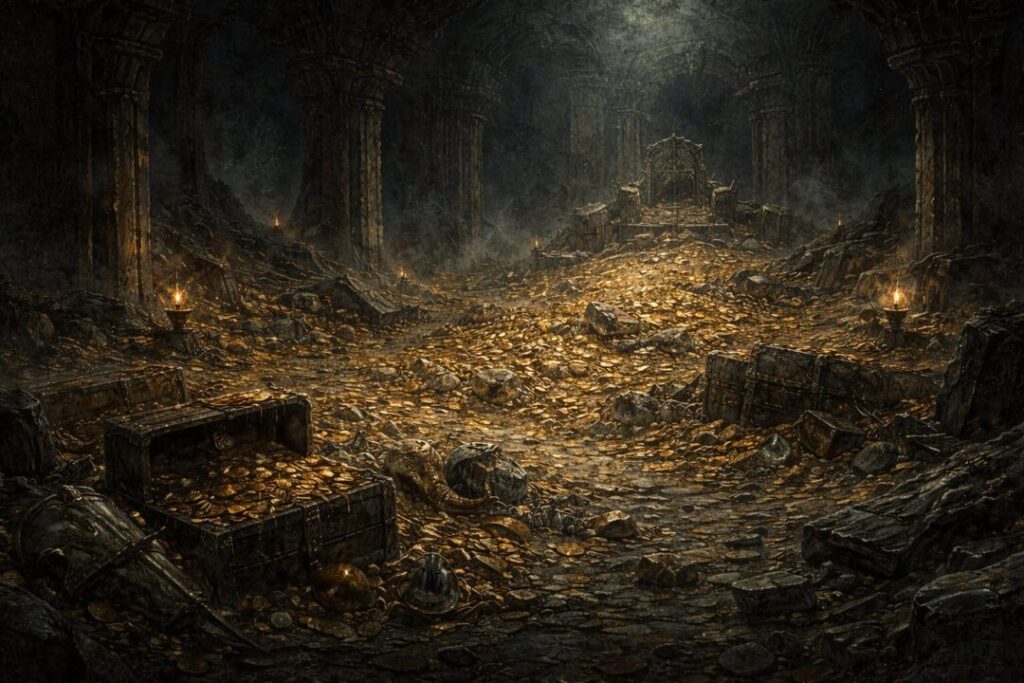
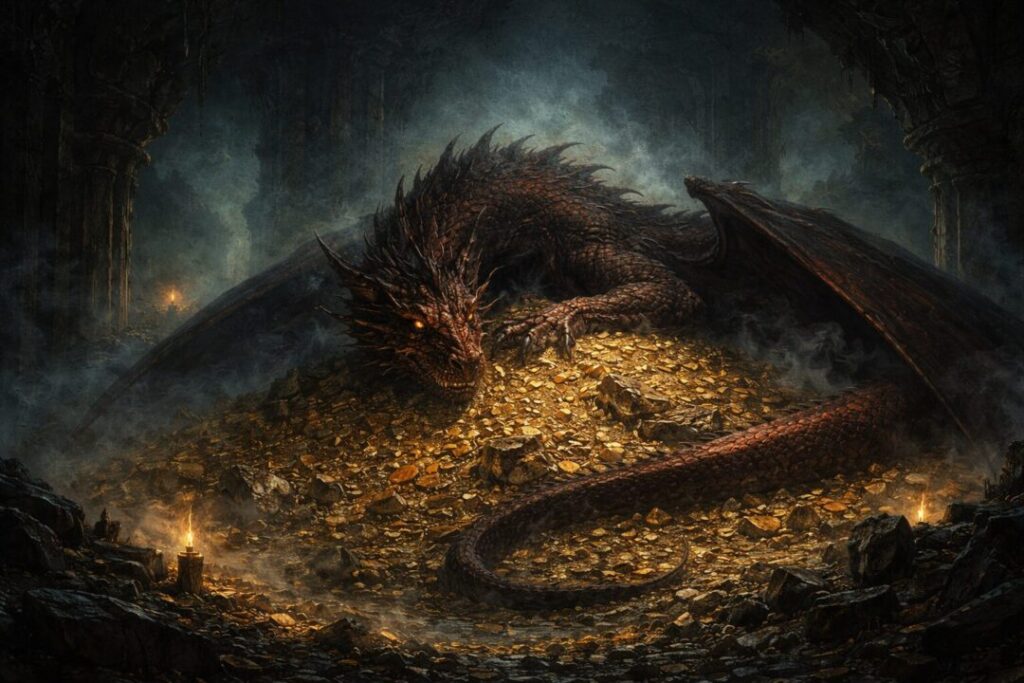
When he descends upon Erebor, he does not conquer it to rule. He does not establish laws, raise armies, or bend others to his will. He kills, claims, and then withdraws—curling himself around gold he did not create and treasures he can never meaningfully use.
Smaug does not spend wealth.
He does not share power.
He does not build anything at all.
He waits.
His hoard is not a means to an end. It is the end.
This pattern is not unique to Smaug. It stretches back to the earliest days of dragon-kind. Glaurung, the Father of Dragons, spreads devastation not by commanding legions, but by breaking minds. His words twist truth. His presence sows despair. His victims destroy themselves long after he has passed.
Even Ancalagon the Black—mightiest of all winged dragons—leaves no legacy of rule behind him. He is remembered not for dominion, but for annihilation.
Dragons do not rule.
They accumulate.
Greed Without Excuse
Greed is not unique to dragons in Middle-earth.
Dwarves struggle against it, and sometimes fall.
Men desire power, wealth, and legacy—and are easily corrupted by it.
Even Hobbits, small and content though they are, feel its pull when the Ring is near.
But dragons are different.
They do not struggle.
They do not rationalize.
They do not repent.
They simply are greed—magnified, intelligent, and embodied.
Smaug never pretends that Erebor belongs to him by right. He does not claim ancient lineage or divine authority. He knows the hoard is stolen. He knows the mountain was built by others.
And he keeps it anyway.
This is what separates dragons from other villains in the legendarium. They do not believe themselves righteous. They do not disguise their hunger behind ideology, destiny, or fear of a greater master.
They want.
And wanting is enough.
Why Dragons Feel “Evil” Without Being Enslaved
This is why dragons feel so profoundly evil without ever kneeling to a Dark Lord.
They embody corruption without coercion.
Where Sauron dominates through control, dragons dominate through possession. Where Morgoth seeks to unmake the world through hatred and rebellion, dragons withdraw from it—curling inward, hoarding, stagnating.
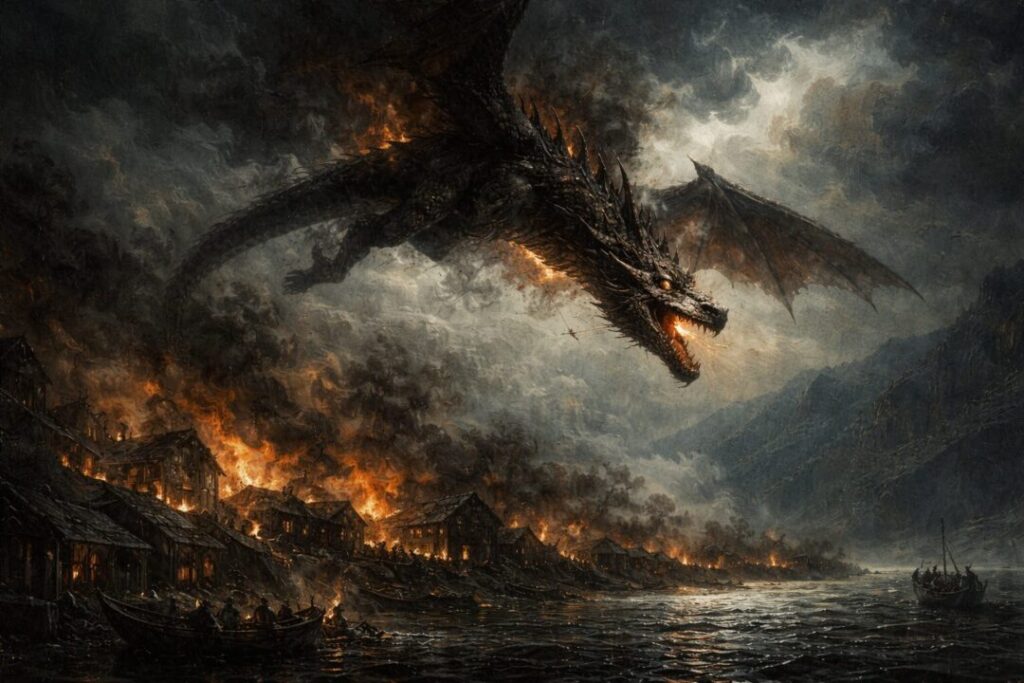
Their fire destroys outwardly.
Their greed destroys inwardly.
Entire cultures collapse around dragon-hoards not because dragons rule—but because they deny circulation. Wealth ceases to move. Trade stops. Memory freezes. The past is locked beneath coils of scale and flame.
Erebor does not die because Smaug governs badly.
It dies because nothing can grow beneath a dragon.
Dragons and Moral Responsibility
One of the most striking features of dragons is that Tolkien consistently portrays them as morally aware.
Smaug speaks with irony and calculation. Glaurung lies with intent. Dragons understand fear, manipulation, and consequence. They are not animals acting on instinct, nor are they mindless weapons forged by another’s will.
They are choosing beings.
This matters deeply in Tolkien’s moral universe. Evil is not defined by power alone, but by the misuse of will. Dragons are never shown resisting corruption because they never wish to. Their fall is not tragic—it is complete.
They do not seek redemption.
They do not hesitate.
They do not doubt.
They embrace desire until it consumes everything else.
A Deliberate Moral Design
Tolkien rarely pauses his narratives to explain dragons directly. There is no philosophical treatise on their nature within the main texts. And yet, his moral framework makes their role unmistakable.
Evil in Middle-earth is not always loud.
Sometimes it is silent.
Sometimes it sleeps.
Sometimes it hoards.
Dragons are not metaphors for chaos. They are metaphors for what happens when desire exists without limit, without community, and without restraint.
They do not corrupt rings.
They do not command armies.
They do not promise power to others.
They remove wealth from the world—and keep it forever.
That is why dragons are so rare.
Not because the world defeated them.
But because the world could not survive many of them.
Dragons and the Fading of the World
There is also a quiet, tragic element to the dragons’ decline.
By the Third Age, dragons are no longer world-shaping forces. Smaug is terrifying—but isolated. He destroys a single kingdom, not civilizations. His death marks not the end of an age, but the clearing of a wound.
This mirrors the broader fading of Middle-earth itself. The great evils of earlier Ages no longer stride openly across the world. They retreat into shadows, ruins, and hoards.
Dragons, like the Elves, belong more fully to the past—but unlike the Elves, they refuse to let go.
They cling.
Why This Question Still Matters
Modern fantasy often treats dragons as either beasts or gods—animals driven by instinct, or symbols of overwhelming power.
Tolkien does neither.
His dragons are moral beings, fully responsible for their choices. They are not cursed. They are not deceived. They are not enslaved.
They choose greed.
And in a world where evil often arrives wearing noble intentions, righteous causes, or tragic necessity, dragons remind us of something far simpler—and far more frightening:
Some evils do not need a justification.
They do not need a master.
They do not even need hatred.
They only need desire—left unchecked, unchallenged, and unshared.
And when that desire is given fire, wings, and time, it becomes a dragon.