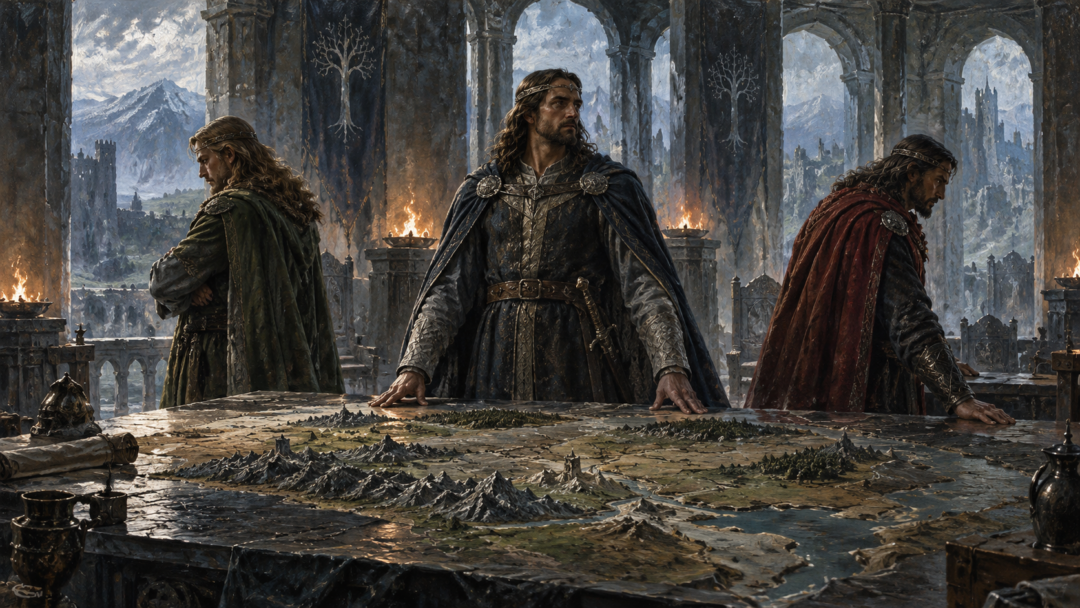
By the time Frodo reaches Weathertop, Amon Sûl is only a ruined ring of stone above the wild. It is remembered most easily as the place where the Nazgûl found the Ring-bearer. But centuries before that attack, the hill had already stood at the center of another disaster: the slow political failure of the North-kingdom.
Arnor did not first break when Angmar invaded. It broke in T.A. 861, after the death of King Eärendur, when dissension among his three sons divided the realm into Arthedain, Cardolan, and Rhudaur. The eldest, Amlaith, still claimed kingship over all Arnor, yet in practice he ruled only Arthedain. The northern Dúnedain preserved a claim to unity while losing the political reality that made unity work.
Calling this an “administrative” failure requires care. The texts do not describe tax systems, councils, bureaucracies, or constitutional law, and we should not invent them. The point is narrower: the succession produced rival realms, overlapping claims, and a disputed strategic center. Long before the Witch-king destroyed the North-kingdom by force, Arnor had ceased to function as one kingdom.
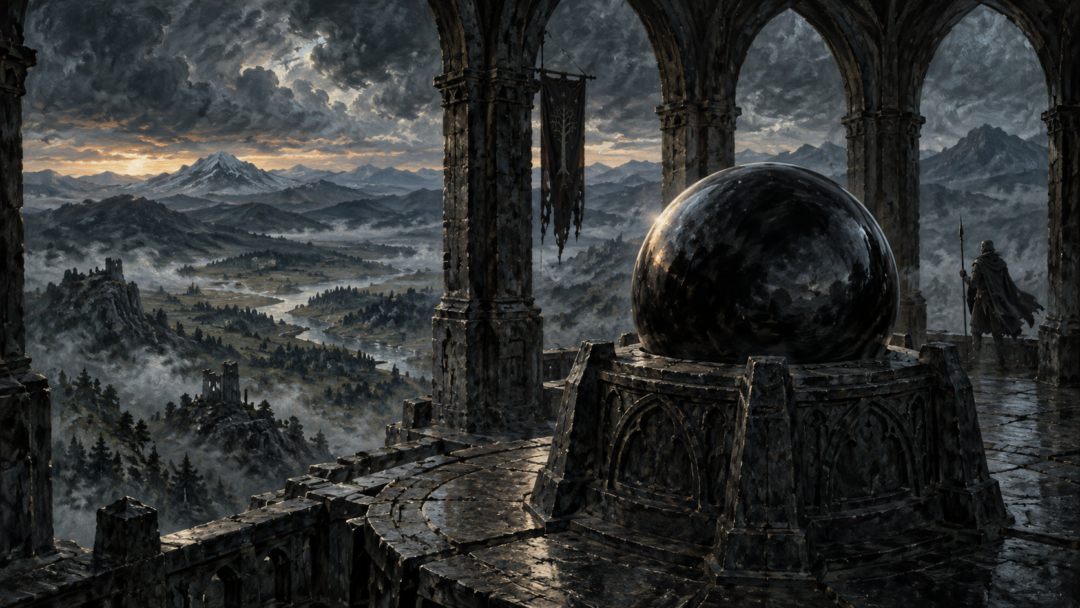
The decisive break came in 861, not 1409
Appendix A gives the sequence with remarkable economy. Eärendur dies. His sons fall into dissension. Arnor is divided. Amlaith, the eldest, claims the kingship of all Arnor but becomes king only of Arthedain, while the other brothers establish Cardolan and Rhudaur.
That is not merely a change on a map. It is a succession crisis that never receives a full political resolution. Amlaith’s senior claim survives, but the other realms do not simply remain provinces under him. They have their own rulers and pursue their own interests. The old kingdom therefore leaves behind both a memory of one kingship and three separate centers of power.
Nothing in the primary account suggests that the brothers created a durable structure for joint rule. What the record does show is repeated strife among their successor kingdoms, especially over the Weather Hills and Amon Sûl. The failure was not that three realms existed. The failure was that Arnor’s division left the most important questions of legitimacy and control unsettled.
Amlaith inherited the claim, but not the kingdom
Amlaith’s position exposes the central contradiction. As the eldest son, he claimed kingship over all Arnor. Yet his effective realm was Arthedain.
In other words, the title reached farther than the ruler’s power.
That gap between legitimacy and control outlived Amlaith. The line of Isildur continued in Arthedain, while in Cardolan and Rhudaur it eventually failed. Centuries later, Argeleb I of Arthedain would again claim lordship over all Arnor on that basis. Rhudaur resisted him. The old question had never disappeared: was Arthedain merely one successor state, or was its king the rightful ruler of the whole North-kingdom?
The texts do not give us a formal legal argument from Cardolan or Rhudaur, so it would be wrong to invent one. But the political consequence is visible. Arnor possessed a senior royal line without possessing an uncontested mechanism for restoring senior rule. The kingdom had split, but the meaning of that split remained unresolved.
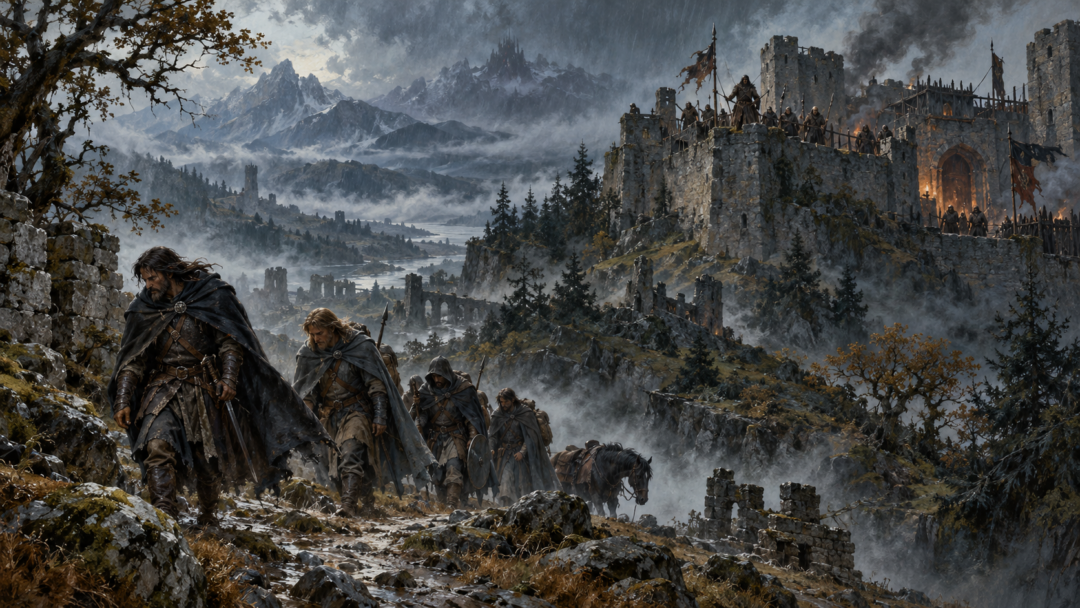
The palantíri made the partition harder to live with
The dispute over Amon Sûl shows why the breakup was not only dynastic.
The northern realm had three palantíri. One was kept at Annúminas. Another stood in Elostirion in the Tower Hills and was exceptional, looking west rather than serving the ordinary network of communication. The third was the great Stone of Amon Sûl on Weathertop, the chief northern Stone for communication with the South.
After Arnor was divided, Arthedain held the other northern Stones and also possessed Amon Sûl, while Cardolan and Rhudaur contested the Weather Hills and desired the Stone there. A strategic height near the meeting-point of the successor realms also contained one of the old kingdom’s most important instruments of long-distance sight and communication.
We should not turn the palantíri into a modern communications ministry. Their use was restricted, and the texts never describe routine administration through them. But they were royal assets of exceptional value. The struggle for Amon Sûl therefore reveals something larger than a border quarrel. The successor kingdoms were fighting over authority and inherited resources from a state that no longer existed as a single political unit.
Amon Sûl was where geography, kingship, and the remnants of Arnor’s central power all collided.
Rhudaur shows what happens when succession becomes institutional weakness
For generations, the three kingdoms continued to exist. That fact matters, because “failed arrangement” does not mean instant collapse.
But endurance is not the same as stability.
The line of Isildur soon failed in both Cardolan and Rhudaur. In Rhudaur, where the Dúnedain were already few, power was eventually seized by a lord of the Hill-men who was secretly allied with Angmar. By the reign of Argeleb I in Arthedain, the dynastic landscape had changed completely.
Argeleb therefore claimed lordship over all the old territory of Arnor. Rhudaur rejected the claim. He fortified the Weather Hills, and in T.A. 1356 he was killed in battle with Rhudaur and Angmar.
This is the point where political fracture becomes military vulnerability. Angmar did not create the dispute over who ruled Arnor. It entered a world in which that dispute had been unresolved for roughly five centuries. Rhudaur could be turned against Arthedain because it was already a separate realm with its own power structure and its own resistance to Arthedain’s claim.
Angmar exploited the fracture; it did not invent it
Angmar arose around T.A. 1300, more than four centuries after the partition of 861. Its great assault of 1409 came roughly five and a half centuries after Arnor had been divided.
That chronology is the strongest reason to resist the simple story that “the Witch-king destroyed Arnor.”
He certainly destroyed what remained of the northern kingdoms in war. Angmar was a deliberate enemy of the Dúnedain, and its attacks were catastrophic. But by the time it became a major power, there was no unified Arnor for it to break apart. There were successor states whose rivalries, disputed borders, and dynastic problems were already old.
The distinction does not diminish Angmar. It explains why Angmar’s strategy was so effective. A hostile power did not need to defeat one coordinated northern monarchy at the height of its cohesion. It could pressure separate realms, work through Rhudaur, force Arthedain to defend a contested frontier, and strike Cardolan and Amon Sûl as part of the same fractured system.
The texts do not prove that a united Arnor would have defeated Angmar. Arnor had suffered terrible losses in the War of the Last Alliance and at the Gladden Fields, and the northern Dúnedain were never as numerous or powerful as Gondor. Unity would not magically have solved those weaknesses. But disunity clearly gave Angmar opportunities that a single undisputed kingship would not have presented in the same form.
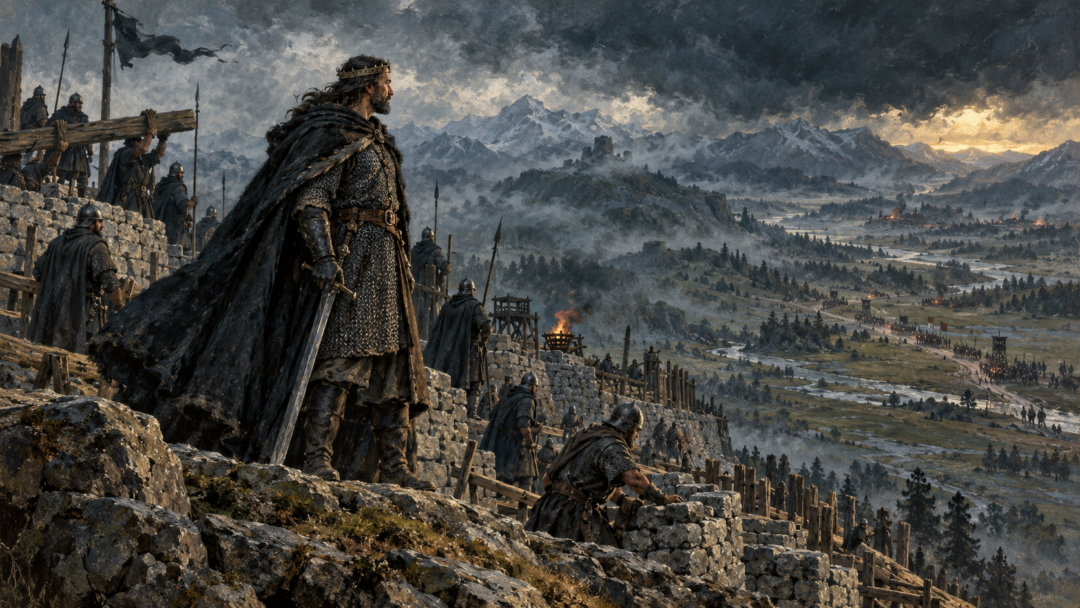
Weathertop became a battlefield because it had first been a political problem
After Argeleb’s death, his son Arveleg I, aided by Cardolan and Lindon, drove the enemy back from the Weather Hills. For a time Arthedain and Cardolan maintained a defensive line along the Hills, the East Road, and the lower Hoarwell. This cooperation is important. It shows that the northern realms could act together when the danger became undeniable.
But they were cooperating after centuries of fragmentation, not operating as one restored kingdom.
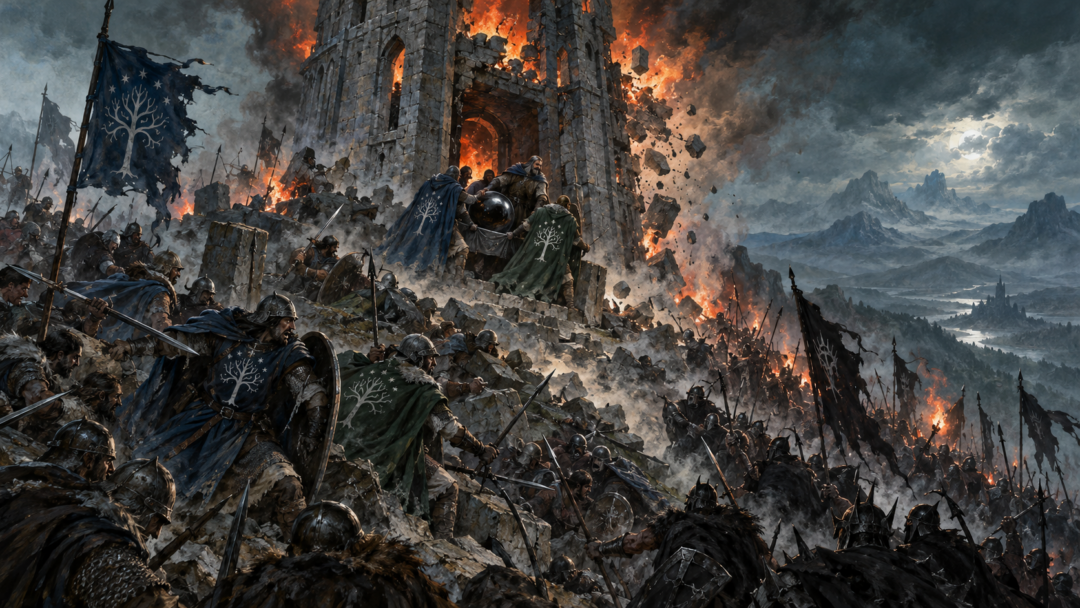
In T.A. 1409 a great force from Angmar attacked. Amon Sûl was surrounded and its tower destroyed. Arveleg was slain, and the last prince of Cardolan also died in the catastrophe. The palantír was saved and taken to Fornost, but the old center of dispute was physically ruined.
There is a cruel symmetry in that sequence. For centuries, the successor states had contended over Weathertop because of what it represented and what it contained. When the external enemy finally took the hill, the northern Dúnedain were defending together a place their political order had never learned to share peacefully.
The system failed long before every kingdom disappeared
It is tempting to object that Arthedain survived until T.A. 1974, more than eleven centuries after the partition. Survivors of Cardolan also endured after the catastrophe of 1409. Surely a political arrangement that lasts for centuries cannot simply be called a failure.
The objection sharpens the thesis. The three kingdoms were viable states for long periods. What failed was the partition as a solution to Arnor’s succession. It did not produce an accepted hierarchy. It did not settle the status of the kingship over all Arnor. It left contested territory at the strategic center of the old realm. And when dynastic lines failed, there was no uncontested path back to unity.
The evidence is not a record of administrative incompetence in the modern sense. It is a record of unresolved sovereignty.
That is why Argeleb’s later claim matters so much. Centuries after Amlaith, Arthedain was still trying to turn inherited seniority into actual rule over the whole North. The fact that the question had to be fought over at all shows that the partition had never fully solved the original quarrel.
Arnor’s tragedy began before the Witch-king arrived
The Witch-king remains the great destroyer of the North. His wars killed kings, shattered Cardolan, subverted and conquered Rhudaur, destroyed Amon Sûl, and eventually drove the last king of Arthedain from Fornost.
But he attacked a political structure that had been weakened by its own unresolved division.
That is the deeper history hidden in the ruins of Weathertop. Amon Sûl was not merely a fortress that Angmar conquered. It had been the symbolic center of a political problem for generations: one old kingdom, three successor states, one senior royal claim, and no durable settlement accepted by all.
So did Arnor’s three kingdoms fail for administrative reasons before they failed in war?
If “administrative” means bureaucracy, the texts do not support the claim. If it means the political machinery of succession, sovereignty, shared strategic assets, and recognized authority, then the pattern is difficult to miss. Arnor was divided in 861. Its successor kingdoms spent centuries living with the consequences. Angmar arrived later and turned those consequences into weapons.
By the time war destroyed the North-kingdom, the argument over what the North-kingdom actually was had already been lost.
Sources & Notes
This article is based on close reading and interpretation of Tolkien's published works and related source material where relevant.