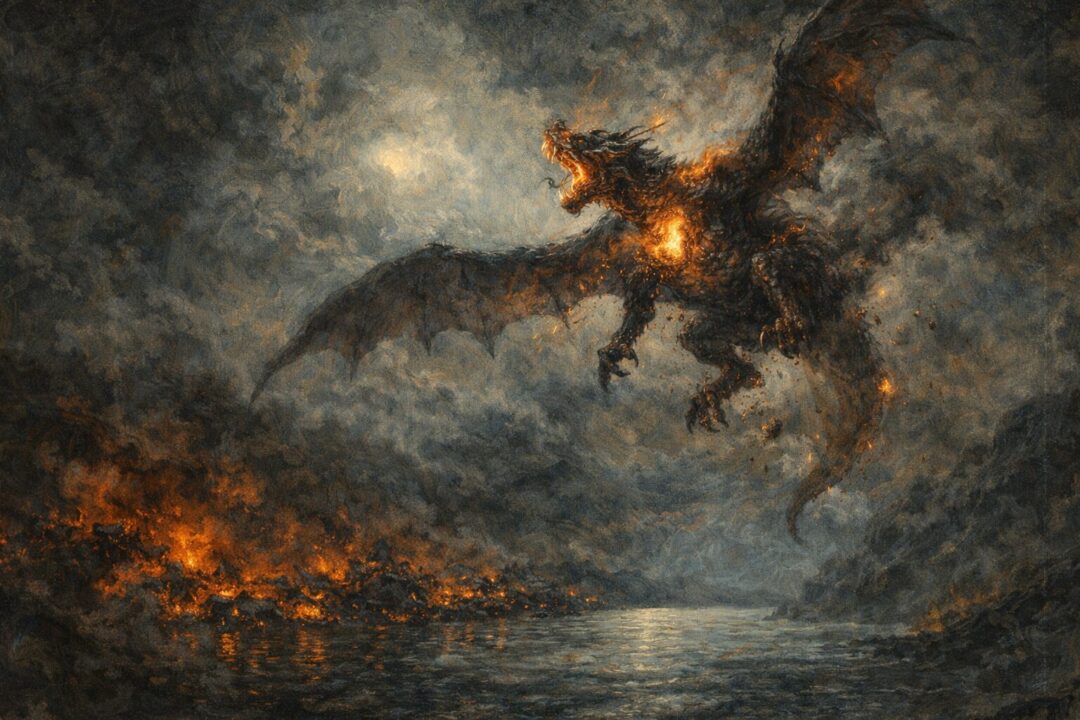
Smaug the Golden is often remembered as a force of nature—an ancient dragon whose fire toppled kingdoms and whose presence alone drove Dwarves into exile. His name is spoken with a kind of awe even centuries after his fall, as if he were less a creature and more a living catastrophe.
And yet, when Smaug’s story ends, it ends suddenly.
Not in a great war.
Not in a long siege.
Not beneath a mountain of fallen heroes.
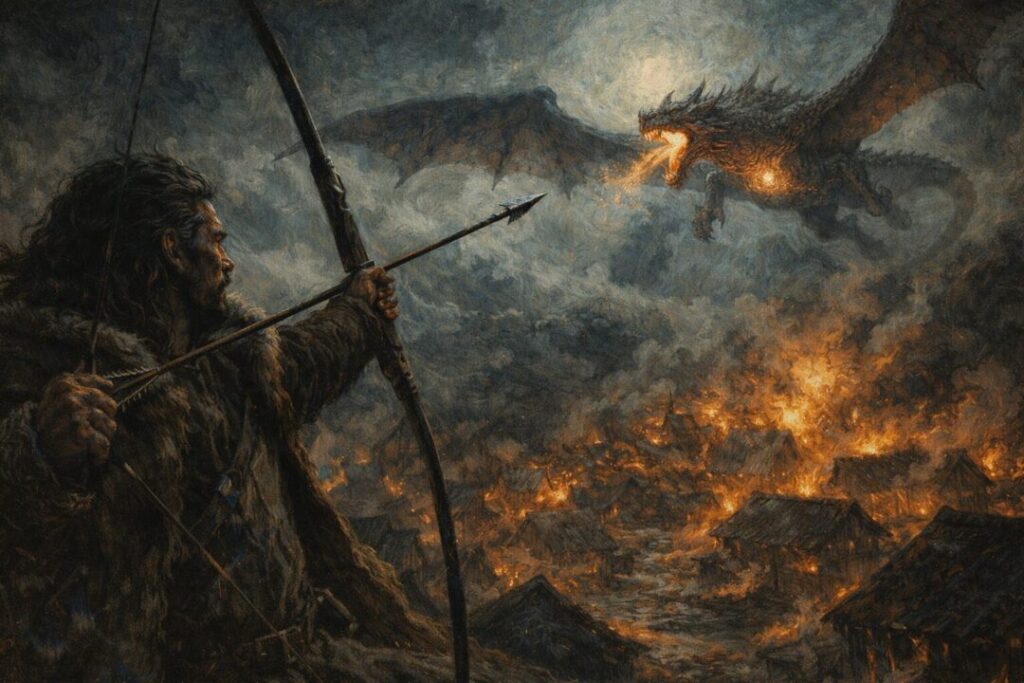
But with a single arrow.
This abrupt ending raises a deceptively simple question that lingers long after the final pages of The Hobbit:
Was Smaug truly invincible—and did he doom himself by revealing his one weakness?
To answer that, we need to look closely at what actually kills Smaug, how that knowledge spreads, and why his fall feels both avoidable and inevitable at the same time.
Smaug Was Nearly Untouchable
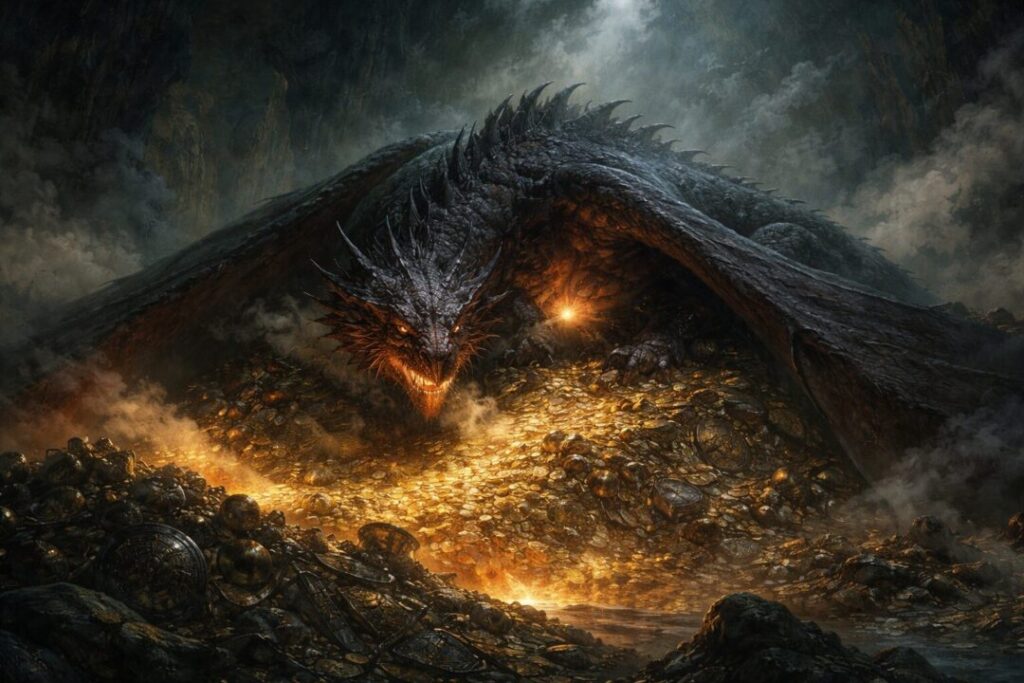
By the time of The Hobbit, Smaug has spent decades lying upon the treasure hoard of Lonely Mountain, also known as Erebor. This is not merely a matter of comfort or greed—it is the foundation of his defense.
As Smaug sleeps atop gold, gems, and armor taken from fallen Dwarves, his underbelly becomes encrusted with treasure. Over time, this forms a kind of living mail: scales layered with precious stones, fused together by heat, weight, and age. Ordinary weapons cannot penetrate it. Swords shatter. Arrows glance off harmlessly.
This explains why the Kingdom of Dale falls so swiftly. It is not that its defenders lack courage or skill—it is that they face something functionally immune to their strength. Against Smaug, valor alone is meaningless.
Smaug knows this.
He revels in it.
Unlike many monsters of Middle-earth, Smaug is not a mindless beast driven purely by hunger or rage. Dragons are ancient, cunning, and deeply intelligent. Smaug understands language, psychology, and fear. He remembers insults. He anticipates lies. He manipulates conversations as carefully as he guards his gold.
His confidence is not arrogance born of ignorance—it is arrogance born of experience.
Which makes his one flaw all the more striking.
The Bare Patch: A Real, Canonical Weakness
Despite all his armor, Smaug is not perfectly protected.
There is a small bare patch on his breast, left uncovered even after decades upon the hoard. This detail is not symbolic, speculative, or inferred—it is explicitly described in The Hobbit. Smaug himself confirms it, albeit unintentionally.
What matters most is this: no one knows about it.
Not the Dwarves who fled Erebor.
Not the Men of Dale.
Not even Smaug’s enemies.
Until Smaug decides to talk.
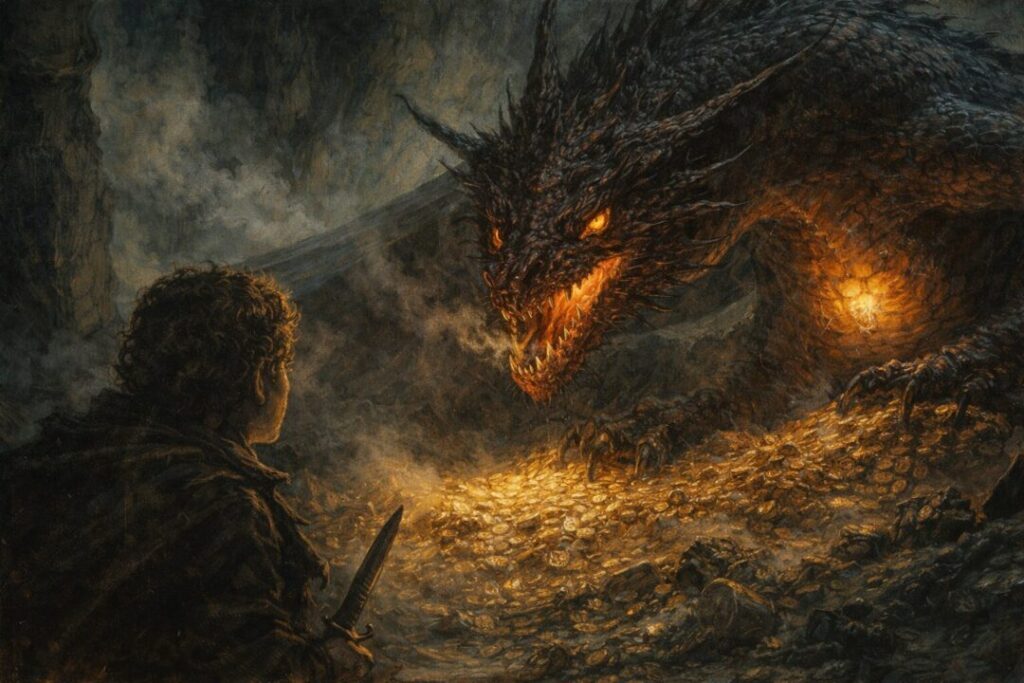
When Bilbo Baggins enters the dragon’s lair, the encounter becomes a contest not of strength, but of words. Smaug probes, flatters, intimidates, and boasts. He wants to dominate the exchange. He wants Bilbo to feel small, exposed, and helpless.
And in doing so, he reveals too much.
Smaug boasts of his impenetrable armor. He mocks the idea that weapons could harm him. And in explaining his invulnerability, he inadvertently reveals its limit.
Bilbo notices.
So do others.
Thrushes hear.
Words travel.
Knowledge spreads.
This is not a battlefield failure. It is an intellectual one.
Smaug is not undone by steel. He is undone by speech.
Could Smaug Have Lived If He Stayed Silent?
Strictly speaking: yes.
If Smaug had never revealed the bare patch, Bard would have had no reason to aim where he did. The Black Arrow, though heirloom and symbolically significant, is not described as magically seeking weak points. It must be guided.
Without knowledge, Smaug’s armor would likely have held.
This distinction matters.
Smaug is not slain because he is overpowered.
He is slain because he is known.
In Middle-earth, secrecy matters. Information matters. Words—once spoken—cannot be reclaimed.
Smaug’s mistake is not tactical. He does not misjudge distance, speed, or force.
His mistake is moral.
He believes himself beyond consequence.
Pride Is the True Weakness of Dragons
Smaug’s death fits a broader pattern woven throughout the history of Middle-earth: great evils fall not when they are weakest, but when they are most certain of themselves.
Smaug cannot imagine a small creature like Bilbo posing a threat.
He cannot imagine Men succeeding where Dwarves failed.
He cannot imagine that his own voice could be the instrument of his ruin.
This same flaw appears again and again in later ages.
Power assumes it will always be power.
Dominance assumes it cannot be challenged.
Certainty assumes it cannot be wrong.
Dragons hoard gold—but they also hoard certainty.
And certainty breeds blindness.
Smaug does not consider silence because silence would imply restraint. And restraint is incompatible with the kind of domination Smaug enjoys. He does not merely want to rule through fear—he wants to demonstrate his superiority.
In that desire, he exposes himself.
Fate Still Had a Hand
Even so, Smaug’s death is not only his fault.
Middle-earth is shaped by chance that feels purposeful. Events align in ways that suggest guidance without coercion—opportunity without compulsion.
The thrush that overhears Smaug’s words.
The survival of the Black Arrow through generations.
Bard’s lineage, memory, and resolve.
These elements do not force Smaug’s fall, but they make it possible once he has spoken.
Fate does not compel Smaug to reveal his weakness.
It does not place words in his mouth.
It waits.
And when Smaug chooses pride, fate responds.
This is a recurring pattern in Middle-earth: doom often arrives only after a choice is made freely.
Smaug’s Death Was Avoidable—but His Nature Made It Certain
So could Smaug have survived?
Yes—if he were less proud.
Less cruel.
Less eager to dominate through fear and speech.
But then he would not be Smaug.
Dragons in Middle-earth are not merely powerful creatures; they are embodiments of a particular moral failure. They accumulate wealth without creating. They dominate without stewardship. They speak not to understand, but to diminish.
In such beings, destruction is not imposed from without—it grows from within.
Smaug is not defeated by heroes stronger than him.
He is not undone by superior numbers or greater weapons.
He is defeated by being exactly what he is.
And that is why his fall still feels inevitable—no matter how small the arrow.
Because in Middle-earth, power that cannot imagine restraint eventually reveals the very weakness that ends it.