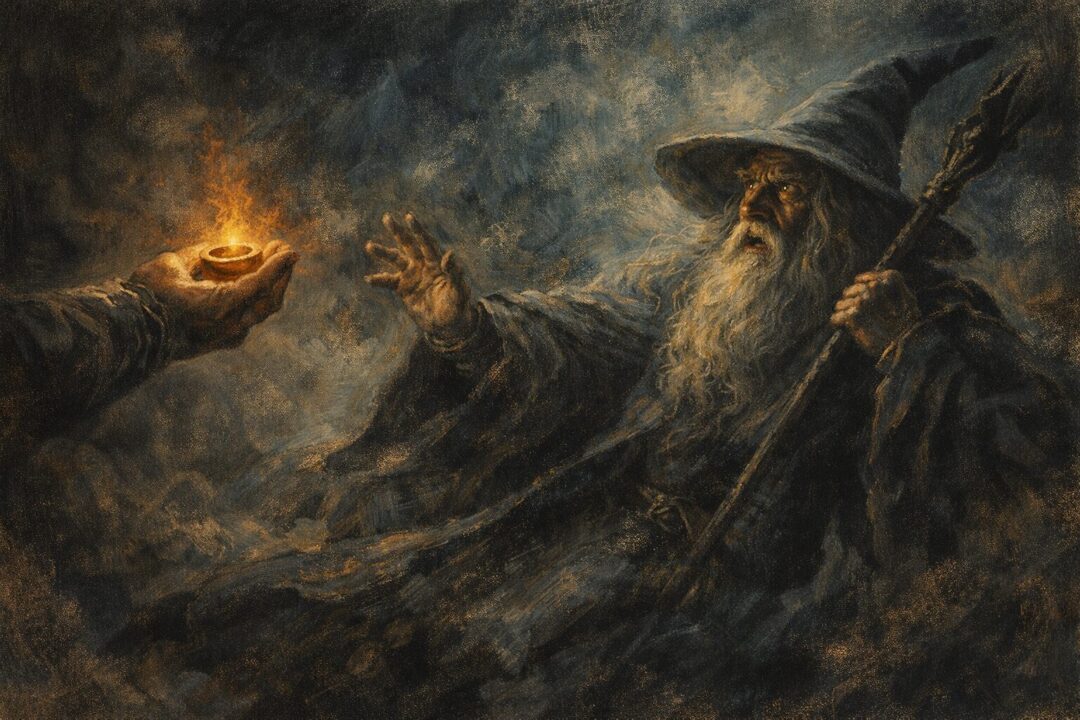
The temptation to use the One Ring is not a modern invention.
It exists inside the story itself, voiced openly by characters who are neither foolish nor evil.
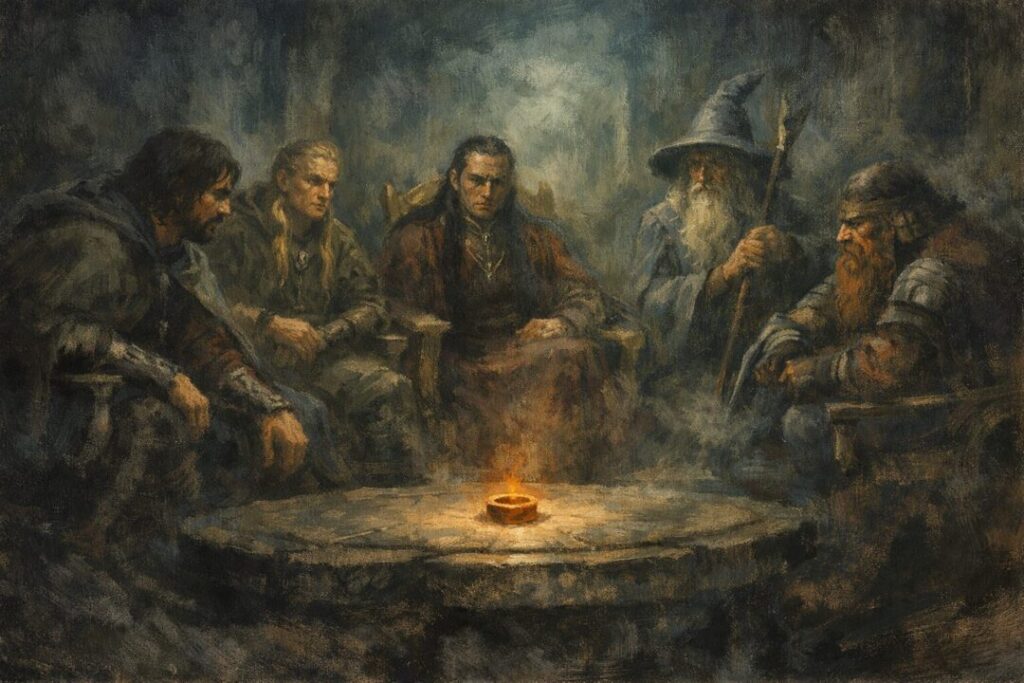
At the Council of Elrond, no one doubts the Ring’s power. It is not treated as a cursed trinket or a symbolic burden. It is acknowledged—almost reluctantly—as something that works. It can command, dominate, and overturn the balance of the world.
This is precisely why the question lingers:
If the Ring is so powerful, why not use it once?
Why does no one seriously propose a controlled, strategic moment—a single decisive battle, a final confrontation, a swift overthrow of the Enemy—to shorten the war and spare countless lives?
Why must the path be so slow, so fragile, so costly?
To answer that, we have to understand what the Ring actually is—and what it does to anyone who tries to wield it.
The Ring Is Not a Weapon—It Is a Beacon
The One Ring is not merely an artifact of power.
It is an extension of Sauron himself.
Unlike swords, armies, or fortresses, the Ring does not act independently of its maker. It carries his will, his mode of domination, and—most critically—his attention. It is bound to him on a level deeper than physical distance.
When the Ring is worn accidentally or in ignorance, Sauron’s awareness stirs dimly. When it is worn deliberately, with intent to command or dominate, the connection becomes unmistakable.
This is why Frodo Baggins feels the Eye searching for him at Amon Hen. He has not attacked Sauron. He has not claimed the Ring. He has merely used it—and that is enough.
It is also why claiming the Ring at Mount Doom instantly reveals its bearer. The Ring does not need time. It does not need repetition. The moment it is asserted as a tool of will, it announces itself.
Using the Ring is not a neutral act.
It is a declaration.
Why “Just Once” Is Not Possible
The idea of using the Ring once assumes something crucial:
that it can be set aside afterward.
Middle-earth does not operate on that logic.
Power leaves a mark.
The Ring does not simply amplify existing strength. It reshapes the inner world of the one who uses it. Each act of domination makes the next easier, more justified, more inevitable.
This progression is visible even in those who never touch it.
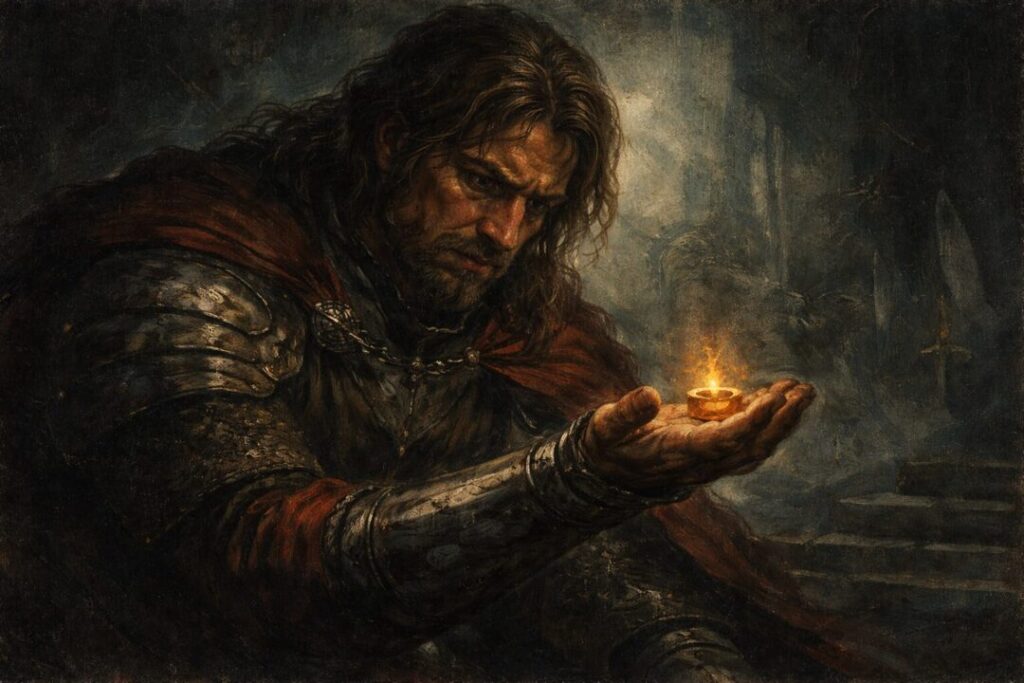
Boromir begins with patriotic concern for his people. He never wears the Ring, never commands with it—yet his thoughts circle it obsessively. His reasoning becomes sharper, more urgent, more absolute. He convinces himself that refusal is irresponsible.
The Ring does not need contact. It only needs proximity and desire.
Then there is Gollum, whose fall is slow, internal, and devastating. He does not begin as a monster. He begins as a being who finds something precious and justifies keeping it. Possession turns into dependence. Dependence turns into erosion. What remains is not evil ambition, but ruin.
Even Frodo himself only truly claims the Ring once. That single act—at the Crack of Doom—ends the quest as it was intended. His will collapses not because he is weak, but because no one, at that moment, can bear that weight.
The Ring is designed to remove restraint.
There is no “one time” because the first use alters the ground on which all later choices stand.
Why Gandalf, Galadriel, and Elrond Refuse It
The most important refusals in the story come not from fear, but from clarity.
The wisest figures in Middle-earth understand something the warriors do not:
victory achieved through the Ring is indistinguishable from defeat.
Gandalf does not deny that he could use the Ring. In fact, he explicitly states that he could wield it with great effect. But he also knows how he would do so—through righteous intention, through a desire to set things right.
That is the danger.
Rule enforced “for good” is still rule. Order imposed by domination is still tyranny. Gandalf would not replace Sauron with chaos—he would replace him with something cleaner, kinder, and just as absolute.
Galadriel sees this with terrifying clarity. Her vision is not crude conquest, but a world made flawless through her will—“beautiful and terrible,” loved and feared. Her refusal is not humility; it is self-knowledge.
Elrond understands something else entirely: secrecy is the Fellowship’s only true defense. Once the Ring is used openly, subtlety vanishes. The quest becomes a war of power—and that is a war Sauron is prepared to fight.
Their refusal is not weakness.
It is foresight.

Is There Any Scenario Where the Ring Could Be Used?
There is only one theoretical edge case—and it is barely an exception at all.
If the Ring were used at the exact moment of its destruction, its claim might not matter.
This is precisely what happens in Mordor.
When Frodo claims the Ring at the Crack of Doom, the quest technically fails. He does not destroy it. He asserts ownership. And yet, the world is not lost.
Why?
Because events have already moved beyond choice.
The Ring’s destruction comes not through mastery, but through accident, consequence, and the long chain of mercy shown earlier in the story. The Ring is not used to win. It is used—and immediately lost.
Even here, the Ring does not save the day. It nearly destroys everything.
This is not a success case for controlled use. It is proof that even the smallest assertion of ownership carries catastrophic risk.
The Fellowship’s Real Strength
The Fellowship was never meant to win quickly.
Speed favors domination. Patience favors humility.
From the beginning, the quest is structured around avoidance, endurance, and delay. Every instinct that screams for decisive action is intentionally denied.
The Ring is entrusted to Hobbits not because they are pure or innocent, but because they are small. They lack the hunger for mastery that defines the great powers of the world.
Their resistance lies not in strength, but in endurance.
Frodo does not conquer the Ring. He survives it.
Sam does not overcome evil through force. He outlasts despair.
This is not a flaw in the strategy. It is the strategy.
The tragedy of Middle-earth is not that the Ring was unused.
It is that it was used at all—and even then, only at the very end.
Why This Question Still Matters
The idea of “using evil for good” is one Middle-earth rejects completely.
There are no clean shortcuts.
No borrowed power without consequence.
No victories that do not reshape the victor.
The Ring ensures that the price of power is always higher than it appears—and that the cost is paid not all at once, but over time, in ways that feel justified until they are irreversible.
That is why the Fellowship never asks how to use the Ring safely.
They understand that the moment they do, the quest has already failed.
And once you see the Ring not as a weapon, but as a claim to domination itself, the refusal to use it—even once—stops looking naïve.
It becomes the only choice that leaves the world intact.