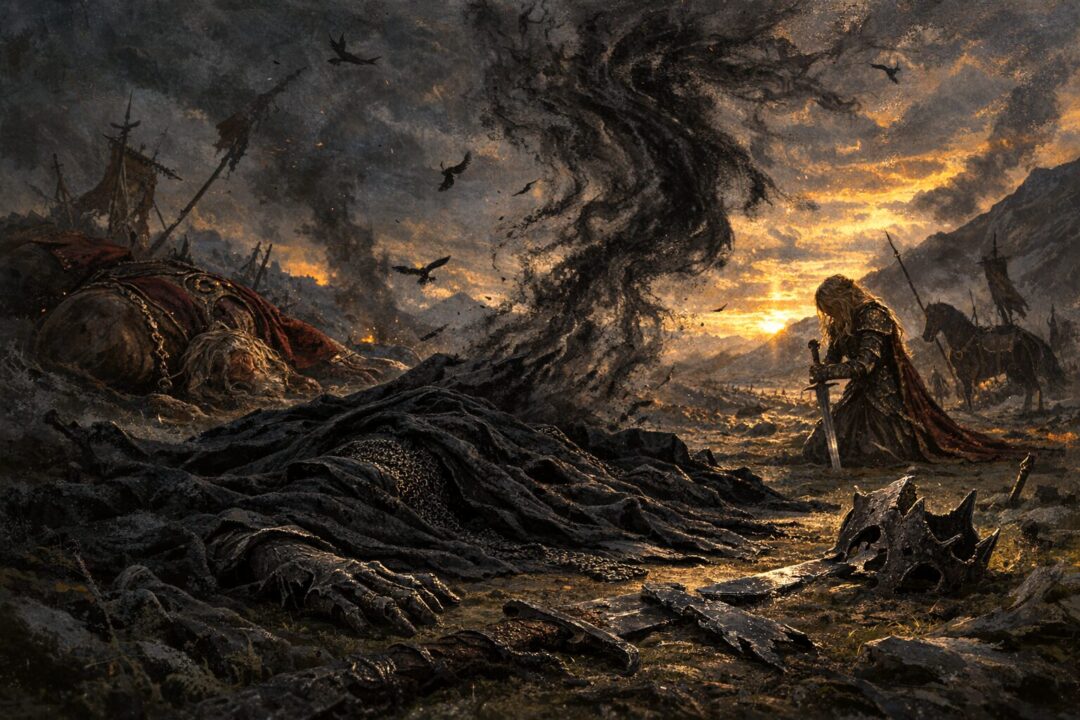
The Witch-king’s end is one of those moments in The Lord of the Rings that feels final even before you stop to ask what, exactly, has happened.
A crown falls.
A black mantle collapses.
A cry rises into the air and is lost.
It reads like annihilation. But the being who dies there is not an ordinary man, and that is where the question begins.
Could the Witch-king have been “re-made” if his Ring had somehow been recovered?
The short answer is that the texts do not say so. In fact, they never describe any process by which a Nazgûl who has been overthrown can be rebuilt merely by regaining his own Ring. But the question still matters, because the Witch-king falls before the One Ring is destroyed, and that leaves a narrow space where readers naturally wonder whether his destruction was absolute or only the ruin of the form he wore on the Pelennor.

What the texts actually say about the Witch-king’s fall
The crucial point is that the Witch-king is not brought down by Éowyn alone, nor by Merry alone, but by a sequence the text treats as unusually significant.
Merry’s barrow-blade strikes first. Later the narration explains why that wound mattered: the blade of Westernesse broke “the spell” that knit the Ringwraith’s unseen sinews to his will. That is not the language of a normal battlefield injury. It tells you the Witch-king’s bodily presence depended on some binding force that held his wraith-like being in effective action.
Then Éowyn strikes between crown and mantle.
And what follows is one of the strangest death-scenes in the book. The mantle and hauberk lie empty. What rises is a bodiless cry that is swallowed up and “was never heard again in that age of this world.” That wording matters. The text does not describe a corpse. It describes the collapse of a visible, armed, fearsome presence into emptiness and disembodied voice.
So the Witch-king is not merely stabbed and killed like a mortal captain.
Something more fundamental is broken.
Why the Nine Rings matter to the question
The Nazgûl exist because Sauron gave Nine Rings to mortal Men, who became mighty and then faded into wraiths under his domination. That much is straightforward. Their condition is inseparable from the Rings that ensnared them.
But an important complication enters here.
In The Council of Elrond, Gandalf famously says, “the Nine the Nazgûl keep.” Yet later evidence and commentary summarized in reliable references point to Tolkien’s later conception that Sauron himself held the Nine Rings after their bearers had become fully enslaved. That is why careful readers usually treat the line in Council of Elrond as an older wording that was never fully revised, rather than the last word on the matter.
That distinction matters because if Sauron held the Nine, then “recovering the Witch-king’s Ring” would not mean picking a ring up from the battlefield. It would mean recovering something Sauron already controlled or had in his keeping. In other words, the premise itself becomes unstable. The Witch-king was not likely riding about Minas Tirith with his Ring on his hand.
So the question is better framed this way:
Could Sauron, by means of the Nine and his own power, have restored the Witch-king after Pelennor?
That is a stronger question. But even then, the texts stop short of saying yes.
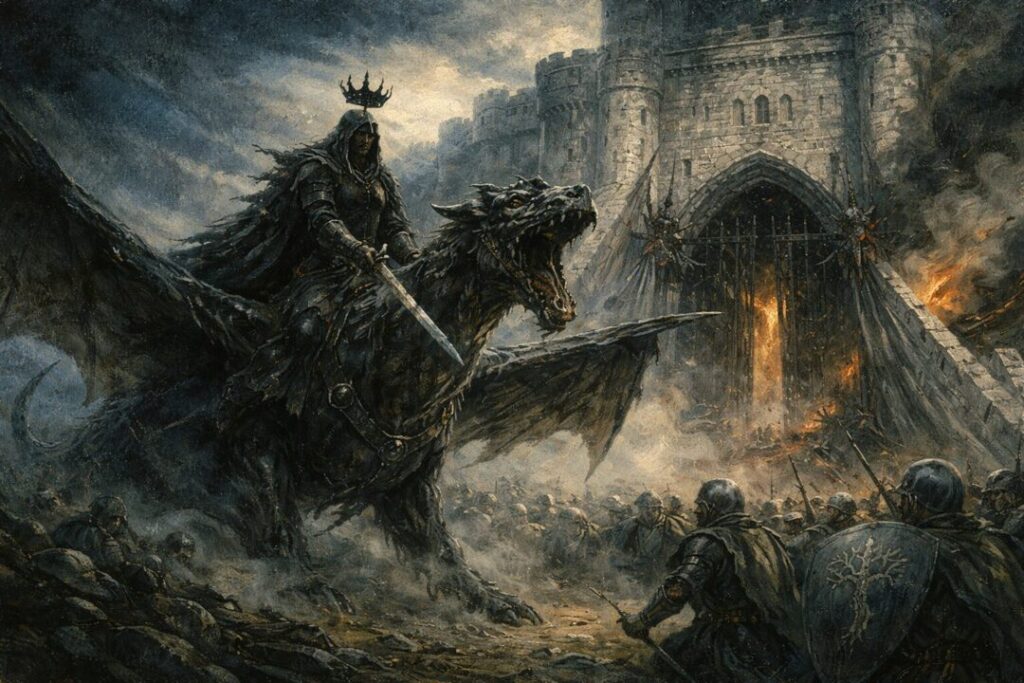
What Nazgûl can recover from—and what they cannot
Part of the reason this debate persists is that Nazgûl do recover from lesser defeats.
They can be driven off. They can lose horses. They can move unclothed and invisible. In The Hunt for the Ring tradition, Sauron even sends the Nine out unclothed and under strict command, which shows that their visible gear and mounted terror are not identical with their underlying existence as Ringwraiths.
That means the destruction of outward form is not, by itself, enough to prove permanent extinction.
But the Witch-king’s case is not presented as a routine setback.
Merry’s blade is singled out as uniquely fit for that enemy, forged in the North-kingdom when Angmar was the chief foe, and specifically said to break the spell that bound his unseen sinews to his will. The text gives this wound special explanatory weight after the battle, almost as if it wants the reader to understand that something happened here which ordinary weapons could not have done.
So although Nazgûl can survive many forms of loss, the Witch-king’s fall is narrated as a deeper undoing than the loss of horse, cloak, or mount.
The narrow window where speculation is possible
There is, however, one place where careful speculation remains possible.
The Witch-king is destroyed on March 15, 3019.
The One Ring is destroyed on March 25.
Between those dates, Sauron still exists, the One still endures, and the structure of domination that sustains the Ringwraiths has not yet been broken. The Nazgûl as a class are still active until the end; indeed they remain terrible agents of Sauron in the final days before the Ring’s destruction.
So can we prove that the Witch-king could not have been restored in that interval?
No. The texts do not explicitly say that he could never return between Pelennor and the fall of Barad-dûr.
But can we prove that he could have been restored, specifically through recovery of “his Ring”?
Also no.
And that second “no” is more important.
Because the books never give a mechanism. They do not describe Sauron re-forming a destroyed Nazgûl through possession of one of the Nine. They do not show the Witch-king lingering nearby, ready to be re-bodied. They do not even hint that his restoration was expected. The story treats his fall as the fulfilment of a doom long foretold, not as a temporary inconvenience.
That does not make absolute impossibility certain.
It does make confident claims about his “re-making” go beyond what the text supports.
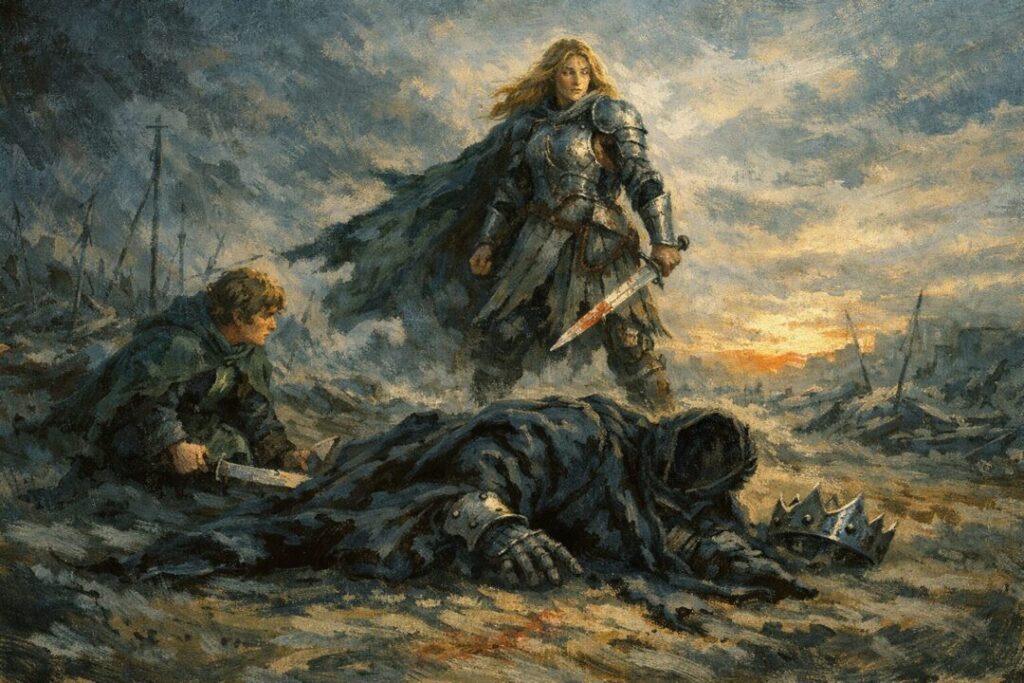
What changes once the One Ring is destroyed
After March 25, the question closes.
The Nazgûl are bound not only to the Nine but to the whole order of domination centered in the One Ring. Once the One is destroyed, the power that upheld Sauron’s empire collapses, and with it the Nazgûl’s remaining basis of endurance. Reliable summaries of the text are clear that with the destruction of the One, the power of the subordinate Rings fails in the way that matters most to Sauron’s control.
So after the fall of Barad-dûr, there is no serious textual case that the Witch-king could be “re-made” at all.
Not by recovering a Ring.
Not by rebuilding a body.
Not by some hidden reserve of Nazgûl power.
Whatever room for uncertainty existed before March 25 disappears when the One goes into the Fire.
So could the Witch-king have been “re-made”?
As far as the texts let us say with confidence: not on the basis of Ring-recovery alone, and not at all after the destruction of the One Ring.
Before March 25, a very cautious reader may leave open a narrow theoretical possibility that Sauron, while still in full power, might have done something not described in the text. But that is interpretation, not stated fact. The books never say the Witch-king could be rebuilt, and they never present the recovery of his Ring as the key to such a restoration.
What they do show is more precise than that.
They show a Ringwraith whose visible form is unmade by a very particular combination of prophecy, Westernesse-forged blade, and Éowyn’s final stroke.
They show that his end is treated not like a routine Nazgûl retreat, but like the breaking of something long held together by dark will.
And then, ten days later, they show the destruction of the One Ring, which removes the last imaginable foundation for any return.
So the best lore-accurate answer is not dramatic.
It is narrower, and better.
The Witch-king might invite speculation because he is a wraith.
But the text does not.
The text lets him fall once—and then closes the door.