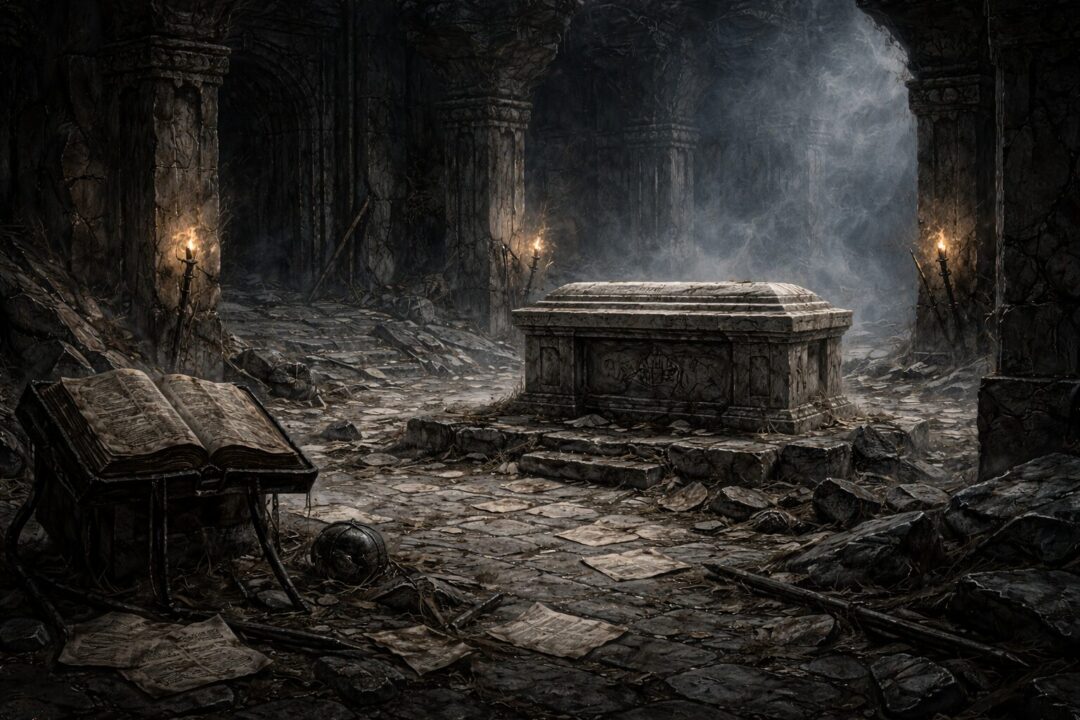
Moria is one of the few places in The Lord of the Rings that feels less like a location and more like a verdict.
It is not merely dangerous. It is final—as if the mountain itself has decided what happens to those who go inside.
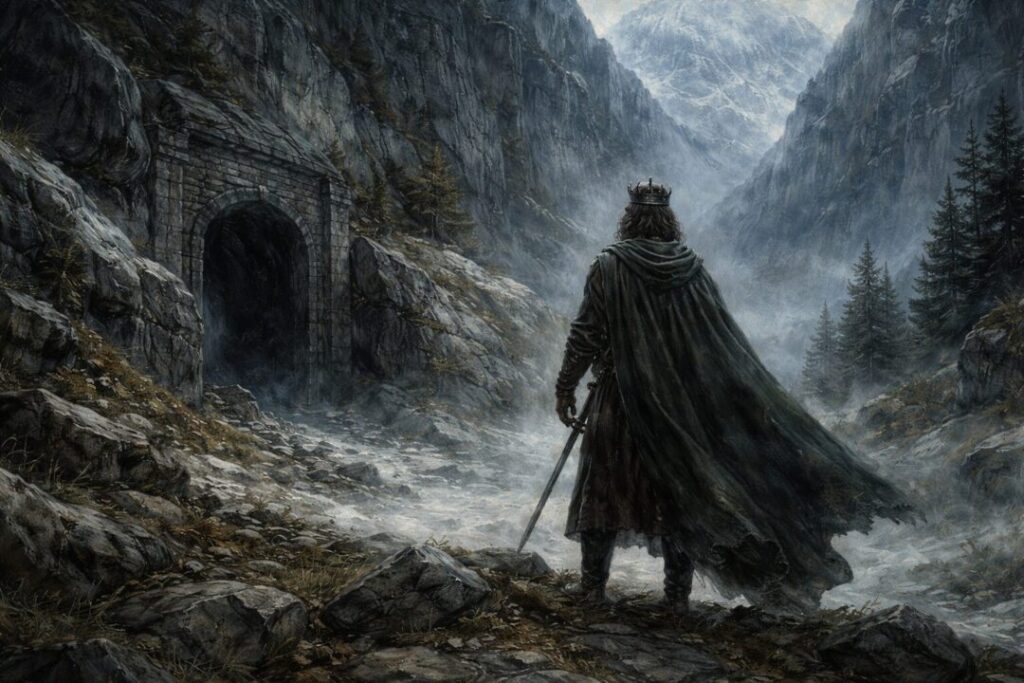
Aragorn knows this before the Fellowship ever reaches the West-gate. He argues against the route, and when the Company is forced down from Caradhras, he goes in because there is no other choice worth taking.
But he goes in as a Ranger.
And that matters, because Aragorn’s one confirmed passage through Moria belongs to the story of desperation: the snows, the failing strength, the need to move forward even when forward is worse.
So when readers ask whether he ever entered again as King Elessar, they are really asking something deeper than travel.
They are asking whether the world that followed the Ring’s destruction was the kind of world where Moria could be faced openly—by law, by power, by renewal, rather than by flight.
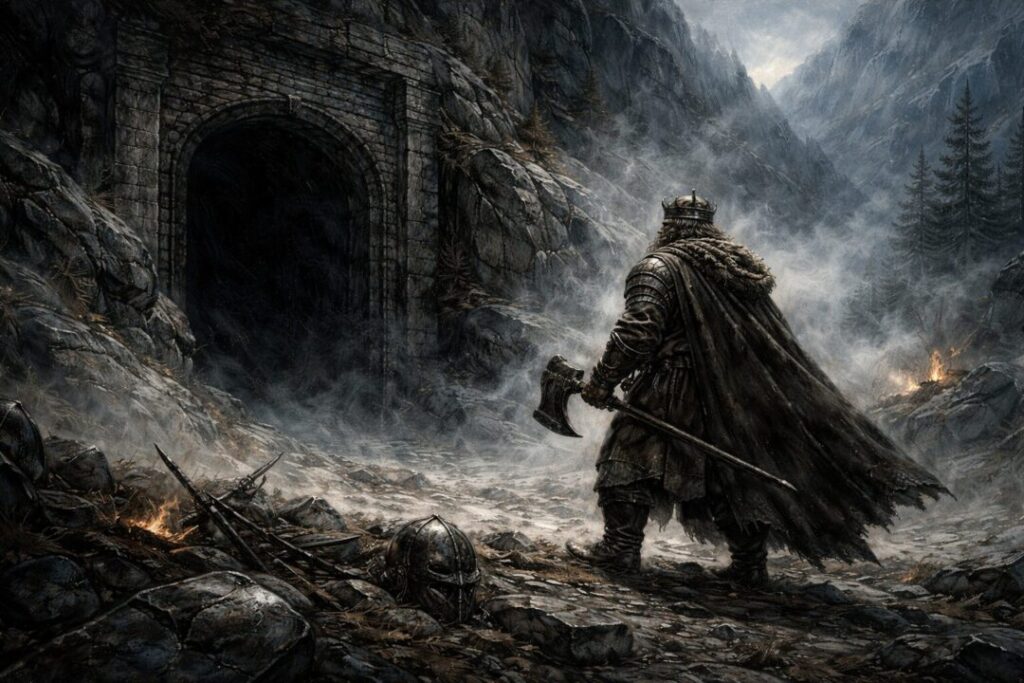
What the texts clearly say: Aragorn entered Moria once
In the published narrative, Aragorn enters the Mines of Moria with the Fellowship and comes out the East-gate after Gandalf falls in the struggle with the Balrog.
That is the only explicit “Aragorn in Moria” that The Lord of the Rings gives as a story-event.
After that, the plot and the appendices give us many details about Aragorn’s reign—rebuilding, securing borders, restoring the North-kingdom, and campaigning with allies.
But none of those details includes a return beneath the Misty Mountains.
No chapter narrates it. No appendix lists it. No note, in the material commonly read alongside the main text, describes King Elessar riding to the Dimrill Dale and going in.
So the most cautious answer is the simplest:
No surviving canonical passage states that Aragorn ever entered Moria as King.
That does not prove he did not. It means the texts do not record it.
And in Tolkien’s world, that difference matters. Some absences are simply absences. Others are deliberate silences where the shape of the story is telling you what not to expect.
Why the silence makes sense: Moria is not “his” realm
Part of what makes the question feel plausible is how naturally we imagine a king “claiming” old places once the war is won.
But Moria is not a lost Gondorian fortress. It is Khazad-dûm—Durin’s ancient mansions. Even when the Dwarves are scattered, its identity does not become “available” for someone else to inherit.
The texts reinforce that sense of Dwarven primacy again and again.
The strongest statement comes from the War of the Dwarves and Orcs, when Thráin speaks of victory and someone declares, “Khazad-dûm is ours!” But Dáin refuses the idea of taking it back—not because it is impossible to seize, but because something worse than Orcs is inside.
And his warning is not merely tactical. It is almost prophetic:
“The world must change and some other power than ours must come before Durin’s Folk walk again in Moria.”
Even without adding anything, that line sets the frame.
Moria is not reclaimed by an army in a single glorious sweep. It is held shut by a doom that requires the world itself to change first.
The one thing Aragorn did change: Durin’s Bane was removed
The “other power” that Dáin says must come is left undefined. The text does not name Aragorn. It does not name any king of Men.
But it does name the obstacle: Durin’s Bane.
In the Fellowship’s passage, Gandalf confronts that power and falls—yet the end of the story reveals the truth: the Balrog is defeated, and it is defeated in the years that lead directly into Aragorn’s kingship.
So one piece of the puzzle is firm:
By the time Aragorn is King Elessar, the great terror that barred the Dwarves from returning is gone.
That does not automatically make Moria safe. But it changes what “going back” would mean.
It would no longer be a king walking into the lair of Durin’s Bane.
It would be a king walking into something else: the ruin left behind after a shadow has been driven out.
What would he have found? The safest answer is: the aftermath of long loss
If Aragorn entered as King, what would he have found?
Here the Evidence & Claim Control rule matters, because the texts do not give us an inventory of post-war Moria. There is no canonical “cleansing of the mines” narrated after the Ring is destroyed.
So we have to speak in what the story supports, and we have to mark inference clearly.
What the Fellowship saw inside is clear enough: broken halls, Orcs, a Troll, and the Chamber of Mazarbul where Balin’s tomb stands and the record of the colony’s failure lies open. (Those details belong to The Fellowship of the Ring, not quoted here directly.)
And even when the Company escapes, the world outside confirms that Moria still had teeth. Orcs identified as coming from Moria appear among the enemies moving through the war.
So the conservative inference is this:
After the Balrog’s fall, Moria may still have contained Orcs and other dangers, even if its greatest terror was gone.
That is inference, not a stated fact—because the text never gives the “after” scene.
But if Aragorn entered, he would almost certainly have found a place shaped by two layers of emptiness:
- The ancient emptiness—the long-abandoned grandeur of Khazad-dûm, vast enough that “many of its mansions became dark and empty” even before its final disasters fully fell.
- The recent emptiness—the broken attempt of Balin’s people, whose last traces remain as a tomb and a book, not as a living colony.
A king walking those halls would not be walking into a proud kingdom waiting to be crowned.
He would be walking into an argument about time: how stone can outlast peoples, and how glory can remain visible long after it becomes unusable.
Why Gimli matters more than Aragorn here
If the story wanted to tell us about Moria’s renewal under Men, it would likely point to Aragorn.
Instead, it points to Gimli.
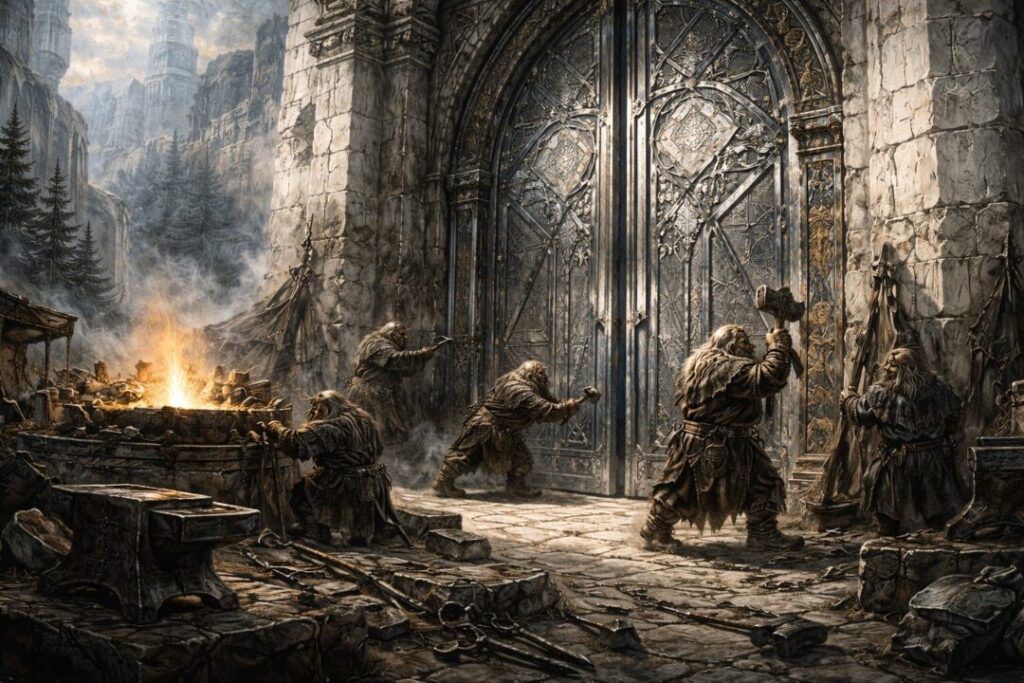
After Sauron’s fall, Gimli becomes Lord of the Glittering Caves and his people do “great works in Gondor and Rohan,” including forging new gates of mithril and steel for Minas Tirith.
That single paragraph is quietly enormous.
It tells you that Dwarves are not merely surviving after the War—they are building, and their craft is once again shaping the visible world.
If Moria were to be reclaimed in the Fourth Age, the text’s logic suggests it would be reclaimed by Dwarves on Dwarven terms, not by a king of Men treating it as conquered territory.
And that returns us to the silence:
The appendices record that King Elessar issued laws, restored borders, rode north to the revived lands of Arnor, and protected the Shire.
They do not record him taking possession of Khazad-dûm.
The later tradition: a return to Moria does exist—but not in the published appendices
There is one more piece of evidence that many readers sense hovering behind the question: the idea that Moria does not remain empty forever.
That idea does appear in Tolkien’s later materials on the making of Appendix A, preserved in The Peoples of Middle-earth.
In a draft passage, we’re told that an heir of Dáin’s line, bearing the name Durin, “returned to Moria,” and that there was “light again in deep places” and the “ringing of hammers” until the Dwarves at last failed.
Two cautions are necessary:
- This is not part of the final published appendices in The Lord of the Rings.
- It is preserved as draft material in Tolkien’s later writings as presented by Christopher Tolkien.
But even with those cautions, the shape of the tradition is revealing:
If Moria is reclaimed at all, it is reclaimed by Durin’s Folk, not by Elessar.
So did Aragorn ever enter as King?
The cleanest answer is still the honest one:
No canonical passage states that Aragorn entered Moria as King Elessar.
But the more interesting answer is why the texts don’t need him to.
Aragorn’s kingship is about the world above ground: the healed White Tree, the restored roads, the renewed realm of Men, and the peace secured by war and wise rule.
Moria is something else.
It is the oldest kind of loss in Middle-earth: a masterpiece of a people, ruined from within, lingering as a shadowy threshold between ages.
If Elessar had entered, he would have found darkness retreating but not erased—great halls still wounded by time, and the haunting proof that some places are not “saved” by a crown.
Perhaps that is the real point.
Aragorn’s story does not require a royal triumph in Moria, because Moria is not a stage for Men’s dominion.
It is a reminder that even in victory, the world does not become new all at once.
Some doors open only when the world has changed enough that no king can claim the opening as his own.
And that leaves the question where it belongs—half in the text, half in the silence it keeps.