
At first glance, the confrontation between Denethor and Aragorn in The Return of the King feels like a moment of sudden revelation. Aragorn arrives in Minas Tirith after the Battle of the Pelennor Fields, reveals his lineage, and claims his place as the rightful King of Gondor. Denethor, by then broken and near madness, never truly faces that claim.
But Tolkien rarely builds his great confrontations on surprise alone. His world is one of long memory, slow knowledge, and truths understood long before they are spoken aloud. When we examine Denethor’s history, his words, and—most importantly—his secret use of the palantír, the evidence strongly suggests that Denethor already knew who Aragorn was long before they ever met face to face.
The real tragedy, then, is not that Denethor learned the truth too late—but that he knew it and refused to accept it.
Denethor Was Not an Ignorant Steward
Denethor II was not a weak or foolish ruler by nature. In his prime, Tolkien describes him as proud, stern, farsighted, and learned—more kingly in bearing than many of his ancestors. Gandalf himself admits that Denethor was a formidable man, “wise in the lore of Gondor,” and not easily deceived.
Appendix A of The Lord of the Rings makes it clear that the Ruling Stewards were not merely caretakers; they were historians, genealogists, and guardians of ancient knowledge. The House of Húrin preserved detailed records of Númenórean lineage, including the northern line of Isildur. This was not forgotten lore. It was studied, debated, and—crucially—politically inconvenient.
The oft-repeated phrase that Gondor was ruled “until the King should return” was not ceremonial window dressing. Denethor understood exactly what it meant. He knew that his authority, however absolute in practice, was conditional in theory. That knowledge alone makes it difficult to believe he would be unaware of persistent rumors surrounding the Chieftain of the Dúnedain.
By the time Aragorn appears openly during the War of the Ring, Denethor had already ruled for decades. He had seen Gandalf come and go, had observed the movements of the Rangers in the North, and had followed the shadow stirring in Mordor. A man so attentive to power and lineage would not simply miss the reemergence of the Heir of Isildur.
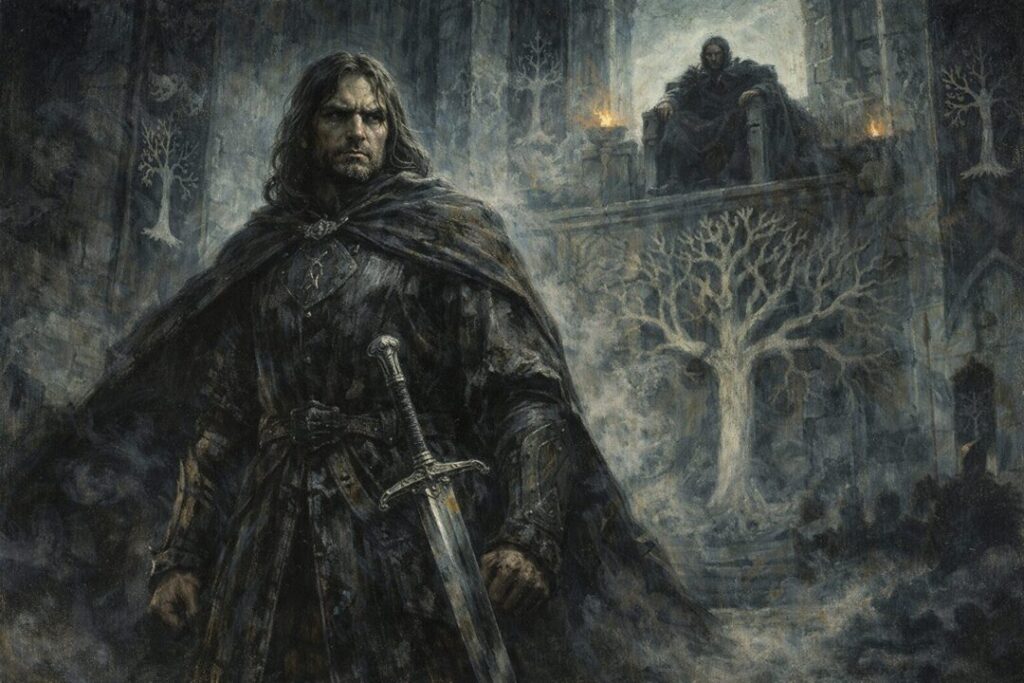
The Palantír Changes Everything
If Denethor’s learning makes his ignorance unlikely, the palantír makes it almost impossible.
In Unfinished Tales, Tolkien reveals that Denethor secretly used the palantír of Minas Tirith for many years. Unlike Saruman, Denethor was not immediately ensnared by Sauron’s will. He was strong enough to wrest real knowledge from the Stone—though at terrible cost.
This detail is crucial. The palantíri do not show lies. They show selected truths, framed and distorted, but grounded in reality. Through it, Denethor would have seen events far beyond Gondor’s borders: movements of armies, shifting powers, and figures of great importance walking openly in the world.
And Aragorn was not subtle.
By the time of the War of the Ring, Aragorn had reclaimed Andúril, the reforged sword of Elendil. He had openly declared himself Elessar to allies. He commanded the Grey Company, revealed himself to Sauron through the Orthanc-stone, and later led the Dead Men of Dunharrow. These were not the actions of a man hiding his identity.
If Denethor looked into the palantír—and Tolkien tells us he did—then he almost certainly saw Aragorn. A Númenórean lord bearing the sword that broke beneath Isildur. A captain commanding ancient oaths. A figure of authority moving with the confidence of kingship.
This explains something otherwise strange: when Aragorn finally arrives in Minas Tirith, Denethor does not accuse him of fraud. He does not demand proof. He does not ask who he claims to be.
Instead, he argues legitimacy.
Denethor’s Reaction Is Not That of a Man Who Is Surprised
When Denethor speaks of Aragorn—both before and after his arrival—his tone is not skeptical. It is bitter.
He accuses Aragorn of waiting, of watching Gondor bleed while biding his time. He frames Aragorn’s claim not as false, but as opportunistic. That accusation only makes sense if Denethor already accepts Aragorn’s lineage as genuine.
A man confronted with an unexpected pretender would attack credentials. Denethor attacks timing and intent.
This distinction matters. It shows that Denethor’s resistance is not based on doubt, but on pride.
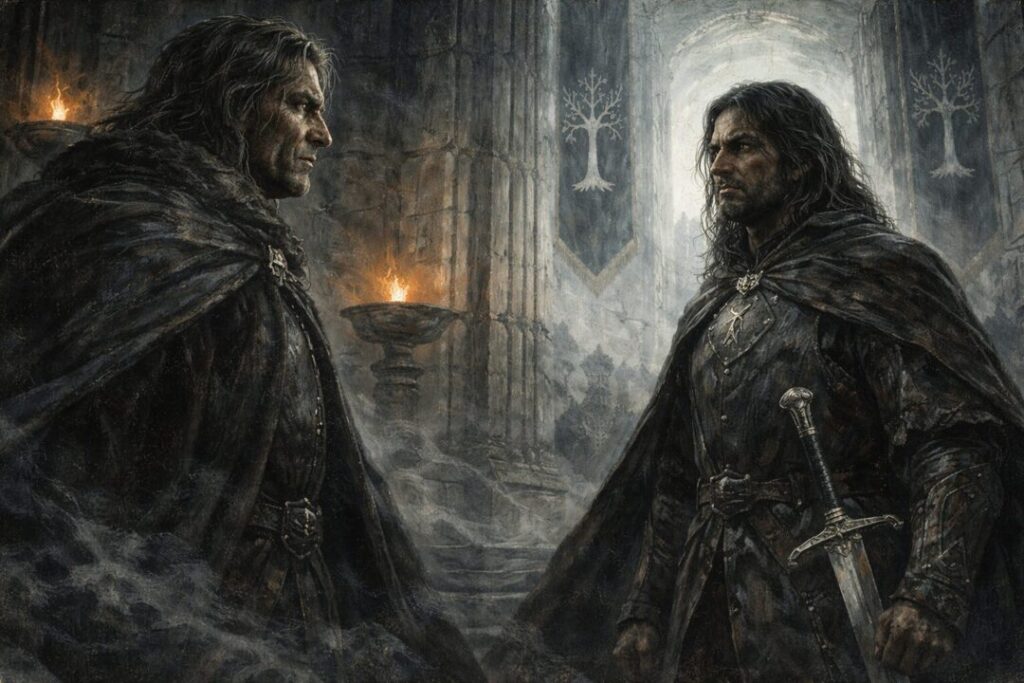
Gandalf Confirms What Denethor Already Knows
Gandalf provides further confirmation. In their final confrontations, Gandalf does not attempt to prove Aragorn’s identity to Denethor. He treats it as settled fact.
Instead, Gandalf challenges Denethor’s refusal to accept it.
He tells Denethor that Aragorn’s coming was long prepared, that his role in the war was essential, and that hope lies beyond the Steward’s authority. Denethor does not deny this. He resents it.
That resentment reveals everything. Denethor does not fear being deceived—he fears being replaced.
Why Denethor Never Spoke the Truth Aloud
If Denethor knew, why did he never openly acknowledge Aragorn as King?
The answer is painfully human.
To speak that truth would have meant admitting that his life’s work, his sacrifices, and his rule were always provisional. It would have meant surrendering not just power, but identity. Denethor did not see himself as a caretaker; he saw himself as Gondor’s last bulwark against ruin.
Tolkien emphasizes repeatedly that Denethor’s fall is rooted in despair, not ignorance. He sees too much and hopes too little. The palantír shows him defeat without context, power without mercy, and enemies without end. When Aragorn appears as a symbol of renewal, Denethor rejects him—not because he doubts him, but because he cannot bear what he represents.

The Final Answer
So did Denethor know Aragorn was the Heir of Isildur?
All textual evidence points to yes.
He knew Aragorn’s lineage.
He knew the signs.
He knew the ancient promise that the King would return.
And in true Tolkien fashion, that knowledge did not save him.
It destroyed him.
Because in Middle-earth, knowing the truth is not enough. One must also choose hope—and Denethor, tragically, could not.