Mithril, Elvish Craft, and a Common Misreading of Middle-earth
One of the strangest modern myths to emerge around The Lord of the Rings is the idea that Frodo gradually becomes “more Elvish” as the story progresses.
It usually starts as a joke.
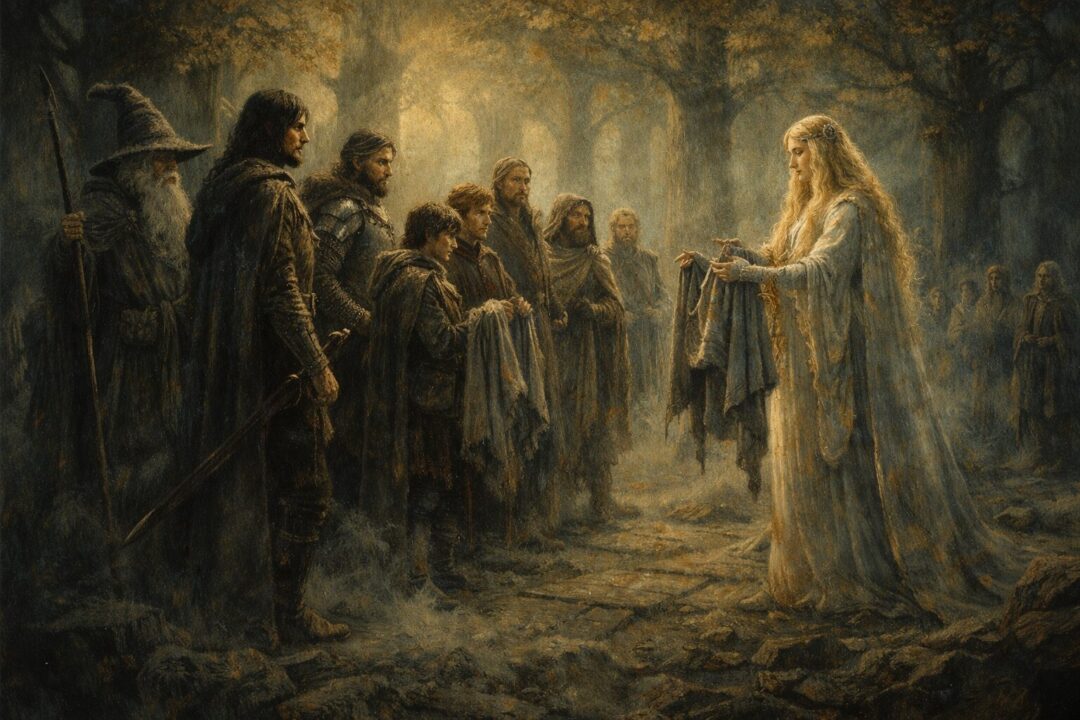
Frodo receives finely made gear from ancient peoples. He moves more quietly. He grows distant from ordinary Hobbit life. By the time the Fellowship has passed through Rivendell and Lórien, he is no longer wearing homespun clothes from the Shire, but objects of astonishing craftsmanship.
A shining mithril coat.
Light grey Elvish cloaks.
Soft boots, muted colors, careful movement.
Put together, this visual shift creates the impression that Frodo is being dressed as something he is not—almost like a miniature Elf warrior, or as fandom shorthand has it, “baby Legolas.”
But this interpretation gets something fundamentally wrong about how Tolkien’s world works.
Frodo is not being elevated.
He is being protected.
And the difference between those two ideas is central to the meaning of the story.
The Mithril Coat Was Never a Symbol of Power
Mithril is rare, beautiful, and unimaginably valuable. That much is beyond question. It is lighter than steel, harder than tempered iron, and found in meaningful quantity only in the depths of Khazad-dûm.
It would be easy—almost automatic in modern fantasy—to treat a mithril shirt as a sign that a character has “leveled up.”
But that is not how Tolkien uses it.
Bilbo’s mithril coat does not make Frodo stronger. It does not sharpen his reflexes. It does not allow him to fight like an Elf, a Dwarf, or even a trained Man.
It exists because Frodo cannot fight at all.
At the Council of Elrond, it becomes clear that Frodo’s role is not to win battles. He is not expected to survive open combat. He is meant to avoid it entirely. The Ring-bearer’s success depends on remaining unnoticed, undefended by force, and unimportant in appearance.
The mithril coat is not armor for a warrior.
It is a last defense for someone who must never be struck.
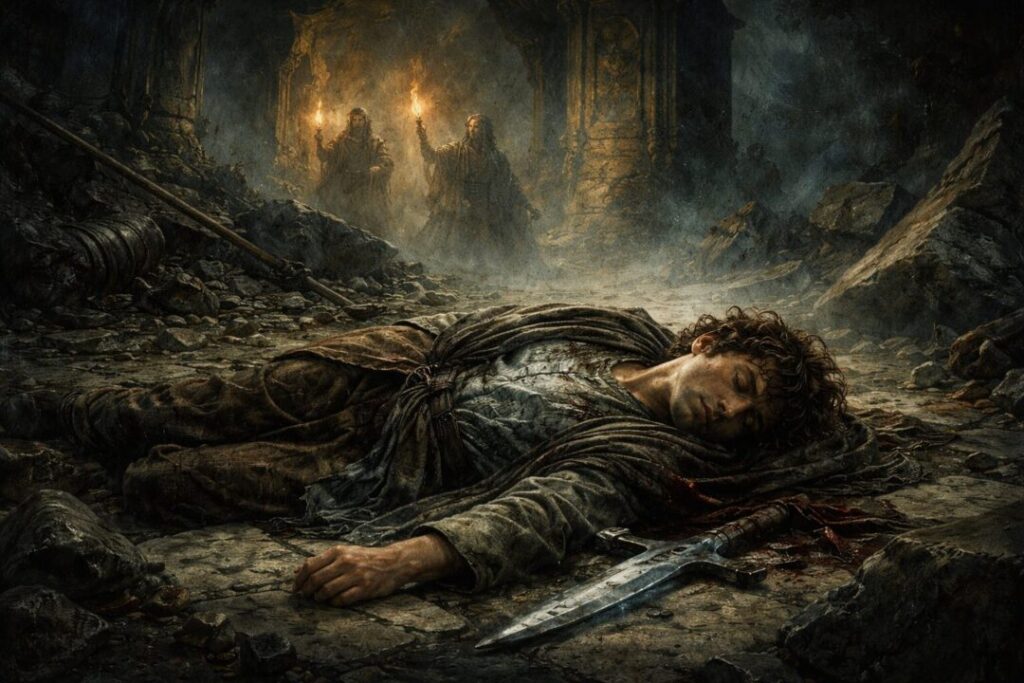
This becomes painfully clear in Moria. When the cave-troll’s spear pierces Frodo, there is no triumphant stand, no heroic reversal. Frodo collapses. He is unconscious. The Fellowship believes him dead.
The coat saves his life—but it also exposes the truth.
Frodo’s body is already failing him.
He survives because ancient craft intervenes, not because he has become something greater. The mithril does not empower him; it compensates for his weakness.
In Tolkien’s moral universe, that distinction matters.
Elvish Cloaks Do Not Change Who You Are
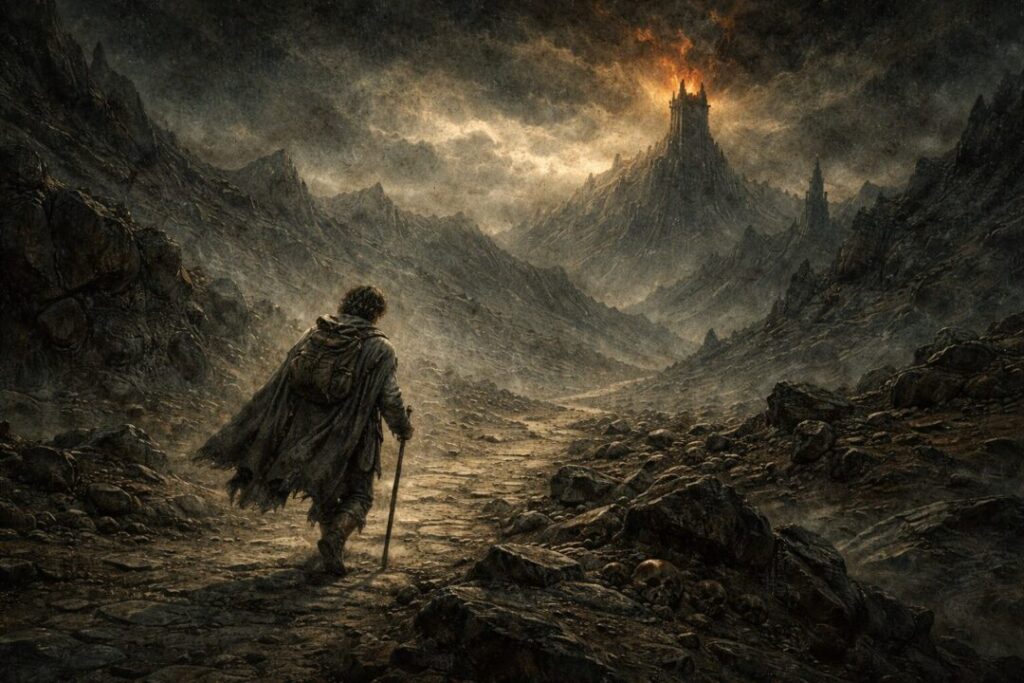
The cloaks given in Lothlórien are another frequent source of misunderstanding.
They are often described as if they were magical stealth gear—fantasy camouflage that turns the wearer into something supernaturally elusive. But that framing belongs to a different kind of story.
The Elvish cloaks do not “hide” the wearer in a mechanical sense. They respond subtly to light, shadow, and environment. More importantly, they seem to respond to the nature of the person wearing them.
This is why Samwise Gamgee benefits from the cloak so profoundly. Sam does not become invisible because he is skilled or trained. He becomes hard to notice because he already exists on the margins of attention. The cloak reinforces what is already there.
The same is true for Frodo.
The cloaks do not overwrite identity. They do not turn Hobbits into Elves.
An Elf wearing one would not become “more Elvish.”
A Hobbit wearing one does not cease to be a Hobbit.
They remain exactly what they are.
Tolkien’s world does not operate on the logic of transformation through equipment. Objects do not replace nature. They serve it.
Frodo Moves Differently Because the Ring Is Killing Him
Another reason Frodo is often described as increasingly quiet, distant, or “graceful” is that readers mistake suffering for refinement.
By the time the Fellowship reaches Lórien, Frodo has already been stabbed by a Morgul blade. Though Elrond prevents the wound from becoming fatal, it never truly heals. It leaves a lasting spiritual scar that pains him for the rest of his life.
On top of this, the Ring grows heavier with every mile eastward.
This weight is not metaphorical. Tolkien repeatedly emphasizes that Frodo feels it as a physical and psychological burden. His movements become careful not because he is becoming Elvish, but because every unnecessary step costs him.
Frodo’s quietness is not elegance.
It is pain management.
This is why Tolkien consistently frames Frodo’s heroism in terms of endurance rather than prowess. Frodo does not triumph through skill, beauty, or superiority. He persists through exhaustion, fear, and loss of self.
If he begins to resemble something other than a Hobbit, it is not an ascent.
It is erosion.
Why Frodo Had to Look “Out of Place”
There is a deeper narrative reason Tolkien clothes Frodo in such extraordinary items.
He is meant to look wrong.
A Hobbit wearing the works of Elves and Dwarves should feel unsettling. The visual mismatch highlights the imbalance of the task placed upon him. These are tools meant to compensate for how utterly unsuited he is to what lies ahead.
That contrast is not accidental—it is the point.
The Ring is not entrusted to the strong, the radiant, or the visibly heroic. It is given to the one least likely to draw attention, least able to dominate others, and least capable of using it successfully.
If Frodo truly became “Elvish,” the story would lose its moral center.
The Ring is not destroyed by transformation, but by refusal—by remaining oneself under unbearable pressure, even as that self is slowly worn down.
Frodo and Legolas Are Meant to Be Contrasted
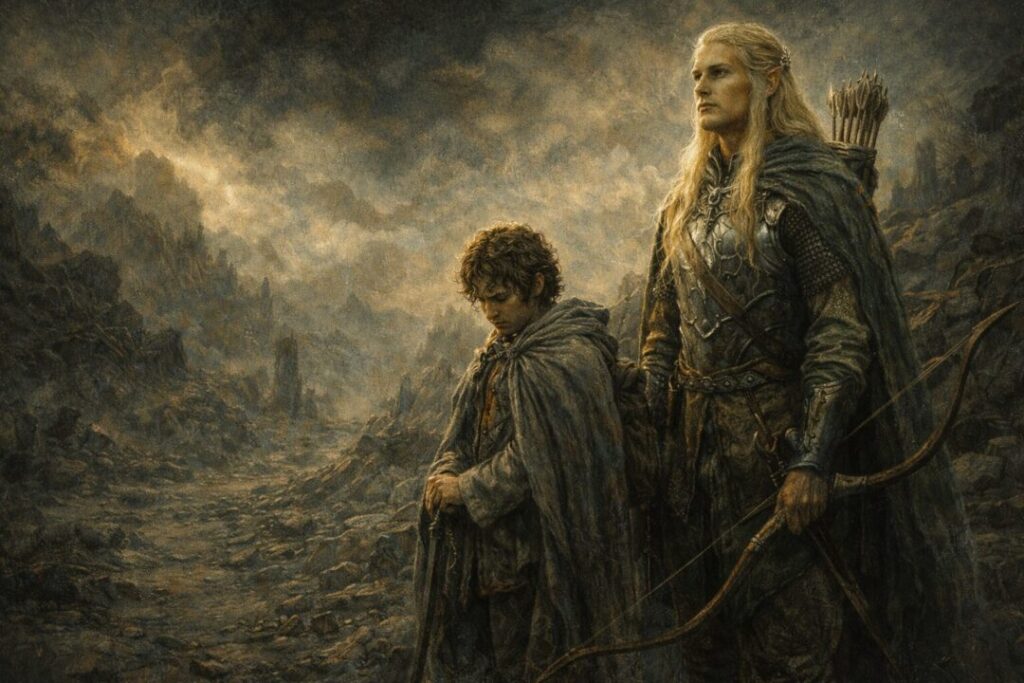
The comparison to Legolas actually highlights the misunderstanding.
Legolas moves lightly because he is Elvish. His body, spirit, and relationship to the world are fundamentally different. He walks on snow without sinking not because of training or equipment, but because that is his nature.
Frodo, by contrast, struggles under every step.
If Tolkien wanted Frodo to resemble an Elf, he would have shown it through action and ability—not clothing. Instead, he consistently emphasizes Frodo’s limits.
The resemblance is superficial.
The difference is essential.
The Myth Misses the Tragedy
Calling Frodo’s gear “baby Legolas equipment” turns a tragedy into a costume joke.
Frodo is not being trained for glory.
He is not being prepared to shine.
He is being prepared to endure loss.
He survives Mordor, but he does not return whole. No armor, however perfect, can prevent that outcome. The finest works of Elves and Dwarves can preserve his life—but not his peace.
And that is precisely why Tolkien gives Frodo the best protection in Middle-earth while ensuring it never makes him powerful.
Because the story was never about power.
It was about what it costs to carry it—and what it takes to refuse it until the very end.