At first glance, the question seems simple.
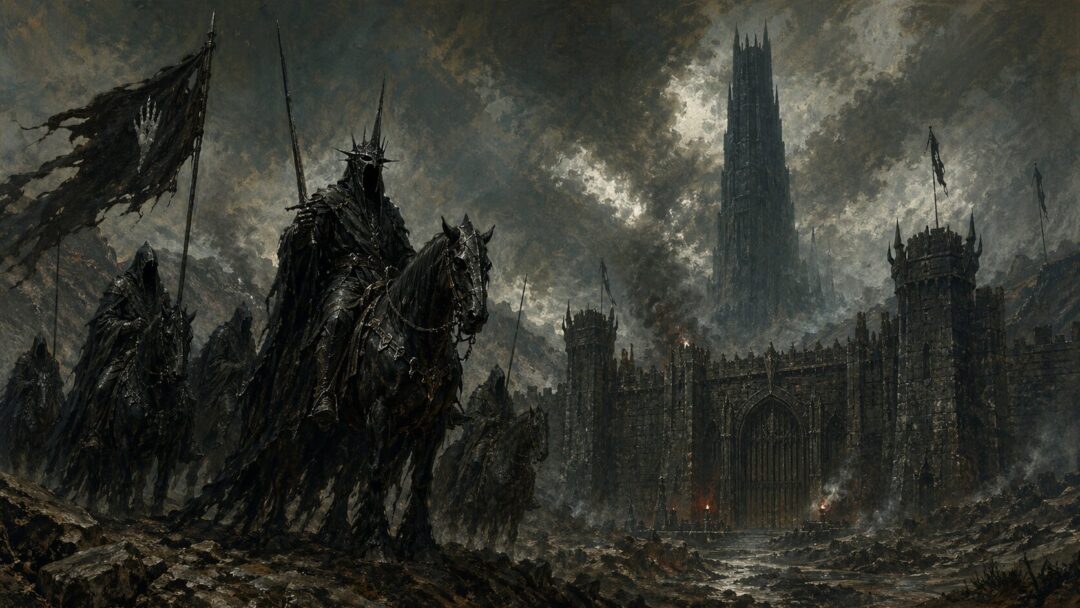
If Saruman had dealings with Sauron, and if the Nazgûl were Sauron’s most feared servants, then surely there must have been some moment when those roads crossed directly.
And if they did, another question follows almost at once.
Why, after Isengard was broken and Saruman was trapped in Orthanc, did the Nazgûl not simply free him?
The answer is more unsettling than it first appears.
Because the texts strongly indicate that Saruman did indeed meet the Nazgûl.
But by the time his ruin was complete, a rescue was neither simple nor, perhaps, even desirable from Sauron’s point of view.
Saruman Was Not Cut Off from the Nazgûl
It is easy to imagine Saruman and the Nazgûl moving in parallel but separate tracks.
Saruman in Orthanc.
The Ringwraiths on the roads.
Each serving the same dark cause from different directions.
But the canon does not leave them that neatly divided.
In the account of the hunt for the Ring preserved in Unfinished Tales, the Witch-king comes to Isengard seeking information about Baggins and the Shire. Saruman, already playing his own game, deceives him. He pretends ignorance and turns the search toward Gandalf instead. The important point is not only that this happens, but that it happens face to face through the power and protection of Isengard. Saruman is not hiding from the Nazgûl because he has never encountered them. He is using his stronghold to mislead them.
That matters.
Because it means the question is not whether Saruman ever met the Nazgûl.
He did.
The real issue is what kind of relationship that meeting reveals.
And the answer is: not partnership, not trust, and certainly not equality.
The First Meeting Already Shows the Problem
When the Witch-king comes to Isengard, Saruman is still strong.
He still commands armies.
He still controls the Ring of Isengard.
He still believes he can delay Sauron, deceive him, and perhaps seize the One Ring before Mordor does.
So when the Nazgûl arrive, Saruman does not submit.
He lies.
This is one of the clearest signs of how Saruman understands his own position. He is outwardly aligned with Sauron, but inwardly he is still pursuing his own claim to power. He has not become a loyal servant. He has become a rival who is pretending to be useful. That is why he withholds what he knows of the Shire. That is why he directs suspicion toward Gandalf. He is buying time for himself.
Just as important is the military detail attached to that encounter.
The Nazgûl do not simply break Isengard open.
The tradition of the text says they did not have the strength to assault it. That detail can be overlooked because it passes quickly, but it is crucial. Even the Witch-king, with others of the Nine, cannot simply force Saruman out of Orthanc at that stage. Isengard is still too formidable, and Saruman is still too well-defended behind his own walls.
So from the beginning, the meeting between Saruman and the Nazgûl is not a scene of command and obedience.
It is a scene of tension.
He is already trying to cheat the master he claims to serve.
After Isengard Falls, the Situation Changes Completely
By the time Théoden, Gandalf, Aragorn, Legolas, and Gimli come to Isengard, Saruman’s position has collapsed.
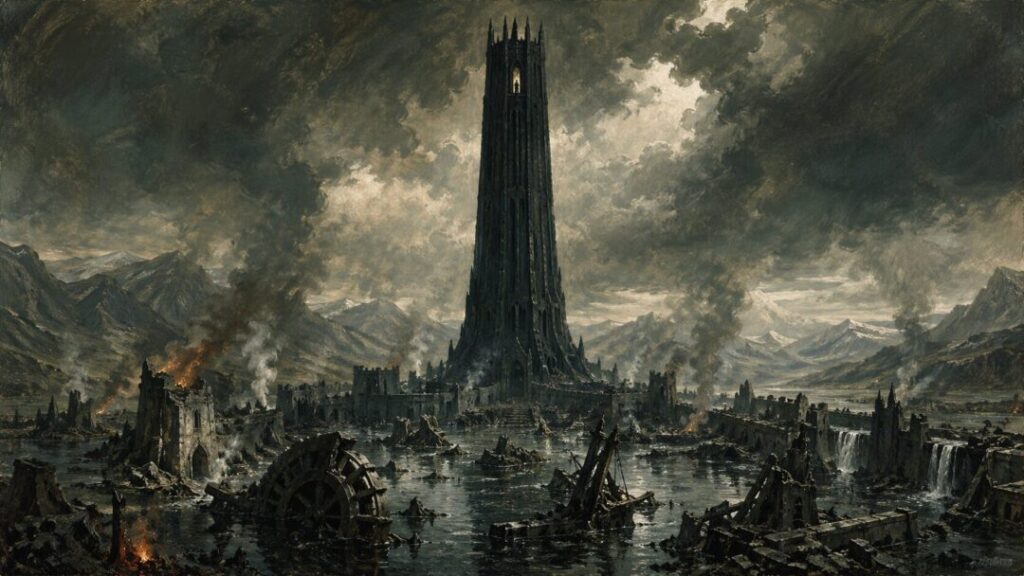
The Ents have broken his war-machine.
The circle of Isengard is flooded and ruined.
His army is destroyed.
His voice remains, and his mind remains dangerous, but his worldly strength is gone.
And yet Orthanc itself still stands.
This point is easy to miss because the destruction of Isengard is so dramatic.
But Saruman is not dragged down from the tower and chained in some dungeon.
He is confined in Orthanc.
That is not the same thing as helplessness.
Orthanc is not merely a tall room with a locked door. It is an ancient Númenórean tower, immensely strong, and it remains unconquered even after everything around it has been laid waste. Saruman is cut off, but he is still inside the one structure that no one has actually broken.
That changes how we should picture any later Nazgûl approach.
They are not coming to open a prison cart.
They are approaching a fortress that has already survived what destroyed the rest of Isengard.
The Winged Nazgûl Over Orthanc
The second moment linking Saruman and the Nazgûl comes after Pippin looks into the Orthanc-stone.
This is one of the most important details in the entire question.
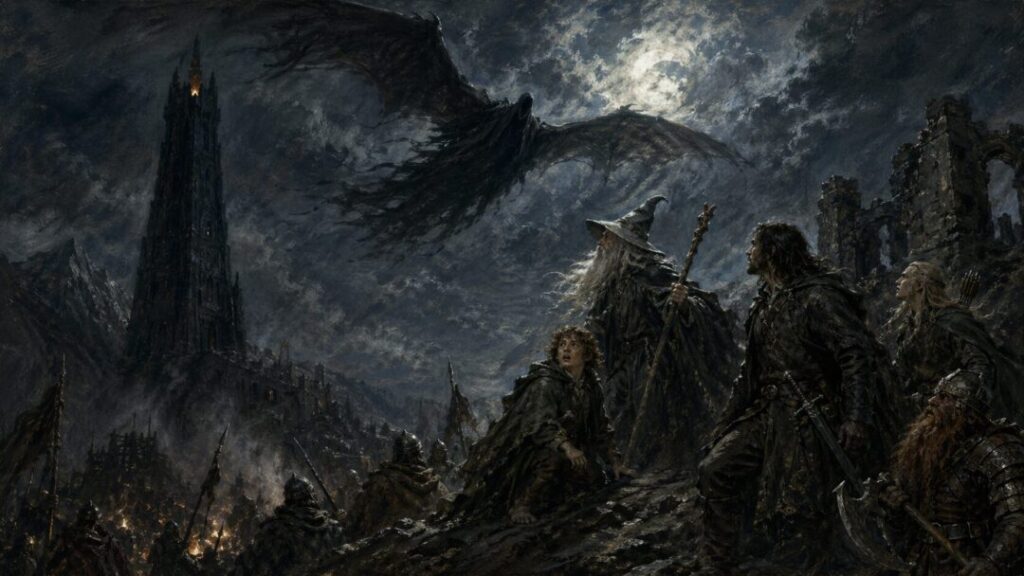
In The Two Towers and in the chronology of Appendix B, a winged Nazgûl passes over the camp at Dol Baran shortly after Pippin’s encounter with Sauron through the palantír. Gandalf immediately understands the danger and rides for Minas Tirith with Pippin. The implication is plain: Sauron has reacted, and Orthanc is now part of that reaction.
But here the text becomes very careful.
It does not say that the Nazgûl entered Orthanc.
It does not say Saruman was contacted successfully.
It does not say any rescue took place.
That silence is important.
Because the story gives us the event, but not the result.
And into that gap Gandalf offers one of the key observations. He says Saruman still has power, while in Orthanc, to resist the Nine Riders. He even considers that Saruman might try to trap the Nazgûl or kill its flying beast. That is not a casual remark. It means Gandalf does not imagine the Nazgûl as simply sweeping in and taking control of the situation. Even diminished, Saruman inside Orthanc remains dangerous enough to make such an approach uncertain.
Why a Rescue Was Not Simple
This is the point where modern instinct can mislead the reading.
We hear “Nazgûl” and think automatic terror.
We hear “fallen Saruman” and think helpless victim.
But that is not the picture the book gives.
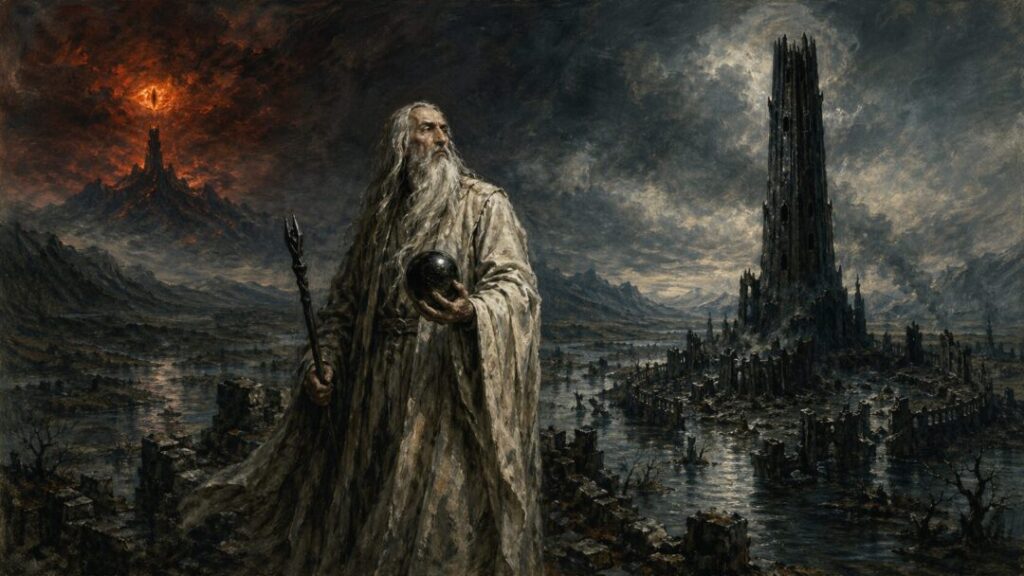
Saruman at Orthanc is defeated politically and militarily, but not yet empty of power. Gandalf’s own words show that he still thinks Saruman could resist a Nazgûl while inside the tower. Orthanc itself remains secure. And the outer circle of Isengard is no longer friendly territory. It is in the hands of the Ents, with enemies near at hand.
So even if a Nazgûl came as messenger or observer, a clean extraction was far from guaranteed.
There is also a practical point.
Sauron’s strength is vast, but it is not infinite in every direction at every hour. The winged Nazgûl at this point in the war are instruments of fear, reconnaissance, and pressure as much as brute-force rescuers. The text never suggests that one lone aerial messenger was sent to wage a private siege against Orthanc, especially when Saruman himself had become suspect.
So the idea that “they should just have freed him” assumes a simplicity the text does not grant.
Saruman Did Not Look Like a Servant Worth Saving
There is an even darker reason.
By the time the winged Nazgûl is sent toward Orthanc, Saruman no longer appears to Sauron as a loyal subordinate in distress.
He appears as a rebel.
Pippin’s use of the palantír changes everything.
Sauron, believing that the Orthanc-stone is still in Saruman’s possession, now thinks Saruman may be withholding both the stone and a captured hobbit who might even be the Ring-bearer. Gandalf says this explicitly in substance: whether Saruman answers or does not answer, whether he tells the truth or not, he will now appear guilty. Isengard may be ruined, but so long as Saruman is safe in Orthanc and not delivering what Sauron expects, he looks like a defiant vassal.
That is the real turn in the knife.
Saruman wanted to stand between Sauron and the West as a third power.
He wanted enough independence to betray both sides if necessary.
But once Isengard falls, that ambiguous position becomes fatal.
From Sauron’s perspective, Saruman is no longer a valuable ally trapped by enemies.
He is a failed subordinate who appears to be keeping prizes for himself.
That is not the kind of position that inspires mercy.
Could the Nazgûl Have Freed Him If They Truly Wanted To?
The texts do not answer this directly.
So any confident claim here would go too far.
What we can say is narrower and firmer.
The earlier meeting at Isengard proves that even before Saruman’s fall, the Nazgûl could not simply overrun his stronghold.
The later passage in The Two Towers shows that Gandalf still considered Saruman capable of resisting them while inside Orthanc.
And the narrative never records any successful attempt to remove him from the tower.
From that, one careful conclusion follows.
A rescue was at the very least uncertain, dangerous, and not something the text treats as easy.
Anything stronger than that becomes interpretation.
It is possible that a larger force from Mordor, sent deliberately against Orthanc, might eventually have dealt with Saruman.
But that is not what the story shows.
What it shows is a ruined Isengard, a still-standing Orthanc, a winged Nazgûl overhead, and a fallen wizard whose usefulness to Sauron has already curdled into suspicion.
Why This Makes Saruman’s End More Tragic
Saruman’s downfall is often read as a punishment for pride.
And it is.
But there is a more specific pattern underneath it.
He spends years believing that he can look into the enemy’s mind without being mastered.
He believes he can use Sauron’s methods without becoming Sauron’s servant.
He believes he can hold his own tower, build his own strength, and enter the final contest as something more than a lieutenant.
That illusion survives longer than it should.
Long enough for him to deceive the Nazgûl once.
Long enough to imagine that he is still choosing his own path.
But when the war closes around him, the truth becomes unmistakable.
He is too treacherous to be trusted by the West.
Too compromised to be trusted by Sauron.
Too diminished to stand alone.
And too late in understanding all of this to recover anything at all.
That is why the question of the Nazgûl matters.
Not because it reveals a plot hole.
But because it reveals the true shape of Saruman’s failure.
He did meet them.
He did deal with them.
He even deceived them for a time.
And in the end, none of that bought him rescue.
The Most Likely Lore-Accurate Answer
So: did Saruman ever meet the Nazgûl?
Yes, the texts strongly indicate that he did, most clearly when the Witch-king came to Isengard during the hunt for the Ring.
Why did they not free him from Orthanc?
Because by the time Saruman was shut up in the tower, several things were true at once.
Orthanc still remained a formidable stronghold.
Saruman still retained enough power there to make a Nazgûl’s approach dangerous.
The later winged Nazgûl episode is recorded, but no successful rescue is ever described.
And most importantly, Saruman no longer looked like a faithful ally in need of extraction. He looked like a rival who had failed and was withholding what Sauron wanted.
In other words, Saruman was not left in Orthanc because the Nazgûl forgot him.
He was left there because the tower was still hard to master, and because Saruman had finally become what all double-traitors eventually become in Middle-earth:
useful to evil for a time,
and disposable the moment they are no longer useful.
Sources & Notes
- J.R.R. Tolkien, Unfinished Tales, “The Hunt for the Ring” — gives the Nazgûl’s visit to Isengard and Saruman’s misleading answers during the search for the Shire.
- J.R.R. Tolkien, The Lord of the Rings, Book III, Chapter 10, “The Voice of Saruman” — shows Saruman defeated but still shut inside unconquered Orthanc after Isengard’s fall.
- J.R.R. Tolkien, The Lord of the Rings, Book III, Chapter 11, “The Palantír” — records Pippin’s use of the Orthanc-stone and the winged Nazgûl passing over Dol Baran soon after.
- J.R.R. Tolkien, The Lord of the Rings, Book III, Chapter 11, “The Palantír” — has Gandalf judge that Saruman still has power in Orthanc to resist the Nine Riders.
- J.R.R. Tolkien, The Lord of the Rings, Appendix B, “The Tale of Years” — fixes the timing of Pippin’s look into the palantír and the Nazgûl’s movement toward Orthanc.